A New Shutterbug

I thought that others might enjoy reading his challenge to the use of graphic programs to enhance photographs. He’s not completely against using them – see his last paragraph – but I think he makes a valid case against the dependency upon graphic programs for good photos.

I agree with his primary sentiment - Photoshop will not make you a better photographer. However, many are the pro photographers that rely on PS or some other image editor for post shot processing (workflow) because shooting the RAW image format requires some level of work outside of the camera. Few pro photographers are going to rely on the in-camera processing that is associated with using .jpgs as they want more control over the color, tonality, sharpening, etc. Most (if not all) DSLR’s still have some issues with handling proper white balance in different lighting situations. This does not mean that they are relying on the program to make good images; a photographer still has to have an eye for composition, light range, correct aperture and shutter speed, etc. Essentially the better pro photographers view PS and other programs as their digital darkroom. In that light, they develop and handle digital files in the same way that film photographers develop and handle film format. Tweaking images is nothing new just because of the shift to digital. It’s just that it is more in the hands of the common man now.

One thing for sure, I think, is that camera pixels are always larger than film grain, so there is always some pixelation when the images are zoomed in on.

Sure, it just depends on how much you have to zoom in or enlarge your image. That said, professional DSLR’s in the 10-12 megapixel range are typically more than enough for some decent enlargements and have absolutely no issues with your typical magazine publications, books or web sites. Canon’s top studio DSLR has a full 35mm frame sensor with 21.1 megapixels. There is a lot of image information there and you can enlarge that quite a bit. Of course you have to be willing to shell out about 7 or 8 grand. Hasselblad makes a digital back of the medium format size with 50 megapixels… way expensive of course but capable of incredible images. Digital hasn’t killed film (yet) but it certainly gives it a run for it’s money, and in many instances the advantages far outweight the minimal gain you get from film resolution. Even that gap is slowly closing.

Even though I don’t shoot professionally, I opted for a professional camera because I could afford it. I have the Canon 1D Mark III. That is primarily aimed at action/sports photography due to it’s speed, but it is far more versatile than that. It doesn’t make me a better photographer, but it allows me the flexibility to exercise what talent I do have. My equipment definitely exceeds my ability at this point.

I agree with his primary sentiment - Photoshop will not make you a better photographer. However…

I think that the essential question is, what is or what makes a good or great photograph?

Leaving aside whether or not photography is an art form (Rand obviously held that it is not.), just as with the visual arts (painting or drawing with or in various media) it is a method of creating images, representational images (assuming that one does not include abstract images as art).

So then, what is essential to good or great photographs (or paintings or drawings)? (Without an answer, is it possible to determine the appropriate usage of Photoshop or actual darkroom methods in manipulating photographs?)

To the post prior to this one: I’d love to be abile to learn to use L-view Pro in a systmatic way. Soooo many gadgets! but the differening strengths of differeng programs is why I’m armed to the bicuspids. In addition to Auto-Corect. Microsoft Photo Editor does let you perfomr the operations individually, having Color: amount, hue and saturation. Brightness: brighness, contrast and mid-tones, as well as the usual Resize, crop and the like. But only Photo Explorer has Focus (sharpness). To me, many raw photos appear translucent until I kick up the brightness (adds opacity) and sharpness (edges seem to be a bit blurred) and often the contrast (for distinction). Whether that is real or just a function of my eye, I don’t know, but I don’t have that trouble with drann or photos on the Web.

For myself, I’m interested in these kinds of things to make the images look as true to life as I can.

There are two difinitions of “art” to whcih Rand ascribed.

  1. The Classical arts. music, literature, painting/scupture/archetecture and the stage

  2. Implementation in an integrated, systematic fashion. such as the 'art of medicine" as differentiated from teh science of medicine. Music Engineering (mixing, effects etc in such a way that it validates a sense of life. In '93 I composed, played and recored an album called DEADLY FARCE on an X-15 4-track that often used more than four instruments. Wish I had that back. its only flaw was that when you hit Pause there was a click I do have a Port-a-Studio 03 somewhere that I should break out and fire up. Yes, I;m a rock and roller I alos have Audcity and KRISTAL which I really ought to get to work on but I need samples and a controller Kb and tofind the midiport if this puter has one or get a MIDI-USP interface [63 years old and I;m still ready, willing and able to hit the strings and tickle the “ivories”] and things like that) and the like. More recent is sound synthesis; both in imation of acoustic instruments such as string ensembles, wind and brass ensemobles and creation of whole new sounds (and with instruments like the SQ-80 digital-analog synthesizer. WOW!).

I favor the view that there are “quasi-arts” like “abstract” or “non-representative” visuals which have some, but not all of the aspects of full art. Perhaps these may be thought of more as Design “etudes” more than art. 40 years ago I did an “abstract” that used light and dark paired and image sizes that were larger on the outside than towards the center (all the images were triangles) that gave a sense that the thing was either expanding or contracting, sometimes sequentially; sometimes alternativley. That thing would hold your attention for sometimes 5 or more minutes. That was a trip. Even so, my “abstracts” were known for their clarity of shape and color and dictinct edges, where most “abstracts” tended to be dreamy or indistinct". When I ran the lightshow for Resurrection. I used three concepts. pairing colors, having upped the range from the traditional red, yello and blue to full spectrum, placemtn of light source to use light, shadow and complementarity to induce “animation” and rhythm: “playinn” the controls (of which I had 7; red, orange, yellow, blue, green, purlple and the strobe) like an instrument, following either the bass or drums. These made the visual aspect match the movement of the music rather than being just added on or even a distraction (I told you I was a psychedelic “Take the trip without having to drop the acid”). I think phtography can fall into that when you start to do things like composition.

I think that the essential question is, what is or what makes a good or great photograph?

I think the answer to that is contextual to the purpose of the photograph. Some photographs attempt to document the subject as best it can according to reality. Other photographs attempt to capture something that the photographer sees or wishes to express (a selective recreation of reality reflective of the photographers value judgments). I think I part company with Rand in saying that I think certain types of photographs and forms of photography are forms of art. A good or great photograph is one that essentializes its purpose (at least as best as I can tell).

In photographs that attempt to capture reality, I would offer that the line for editing the photo is pretty minimal except as necessary to compensate for the limitations of the hardware in capturing the image. Of course, since this typically calls for the photographer to restore the scene as he believes he saw it, there is the possibility that his/her bias can sneak into the picture. On the other hand, a photograph designed to capture the photographers selective recreation of reality may call for extensive editing. The photographer/artist may seek to express a particular mood through the photograph that requires a darker overall image and blackening out certain aspects of the image that detract from focusing on the subject… things like that. These two different styles have been blurred together in the past in Photojournalism.

That said, I readily that sometimes drawing the distinction of how much is too much can be very difficult.

I’m not sure if the exactly answers your query but I’m trying to give it a shot.

More megapixels will definitely give one a sharper image. I think the digital camera at work only has about 2 megapixels and probably a small image capturing surface, so, yes the images are not extremely sharp coming out of the camera. It’s good enough for making a website, which I did myself (using FrontPage 2002), but I wouldn’t use it for professional looking images. I do think the higher end digital cameras are giving film a run for it’s money, and maybe some of those can have effects that mirror things like shutter speed, aperture, and focal plane of film cameras. I can’t afford one, so I haven’t played with one to find out.

Regarding art versus photography, photography does have some elements of art, such as a selective recreation of reality and maybe some of the metaphysical value judgments that go with creating a work of art (once one learns how to use the camera). However, photography really only captures reality as it is, not as it might be and ought to be; even though a great photographer can give moods to his shots in dealing with lighting and settings. As a custom picture framer, I have seen some incredible digital photographs and with modern in-home high end printers, one can get paper printed images that are extremely sharp in content and color / light range that rivals film reproductions.

When this first came up on my radar, the reccommended minimum was 1.3 megapixels. I’ve seen on ebay factory refurbished units of 10 meg for about $US85 and was tempted but didn’t know about the documentation, and some units going for $US500 and more. I figure 7 meg ought to be enough for more than I plan to do.

The Polaroid i739 has 7 megapixels and 3 levels of image quality: Economy, Normal and Fine. Wiht an SD card of 2 GB you can hold 553 still images so I’m not going to spare the bytes there although the filesize is big. 2+ MB. I’ve used the Microsoft editor zoom in to as high as 200% and there was no image breakup that I could see.

The unit also functions as a camcorder with, at 2 GB a time limit of what looks like 57 minutes, and a “PC camera” which I take to be a webcam

I made my own website using Notepad. and the “headbump” method; learning the HTML by bumping my head on the ceiling of my knowledge and needing some more.

This is what I have: Time=10:20 am, Location=Fall River, MA, Direction=approx True North+ 60 deg, Size=7 Mp, Quality=Fine, Mode=Landscape, Focus=Standard (auto), File Size each 3.40 MB

EDIT: from image to url due to page display time

  1. Raw

http://mediazilla.spacepatrol.us/5_21_pic1.JPG

  1. Processed via Microsoft Photo Editor Auto-Correct

http://mediazilla.spacepatrol.us/5_21_pic2.JPG

Thomas,

Yes, DSLRs definitely do many things exactly as a film camera does. Shutter speed, aperture and focal plane (if you mean depth of field) are all mechanical functions on DSLRs that operate exactly as a film camera. As near as I can tell, the more advanced sensors also are equally as responsive to light as some high quality film. Digital ‘shutters’ (turning the sensor and turning the sensor off instead of having an actual bladed aperture opening) are obviously more common on the point and shoot cameras.

In fact, a major advantage to digital cameras over film cameras is the ability to adjust ISO settings on the fly without having to change film. My cameras effective ISO range is from 50 to 6400. The sensor in my camera handles low light noise very well on the higher ISO settings. One could go from landscape shooting to sports shooting almost instantly if the need were to arise.

I still stick with the idea that certain forms of photography are art forms for the reasons I have already stated.

I’ve discovered Auto Exposure Bracketing which takes a burst of images (in my calse 3) at different exposures. You’d be surprised at the difereences in image quality that can make and with an SD card, space is not at a premium. If been through 5 sets of batteris. One set of alkaline and 4 recharge cycles and am on my fifth of the latter. I have 3 sets of NiMH AA and 4 AAA’s for other things.

I’ve discovered Auto Exposure Bracketing which takes a burst of images (in my calse 3) at different exposures.

I may have mentioned this above, but you can use some programs to take those 3 images and make a composite image with a broader range of light. The process is called High Dynamic Range Photography and the results can be quite stunning, if not surreal.

Photography as art? considering that anything goes for art today, when even craft is ‘art’, then sure.

For me, it is categorically not art. Certainly it requires creativity, definitely there are tools and techniques that incrementally increase the photographers’ communication of his view to the viewer. But, photography is what it is. It is always going to be subject-based.

With the most beautiful light, the perfect camera angle, the most critical timing, and an attractive or eye-catching subject, it remains a photograph - a craft, at its best approaching art but never getting there.

Any other claim, reduces, IMO, photography’s unique specialness.

This conclusion wasn’t arrived at easily, since I badly wanted to extend the ‘range’ of the craft into art, for a long time, but after nearly 40 years as photographer, and seeing the finest of other guys work, I am convinced.

On the question of PhotoShopping a picture, to accentuate or eliminate aspects in it , my feeling is a little ambiguous. This is a marvellous tool, but there definitely comes a stage where the finished image is no longer a photograph, but an attractive image. I spent thousands of hours in dark rooms improving on B+W pics, so I can’t deny some manipulation can be valid. A nd anyway, to this day, I attempt to get the photo ‘right’ in camera - a throwback, I suppose to my film days!

Replying to Space Patroller re: the ‘red eye effect’.

This is a photograph that shows the retina at the back of your subject’s eye.

It’s of course unflattering and distracting, as the subject’s eyes seem to be pure red blobs, and camera manufacturers go to lengths to avoid it.

It is dependent on 3 factors: Your subject is looking directly at the lens ; you are using a flash, and the dedicated flash that is on camera ; the ambient light level is very low.

The camera flash fires, and because it is placed very near the optical axis of the camera’s lens, and because the subject is looking straight back at the lens, and because his pupils are at their widest[because existing light is low or dark], the flash goes directly into his eyes, and bounces directly back into your lens along the same axis.

Voila, pretty pic of the retinas.

So most cameras with built-in flash are designed to pre-flash in little bursts, to trick the eyes into closing down the pupils, and then the main flash and exposure. I find this totally annoying, as of course, there is a delay after firing the shutter.

Simplest way around this is to get him to avert his eyes slightly; or to use a synched ‘hammerhead’ flash mounted at least 6 inches to one side of the lens.

Or there always Photo Shop…

I’m becoming aware of other things about this little gem of mine. It has several modes of basic operation

Setup which is just that. Auto; point and shoot, Landscape, Progarm mode; has a larger choce of menus, night, sports: I gess that’s a quick shutter for action shots, portrait and movie. These you set before you turn it on.

Once you turn it on you have

Flash: auto, red-eye, on, off

focus: Standard, infinity, macro

Capture. single, burst (3 at a whack) Auto-Bracket burst (3 at three different exposures)

Menu Size in mp 7, 5, 3, 1.3 and the smallest

Quality: Fine. normal, economy

Proggram mode extends the menu to include

Color: color, BW, sepia

Sharpness and color saturation. I just set mine for high

Also you can set ISO, metering: center, spot, and EV the latter between -2,0 to +2.0 I really haven’t touched these since I don’t know what I’m doing

Also uses a 2GB SD card 552 images@7m Fine

Of course, I do have to feed the beast: 3 sets of NiMH batteries, two chargers (I keep the 4 battery unit at home and put the 2-banger in the bag, 2GB card, minitripod and a shoulder bag in whichI keep that, my iPod Nono clone and full coverage earphones, and card reader (and If I can get it, compact binox). I’m entertaining the idea of getting a 4, 8 or 16 GB card to bring with me. Even at home, I work out of the bag

I have a feeling that this thing packs more wallop than I really understnad at this point in time.

I just wanted something that could do reasonably well at a decent price and a brand name (Polaroid i739m) 7m camera for $US65 looked like a peachy keen starter to me. I’m not planning to be a professional photographer or even and advanced hobbyist, (what would the normally-sighted say if I became even moderately competent at that level?)

Well, for my niece’s wedding and family reunion, I decided to buy myself a brand new digital camera at Best Buy to take photographs. It’s a Fuji FinePix J20: 10MP (excellent quality), $110, plus $35 for the extra large 8G memory chip. It takes good pictures, though I have to get used to it. The photo files are about 1.5 meg large, so I needed to touch up this one and make it smaller so it would email better. Supposedly, I can store up to 1,000 images on this memory card. A little overboard, but not that much more money compared to smaller memory chips. And it is smaller than a pack of cigarettes! Amazing technology. After being used to high quality film cameras, I wanted to wait until quality went up and price came down. Next year, they’ll probably go for half this price but it was a good time to buy one. Beats carrying around a large bulky camera :smiley:

When buying electronics, I look for the point in the price curve where it suddenly zooms upward. I buy right at the bend. Things below that can’t drop too much in price before they are not worth manufacturing at all–things above it will drop, probably within six months.

That way I don’t kick myself too hard for not waiting.

That way I don’t kick myself too hard for not waiting.

I hear ya…but it was either buying a digital camera, or spending the same amount of money on film, processing, printing, and digitizing. It’s certainly not top of the line, but it has good features, and was in my price range :smiley:

For 10 megapixels, I thought it was a great deal. Of course, I don’t know about the image panel behind the lens and how big it is – not super high quality, I’m sure. But it is also pocket size and convenient.

I’m too excited about the reunion and the camera to go to sleep and I have to get up at 5 am…

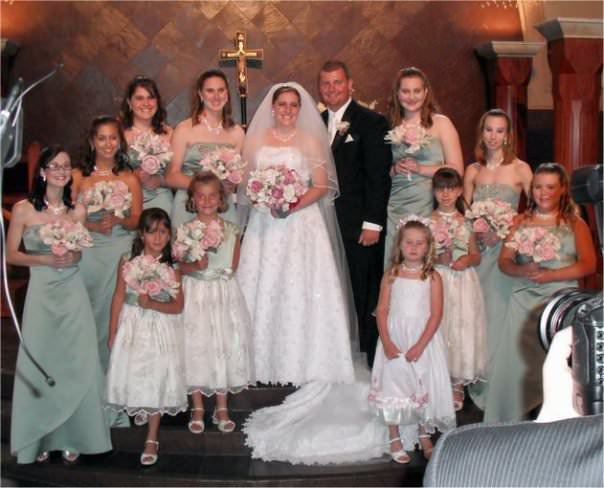
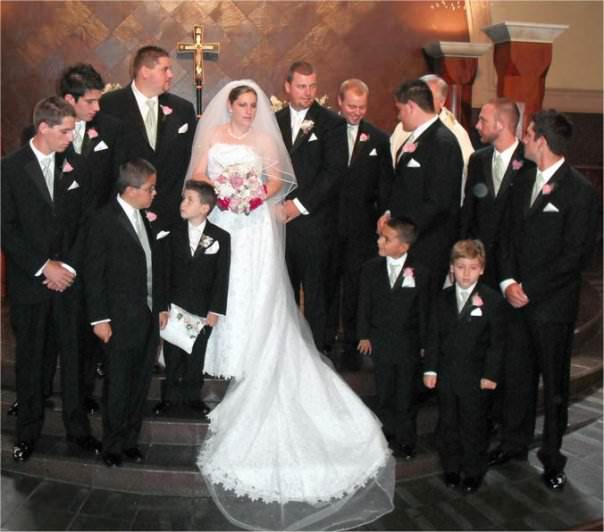
I think the FinePix J20 takes really good pictures for its size and price. I didn’t have the primary photographer’s position or command of the audience, so these are not perfect in composure. Also, because the original photo files are over 1.5 meg in size and very large (10mp images), I reduced their size a bit for internet uploading. My nieces wedding album pics, taken inside a church with low lighting. I know, I 'm not for the church, but I was a guest…

Regarding megapixels and quality of image: generally the most important factor is the quality of the lens. The number of megapixels affect the maximum size at which you can output the image.

However, the physical dimensions of the sensor also affect quality: the greater the area, the less noise in the image, especially with longer exposures. Many digital cameras have a smaller sensor area than what 35mm film provided. I’ve recently upgraded to a camera with a full frame sensor (as in, full 35mm), and that, along with sensor technology improvements that have taken place since the time I bought my previous camera, does a remarkable job in reducing the amount of noise.

I’m not seeing any noise in those images (bridesmaids and bridegrooms), but maybe I’m not looking at them correctly? They are a little out of focus I think because I am not used to an autofocus camera and I may not have had a face centered in the lens (I’ve noticed that for other more obvious out of focus shots taken with the same camera). It has a built-in face detector, but I only had a few seconds to take these photos. The lens is a good sized lens, but I don’t know the specs right off hand, and I’m sure the detector is not 35mm size. For the money, I’m more than satisfied. This camera on manual has a lot of controls on it, I think, shutter speed and aperture opening and focus, though I took all of my photos so far on automatic. I’m happy with it :smiley: and the software that came with it that worked better after I downloaded an upgrade. For professional photos, I’d use my Minolta X700; however, I took over 200 photos while on this vacation, and that would have been a lot of rolls of film! Now I need to look into sending some of them off to be professionally printed or get photo-grade paper for my home printer.