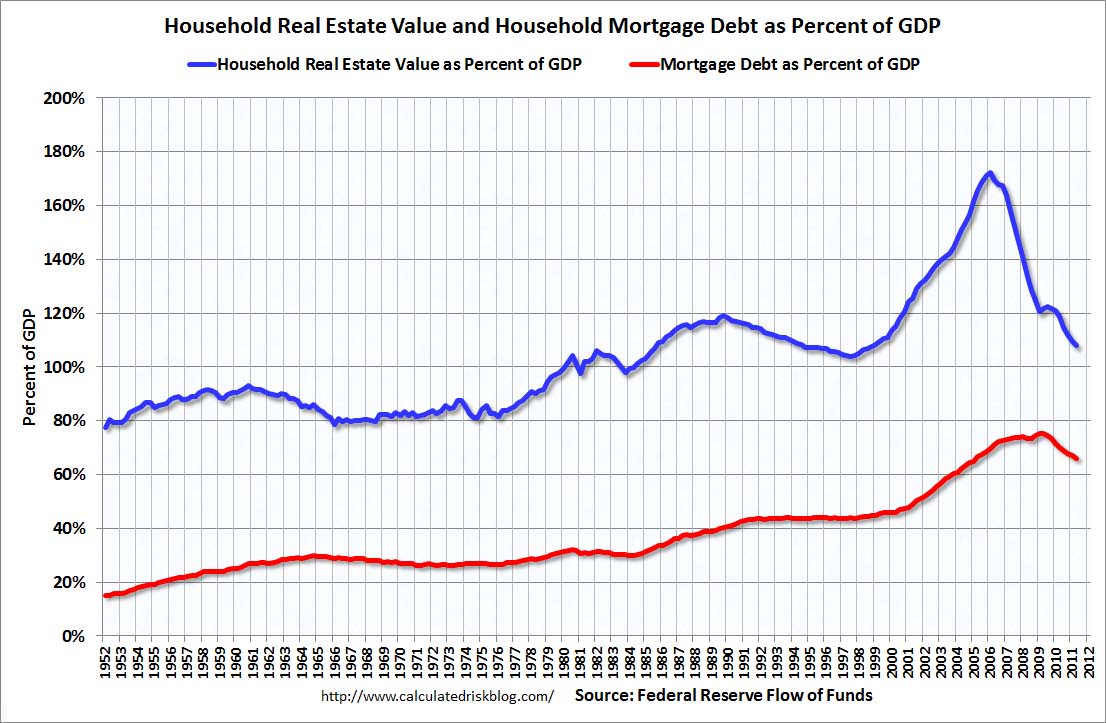
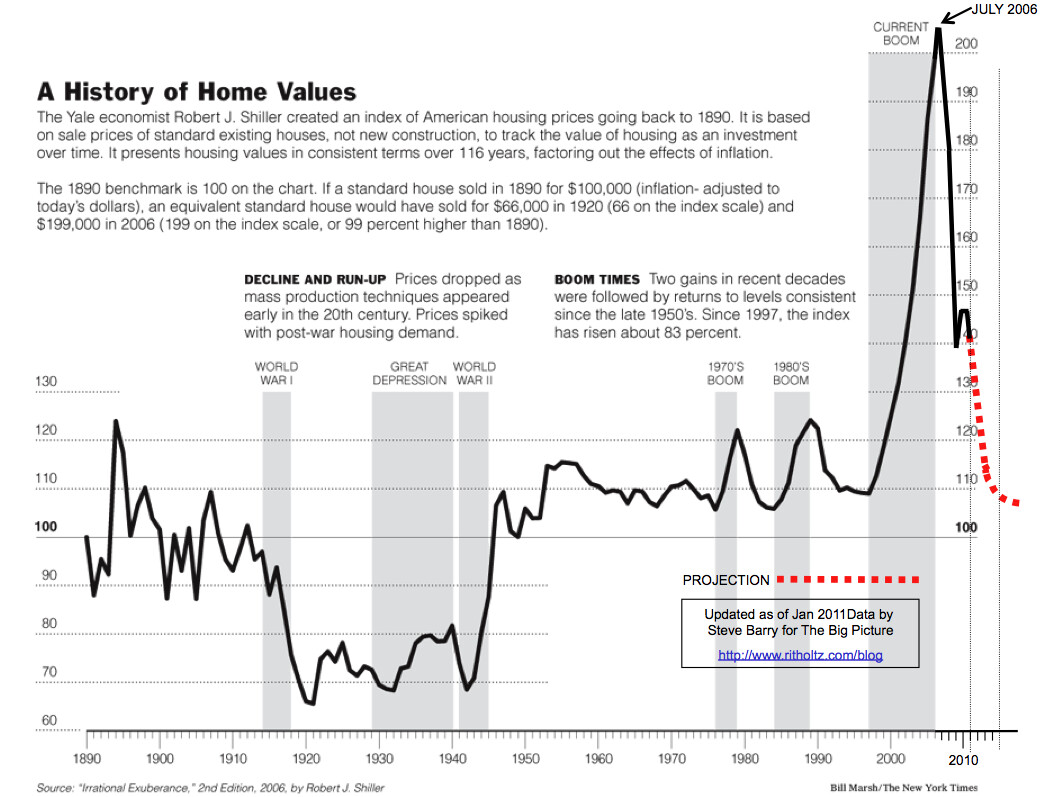
Houses are not tulip bulbs and they’re not dot-coms. When most bubbles collapse the assets behind the bubble disappear rather quickly as people rush to avoid further losses on cratering assets. The difference with houses is that selling the house (or walking away from it)) leaves the owner in a worse situation than holding on to it, even if the value is expected to continue to fall. With assets wiped out, no money for a dp (you need at least 25% these days) and a default on their record, they have no way of getting another loan and face a foreseeable future of renting. Since rents are often now considerably higher than mortgage payments on the same place, the owners are better off staying put and ignoring the continuing loss of value of their home. The back pressure against selling homes only gets worse as their values fall.
The economy is in a slow death spiral now, with the slow decline in housing prices further depressing the economy, which throws people out of work, which forces them into foreclosure, which drives prices down, which makes it even harder for those who didn’t sell to sell. Worker mobility is close to zero, and businesses are waiting for the next “great idea” to come out of Washington. If they’re lucky, it won’t be as great as Obamacare or Dodd-Frank.
There have been a lot of suggestions for “solving” this. Most involve reducing the principal of loans below the homes’ market values, but what happens when people see daylight and rush to get out of their homes? A further devaluation. So the plans are modified so that those who get their principal lowered have to stay put. If they leave, the gov’t can go after other assets, etc. Another is to subsidize the purchase of empty homes to rent them out. That drives down rent prices and will force current rental property owner to sell. Every “answer” has unintended, negating consequences.
Left alone, it will take a combination of defaults (bank losses) and the gradual paydown of mortgages to below the home value. On average, a house bought in 2006 or 2007 with a fixed 30yr and no DP will not get its principal below today’s value until 2022. Even buyers who put down 20% are just at breakeven, which means they lose their entire DP investment if they sell now.
Devaluation of the currency to pay the federal debt is an inevitability. So why wait and prolong the pain to the economy? Imagine the worst case: gov’t lets mortgages unwind slowly as our economy slowly dies, then when revenues drop below a certain point, it becomes crystal clear that gov’t default is the only recourse. They print a shipload of money to pay off debt because no one is renewing prices rocket uncontrolled and the housing problem is finally solved, amidst the ruins of a once great economy. If they devalue now, let people know why they’re devaluing, put in place safeguards against future bubbles (like, oh, I don’t know… a full-reserve, audited gold standard?), then everyone takes their lumps and we rebuild what is still a vital, intact economy.
I’m as against gov’t intervention as the next guy, but when gov’t intervention causes a bubble, gov’t de-intervention may be required to re-balance the system. At least in this case, where the bubble dynamics of people’s homes prevents a quick orderly correction.