Existence, We

On 4/4/2021 at 8:12 PM, Boydstun said:

. . .

PRIMACIES OF EXISTENCE

. . . Things in all that they are are what we know part of and know that our known is only part of the all there to be known. Further, existence of a thing is nothing more than—indeed, it is identically the same as—existence of all that a thing is.[10]

[10] See further, Baumgarten 1757, §§15, 37; Kant, KrV A324–27 B380–83. . . .

References

Baumgarten, A. 1757 [1739]. Metaphysics. 4th ed. In Fugate and Hymers 2013.

Kant, I. 1781, 1787. Critique of Pure Reason. W. S. Pluhar, translator. 1996. Indianapolis: Hackett Publishing.


Additionally, “existence is identity” in mathematics means not only that any mathematical fact will be correct statement of an identity, but that the identity is the existence. Concerning concrete existence, “existence is identity” must include in that identity: specification of spatial and temporal relations, for it to be the case that the identity is the existence.

If we add that all existence outside existence in mathematics (or in logic, e.g. Löenheim-Skolem Theorem) is existence in physical space and time, then the ontological argument, of Anselm and Descartes, for the existence of God fails with respect to non-mathematical existence. From a set of predicates not including specification of spatial and temporal relations, the existence of God cannot be inferred, and inclusion by fiat of Its spatial relations (everywhere) and temporal relations (everywhen) in a mere conception does amount to the existence of God in that usual intended sense of existence.* Whereas, Existence itself is not something concluded from a conception, but is simply there all around us and is the physical and epistemological context for any knowing of any existent or identity.

* Cf. Christian August Crusius (1745) in Leibniz & Kant, Brandon C. Look, editor, (Oxford 2021), pp. 61–66.
1 Like

On 6/21/2021 at 9:22 PM, Boydstun said:


My paper Existence, We which I worked on from 2014 to 2019 is now published.

That link is no longer any good.

The following link is still good. (Scroll down)

_ The Journal of Ayn Rand Studies _ - Summer 2021

Page 89

In that last full paragraph on page 89, I had written: “Contrary to the doctrines of Heidegger, time exists, and there is no originating or primordial time of being from which nature-time arises.[58] Being is only Existence, only Existence and its nature-time relations of existents.” The note [58] lists good reads on Heidegger’s view: Heidegger [1927] 2010, 329/314; Blattner 2005; Ruin 2005, 168–69. Those references are: Heidegger’s BEING AND TIME and the contribution of William Blattner and the contribution of Hans Ruin in the collection A COMPANION TO HEIDEGGER (Blackwell). There are some other notions of a metaphysical sort of time allegedly distinct from physical time besides Heidegger’s notion of a metaphysical time. These are nicely lain out by Henrik Zinkernagel within his paper “Did Time Have a Beginning?” (2008) which is available online here. To HZ’s title question, by the way, he argues that time, physical time, did have a beginning. This is on account of current scientific cosmology, under General Relativity, concerning the history of spacetime. His conclusion does not, however, form a counter-example to the thesis that there are no existents (say, the total mass-energy of the universe, a constant from now back to the Initial Singularity) that exist ever with their present or past character outside of physical time.

Related: ABC

Also under “Related” – DE

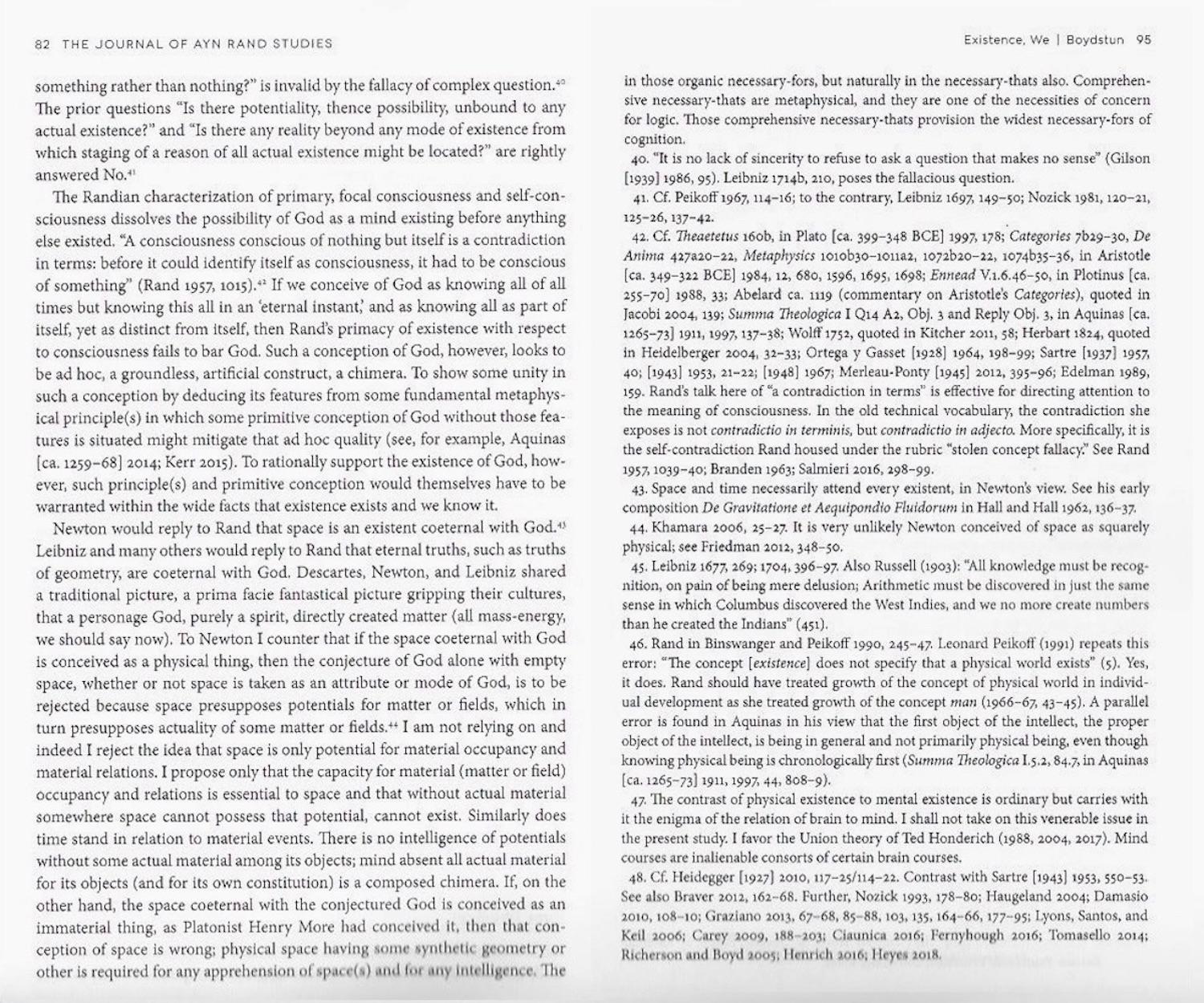
This post concerns only a little treasure chest of intellectual history. It pertains to a point in metaphysics and philosophy of mind that Ayn Rand stated in her 1957, namely, her conception of consciousness at what she regarded as its most basic meaning and on which all other occasions of consciousness are derivative. Within my fundamental paper “Existence, We” (2021), I had conveyed this conception Rand had put forth—consciousness is consciousness of existence—and at my quotation of her statement, I had placed an endnote (42) containing the earlier such conceptions in the history of philosophy, which I had collected through my years of study, coinciding with or approximating the conception Rand was putting forth. I show that excerpt from my paper here. (Click on image.)

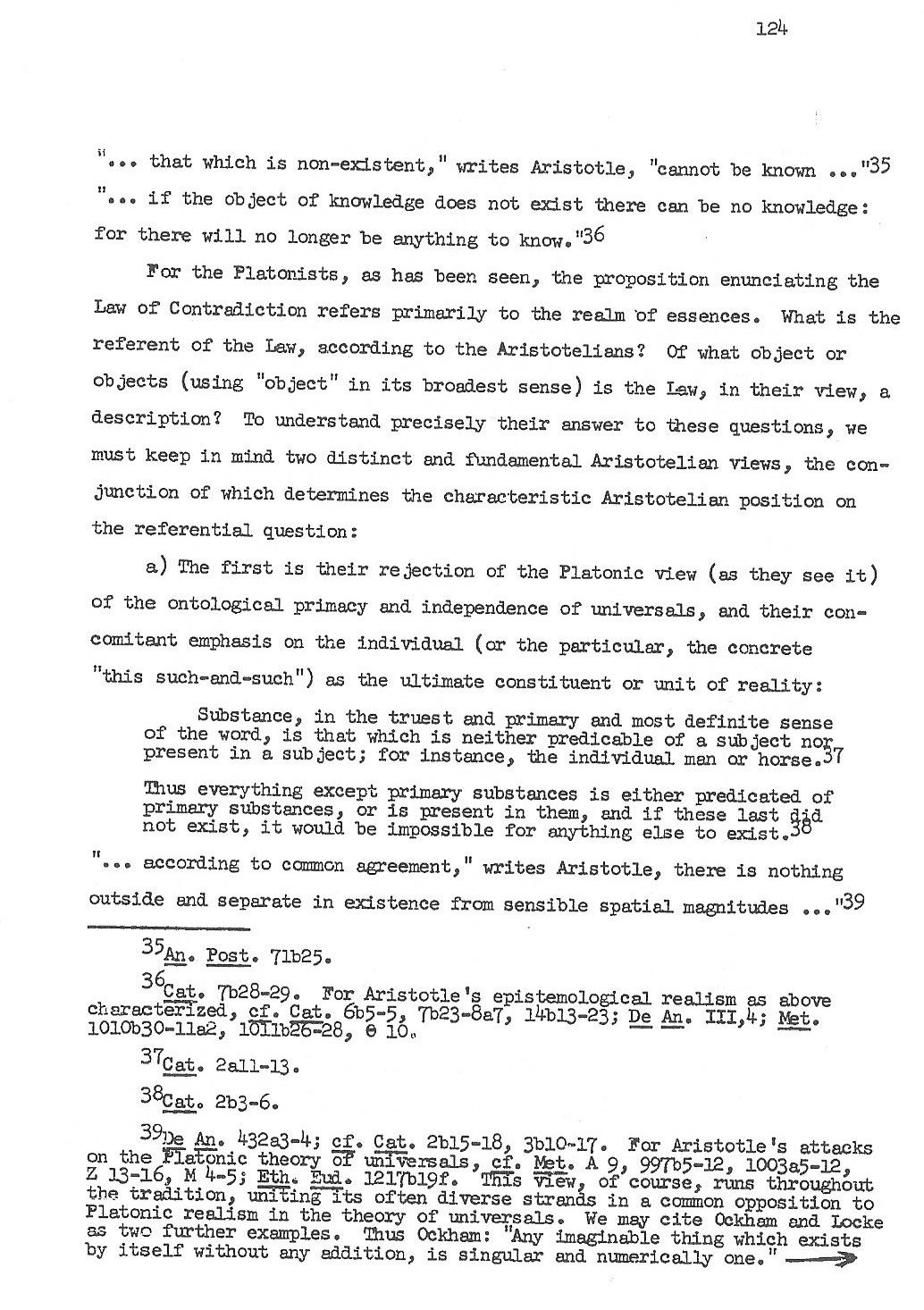
In a recent rereading of Leonard Peikoff’s Ph.D. dissertation (1964), I noticed that he had found places in which a close-companion idea arises in the work of Aristotle. This is the idea that knowledge requires a known existent. I’d like repose here this little treasure chest (footnote 36) conjoined with mine. (Click on image.)