Hasn't the free market failed

There is no, read NO, panic during the 19th century that equals in scope any of the panics we have had since govt started getting involved in regulating the economy.

The Great Depression was caused by govt intervention. This panic was caused primarily by govt intervention. I sure can imagine the political fall out from 20% unemployment. It’s a wonder govt still wants to be in the picture. The “cure” is the illness.

Great Myths of the Great Depression

http://www.mackinac.org/article.aspx?ID=4013

Govt Did It

http://www.forbes.com/2008/07/18/fannie-fr…_0718brook.html

Nice try, Kendall but I have an article of my own from someone who was actually alive during that time…

Inequality of wealth and income

Marriner S. Eccles, who served as Franklin D. Roosevelt’s Chairman of the Federal Reserve from November 1934 to February 1948, detailed what he believed caused the Depression in his memoirs, Beckoning Frontiers (New York, Alfred A. Knopf, 1951)[22]:

As mass production has to be accompanied by mass consumption, mass consumption, in turn, implies a distribution of wealth – not of existing wealth, but of wealth as it is currently produced – to provide men with buying power equal to the amount of goods and services offered by the nation’s economic machinery. [Emphasis in original.]

Instead of achieving that kind of distribution, a giant suction pump had by 1929-30 drawn into a few hands an increasing portion of currently produced wealth. This served them as capital accumulations. But by taking purchasing power out of the hands of mass consumers, the savers denied to themselves the kind of effective demand for their products that would justify a reinvestment of their capital accumulations in new plants.In consequence, as in a poker game where the chips were concentrated in fewer and fewer hands, the other fellows could stay in the game only by borrowing. When their credit ran out, the game stopped.

That is what happened to us in the twenties. We sustained high levels of employment in that period with the aid of an exceptional expansion of debt outside of the banking system. This debt was provided by the large growth of business savings as well as savings by individuals, particularly in the upper-income groups where taxes were relatively low. Private debt outside of the banking system increased about fifty per cent. This debt, which was at high interest rates, largely took the form of mortgage debt on housing, office, and hotel structures, consumer installment debt, brokers’ loans, and foreign debt. The stimulation to spend by debt-creation of this sort was short-lived and could not be counted on to sustain high levels of employment for long periods of time. Had there been a better distribution of the current income from the national product – in other words, had there been less savings by business and the higher-income groups and more income in the lower groups – we should have had far greater stability in our economy. Had the six billion dollars, for instance, that were loaned by corporations and wealthy individuals for stock-market speculation been distributed to the public as lower prices or higher wages and with less profits to the corporations and the well-to-do, it would have prevented or greatly moderated the economic collapse that began at the end of 1929.

The time came when there were no more poker chips to be loaned on credit. Debtors thereupon were forced to curtail their consumption in an effort to create a margin that could be applied to the reduction of outstanding debts. This naturally reduced the demand for goods of all kinds and brought on what seemed to be overproduction, but was in reality underconsumption when judged in terms of the real world instead of the money world. This, in turn, brought about a fall in prices and employment.

Unemployment further decreased the consumption of goods, which further increased unemployment, thus closing the circle in a continuing decline of prices. Earnings began to disappear, requiring economies of all kinds in the wages, salaries, and time of those employed. And thus again the vicious circle of deflation was closed until one third of the entire working population was unemployed, with our national income reduced by fifty per cent, and with the aggregate debt burden greater than ever before, not in dollars, but measured by current values and income that represented the ability to pay. Fixed charges, such as taxes, railroad and other utility rates, insurance and interest charges, clung close to the 1929 level and required such a portion of the national income to meet them that the amount left for consumption of goods was not sufficient to support the population.

This then, was my reading of what brought on the depression.
Nice try, Kendall but I have an article of my own from someone who was actually alive during that time…

Nice try Akosiwa, but this account is pure Keynsian thought which has generally been discredited in most economic circles.

This isn’t dueling articles. It’s what has generally come to be the accepted causes of Depression.

In addition, your FED chairman would have the interpretation that drove administration policy. If in fact the govt caused it, then his interpretation would have to be self-serving and wrong.

It may be obvious in this example that you are entitled to leave behind a better future for your children (I hope it’s obvious to you), but many people in today’s society claim it is unjust for one kid to have a better starting point than another. That the kid of the bum who spent his life on welfare is entitled to exactly the same start as the kid of the person I described above. I actually had a conversation once with someone who believed it’s not fair for a person to leave behind his wealth for his children. If you have a similar belief, then you are too far off for me.

No I don’t believe it is immoral to give things to your child. I just know that all wealthy people aren’t the most productive like most of you claim on this forum(And yes there is evidence of this). People don’t hate the rich they just know that the rich will be alright(Paris Hilton, Kim Kardashian etc.) while others have to struggle and work two jobs even just to make ends meat. This economy’s debt has to be paid off someway. We can already see how tax cuts work out by just looking at the Bush administration.

Nice try, Akosiwa, but I have the best source of all: the chief architect of the New Deal, Raymond Moley, who soon after its creation, became its chief critic. Read After Seven Years or his later, more thorough book, The First New Deal.

(enter your ZIP code on either of those pages to find the closest libraries with the book, then you can go to your local library and submit an Interlibrary Loan request, they’ll get it for free)

I just know that all wealthy people aren’t the most productive like most of you claim on this forum(And yes there is evidence of this).

Then you might want to produce this evidence of yours. I dont think I have heard anyone on this site claim that all wealthy people are the most productive. In fact, the opposite is often true. Look at the Kennedy’s for example. They are wealthy and have produced nothing. Most of them would be hard-pressed to identify the business end of a plunger.

I just know that all wealthy people aren’t the most productive like most of you claim on this forum(And yes there is evidence of this). People don’t hate the rich they just know that the rich will be alright(Paris Hilton, Kim Kardashian etc.) while others have to struggle and work two jobs even just to make ends meat.

No one claimed everyone who is rich produced their wealth themselves. (Although Paris Hilton is a bad example: she is yet to inherit what’s left of her great graandfather’s fortune, and she is earning money herself-sure, it’s partly from getting paid for going to a party or having sex on tape, but that still is wealth she herself produced, and is therefore perfectly entitled to)

The point is wealth is produced by somebody, it doesn’t fall from the sky. If you have wealth, there are only 3 possibilities:

  1. You produced that wealth yourself, by hard work and consentual trade, with other productive members of society.

  2. You were given that wealth by someone who produced it themselves.

  3. You obtained it through fraud (theft, breach of contract) or force(such as armed robbery or a government program).

In the third case, it is the government’s job to punish you, however in the first two cases, it is imoral for members of the govenment to even ring your doorbell over it, let alone take half your profits at gunpoint.

No one claimed everyone who is rich produced their wealth themselves. (Although Paris Hilton is a bad example: she is yet to inherit what’s left of her great graandfather’s fortune, and she is earning money herself-sure, it’s partly from getting paid for going to a party or having sex on tape, but that still is wealth she herself produced, and is therefore perfectly entitled to)

The point is wealth is produced by somebody, it doesn’t fall from the sky. If you have wealth, there are only 3 possibilities:

  1. You produced that wealth yourself, by hard work and consentual trade, with other productive members of society.

  2. You were given that wealth by someone who produced it themselves.

  3. You obtained it through fraud (theft, breach of contract) or force(such as armed robbery or a government program).

In the third case, it is the government’s job to punish you, however in the first two cases, it is imoral for members of the govenment to even ring your doorbell over it, let alone take half your profits at gunpoint.

Excellent. Couldn’t have put that any better.

am I wrong, or is it true that until 1914 there was no income tax at all? and until 1920’s there has never been any kind of economic depression? could there be a connection there? pure capitalism existed in the US of A until the 1914 amendment.

am I wrong, or is it true that until 1914 there was no income tax at all? and until 1920’s there has never been any kind of economic depression? could there be a connection there? pure capitalism existed in the US of A until the 1914 amendment.

The Sherman Act of 1890 was the first major swing toward statism.

Before that though, there were still other taxes and eminent domain among others. So never was it laissez faire, but it was pretty close, all things considered.

<snip>

Also I must add that the wealthiest aren’t always the “most productive” as I hear Rand say over and over again. Most of them were just hooked up and some were born into it. I don’t see anything wrong with taxing more from the wealthy because they can afford it. McCain has 3+ houses for goodness sake while others who aren’t so lucky(Didn’t get hookups or weren’t born into it) have to worry about keeping there “one” house. Plus President Bush is wealthy and he isn’t that smart.

You’re absolutely 100% correct. Many wealthy people inherit it. Inheriting wealth makes it easier to stay wealthy. A lot of life circumstances and attitudes change when you have the freedom and power that money gives. It’s easier to focus on the long term when you’re not worried about putting food on the table tomorrow.

This doesn’t make it right to just “tax the rich” because they inherited their money. As Agrippa noted, the taxes make it harder for truly productive people to become wealthy because they are punished like those who inherit. But there’s a more fundamental philosophical point here. You’re saying, essentially “You own this. I want it. You didn’t work for it, so it’s OK for the government to take it from you and give it to me/society.” Um, no.

Money is power. Inheriting money means inheriting power. Yes, this is often unfair. But money is the fairest arbiter we know of. Fools tend to lose their money over time. Unproductive people tend to lose their money. Productive, capable people can gain money and power over their lifetimes. (Look at the founders of Google for a modern example.)

Society is run by money. This is not a bad thing. If not money, it necessarily becomes politics, and politics is run by pull. Who knows X, who has the dirt on Y, who can do a favor for Z to be repaid later. If you think money is unfair, you haven’t seen anything yet. With money, your future is at least in your hands, to shape or destroy by your own choices. With politics, your future is at the whim of whoever has power over you at this moment.

(That fact that politics and money are inextricably linked is a flaw of the current system; Ayn wanted to see government and the economy separated for just this reason.)

am I wrong, or is it true that until 1914 there was no income tax at all? and until 1920’s there has never been any kind of economic depression? could there be a connection there? pure capitalism existed in the US of A until the 1914 amendment.

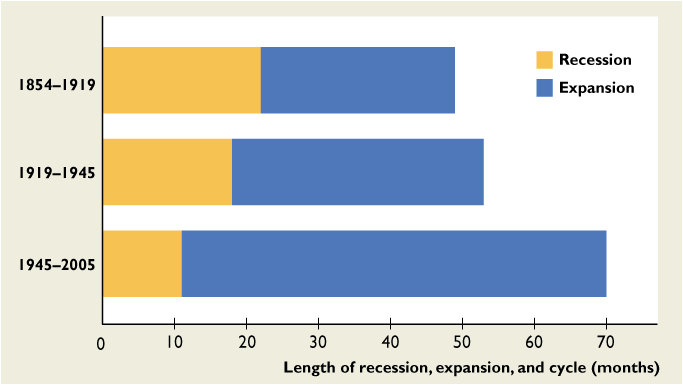
Marty Mcfly the numbers don’t lie…

We have never had pure capitalism in this country.

Akiosawa, you put no source whatsoever for your chart. Also, it is also very unclear what constitutes “recession”, “expansion”, etc.

MAE_Lesson_14__29__AS_AD___Business_Cycle__ppp.ppt (1.84 MB)

Slide 21 is the chart. It is from Macroeconomics. “Recessions” and “Expansions” are part of the business cycle.

Slide 21 is the chart. It is from Macroeconomics. “Recessions” and “Expansions” are part of the business cycle.

I think a chart showing depth of recession, would be more interesting. Your slide show for instance claims that the longest and deepest single receesion was TGD, which falls in the wrong bar.

This chart implies that all recessions are created equal. They’re not. Nice try.

http://www.aynrandbookstore2.com/prodinfo.asp?number=BS70M

Marty Mcfly the numbers don’t lie…

Akosiwa, I’m not sure if you’re using this graph as a polemical device, or if you;re trying to understand the facts. I’m going to assume the latter.

In general that graph is not useful information. Kendall has explained one reason in his post above. For instance, consider the following two situations:

A. Economy has a recession for 2 years

B. Economy has a recession, government starts the printing-press and pulls things out using the tried and tested formula of inflation ending the downward trend in 1 year. The economy sees some growth, but it splutters and there is another year of recession.

Summary: Situation A has a 2 year recession, while situation B has two recessions of 1 year each, with a short interval – likely of slow real growth. The fact that the average duration of the recession has halved is deceptive. It does not tell us anything that is useful.

To those who asked for a source, I assume that graph is using the NBER data.

Basically, trying to understand recessions by taking the 32 official recessions and working off aggregated statistical data is not going to yield useful results. There are too few data-points, too many definitional problems, and too many other factors for such an approach to give one anything other than clues and hints about what further research one ought to do.

The free market hasn’t failed.

In fact what happened was that a bunch of people sold a bunch of financial instruments at completely incorrect prices and lost money as a result.

Why were the prices completely incorrect?

The models used to price the instruments didn’t accurately reflect the real behavior of the markets.

So yes, if everyone is going to go around devising weird exotic financial instruments that they are unable to price correctly then they are all going to lose money to people who can exploit the fact that the prices are all wrong.

Marty Mcfly the numbers don’t lie…

Mature markets tend to have a lot fewer fluctuations and the United State’s economy has definitely matured a lot from 1854-2005

Yea hasn’t freedom obviously failed? I think the principles of engineering have failed too because I saw this dude build a bridge and it collapsed.. although come to think of it he didn’t really use any math or calculations or anything, mostly just this voodo witch doctor stuff.. but he said he was an engineer. Anyway the case is definitely closed on freedom though and we should really just give the whole thing up. I mean everyone in the media agrees that freedom caused the financial crisis! Can I nominate myself for Fuhrer?

Yea hasn’t freedom obviously failed? I think the principles of engineering have failed too because I saw this dude build a bridge and it collapsed.. although come to think of it he didn’t really use any math or calculations or anything, mostly just this voodo witch doctor stuff.. but he said he was an engineer. Anyway the case is definitely closed on freedom though and we should really just give the whole thing up. I mean everyone in the media agrees that freedom caused the financial crisis! Can I nominate myself for Fuhrer?

You hit that one out of the park, SkyTrooper! Nicely done. Funny how the statists use that sort of argument and all the collectivist robots nod and clap in mindless agreement. Funny, that is, if it weren’t for the destruction of our freedom that was taking place.

Many excellent points have been posted here. The original poster of this thread asks if the free market has failed, yet uses the extremely non-free market as evidence.

The current recession, like the Great Depression, is a glaring example of how the non-free market has failed. Of course, the statists/central planners/socialists refuse to admit that the regulations are to blame. Faced with the failure of their own policies, they call for more power and control by the government. Trying to “fix” the current economic crisis with more government involvement is like trying to repair a broken-down car by pouring a truckful of concrete on it.

Free Market has never failed because it had never existed. Those are the politicians who failed to create free market, not the free market itself.

Can I nominate myself for Fuhrer?

I’m betting you have the firepower to have my vote. :wink: