Origins of Kashmir Conflict

On 5/18/2025 at 10:57 AM, human_murda said:

US doesn’t stay away from other countries (with the largest number of foreign interventions: the US has intervened in 81 foreign elections and has done 400 military interventions in the past few decades), lost half the wars it started and as of 2025, isn’t that powerful relatively (especially compared to China).

Wait - lost half the wars we started?  Where are you getting that?

People often cite Iraq as a lost war, since we failed to convince the Iraqis that they should embrace Western values.  And we did fail to convince them of that, true enough, but that’s not exactly a military operation.  Where is Saddam Houssein today?
People often also cite Vietnam as a lost war, and we did retreat from Vietnam.  Did we retreat because there were no American soldiers left to fight, or because the enemy had crippled our ability to deliver equipment and munitions to the front lines?  We left Vietnam because we got bored of farming Chinese peasants for XP.  Mao’s philosophy was that he could throw more Chinese peasants at us than we had bullets to fire at them, which was absolutely dead wrong - he had more Chinese peasants than we had the desire to continue mowing them down.

And that’s basically what the Chinese military still has.  Plenty of bodies.  Granted, they’re getting pretty close to the point of being able to challenge the American military, but mostly because there are so damn many of the Chinese (and even then they are not there yet; if they were then Taiwan would not still be a country).

Even if we were to count Iraq and Vietnam as losses (which were not military losses) I’m still at a loss for how you get to half the wars we’ve started.


On 5/18/2025 at 11:14 AM, human_murda said:

Is Objectivism a philosophy of American nationalism?

Quote

There is a special reason why you, the future leaders of the United States Army, need to be philosophically armed today. You are the target of a special attack by the Kantian-Hegelian-collectivist establishment that dominates our cultural institutions at present. You are the army of the last semi-free country left on earth, yet you are accused of being a tool of imperialism — and “imperialism” is the name given to the foreign policy of this country, which has never engaged in military conquest and has never profited from the two world wars, which she did not initiate, but entered and won. (It was, incidentally, a foolishly overgenerous policy, which made this country waste her wealth on helping both her allies and her former enemies.) Something called “the military-industrial complex” — which is a myth or worse — is being blamed for all of this country’s troubles. Bloody college hoodlums scream demands that R.O.T.C. units be banned from college campuses. Our defense budget is being attacked, denounced and undercut by people who claim that financial priority should be given to ecological rose gardens and to classes in esthetic self-expression for the residents of the slums.

Some of you may be bewildered by this campaign and may be wondering, in good faith, what errors you committed to bring it about. If so, it is urgently important for you to understand the nature of the enemy. You are attacked, not for any errors or flaws, but for your virtues. You are denounced, not for any weaknesses, but for your strength and your competence. You are penalized for being the protectors of the United States. On a lower level of the same issue, a similar kind of campaign is conducted against the police force. Those who seek to destroy this country, seek to disarm it — intellectually and physically. But it is not a mere political issue; politics is not the cause, but the last consequence of philosophical ideas. It is not a communist conspiracy, though some communists may be involved — as maggots cashing in on a disaster they had no power to originate. The motive of the destroyers is not love for communism, but hatred for America. Why hatred? Because America is the living refutation of a Kantian universe.

…

In conclusion, allow me to speak in personal terms. This evening means a great deal to me. I feel deeply honored by the opportunity to address you. I can say — not as a patriotic bromide, but with full knowledge of the necessary metaphysical, epistemological, ethical, political and esthetic roots — that the United States of America is the greatest, the noblest and, in its original founding principles, the only moral country in the history of the world. There is a kind of quiet radiance associated in my mind with the name West Point — because you have preserved the spirit of those original founding principles and you are their symbol. There were contradictions and omissions in those principles, and there may be in yours — but I am speaking of the essentials. There may be individuals in your history who did not live up to your highest standards — as there are in every institution — since no institutions and no social system can guarantee the automatic perfection of all its members; this depends on an individual’s free will. I am speaking of your standards. You have preserved three qualities of character which were typical at the time of America’s birth, but are virtually nonexistent today: earnestness — dedication — a sense of honor. Honor is self-esteem made visible in action.

-Ayn Rand at West Point, italics and bold are mine


On 5/18/2025 at 8:46 AM, human_murda said:

As I’ve stated previously, the most anti-Western state in India leads on most metrics. So this is categorically untrue.

Oh, yes.  And as an American (Ayn Rand’s favorite country, which was founded on some pretty extreme anti-British sentiment) I’m glad to live in the most anti-Western state in the world.


On 5/18/2025 at 11:12 AM, stansfield123 said:

I didn’t realize you’re an Indian nationalist, and anti-American. Had I known, I wouldn’t have started this conversation. It’s a waste of time, obviously.

He also attributes whatever success India has gained in the 20th century to the Communists and every bad thing that has ever happened before to the West.  But it is interesting to hear the perspective that’s holding India in the third century.
1 Like

Well the Chinese must of got better , in Korea we killed or wounded almost a million Chinese combatants and left in a draw. In Vietnam they halved  their casualties and the whole place went commie.

Why was it Saddam needed to die, the first time? It would be unAmerican to ‘let’ him have the Kawait?

That Taliban is quite the outfit, too.


4 hours ago, Harrison Danneskjold said:

Wait - lost half the wars we started?  Where are you getting that?

People often cite Iraq as a lost war, since we failed to convince the Iraqis that they should embrace Western values.  And we did fail to convince them of that, true enough, but that’s not exactly a military operation.  Where is Saddam Houssein today?
People often also cite Vietnam as a lost war, and we did retreat from Vietnam.  Did we retreat because there were no American soldiers left to fight, or because the enemy had crippled our ability to deliver equipment and munitions to the front lines?  We left Vietnam because we got bored of farming Chinese peasants for XP.  Mao’s philosophy was that he could throw more Chinese peasants at us than we had bullets to fire at them, which was absolutely dead wrong - he had more Chinese peasants than we had the desire to continue mowing them down.

And that’s basically what the Chinese military still has.  Plenty of bodies.  Granted, they’re getting pretty close to the point of being able to challenge the American military, but mostly because there are so damn many of the Chinese (and even then they are not there yet; if they were then Taiwan would not still be a country).

Even if we were to count Iraq and Vietnam as losses (which were not military losses) I’m still at a loss for how you get to half the wars we’ve started.

Losing a war means failing to attain the aims of the war; the “reasons” an event happened don’t change whether it happened. We lost the Vietnam war, Afghanistan war, Iraq War (the stated goal was not “kill/topple Saddam” though it perhaps should have been), and Korean War (whose goal was not “stop China,” who wasn’t originally in the war, but retake the whole peninsula). One could also count the Bay of Pigs as a failure, though it’s not really in the same category as a whole lost war. Whether we lost “half” or a given percentage might depend on which thing you choose to count as wars and which merely as “conflicts.” It might also be fairer to give more weight to larger wars, so us being victorious in WWII counts for more than losing Vietnam, for example, but that loss might be worth more than winning the first Gulf war when we compare what was invested.

His assertion that the US military isn’t that strong compared to China’s is wishful thinking from Communists (I don’t know if he himself is one, but it’s a propaganda claim that comes from them) and little more. The US military is exceptionally good at conventional warfare, which is what a naval war against China would largely be. If we were to invade China we’d have a problem because we aren’t great at guerrilla combat and insurgencies. But shooting down planes and sinking ships? That we can do quite well. 

On 5/20/2025 at 4:13 PM, stansfield123 said:

The reason why Japan is a better place than India has nothing to do with where they started in 1947, and everything to do with what they did since 1947.

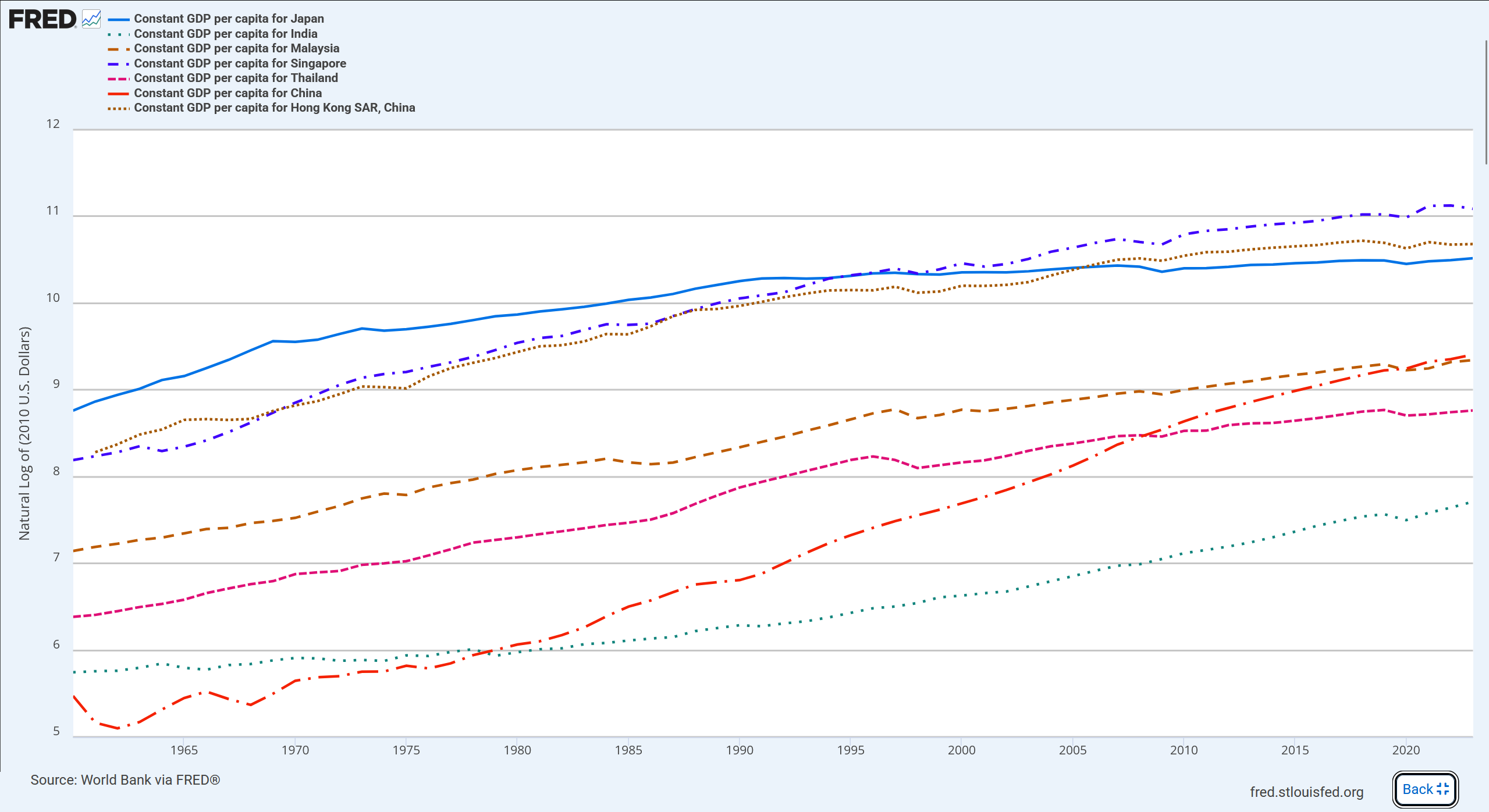
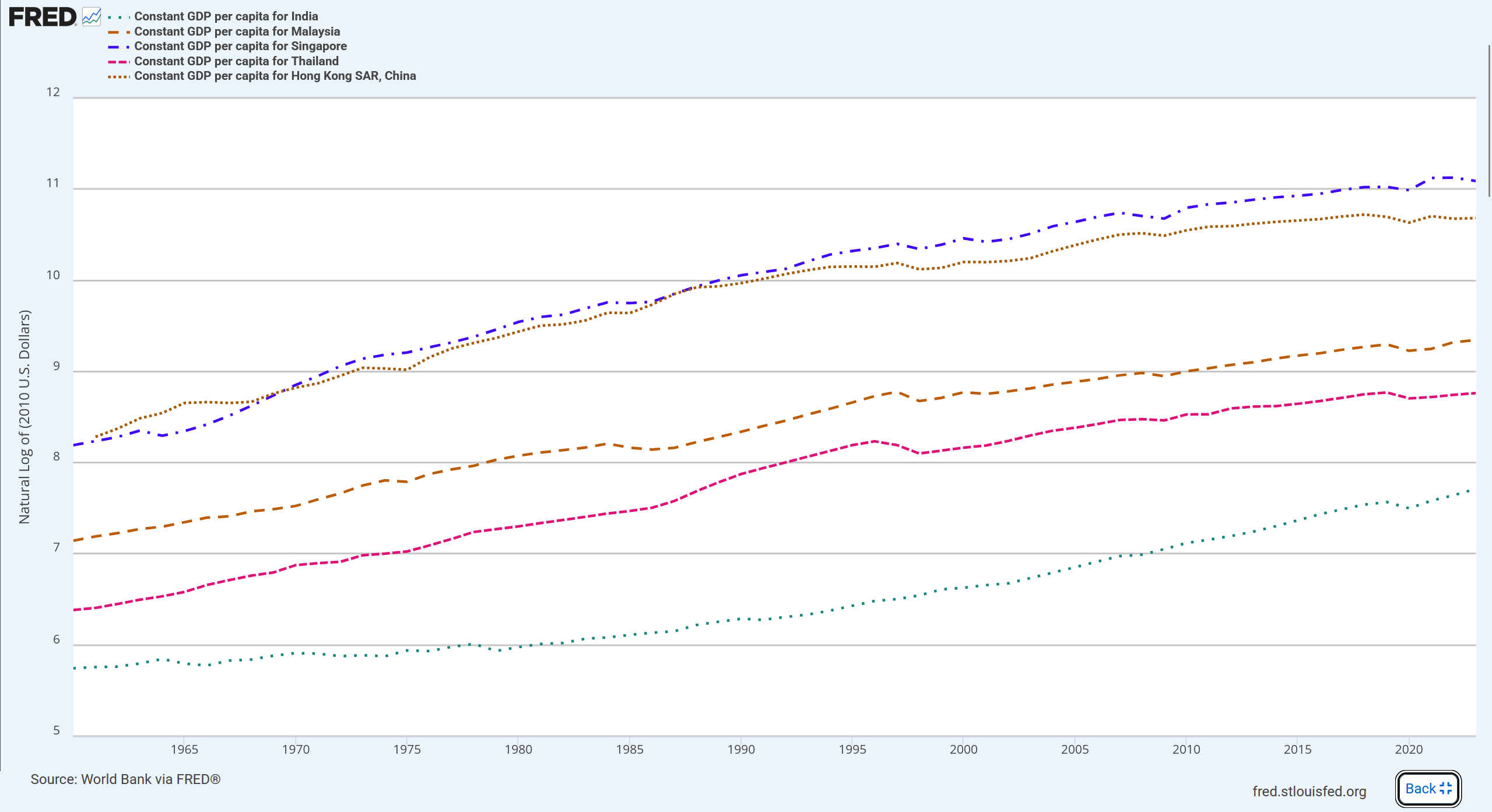
Here is the log of constant GDP per capita for India, Thailand, Malaysia, Singapore and Hong Kong:

All countries are rougly parallel: ie, India, Thailand, Malaysia, Singapore and Hong Kong have had roughly similar growth rates over the past 65 years. India started out slightly slower but picked up after the 90s. Overal, there’s no significant difference in the growth rate of all these countries. India’s accumulated growth in per capita GDP (after adjusting for inflation) over the last 65 years is basically identical to that of Hong Kong and Thailand.

The difference between India and these other countries is not the growth rate, but the starting point. And that dates back to the colonial era: India was an extractive colony while Hong Kong and Singapore were trade hubs (and Thailand was not colonized). Malaysia was around 10 times richer than India at the time of their independence.

This is what happens when you add China and Japan:

China’s growth is impressive. China is cutting across lanes and its trajectory is clearly steeper than the others. China’s current GDP per capita is not just because of their starting point but also because of their higher growth rates. South Korea’s growth rate was also moderately high (but they also started at a much higher GDP per capita). Japan’s growth is slightly lower than that of India over seven decades.

People call Hong Kong and Singapore “Asian Tigers”, but their growth rates were essentially the same as that of India for the last 70 years. They just had a better starting point. The idea of east asian countries growing much faster than India doesn’t have any factual basis (except for China). Also, a lot of the early growth in east asia was state led.

India’s poverty is pretty much exclusively due to British rule. India had a higher GDP per capita than Japan in 1700AD. The only period in history that’s responsible for Japan surpassing India’s GDP per capita is 1757-1947, aka British rule. India had a higher growth rate than Japan both before and after British colonialism. The problem period is 1757-1947 when India’s GDP per capita declined by a total of 8% over 200 years. If India had the same growth rate as Japan during 1757-1947, India would have been richer than Japan on a per capita basis today.

India isn’t “evil” because it’s poor. The difference between India and all these other countries happened before 1947. India cannot change history, especially when that history is of foreign rule and has nothing to do with the Indian government. Countries cannot change their GDP per capita instantaneously. India isn’t “evil” just because India’s GDP per capita hasn’t changed instantaneously. India hasn’t even caught up with the “poverty” that Singapore and Hong Kong had in 1960. China has just approached the “poverty” of Japan in 1960.

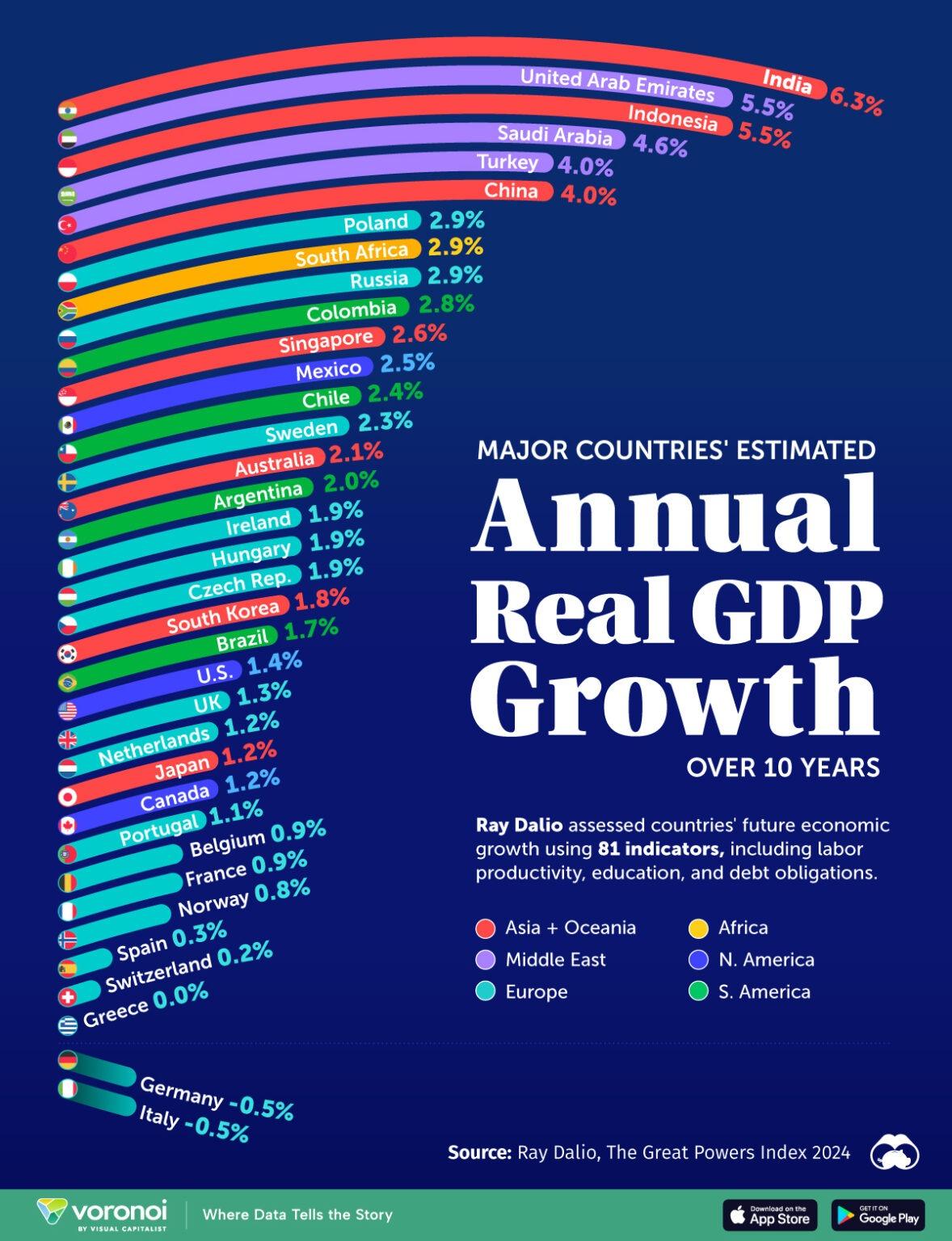
India’s trajectory would become steeper in the future (based on 81 indicators) but probably won’t converge even in the next 50 years due to the stark differences in the starting point:

India would need to grow twice as fast as East Asian countries did historically in order to start converging in the next 50-100 years.


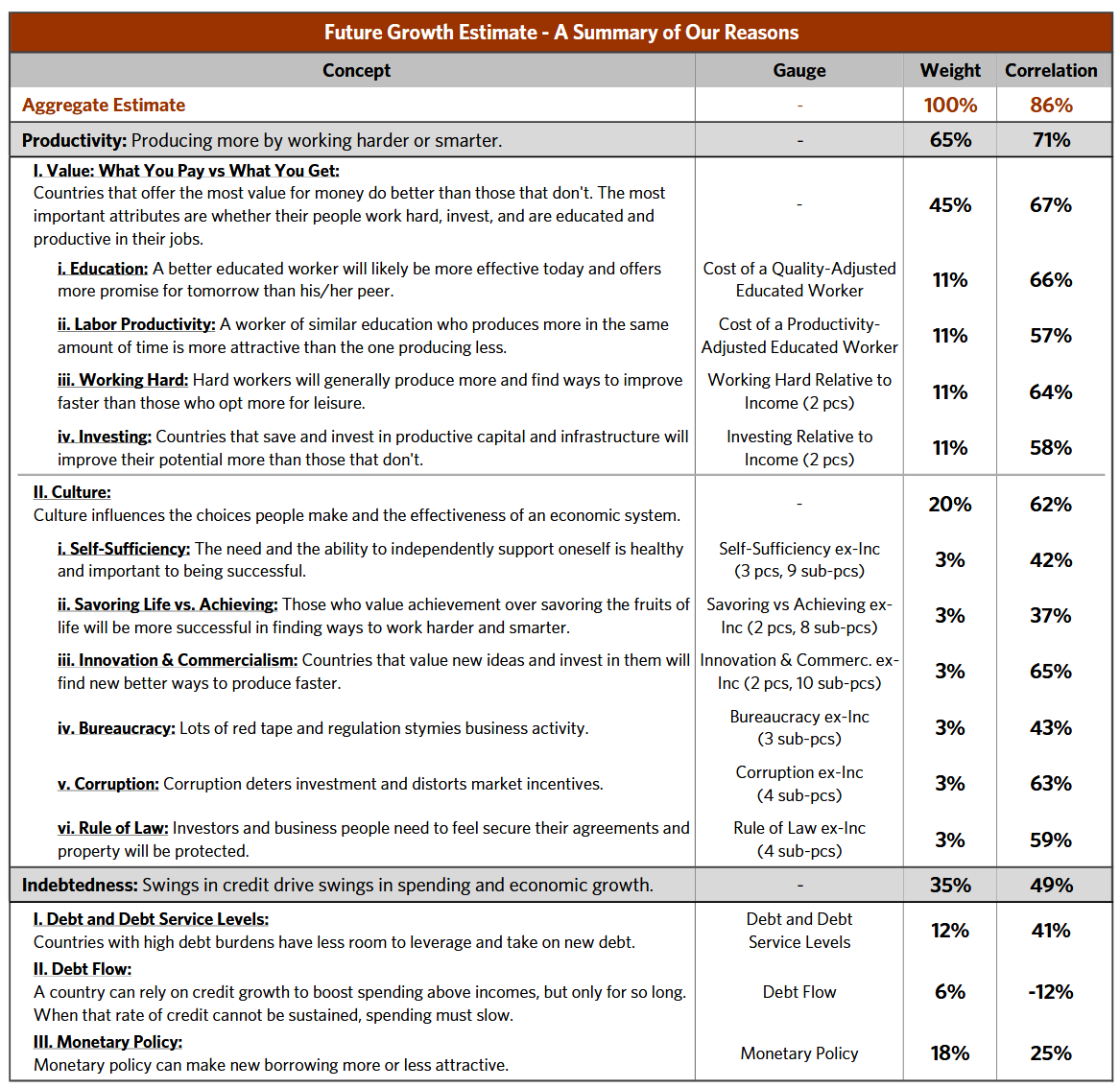
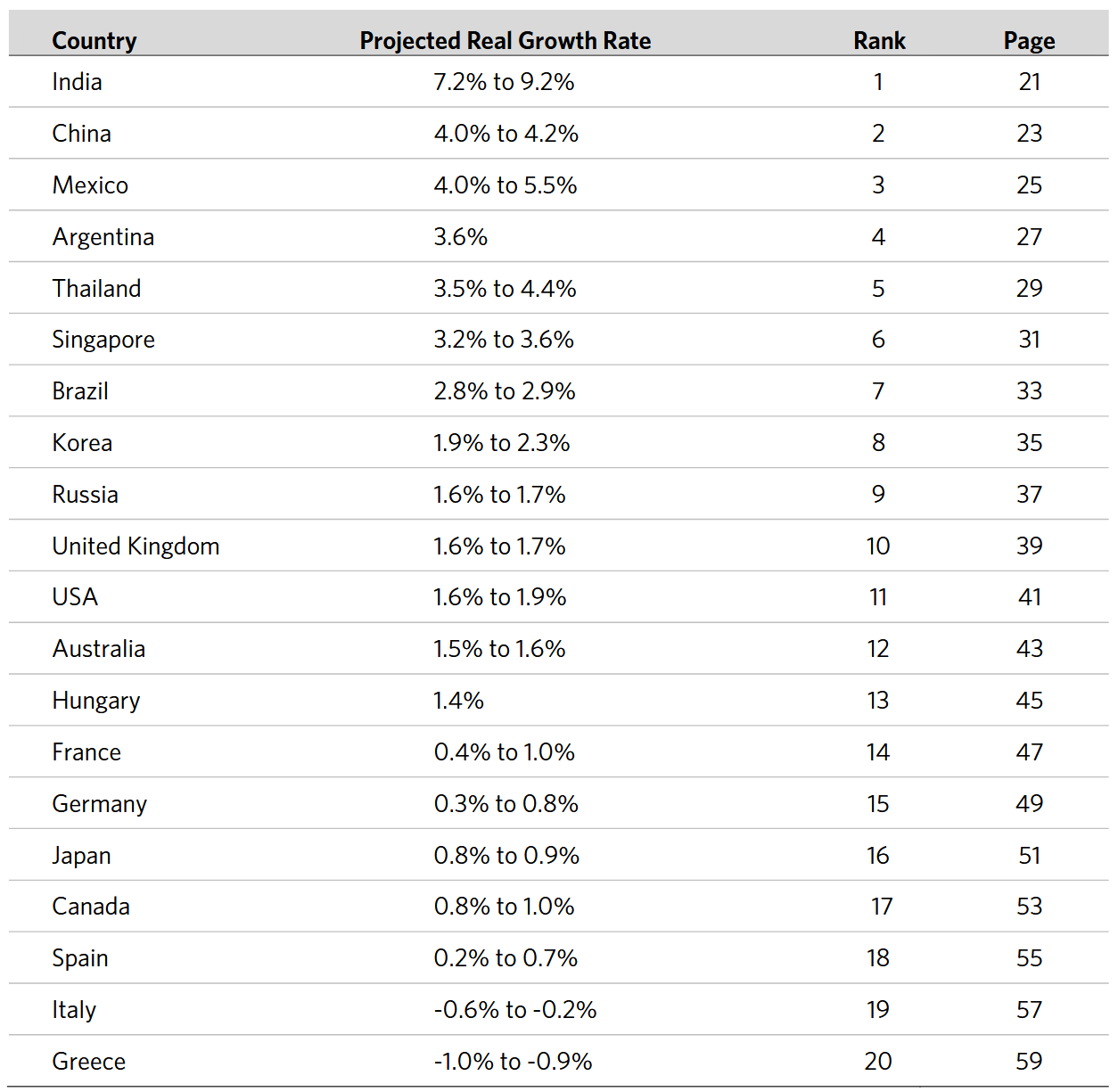
[Here](https://economicprinciples.org/downloads/ray_dalio how_the_economic_machine_works leveragings_and_deleveragings.pdf) is the methodology used by Ray Dalio to predict future growth:

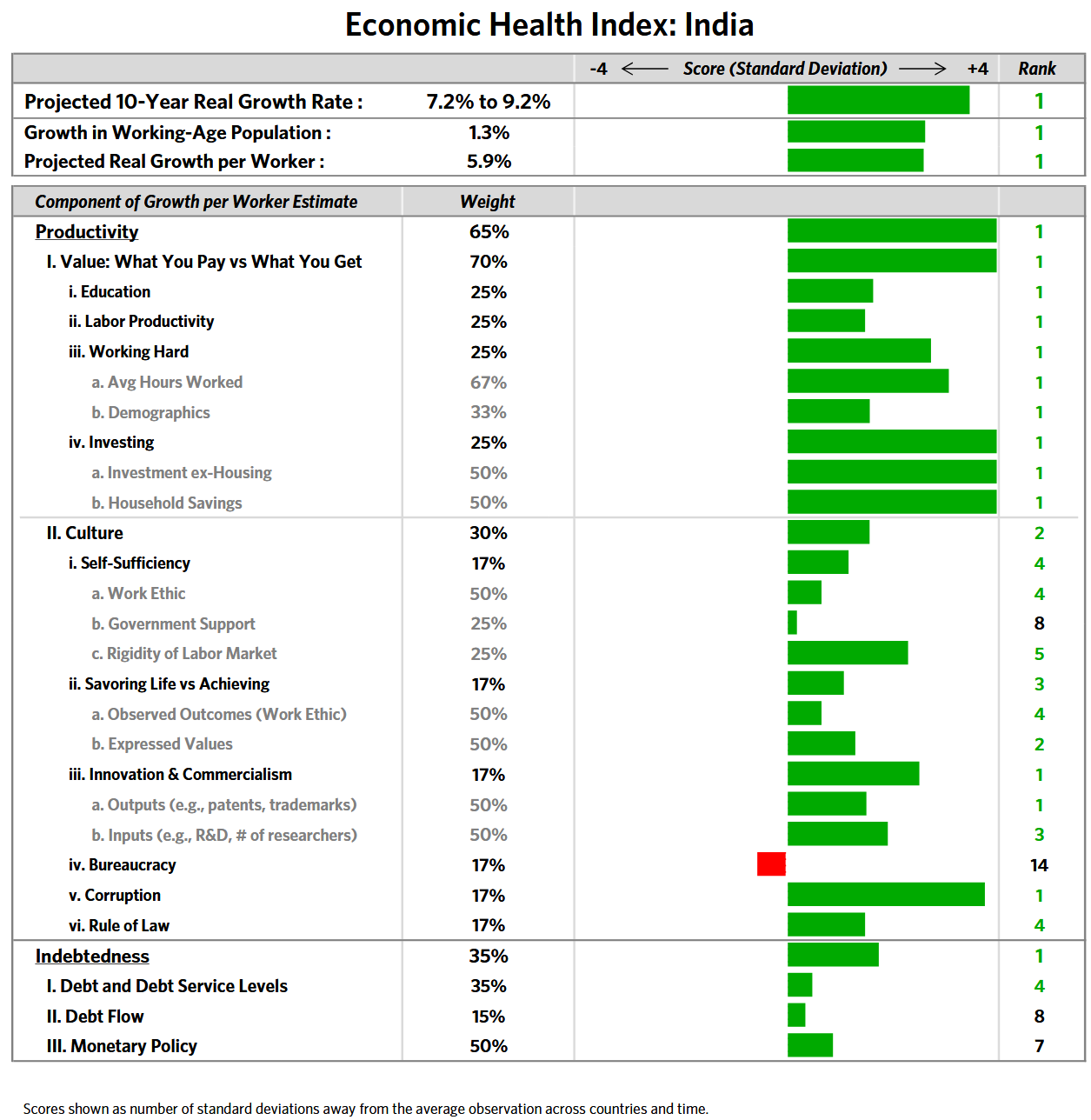
India’s report card is:

The projections for other major countries are:

It is metrics like this that determine the future growth trajectory of countries, not nonsense like “Index of Economic Freedom” by Heritage Foundation.

Heritage Foundation has India at 131 out of 177 countries. China is at 157/177. These rankings are very different from India’s and China’s actual rankings in GDP growth. Heritage’s ranking is correlated with GDP per capita but has no correlation with average GDP per capita growth. “Index of Economic Freedom” is pretty much a crackpot metric for capitalist idealogues (their scores are more correlated with how close, politically, a country is to the West than with their actual GDP growth). It’s pretty much just American conservative (and Objectivist) propaganda that gives the wrong economic advice to developing countries.

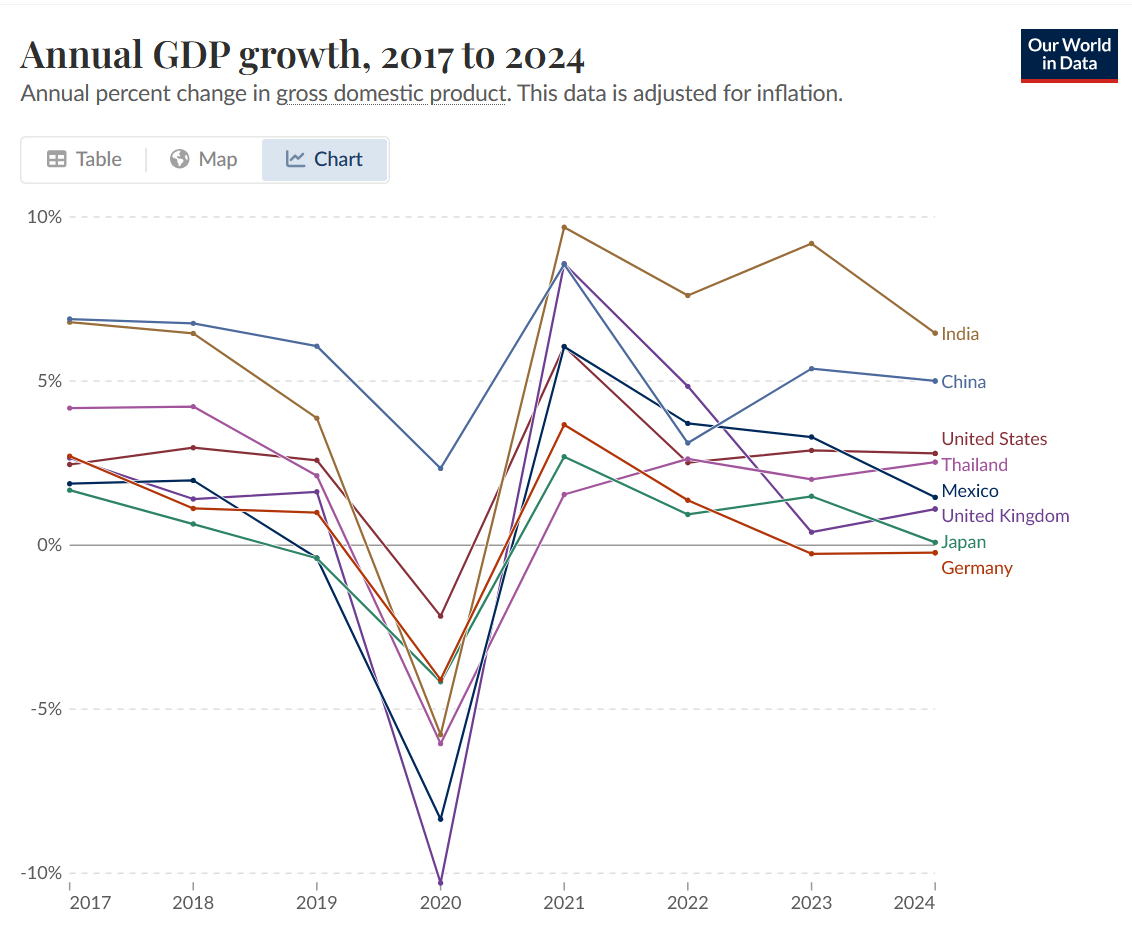
The above predictions were from 2017 but are fairly accurate, even a decade later (actual data):

It’s at least way more accurate than the “Index of Economic Freedom” which predicts and explains nothing. One country that Ray Dalio didn’t predict properly was the US (they didn’t predict the amount of public spending and debt the US was willing to take on to drive economic growth).

9 hours ago, tadmjones said:

Why was it Saddam needed to die, the first time? It would be unAmerican to ‘let’ him have the Kawait?

That Taliban is quite the outfit, too.


Saddam needed to die because he was a real monster.  I don’t know that we had to be the ones to do it (nowadays I am starting to grow more and more sympathetic towards the “fuck the rest of the world; let them deal with their own shit” camp) but somebody needed to do it.

On 5/22/2025 at 10:54 AM, Harrison Danneskjold said:

Wait - lost half the wars we started? 

That oft repeated phrase is the result of a general misunderstanding of the purpose of war. The blame lies with the way History is taught in school.

People are taught that the point of war is to “win”. But that’s nonsense. That’s why savages and mystics fight wars. They place some special significance on the act of winning. On proving their worth to some imaginary observer.

Rational people don’t start wars to win them. They start wars either to protect something they have, or to gain something they don’t have. This is the premise the vast majority of wars are fought on. People rarely go to war for glory and victory. They go to war for some gain. Often a relatively small one, something that’s gained as soon as it becomes clear who the stronger side is.

And this is certainly the premise of American wars. Always. It’s never “to win”, it’s always to gain something. Leaders may present it in terms of “to victory” to the public and to the soldiers, because that’s the only framework most people are willing to think within. But that’s not how the strategists think.

In Vietnam, the US gained something of utmost importance: it halted the spread of communism in the region. In Iraq, the US gained regime change. While it’s unfortunate that the new regime isn’t particularly useful, at least it’s not as dangerous as Saddam’s regime was. Cooperating with Saddam Hussein was impossible. Limiting, or even accurately assessing the risk America and American allies faced from his continued rule was impossible. So the US had a big problem, and Saddam’s removal was the solution.Now, even if it’s through shady methods (blackmail, bribes, whatever it takes to have people the US can influence and get information from, in key places within the Iraqi government), the US has a far greater degree of control over the situation in Iraq. The threat hasn’t been removed, because the ultimate source of the threat is Islam itself. But removing Islam isn’t an option, the only option is to mitigate the danger.

In Afghanistan, the US gained a new relationship with the Taliban. They have committed to certain limits, most notably no more safe harbor for al-Qaeda. They  also committed to a bit of transparency. Just enough to keep an eye on them, to have a degree of certainty that they’re not going back to producing terrorism. Again, the danger has been significantly reduced. Afghanistan is still ruled by savages, but at least it’s not the biggest terrorist factory in the world anymore.

That doesn’t mean these wars were entirely a good idea, they certainly weren’t. The first phase of each of them was a good idea, it achieved significant gains with minimal losses. Then, US leaders got over-ambitious. In the second phase of the Iraq and Afghanistan wars, the new goal became nation building. That was an unequivocal failure, obviously. Lesson learned, hopefully. I think it was learned, I don’t see any US leader trying that again in a Muslim country.

What none of these wars were, however, is defeats. The US is not an empire. When it starts a war, eventual withdrawal of the bulk or all of its forces is inevitable. The wars should be judged based on the gains achieved, or lackthereof. The US has gainful wars and useless wars. What it doesn’t have is defeats … for a very obvious reason: it’s more powerful than everyone else. It can’t be defeated.

As an aside, Russia is impossible to defeat as well. So anyone who goes to war with Russia to win is a fool. The only reason to fight Russia is to discourage them. To convince them to agree to a settlement. Not to win.

Vietnam is communist , as is Laos , N Korea and Cambodia from the end of US military action in Vietnam til 1991? We should claim a gain because even more of Asia would fall like dominoes ? Seems like they did.

1 Like

2 hours ago, stansfield123 said:

Rational people don’t start wars to win them. They start wars either to protect something they have, or to gain something they don’t have. 

And if the something is successfully protected or gained we might call this…winning. And if not we might call it…losing. Your whole post is sophistry disguised as profundity, you do Jordan Peterson proud. 


2 hours ago, stansfield123 said:

As an aside, Russia is impossible to defeat as well. So anyone who goes to war with Russia to win is a fool. The only reason to fight Russia is to discourage them. To convince them to agree to a settlement. Not to win.

Winning a war doesn’t mean conquering the opposing country. Also, https://en.m.wikipedia.org/wiki/Russo-Japanese_War. 

2 hours ago, stansfield123 said:

Cooperating with Saddam Hussein was impossible.

Except for the many times we did?

2 hours ago, stansfield123 said:

In Afghanistan, the US gained a new relationship with the Taliban. They have committed to certain limits, most notably no more safe harbor for al-Qaeda. They  also committed to a bit of transparency. Just enough to keep an eye on them, to have a degree of certainty that they’re not going back to producing terrorism. Again, the danger has been significantly reduced. Afghanistan is still ruled by savages, but at least it’s not the biggest terrorist factory in the world anymore.

Pure. Cope. 

2 hours ago, stansfield123 said:

I don’t see any US leader trying that again in a Muslim country.


Yet I’m sure you’ll clap like a seal if trump invades Iran. 

10 hours ago, Jon C said:

Yet I’m sure you’ll clap like a seal if trump invades Iran. 

I would be horrified.  Iran should be glassed from the air without risking a single American life.  Enough nation-building; let’s build a parking lot or two and see how that goes.

10 hours ago, Jon C said:

Your whole post is sophistry disguised as profundity, you do Jordan Peterson proud. 

Whoa, hang on.  Are we talking new Jordan Peterson or old Jordan Peterson, when he was still addicted to opioids?  I’ll grant that new Jordan Peterson is very sophistic and has really jumped onto the Jesus train with ten toes down.

Old Jordan Peterson was a totally different animal.

https://www.youtube.com/watch?v=1e97FNLk1Lw


1 hour ago, Harrison Danneskjold said:

Whoa, hang on.  Are we talking new Jordan Peterson or old Jordan Peterson, when he was still addicted to opioids?  I’ll grant that new Jordan Peterson is very sophistic and has really jumped onto the Jesus train with ten toes down.

Old Jordan Peterson was a totally different animal.

https://www.youtube.com/watch?v=1e97FNLk1Lw


JP has talked about a whole lot of topics since 2017 when he became a public figure for opposing bill C16 in Canada (I believe this is also the year that the video you linked was recorded). If you’re saying he wasn’t always a sophist, or at least that he used to be a lot less of one, I have little reason to disbelieve you, and moreover I have seen examples of him at least appearing to be genuinely thoughtful. But since he does have thousands of hours of recorded lectures (I think that’s not an exaggeration), I don’t want the standard to be “you must first watch ALL of this before passing judgment on him!”

I’m pretty content to evaluate him for his *exceptionally* ludicrous takes on religion, about which you seem to agree. If you haven’t seen it, and are a bit of a masochist, this Jubilee debate was quite painful. I also think his defense of Russia invading Ukraine because of the “degeneracy” of the west was despicable. 

https://www.youtube.com/watch?v=Pwk5MPE\_6zE

Also it’s always worth noting the irony that during his Benzo addiction Peterson was jetting around telling others how to live their lives and making proclamations about politics, etc., when one of his original bugbears was people trying to change the world before they had adequately worked on themselves. 

21 hours ago, tadmjones said:

Vietnam is communist , as is Laos , N Korea and Cambodia from the end of US military action in Vietnam til 1991? We should claim a gain because even more of Asia would fall like dominoes ? Seems like they did.

I think the Cold War worked out in our favor. Don’t you? Is that the argument you’re making? That the US failed in achieving its Cold War objectives?

Quote

Vietnam is communist

Not really, but let’s say it is. Why do you mention it? Is the political ideology the government of Vietnam professes to operate by of strategic concern for the United States?

Personally, I don’t think it matters much at all. It would be nice if they were more capitalistic, and it would be really nice if they were a full fledged western style democracy, but that’s fairly low on the list of priorities for US foreign policy. Obviously not the reason why the US went to war with China and the Soviet Union, in Vietnam.

They went to war with China and the Soviet Union for reasons that have to do with China and the Soviet Union. Vietnam just happened to be the country the war was fought in. And then, the US decided that it no longer likes Vietnam as the stage for its war against China and the Soviets. More than that: the US decided that it no longer likes the methods by which it was fighting the war, period.

So US leaders switched both the stage and the methods. And won the Cold War. They didn’t surrender, they weren’t defeated. They WON.

Vietnam needed to happen for that lesson to be learned. People aren’t omniscient. No one starts out with the perfect plan, in war. The right plan is something you discover along the way. America did just that. That’s why they won. Not because the communists were destined to lose no matter what. That’s silly talk. If left alone, the communists would’ve taken over the world, and then, when America was all that was left, it too.

Winning the Cold War was no trivial matter. In fact, I would go further than that: if Ayn Rand was in charge of American strategy during the Cold War, the communists would’ve won. I’ve heard enough of what she had to say about it (how dismissive she was of Soviet capabilities) to believe that. Because that is dead wrong: the Soviets weren’t impotent. It would’ve made no difference how poorly the Soviet economy performs. The Soviets had the numbers to take over countries, one by one, and feed on their carcass, until the whole world was theirs.

If America just sat around, passively waiting for the “inevitable collapse” of the Soviet Union, it would be America that no longer exists today, not the Soviet regime. The Soviet regime would be ruling the world.

There are plenty of examples, through history, of the dirt poor side winning. The Mongols vs. China, for example. In the 12th century, China was the richest, most technologically advanced civilization in the world, and the Mongols had yurts (those are a type of tent), decent bows, horses, sheep and goats. That’s it. That’s the extent of their possessions and abilities.

In 1215, Genghis Khan got triggered by a rude message he got from one of China’s rulers, so he led about 100K horsemen into China, burned Beijing (then the greatest city on Earth) to the ground, and (some claim) made a giant hill out of the dried out bones of its million+ inhabitants.

What happened in Beijing could’ve easily been avoided if, instead of just sitting around watching Genghis Khan unite the Mongols and conquer their neighbors, one at a time, Chinese rulers acted in a preemptive manner. Not to kill him, not to wipe out the Mongols. Just to slow him down. Just to help out some of those weaker neighbors which were getting easily conquered by the barbarian hordes. The way the US acted in Vietnam.


1 Like

9 hours ago, Harrison Danneskjold said:

Old Jordan Peterson was a totally different animal.

Old JP was better, but I think I have miles to go before matching even new JP’s historical insight. Granted, I’m interested in very different aspects of history than him, but the history he is studying (and then teaching) is as important as any.

As an aside, why are you responding to JonC? Talking to people who behave like that ruins the conversation. Just let him rant and rave until some mod decides to get rid of him. Or, if not, he can rant and rave forever. Doesn’t really matter if those of us who are sane stop acknowledging his existence.

On 5/26/2025 at 9:30 AM, stansfield123 said:

In Vietnam, the US gained something of utmost importance: it halted the spread of communism in the region.

On 5/27/2025 at 7:04 AM, stansfield123 said:

Is the political ideology the government of Vietnam professes to operate by of strategic concern for the United States?

Personally, I don’t think it matters much at all.

You are an exceptionally bad liar. 


On 5/27/2025 at 7:04 AM, stansfield123 said:

In 1215, Genghis Khan got triggered by a rude message he got from one of China’s rulers

I encourage anyone interested in history to read literally anything that any professional historian has written about GK and see if they can make heads or tails of this assertion. 


It is fascinating that you are unwilling to acknowledge even the basic realities of what the US lost in choosing to fight in Vietnam and then choosing to leave. The most obvious of which is that failing to stop the spread of communism to that region was a major PR victory for the communists who could now accurately say that the US military could be thwarted in its ambitions via guerrilla warfare. 


On 5/27/2025 at 7:04 AM, stansfield123 said:

Andwon the Cold War. They didn’t surrender, they weren’t defeated. They WON.

[…]Winning the Cold War was no trivial matter

On 5/26/2025 at 9:30 AM, stansfield123 said:

People are taught that the point of war is to “win”. But that’s nonsense. That’s why savages and mystics fight wars. They place some special significance on the act of winning.


Can’t even keep your sophistry straight for a full day. JP can get away with it because he does it during long and winding conversations, but you make the rookie mistake of leaving a written record. 


On 5/27/2025 at 8:01 AM, stansfield123 said:

As an aside, why are you responding to JonC?

Harrison and I have been having delightful and productive conversations in multiple threads. It’s not my fault you make absurd claims and/or refuse to justify your positions. 


On 5/27/2025 at 8:01 AM, stansfield123 said:

until some mod decides to get rid of him.

Ooh can you point to any part of TOS that I’m violating? Or is asking you pointed questions and then *accurately* describing you based on your responses a sin in your eyes?


On 5/27/2025 at 8:01 AM, stansfield123 said:

Old JP was better, but I think I have miles to go before matching even new JP’s historical insight.

Hey this might actually be the first true thing I’ve seen you say, though it doesn’t mean what you think it does. 

6 hours ago, stansfield123 said:

As an aside, why are you responding to JonC? Talking to people who behave like that ruins the conversation. Just let him rant and rave until some mod decides to get rid of him. Or, if not, he can rant and rave forever. Doesn’t really matter if those of us who are sane stop acknowledging his existence.

Behave like what? Being rude to you? Neither of you guys are the pope, and I haven’t seen anything except for general snarkiness. If there’s some specific line you think he crossed that deserves ostracization then you’re going to have to fill me in on what it is.

19 hours ago, Harrison Danneskjold said:

Iran should be glassed from the air without risking a single American life.  Enough nation-building; let’s build a parking lot or two and see how that goes.

Would this be the final solution to the Iranian question?


1 minute ago, Doug Morris said:

Would this be the final solution to the Iranian question?

I suppose that would depend on how the survivors felt about continuing to be Islamist bastards.  The great thing about glassing someone from the sky is that it can just continue until there are no Jihadis left.


Quote

Observe what it took for the United States and the Allies to defeat Germany and Japan and thus win World War II. Before the Germans and Japanese surrendered, the Allies had firebombed every major Japanese city and bombed most German cities — killing hundreds of thousands. Explaining the ration­ale for the German bombings, Churchill wrote, “. . . the severe, the ruthless bombing of Germany on an ever-increasing scale will not only cripple her war effort . . . but will create conditions intolerable to the mass of the German population.” And as we well know, what ended the war — and the Nazi and Japanese Imperialist threat to this day — was America’s dropping of two atomic bombs on Japan.

The Civil War provides another stark example of what can be required to win a war. In 1864, as the war was dragging on in endless, bloody battle, the Northern general William Tecumseh Sherman helped end it with a devastating campaign against Georgia’s civilian population. After burning the city of Atlanta, Sherman’s army ravaged much of the rest of Georgia by burning estates; taking food and livestock; and destroying warehouses, crops, and railway lines. These actions had the effect not only of disrupting the supply of provisions to Lee’s army in Virginia, but also (and more importantly) of making the war real to the civilian population that was supporting the war from the rear. This, in turn, broke the spirit of the men on the front lines, who were now worried and demoralized by what was happening to their homes and families.

In both World War II and the Civil War, once massive defeats were handed to the enemy, the causes that drove the military threats were thoroughly defeated as political forces. There are no threatening Nazis or Japanese Imperialists today, nor was there any significant political force agitating for the reemergence of the Slave South after the Civil War.

To have decisively defeated Islamic Totalitarianism post-9/11, America would have had to both correctly identify the enemy and show the same unmitigated willingness to defeat its identified enemies as it has in past wars.

-Just War Theory versus American Self-Defense, by Yaron Brook and Alex Epstein


If it were the final solution for Iran, would that be our problem?  Seems to me like an issue for the citizens there to take up with the theocratic fascists who run their country.  And, just as a somewhat irrelevant side-note, where was the Iranian public outcry of horror and sympathy at the October 7th attacks that their government financed and sanctioned?  Has there been a single Muslim voice in the middle east (I’m serious; can you please find me just one) who has said “raping and murdering those teenagers at that rave was morally wrong”?

That’s right.  Every Muslim nation on Earth can celebrate and cheer what happened on 9/11 and 10/7 but if a single hair on any Arab’s head is impacted by our fight to stop them from killing infidels then that’s what we all need to freak out about. 

Well, shit on that.  Let’s glass 'em.

It should also be remembered that Osama Bin Laden, when we finally caught him, was hiding in Pakistan.  If we were to glass Tehran then it would probably take very little effort to convince them to give Kashmir to India.

And really, India is a much better choice for an ally than Pakistan.  They’ve got issues there as well but at least they’re not of the “allahu snackbar” variety.

So by “glassing” you mean something similar to what we did to the Axis in WW2 or to what Sherman did to Georgia.  That clarifies your position. 

I’ve heard it said by someone who knows more about Japan than I do that it would have been a lot easier to end WW2 if we had just promised no harm to the Japanese royal family.  An analogous promise for Iran might be freedom of religion.


2 hours ago, Doug Morris said:

I’ve heard it said by someone who knows more about Japan than I do that it would have been a lot easier to end WW2 if we had just promised no harm to the Japanese royal family. 

For what it’s worth counterfactual history is notoriously contentious and it’s incredibly difficult to say what “would have” happened if different choices had been made in the past. But it is true that there was a lot of Japanese concern about the fate of their emperor, whom they viewed as literally divine, and even today you can find apologists who’ll try to argue (for example) that the emperor didn’t bear any responsibility for the rape of Nanjing. 
 

But maybe some of these topics deserve their own thread(s), we’re a little ways off from Kashmir.