Russell's Paradox

Am I to understand that you agree with me?

At least for right now, I prefer to state my own arguments rather than say I agree with someone else’s formulation with which I might not endorse every detail. Depending on how important this matter is to you, I suggest you very very carefully read ITOE and OPAR, then look at my post 28 to see if you can sharpen it even more than I already have to arrive at a formulation that adheres impeccably to Objectivist forms. Otherwise, you’ll always be subject to the rebuttal that you’ve not accomplished a reductio ad absurdum on account of not having made the reductio from actual Objectivist premises.

LauricAcid & LaVache:

Am I to understand that you agree with me?

I definitely agree with you that the concept “concept” is a self-referential concept (maybe self-subsuming concept would be a better term, but I don’t see how using that wording would change anything with regard to your original assertation or it’s chain of logic), and that self-reference can be a logical fast track to contradiction, but I need a little more time to noodle over what you’re saying before I can be said to agree with your reductio completely.

In the case of numbers, there are actual characteristics shared by odd numbers (or prime numbers) that are the objective basis for forming the concepts–the basis is not the lack of a characteristic, i.e. an integration based on what they are not. (I will identify those positive characteristics if asked, but it shouldn’t be necessary really.)

It is very common in mathematics to define by negation. Irrational numbers are real numbers that aren’t rational. In fact, as to ESSENTIALITY, what IS essential (at least to the people who discovered irrational numbers) is that they are NOT rational. Not being rational is the whole hullabaloo about irrational numbers.

I found my copy of OPAR. My paraphrase was off (it is the ‘metaphysically given’ not ‘the metaphysical’, but here’s the quote (pg. 23)):

“By the “metaphysically given,” Ayn Rand means any fact inherent in existence apart from human action (whether mental or physical) - as against “man-made facts,” […]”

That definition depends on saying what is NOT man-made. The metaphysically given has the attribute of NOT being man-made. To distinguish what is “inherent in existence APART from human action” [emphasis mine] requires looking at what is man-made and noting what then has the negative characteristic of NOT being man-made or at least looking at something and checking for the negative characteristic of NOT being man-made.

Moreover, does Rand say that a characteristic cannot be a negative characteristic? (Maybe she does, but would those who are arguing against negative characteristics please quote Rand on this.)

Let’s take the very most salient example of an Objectivist concept: Man is the rational animal. Genus, animal; differentia, rational. Now, of course ‘non-human animal’ is a perfectly fine concept. It’s not the concept derived from listing every species of animal except man, but rather the concept derived from the NEGATIVE attribute of NOT being a human, of NOT being an animal but NOT a rational animal. And it is a perfectly fine concept that is derived from being a number but not a rational number, of being a beer but not an alcoholic beer, of being a concept but not a self-referring concept (actually ‘self-including’ would be a better term, since, at least in my view, what refers is a word not a concept).

What does ‘possible concept’ mean here? You seem to be making a descriptive claim, that it is somehow impossible for humans to form these kind of concepts. But I doubt that this is true, and it would require some kind of psychological evidence to support it.

The meaning of “possible concept” is compositional. Given that Objectivist epistemology is a realist and psychologically-grounded theory (as opposed to nominalism), that means that certain collections cannot be encapsulated as a concept. I can give you uncountably many examples of such collections. To harp on this unit-economy point yet one more time, Objectivist epistemology does indeed hold that concepts have to be psychologically valid, and if we had a much bigger crow of say 200 then the nature of concepts would be quite different. Now you can doubt the psychological basis for that limit and then we will have to debate the scientific merits of the claim, but if you want to do that, I suggest you first learn these concepts:

  1. “Flamp” = {238,129,45,0,1923,72,10,204,19}

  2. “Brelp” = {qa,sdf,eyu,uxf,dvy,wuf,st,po,bse}

  3. “Krilb” = {!,!!,!!!,!!!,!!!,!!!,!!!}

The rest of the test involves me asking you some memory questions a month later.

She didnt say that it was literally impossible for humans to form disintegrated concepts like “blonde haired people over 6 foot tall”, just that doing so was a bad idea from an epistemological standpoint.

More specifically, she said “unless some essential characteristic were discovered, distinguishing such blondes from all other women and requiring special study”. She also says (p. 12) “Incommensurable characteristics cannot be integrated into one unit”. There is no claim that Bint isn’t a possible concept, since it’s the anding of a small set of perceptually evident attributes. Child conceptual acquisition, btw, is typified by under-differentiation so that all non-humans are “dog”, all males are “daddy” (or even, all humans are “daddy”).

You could make a strong argument that the concept ‘criminal’ is itself invalid, since the set of actions which you have to perform in order to be a criminal have nothing objective in common - they are grouped together simply because our government has arbitrarily declared that they should be illegal.

I’m totally on board with Fuller’s theses, and you’ve squarely identified why I am a natural law kind of guy. In strict statutory systems, they get out of this by reference to the explicit list, so that the concept of “criminal” is a legitimate concept that anybody can grasp – it’s “doing anything described in this book”. The book itself is not a concept, it is an arbitrary collection is sentences. In a mixed civil/statutory system, the prolem is that the concept of criminal and the actual use under the law are at odds.

A tax-evader has nothing in common with a murderer, and a cannibas user has nothing in common with a rapist.

Except having violated the law.

I dont think that you could given a language-independent account of the distinction between a characteristic and its lack.

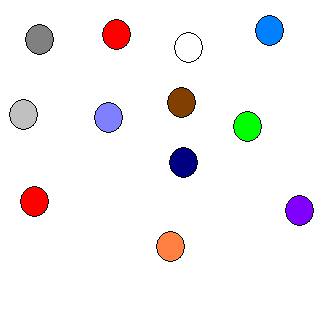
Today? No, certainly not. I have to prepare handouts, so I’m close to out of time. The field of comparative cognitive psychology doesn’t have a huge depth of research to it, and we are rapidly approaching the point where major experimental variables cannot be controlled. Where this discussion would go, if I had the time (what can I say, too much on the plate), is that we would consider experimental data on humans’ ability to abstract things out, for example visually identify something in a picture, or auditorily isolate certain acoustic components. People don’t have an unlimited ability to focus. For the sake of knowing which ones I mean, mentally number the dots from top left moving to the right in about 3 passes. Now mentally abstract the dots 1, 4, 5, 7, 11, which are randomly positioned and colored.

Objectivism rejects (except in very rare cases) the forming of concepts based on the lack of a characteristic(s)

I’m not doubting your word, but for the sake of exactness, would you quote an Objectivist text on that point? Also, what are the bases for the exceptions that are made?

I’m skeptical about this, because odd numbers are defined (positively) as numbers with a remainder of 1 when divided by 2.

‘odd’ can be, and is, defined differently depending on the particular mathematical exposition. It is definitely not true that one must not define ‘odd’ as ‘not even’. In fact, your definition may not even be possible in an exposition that has not yet defined ‘divided by’ and ‘remainder’.

n is even iff there exists a k such that n = 2k.

Then definitions of ‘odd’ that are all perfectly fine:

m is odd iff m is not even.

m is odd iff there exists a k such that n=2k+1.

m is odd iff there exists an n such that n is even and m=n+1.

m is odd iff there exists an n and a k such that n and k are even and m is between n and k (where ‘between’ has been previously defined in regard to a previously defined ordering).

They’re all equivalent, but the “negative attribute” formulation is the most concise and would be preferred by many mathematicians for just that reason. Also, it makes more salient that the evens and odds partition the naturals.

The greater point is that mathematics is not so petty to stoop to squabble about definitions that are equivalent.

A prime number is any positive integer with only two positive integer factors (which would be 1 and N).

You just created an example of the fact that there can be different definitions that do not require finding out which are THE ESSENTIAL characteristics. Your definition of prime is NOT the usual definition. The usual defintion is: n is prime iff the only divisors of n are 1 and n. That’s different from yours: ‘n is prime iff n has only two positive divisors’; even though you threw in the bit about 1 and n as a parenthetical that does not belong in the definition since you’ve already defined without the parenthetical.

But even more pertinent is that the definition of ‘composite’ is one that is often (more often than not, possibly almost always) given as a negative:

n is composite iff n is not prime and n is not 0.

So “negative attribute” definitions, such as the previously mentioned ‘irrational’ are indeed often common, lucid, and useful.

‘odd’ can be, and is, defined differently depending on the particular mathematical exposition.

What is your point? It doesn’t matter what other definitions you can come up with for a concept, the question is whether the concept can be defined by stating a unifying property. Mathematical definitions are completely irrelevant to the theory of concepts, because they are not necessarily concepts. I thought you at least knew that much about Objectivist epistemology.

Isnt this, as bottom, just the statement that the English language does not currently have a single word for ‘violent criminal’? In a different language where there was a single word for each of these categories (violent vs nonviolent), I dont think there would be any ground for denying that these were valid concepts.

Not really, since (as I said before), the entire idea of a non-violent criminal rests on a bad concept. And yes, you could make a very strong argument that the word criminal most often stands for a bad concept–not an invalid concept, as Objectivism defines “invalid concept,” but I would say it’s something closer to a package-deal. That’s way off topic, though.

A more realistic example would be something like ‘innocent’. Is this a valid concept? Well it intuitively seems so, but only because English happens to have a single word for it. However, innocent just means ‘not guilty’. If the English language didnt have the word ‘innocent’ and we instead used ‘not guilty’ to describe innocent people, you could make an argument that ‘innocence’ isnt a valid concept because its just the absence of guilt. This sort of thing is entirely relative to the language under consideration, and whether it happens to use a single word to desribe something instead of the negation of an opposing term.

It’s not very fruitful to go through every pair of opposites in the English language and determine if one side is an invalid concept-by-negative, so I’ll state the principle as I learned it (not a direct quote–I’ll be saying where I learned this in a minute):

A concept may be formed on the basis of a negative only in reference to a validly formed concept, when there is a significant reason for doing so, and only for concepts which are strictly relative, i.e. concepts for which the essential characteristic is a relation to another concept.

I’m not doubting your word, but for the sake of exactness, would you quote an Objectivist text on that point? Also, what are the bases for the exceptions that are made?

I didn’t learn it from a text. My reference is Harry Binswanger’s lecture course, “Logical Thinking.” I don’t know if Ayn Rand ever explicitly said this, but it is definitely implicit in her discussion of essential characteristics.

It is very common in mathematics to define by negation.

It is common, but that does not mean that those defintions would be valid according to Objectivist epistemology. Most often, a defintion by negation indicates a definition by non-essentials, which are very common in mathematics.

Moreover, does Rand say that a characteristic cannot be a negative characteristic? (Maybe she does, but would those who are arguing against negative characteristics please quote Rand on this.)

Does she really need to say it explicitly, in that formulation? A negative characteristic is not a characteristic of the existents in question. Rather, it is a characteristic of other existents, which the ones we’re focusing on do not possess. Since they do not have that characteristic, how can it be a fundamental, essential characteristic? If it’s a characteristic which isn’t even there, how can it cause the greatest number of others?

The best I can come up with as to a direct quote supporting that formulation are instances of her applying the principle to the concepts of non-existence vs. existence and absence vs. presence on page 58 of ITOE, and then later on page 149.

David:

Your objection so far has been that NSRC is an illegitimate concept because there’s no unifying property that all the referents of NSRC have. In order to counter this claim, I’m going to demonstrate that NSRC has at least one property that SRC doesn’t have. You’ll have to forgive me if this post is a little heavy on the formal logic – I’ve done my best to keep this approachable and I haven’t gone into a formal proof, but it may still be rough if you haven’t taken a math class in a while.

Step One:

Even though concepts aren’t themselves sets, we can introduce a set for each concept such that the set includes everything that the concept refers to. So: (note that upper case letters are concepts and lower case letters are objects)

For the concept “ table ” – T{t1, t2, … tn}

For the concept “ chair ” – C{c1, c2, … cn}

For the concept “ furniture concepts ” – F{T, C, … Concept-n}

For the concept “ concept ” – Concept{T, C, F, … Concept-n}

And so on for any concept…

(If you don’t like the idea of pairing up stuff with sets you can just say that we can make a (theoretical) list of everything the concept refers to. Also, if you don’t like the idea of being able to list all of the objects that a concept will ever refer to, think of this as listing the object it refers to at a past time t.)

Step Two:

For any concept, we can create a “ listing ” of the set that concept corresponds to by removing all of the concepts in the set and replacing those concepts with the elements in their corresponding set. So:

The “listing” of the (set corresponding to the) concept “table” will just be the set that corresponds to table because that set has no concepts in it.

The “listing” of the concept “furniture concepts” will be {t1, t2, c1, c2, … object-n}

The listing of the concept “concept” will be {t1, t2, c1, c2, T, C, … etc}

Step Three:

Note that listing is a process we can perform on any set. Since the listing of a set is itself a set, we can perform a listing on it (assuming that there are still some concepts left in the set). We can continue the process of listing until we’re left with a set containing only object and no concepts – call this a “ full listing ”. We’ll say that concepts which can be given a full listing will be “ fully listable ” concepts.

At this point, then, we can introduce:

Lemma One: Self-Referring concepts are not fully listable.

This should be fairly obvious – if I try to give a listing of a self referring concept I’ll include the concept in my list. When I try to perform a listing on this list I’ll end up including the concept on my new list. When I list again I’ll once again include my concept. I’ll never stop including my concept and so I’ll never end up with a list without any concepts on it – i.e. I’ll never have a full listing.

Lemma Two: Concepts containing no self reference are fully listalbe.

This again strikes me as fairly obvious, but the proof of this claim would be more technical if I were to give it. If you want me to give it, let me know and I will.

Step Four:

At this point we notice something about concepts – some, like the concept of tables and the concept of chairs, are fully listable. Others, like the concept of concepts, are not. We distinguish fully listable concepts from other concepts on this basis and integrate them into the concept of fully listable concepts. We use the symbol CFLC for this concept.

Now, CFLC is either fully listable or it isn’t. If it’s fully listable then it’s referred to by CFLC and, by Lemma 1, CFLC isn’t fully listable. If CFLC is not fully listable then, by Lemmma 2, it is fully listable. Either CFLC is or is not fully listable. Contradiction.

Conclusion:

We’ve seen, then, that a real and legitimate property – the property of being fully listable – will generate Russell’s paradox. I’ve been a little fast and loose with my argument and if anything seems questionable to you I’ll slow down and do the full line of reasoning. Again, the property of being fully listable is a property of the concepts in question – it has nothing to do with a contrast against other concepts.
What is your point? It doesn’t matter what other definitions you can come up with for a concept, the question is whether the concept can be defined by stating a unifying property. Mathematical definitions are completely irrelevant to the theory of concepts, because they are not necessarily concepts. I thought you at least knew that much about Objectivist epistemology.

You wrote:

“I’m skeptical about this, because odd numbers are defined (positively) as numbers with a remainder of 1 when divided by 2. A prime number is any positive integer with only two positive integer factors (which would be 1 and N). The claim is not that there are no concepts which also happen to be the complement of another concept, but rather that this is an accidental fact, and they can be described in terms of what they are.” [David Odden]

My point was to rebut YOUR point above. NOW that I’ve rebutted that point, you’ve moved on to a new point to claim that it doesn’t matter since mathematical concepts are not concepts. (1) Where is that found assertion found in Objectivist texts? What ARGUMENT do you give that the concept of an irrational number (which is a concept based on the ESSENCE of something NOT having a certain property) is not a perfectly fine concept? (2) Even if we granted that mathematical concepts are not concepts (which I don’t know why we should), still left unrefuted is that the concept of non-alchololic beer, non-human animal, and Objectivism’s own very CRUCIAL concept of non-man made are all perfectly fine concepts. Moreover, you have not given a REASON, beyond an arbitrary fiat of yours, WHY negation cannnot be used to form concepts. (3) You are in blatant contradiction with Objectivism when you say that “Mathematical definitions are completely irrelevant to the theory of concepts,”. From OPAR: “The mathematician is the EXEMPLAR of conceptual integration.” [pg. 90, emphasis mine] Moreover, the entire section, titled ‘Concept-Formation as a Mathematical Process’ is PREMISED on the relevence of mathematics to concepts.

A concept may be formed on the basis of a negative only in reference to a validly formed concept, when there is a significant reason for doing so, and only for concepts which are strictly relative, i.e. concepts for which the essential characteristic is a relation to another concept.

Okay. And the concepts of non-alcoholic beer, non-human animal, irrational number, and non-self including concept all meet those criteria.

David:

Your objection so far has been that NSRC is an illegitimate concept because there’s no unifying property that all the referents of NSRC have. In order to counter this claim, I’m going to demonstrate that NSRC has at least one property that SRC doesn’t have. You’ll have to forgive me if this post is a little heavy on the formal logic – I’ve done my best to keep this approachable and I haven’t gone into a formal proof, but it may still be rough if you haven’t taken a math class in a while.

I’m not sure which David you mean, since that is both of our objection. I’ll go ahead and give my own answer. (Actually, my full objection is that there is no essential unifying characteristic; not just any unifying characteristic is grounds for forming a new concept.)

Concepts, in Objectivism, do not mean other concepts (except for the concept of “concept”); rather, concepts mean existents. The concept of “furniture” does not stand for the concepts of “table,” “chair,” etc., but actual tables, chairs, etc.

At first glance, it seems that this might be more of a semantic technicality, since the listing of F is ultimately reducible to {t1,t2,c1,c2, etc.}. The problem comes in when we attempt to make the listing of Concept:

Concept{T,C,F, … Concept-n} means: Concept{{t1,t2, ..tn},{c1,c2 … cn},{T,C, … Concept-n}, … Concept-N}, which would mean that individual tables, chairs, and other concretes were the ultimate referents of the concept “concept.”

It is a big mistake to attempt to take about the Objectivist theory of concepts in terms of formal logic, since they involve opposite processes; the former is inductive, but the latter is deductive. In my view, this attempt amounts to epistemological rationalism. One cannot use a rationalist deduction and still claim to be talking about Objectivism. This entire approach to concepts is antithetical to what Objectivism has to say on the subject.

Concepts, in Objectivism, do not mean other concepts (except for the concept of “concept”); rather, concepts mean existents. The concept of “furniture” does not stand for the concepts of “table,” “chair,” etc., but actual tables, chairs, etc.

I know – I just needed an example so I used that. I don’t need it for my argument, but it helped when I was trying to communicate the idea. If you get rid of F then most concepts will be fully listed after only one listing.

Concept{T,C,F, … Concept-n} means: Concept{{t1,t2, ..tn},{c1,c2 … cn},{T,C, … Concept-n}, … Concept-N}, which would mean that individual tables, chairs, and other concretes were the ultimate referents of the concept “concept.”

Ah! This is what was giving me problems this morning and it’s why it took me until about 2 PM to get a response out to you guys. You’re right that if I was treating the objects in the list as the “referents” of the concept “concept” I would be in trouble. The solution to that problem is simply to make the listing correspond with the concept – I’m not claiming that the listing is somehow a list of the referents of a concept, only that the list can be constructed from the concept.

I probably should have emphasized that point though.

It is a big mistake to attempt to take about the Objectivist theory of concepts in terms of formal logic, since they involve opposite processes; the former is inductive, but the latter is deductive. In my view, this attempt amounts to epistemological rationalism. One cannot use a rationalist deduction and still claim to be talking about Objectivism. This entire approach to concepts is antithetical to what Objectivism has to say on the subject.

I’m only using the logic to point out a property – just like I would use it to pick out the property corresponding to the concept “prime.”

(Actually, my full objection is that there is no essential unifying characteristic; not just any unifying characteristic is grounds for forming a new concept.)

I seem to remember that Rand considers properties “essential” if they cause the other properties. But how would properties of abstract objects (like concepts) cause each other?

If you want me to give it, let me know and I will.

I may have seen the proof somewhere, at any rate it’s equivalent to the fact in syntax that a context sensitive grammar without recursion yields a finite set of strings.

I’ll have to think this problem over. Obviously this is somewhat orthogonal to Rand’s theory of concepts, which was designed to be and articulated as a psychological theory rather than a mathematical-symbolic theory. In order to answer your kinds of examples, we need OTC’, which is a formalization of the Objectivist theory of concepts, and that isn’t something that Rand did, but it’s not a bad idea to do so, just an un-done one. I have to think about the matter of whether recursive concepts are good or bad. If it is tenable to say that a concept does not subsume itself, then I believe the paradox is avoided. Only abstractions can have that property, so I should review the list of SRCs that we started with.

Okay. And the concepts of non-alcoholic beer, non-human animal, irrational number, and non-self including concept all meet those criteria.

How is non-alcholic an essential characteristic? How is non-human an essential chracteristic? How is non-self-referring an essential characteristic? How is the absence of alcohol/reason/self-reference causally responsible for the greatest number of other distinguishing characteristics?

In the case of non-alcholic beer, there might be a good reason to form a concept, but the essential characteristic would not be the lack of alcohol, but rather, the process of vacuum evaporation the beer goes through to remove the alcohol after brewing–that is the causally responsible, i.e. essential, characteristic.

I reject the idea that an irrational number is definable only in terms of negative characteristics. The standard definition of “irrational number” is: a number which cannot be expressed in terms of a ratio. I reject the idea that irrational numbers are numbers at all, and instead classify them as methods, much like infinity and imaginary numbers. (That rejection does not originate with me, though, but is another idea I learned from Harry Binswanger, in “Selected Topics on the Philosophy of Science.” It’s pretty cheap if you want to hear his reasons for it, and it’s basis in the Objectivist theory of concept-formation.) A better definition of “irrational number” would be: a method used for making calculations which cannot be made using ratios.

Hal:

Sorry I missed this earlier:

Its not clear what the word ‘refer’ means in this particular context. To go back to the memory example, I can make claims which are true or false about my memories (eg that I can remember a red lego car from my childhood), and even develop a theory of scientific psychology which explains how memories are formed. But none of this depends on (or implies) the claim that there is a queer set of objects called ‘memories’ which somehow live inside a person’s head/mind and constitute the referents of this term. The word ‘memory’ has a use within the English language and it is a useful tool for explaining certain aspects of human cognition. However, to treat it as a term which refers directly to mental objects seems a misleading way of viewing things.

The same thing applies to concepts - we can talk sensible about concepts being formed, but to view the concept of ‘tree’ as being some kind of psychic object which exists inside the human head in a similar sense to how pictures of trees exist inside art galleries is nonsense.

The points you raise are good ones and are part of why I reject the whole idea of reference in the first place – it seems quite dubious to me that there’s a referent to be referred to in many cases.

I seem to remember that Rand considers properties “essential” if they cause the other properties. But how would properties of abstract objects (like concepts) cause each other?

They don’t. But this isn’t a problem since, in Objectivism, concepts don’t stand for other concepts, but actual existents, which are ultimately abstracted from entities. The characteristics of entities, can (and do) cause each other.

It is common, but that does not mean that those defintions would be valid according to Objectivist epistemology. Most often, a defintion by negation indicates a definition by non-essentials, which are very common in mathematics.

The ESSENTIAL aspect of irrational numbers is that they are NOT rational. Moreover, when you claim that that some mathematical definitions are not as to essentials, you’d have to have some clear method of determining “the characteristic responsible for all the rest of the unit’s characteristics, or at least for a greater number of these than any other characteristic is” [OPAR pg. 99], which includes giving a precise meaning for a characteristic being “responsible” for other characteristics and a way to calculate through the combinatorial mass of interrelated characteristics to find the single one most “responsible” for the others. But there is no such thing on the table. And as unwieldy as this would be for mathematics, it would be even more unweildy OUTSIDE mathematics since in mathematics, characteristics are much more rigorously delineated than outside mathematics. So, it doesn’t help to just wave essentiality around like a sword to chop down concept formations one finds convenient to deny.

Does she really need to say it explicitly, in that formulation? A negative characteristic is not a characteristic of the existents in question. Rather, it is a characteristic of other existents, which the ones we’re focusing on do not possess. Since they do not have that characteristic, how can it be a fundamental, essential characteristic? If it’s a characteristic which isn’t even there, how can it cause the greatest number of others?

It’s the DIFFERENTIA. Among animals, it is the lack of rationality. Among beers, it is the lack of alchoholl; among numbers, it is the lack of being a ratio of whole numbers; among facts, it is the lack of being man-made; among concepts, it is the lack of self-inclusion.

Moreover, if negative characteristics are not allowed, then what basis is there for ANY exceptions, as you mentioned that some exceptions are permitted?

The best I can come up with as to a direct quote supporting that formulation are instances of her applying the principle to the concepts of non-existence vs. existence and absence vs. presence on page 58 of ITOE, and then later on page 149.

I don’t have ITOE with me. Quotes would help.

They don’t. But this isn’t a problem since, in Objectivism, concepts don’t stand for other concepts, but actual existents, which are ultimately abstracted from entities. The characteristics of entities, can (and do) cause each other.

What about the concept of even numbers or primes?

I don’t have ITOE with me. Quotes would help.

It’s like 3 pages of the book–way more than I’m willing to retype. If I remember when I get home, I’ll copy and past it from the research CD, but you might just have to wait until you have the book handy.

Edit: As for the rest of the quoted post, I already addressed it.