Doug, to your first question, I also tend to capitalize libertarianism if it is some reference to the Libertarian Party. But I’m not fixed about it, and sometimes now I capitalize it if referring to what post-Atlas significant book writers on libertarianism are aiming at: writers such as Hospers, Rothbard, Nozick, Machan, D. Friedman, G. Smith, Rasmussen and Den Uyl, Narveson, R. Long, and Huemer. There remains the place for lower-case in more general, inclusive, and old usage. I don’t think any strong convention has arisen, unfortunately.
I have always agreed with your view that Objectivist political philosophy is a kind of Libertarianism. There is an effort to disavow Rand’s political philosophy as a genre of current libertarianism of any stripe, which is pushed from the Rand quarter (perhaps including Kelley and Bidinotto). In the books A Companion to Ayn Rand (Blackwell, 2016) and Foundations of a Free Society - Reflections on Ayn Rand’s Political Philosophy (Pittsburgh, 2019), there are attempts, continued from Rand, to class Rand’s political philosophy as not a Libertarian one. I think they are failures.
(My own view of the past three decades still leans toward limited-government Libertarianism, or in the Rand team’s parlance Radical Capitalism, but because they all are erroneous in fundamental theories of property rights in land and its relation to the most elementary state—and that has some bearings on correct contemporary law [such as right federal revenue]—my own view does not coincide with Libertarianism. I don’t want to distract by this at this time [by links], this theory on which I concluded my time, words, and development three-plus decades ago.)
“There are sundry ‘libertarians’ who plagiarize the Objectivist theory of politics . . .” (Ayn Rand, “Philosophical Detection” 1974).
According to Foundations of a Free Society, in the 1970’s Rand associated “libertarianism” with Rothbard anarchism and as well perhaps with Karl Hess a former Goldwater promoter and anti-communist who had lately bannered the New Left and hippiedom. Rand urged her quarter to not latch on to those. Some distorting article in the NYT had cast Rand as of the same feather as those two in political philosophy, an identification to which she rightly objected.
In 1974 she would have known about the book by her former personal interlocutor and confederate in political philosophy who had written the book Libertarianism. Hospers was a professor at University of Southern California. She may have not yet known of the new book by Nozick (Harvard) Anarchy, State, and Utopia. Her silencing-over of Hospers as a major agent and influence among contemporary libertarians was anomalous. His political philosophy was the most like hers at the time, though his view in other areas of philosophy differed from hers, as she and he plainly understood from their communications in the early ’60’s. At least west of the Hudson, it was he, not Rothbard (New York), who was the natural expansion to Libertarianism of what Rand had written about political philosophy.
Somewhat earlier Rand apparently thought of von Mises as a “libertarian”, which is striking to me from my late ’60’s (Rand), early ’70’s (Hospers) awakening to Rand’s political philosophy and Hospers’s Libertarianism. I would have booted Mises from that classification under my Rand-Hospers Libertarianism in those days because Mises supported military conscription, and under Libertarianism, a person’s life does not belong to the state, but to himself, and one’s individual freedom must not be deprived from one who has committed no true crime.
The book Foundations of a Free Society has an excellent comparison by Prof. Lester Hunt of Nozick and Rand in political philosophy. There are exchanges in this book between Objectivists in political philosophy and others such as Prof. Huemer, which I bet are also quite good.
Nozick and wife (MA) sat a little ways from me (IL) at the national convention of the Libertarian Party in New York for Platform and selecting 1976 Presidential ticket. He was quite active and helpful in the Platform debates there on the floor. I had studied his ASU very carefully, and I knew that in future years, whatever he wrote on, I would be reading. And so it was.
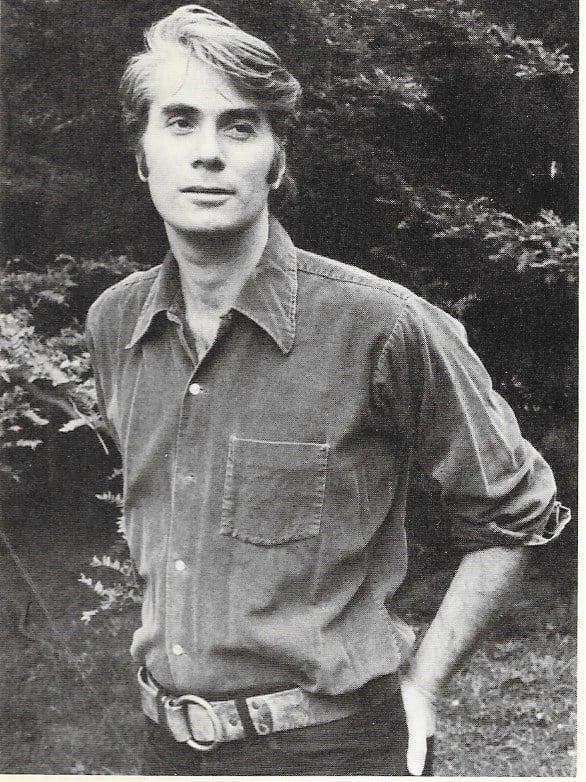
Nozick 1974 - ASU