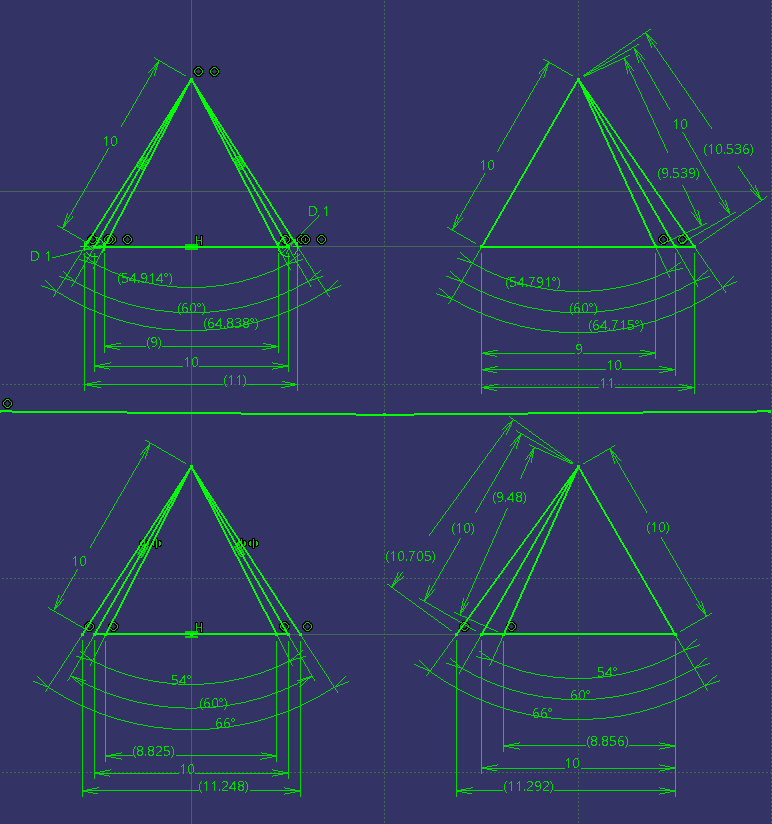
I define an “almost equilateral triangle” to be a triangle whose side-lengths are each within 10% of the average length of all the sides. I claim that this concept, although a perfectly natural and simple one, cannot possibly be accounted for by Rand’s theory of measurement-omission and measurement-range-restriction. There are at least four reasons for this.
-
Any definition must be finite, and to give a Randian definition of the above concept would require us to make an infinitely long list of ranges for the measurements of the sides to be appropriately restricted.
-
The required ranges must vary jointly with the sides in order to work correctly, but Rand’s theory requires that measurements be restricted to ranges independently of the measurements of other characteristics.
-
But even if Rand’s theory allows for the joint variation of measurements and ranges, serious inconsistency issues in the definitions can arise. For example, if a measurement of one characteristic determines the allowed measurement range of another, and this other characteristic also determines the allowed measurements of the first, unless you are extremely careful, it’s likely that certain measurements could end up excluding themselves from the ranges that they themselves determine.
-
Even if something like the procedure in point 3 could be done, it would be so exceedingly complex that it can in no way be considered a realistic representation of human psychology.
The essence of the problem seems to be that some concepts have what I call, “algorithmically non-trivial” definitions. These definitions require us to compute some non-trivial property of the entity or entities in question in order to be able to classify them.
I therefore propose the following improvement to Rand’s theory of concepts. The change that I propose is that a concept is really just an algorithm which, given some measurement-data about an entity, outputs a “yes/no” answer as to whether the entity specified by the data belongs to the concept or not. In other words, that the process of concept-formation is really just informal computer programming.