I have to ask what you refer to as “the fallacy of the idle gold” in the first place.
It is refutation of one of the original justifications proposed for the practice of fractional banking, the idea that most people aren’t going to withdraw in specie all at once, so rather than it sitting in the vault doing nothing it might as well be out in the economy circulating instead. I thought you were raising this argument again by reference to making use of unneeded gold. If that is not what you had in mind then we’re talking past each other.
But both are agencies of the same government, so the actions of both are really just the government acting.
No, the Central Bank in a modern economy is supposed to be independent of Treasury. People get upset if there is suspicion of Treasury interfering with that independence (I’m presuming a similar attitude in the US as I find down here, but I’ve had my fingertips singed on that score in this thread before now). It is as foolish to blithely lump them together as “just government acting” as it is to do the same with say the Supreme Court and the White House. The Central Bank’s priorities may be quite different to those of Treasury, including to the great consternation of the latter at times, just as the Supreme Court may sometimes derail the White House’s plans.
And the long-term net effect of the government’s actions, through borrowing and then causing inflation to make repayment easier, is to suck away the nation’s wealth from productive investments.
Yes.. and this capital destruction is distinct from monetary flows as you yourself have noted. The destruction of real capital (seeds, machinery, etc) is caused by the expansion of financial capital (inflation-generated extra debt and equity) because the messing around with the latter causes malinvestments of the former. The ABCT is a description of how there is a connection between the two that exhibits a hysteresis effect, and of what influences the size of that hysteresis. That hysteresis is the basis of the economic cycle, and is made possible only by the heavy use of some variant of fractional reserves.
What is the essential defining characteristic of “credit expansion” ? You explained it in terms of the actions of a private bank under the gold standard, so I’m not sure how it translates into a central banking scenario.
Credit expansion is the expansion of the debt component of financial capital ahead of investor’s increase in provision for supply of real capital as intended for use at a risk-return level associated with debt funding. This causes those who demand real capital (businesses and consumers) to mistake the increase in financial capital for an increase in the supply of real capital.
Private banks do it by funding credit expansion directly via fractional reserves, and increase the money supply as a consequence of those actions. The Central Bank does it by increasing the basis of the money supply directly and then getting the private banks to do the overt act of credit expansion by lending out of that increased money supply. The Central Bank is thereby taking advantage of the normal bank’s pre-existing (and further encouraged) fractional reserve practices, further increasing the money supply some more, and setting them up to take the blame when it all goes sour.
This is another way in which central bank “credit expansion” seems to differ from the private kind.
It is a difference of motivation and details on mechanics, but not so much of result. The lowering of a particular interest rate by the Central Bank is part of the motivation, or at least the rationalisation for the motive. By lowering the cost of capital there will be more demand for it and hence more jobs as it gets invested. Private banks don’t care about the rate of interest being at any particular level, they just want to make money and use lower costs of debt as the means to attract borrowers. Either way, the lowering of interest rates below what investors are happy with at a given risk level and using credit expansion to maintain that lowness in defiance of investors leads to malinvestment of real capital.
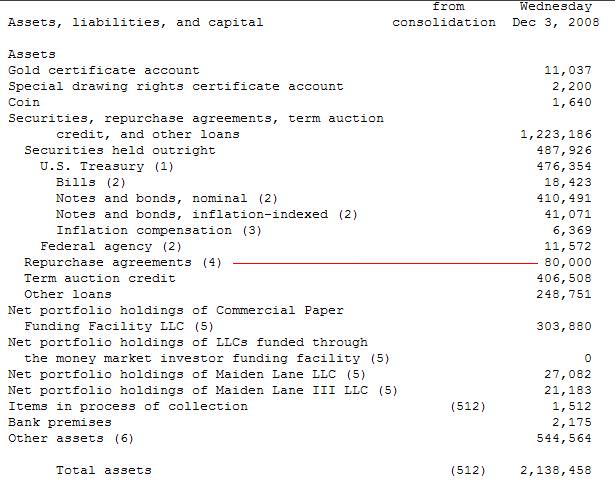
I think a repurchase agreement is something very different from an outright purchase.
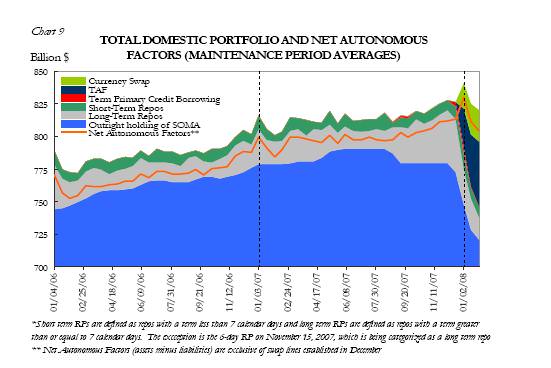
On the face of that alone, you’re right, yes, it is different. What I said was that its use in practice in bulk amounts to the same thing as an outright purchase PLUS CHURN. To maintain the improperly low interest rate the Central Bank will have to continually renew expiring repos plus initiate more, at an accelerating pace. It amounts to the same effect as the Central Bank merely buying some outright and adding to its holdings over time with new money it creates. But anyway, Adrock corrected my mistaken assumption that the details of your Federal Reserve System’s OMO’s were the pretty much the same as those of the Reserve Bank of Australia.
while the latter acts to permanently increase the money supply–and does not have any more effect on interest rates than an increase in gold mining would in a laissez-faire economy.
You’re missing it because you’re focusing on individual transactions while overlooking the accelerating churn with the continual-net-expansion direction.
(Which is to say: if anything, it increases interest rates in the longer run, by raising inflation expectations.)
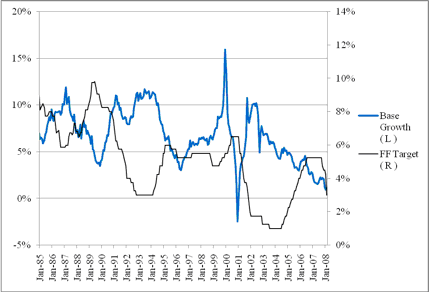
AHHA! The magic words, “in the longer run”! There is a difference between the short run and the long run, which is the basis for the above hysteresis effect. The Central Bank has to accelerate its expansion of the money supply because the flow-on effects of that expansion eventually causes people’s inflation expectations to rise, which causes them to increase their required ROR’s. What the Central Bank is doing is trying to stay ahead of those expectations’ effects on the interbank overnight loan market. It can do so for a while, but not - as you note - in the long run. The long run then finally catches up with the Central Bank, and so it has to make the stark choice between raising the Fed Funds target on the one hand or descending into hyperinflation in the other. I swear, Roland, we’ll make an Austrian out of you yet 
If a bank has an above-target amount of money on its reserve account, you can rest assured that it won’t let it stay that way for long.
Quite. The banks draw down those accounts for other uses (including this being the mechanism by which - in Australia at least - physical notes and coins are taken from the Central Bank and put into the general economy), which is why there is routinely a need to cover shortfalls when they overdo it! But…
The further fate of the extra cash is then going to depend on the decision of whoever sold whatever the bank bought–and so on, similarly to what I said about newly-mined gold in a previous post (starting from “Anyway, the reason I asked…”) … So an outright purchase of Treasury Bonds by the Fed is not going to have a direct effect on the demand for or supply of overnight credit and therefore on the overnight funds rate; all it does is increase the money supply.
… but you’re missing the context in which those repos / purchases are made and why the proceeds are put into those ES/reserve accounts. The proceeds lower the Fed Funds rate because they lower the demand for debt to pay off the shortfalls. That means those with an excess in those accounts then have to go to the trouble of withdrawing funds for use elsewhere, but there will still be at least some market for lending to other banks - just at a lower rate so as to attract banks with shortfalls to borrow from them instead of selling assets / repos to the Central Bank.
A repurchase agreement represents no permanent addition to the money supply because it includes a clause mandating its own extinguishment. It would be possible for the Fed to be a ready supplier of overnight credit through repurchase agreements, keeping interest rates at a healthily low level, while at the same time avoid increasing the money supply too much by abstaining from outright purchases.
Again, you’re missing how churn will be on the march. The Fed is there, every night, increasing its repo book or making net purchases, constantly adding in new dollars to do so, in order to maintain the interest rate on overnight interbank credit at the Fed Funds target. The ‘too much’ will come about eventually.
JJM