Fundamentally, is there only ‘spacetime’?

Dear MisterSwig,


You’re quite right not to be fully satisfied with the ocean wave analogy. I’m afraid all such analogies for hard-core-physics only work up to a point, then they break down and just spawn more questions than they resolve…


…But that said, as a way to address all your very pertinent points, mostly revolving around the necessity of a medium, I’ll imprudently offer up another hackneyed analogy!


We can’t see the forest for the trees.


We’re all looking for the forest (the medium) but on inspection all we perceive are the trees. In this case, ‘the trees’ are just the various dipole values (let’s think of them for now as standard electromagnetic values). The crucial idea to grasp is that, from a close-up context, these values are all there is: together they constitute ‘the medium’ for interactive oscillation patterns. Similarly to how both the forest and the trees exist, the emergence of a medium is actually a question of scale. A medium (a larger-scale entity/event) is made up of smaller-scale constituents (entities/events) — and nothing else.    


The “changes in position” that need accounting for “relative to the medium” can thus be re-thought as changes in ‘value’ relative to (and mutually effected by) neighboring values (rather than some extra medium).


I could stop there, but there’s a glaring question to be subsequently faced: “value of what?”


Anyway, my condensed answer: an attribute/entity.

(I’m aware that by expanding this answer we’ll be crossing over into metaphysics-land, but I might as well continue down that rabbit hole…)


I’ve come to embrace the idea of entity — entities exist — but what are entities really in their most basic definitional form?

Objectivism has tended to define entity in terms of independence, whilst I’m inclined to emphasis the fact that entity starts by way of a difference (a difference which makes a difference with/from some other entity).

That’s all.


It’s the difference that makes/defines the thing as much as the thing that makes the difference. Thus any difference in any value could be enough for the resulting relata to be considered an ‘independent’ entity (Rand’s Razor permitting).


Another way to hammer home this hobby-horse of mine is to consider the relationship between entity and process.

Drum roll for a bold claim: in my opinion all entities are also processes — there’s no entity which isn’t also a process. Granted, processes are of entities, yet can anyone offer proof of an entity which isn’t existentially in flux, given enough time and space?

Note that I don’t give automatic primacy to either process or entity, much depends on the specific context of analysis — I view them as an integral dichotomy (process often being the hidden aspect). However, it is fitting that we build our metaphysics upon our natural epistemology of separating out those ‘solid, stable things’ which we can point to — thus entity has metaphysical primacy over process (and in accordance with Objectivism as I understand it).

Well, that partially exposes the current state of play in my brain around the “value of what?” question (very much work in progress).


Now Macken goes a step further, his theory is that those standard (electromagnetic, etc.) values that are absolutely everywhere in the universe, on all scales, can in turn be described entirely in terms of ‘spacetime’ (scare-quotes to indicate that it’s not the same as standard GR spacetime).


I hope that this goes some way to address your very valid doubts MisterSwig — and that I haven’t just utterly confused everyone even more!
7 hours ago, A.C.E. said:

Drum roll for a bold claim: in my opinion all entities are also processes — there’s no entity which isn’t also a process.

This is worth bold face.  Remember how Rand divided theories of the good into intrinsic, subjective and objective?  There is an intrinsicist approach to metaphysics and identity that expects every entity existing to be sufficient unto itself in a kind of timeless static mode of being which implies contemplating it as isolated.  But there is no existence without acting and interacting with the rest of Universe.  An entity does not have attributes, an entity is its attributes, and attributes are its means of acting as well as its means of being.  

53 minutes ago, Grames said:

This is worth bold face.  Remember how Rand divided theories of the good into intrinsic, subjective and objective?  There is an intrinsicist approach to metaphysics and identity that expects every entity existing to be sufficient unto itself in a kind of timeless static mode of being which implies contemplating it as isolated.  But there is no existence without acting and interacting with the rest of Universe.  An entity does not have attributes, an entity is its attributes, and attributes are its means of acting as well as its means of being.  

Absolutely.  Entities are their attributes and attributes ARE what define their actions and interactions (nothing else does). 

To ACE:

It is also worth remembering that these attributes are found TOGETHER, and in only so many combinations… which give rise to the identification of indivisible individual fundamental particles.

Mass, electric charge, spin, are found in specific known combinations together whenever we “measure” fundamental particles.  This should be given some philosophical weight… no matter how amorphous or continuous we might try to imagine the flexy universe of media-less waving mediums to be with its foreground and background unified into one monolithic consciousness…

we still are faced with the stubborn presence of individual particles which are LITERALLY indivisible.


We can try to say as much as we might… that “really” all the individual bits are just part of collective whole, a unity… etc…  this “whole” approach smacks of a motivation to find something which satisfies an esthetic desire or some human urge for “unification”… when so called science starts from such a desire rather than in response to perception and observation of reality… from a wish rather than in response to any observable necessitating explanation…

…it is sheer speculation and arbitrary… and warrants no further inquiry


Thank you Grames and thank you StrictlyLogical.


I imagine that we all agree with SL’s encapsulation:

On 4/30/2019 at 8:57 PM, StrictlyLogical said:

Entities are their attributes and attributes ARE what define their actions and interactions (nothing else does).


And we’re in good company (Rand ~ ITOE’s Appendix dialogue):

An attribute is something which is not the entity itself. No one attribute constitutes the whole entity, but all of them together are the entity—not “possessed by” but “are” the entity.


SL’s subsequent explication of how entities tend to be particular combinations of attributes (and not others) certainly ought to be born in mind. Indeed, the very plurality of attributes for every single entity is perhaps worth exploring further — everything ‘has’ at least one spacial and one temporal attribute does it not (unless ‘point particles’ are literarily real)?


Indivisibility: literal, practical or mathematical?

This brings me to SL’s assertion that some particles are “literally indivisible”. It’s the one thing that I had issue with — but I’m open to being proved wrong.

“A is A” represents a legit literal indivisibility.

But ought the referred to elementary particles be accorded the exact same literalness when it comes to their inferred indivisibility?


Here’s a smörgåsbord of slightly blander adverbs to supplant “literally”; practically, theoretically, evidently, ostensively, demonstratively.

I contend that, as we are talking about subatomic particles, deduced via calculation, utter indivisibility can’t be proved until we have comprehensive knowledge about reality at ‘infinitesimal’ scales.

Agreed?


NB, the definition of entity relates more to independence of identity rather than to indivisibility — no? 


Walking the Planck

I would be willing to embrace SL’s literal indivisibility if, and only if, there really is a final measure of physicality — Planck length/time units as truly basic rather than as-basic-as-we-can-grasp-today. However, that would still only be a physical (practicable) indivisibility, not a mathematical indivisibility of spacial/temporal measurement (which, I assume, would still potentially be calculable ad infinitum — no?).

Likewise, how much credence should we give to the literal interpretation of a ‘point particle’ — an entity entirely bereft of spacial extension — rather than the more modest ‘point-like particle’?


SL mentioned how our aesthetic preferences bias us towards more attractive, simpler models of fundamental physics — yes and I acknowledge this tendency, and seek to counter it by being logical + strict. However, in the ‘continuum vs. discrete’ debate, both sides exude their own allure: the continuum model satisfies the more ‘holistic-entanglement-seeking’ personality whilst the discrete particle-phile is just as beguiled by that reassuring finitude that makes precise calculations possible (and with more practical implications, garnering greater respect in physics departments).


I suspect that the competing ‘continuum/discrete’ models of the universe will turn out to circumscribe yet another false dichotomy: both true or false dependent on context (or is that just my über-holism I wonder?).


Anyway, I admit that I need to do more physics homework on Planck, universal constants, etc., before being able to contribute anything profoundly worthwhile on this topic.


STOP PRESS!

News from John A Macken

The starting point for this entire topic is The Universe Is Only Spacetime by John A Macken.

I’ve recently been in contact with the author. He is now following the discussion and has asked me to attach an updated 20-page summary of his theory: Single Component Model of the Universe

Single Component Model -5.pdf (1.57 MB) 

It’s a draft version of the forthcoming paper so any feedback from your direct engagement with the physics (or even the philosophy of his bottom-up approach as outlined under “Future Analysis” p.18) would be most welcome.


Calling all physicists out there ~ is this particular zero-point energy model a feasible one (or is the motivation towards simplicity irrevocably suspect in your opinion)?


4 hours ago, A.C.E. said:

Indivisibility: literal, practical or mathematical?

This brings me to SL’s assertion that some particles are “literally indivisible”. It’s the one thing that I had issue with — but I’m open to being proved wrong.

“A is A” represents a legit literal indivisibility.

But ought the referred to elementary particles be accorded the exact same literalness when it comes to their inferred indivisibility?


Here’s a smörgåsbord of slightly blander adverbs to supplant “literally”; practically, theoretically, evidently, ostensively, demonstratively.

I contend that, as we are talking about subatomic particles, deduced via calculation, utter indivisibility can’t be proved until we have comprehensive knowledge about reality at ‘infinitesimal’ scales.

Agreed?


NB, the definition of entity relates more to independence of identity rather than to indivisibility — no? 


Walking the Planck

I would be willing to embrace SL’s literal indivisibility if, and only if, there really is a final measure of physicality — Planck length/time units as truly basic rather than as-basic-as-we-can-grasp-today. However, that would still only be a physical (practicable) indivisibility, not a mathematical indivisibility of spacial/temporal measurement (which, I assume, would still potentially be calculable ad infinitum — no?).

Likewise, how much credence should we give to the literal interpretation of a ‘point particle’ — an entity entirely bereft of spacial extension — rather than the more modest ‘point-like particle’?


SL mentioned how our aesthetic preferences bias us towards more attractive, simpler models of fundamental physics — yes and I acknowledge this tendency, and seek to counter it by being logical + strict. However, in the ‘continuum vs. discrete’ debate, both sides exude their own allure: the continuum model satisfies the more ‘holistic-entanglement-seeking’ personality whilst the discrete particle-phile is just as beguiled by that reassuring finitude that makes precise calculations possible (and with more practical implications, garnering greater respect in physics departments).


I suspect that the competing ‘continuum/discrete’ models of the universe will turn out to circumscribe yet another false dichotomy: both true or false dependent on context (or is that just my über-holism I wonder?).

My contribution, I see, has sent you in various directions unrelated to my purpose.

1.  The importance of indivisibility was not scale… i.e. big versus small, much versus little… but to highlight undeniably what observation and perception have revealed… which imply (by necessity… and only by that necessity) the concepts to be formed.

Electrons, have charge mass and spin etc. in observable related quantities… the mass of electrons cannot be observed in the absence of their charge… and the electric charge of electrons cannot be observed in the absence of their mass.  Moreover, the charge of any quantity of electrons is observed to be equal to an integer number multiplied by some “unit charge” whereas the mass of any quantity of electrons is observed to be equal to that same integer number multiplied by some “unit mass”.  We have also smashed and probed electrons and singled them out… to the limit of our energy and scale of precision of testing (we are finite beings…) we have ever only observed indivisible individual units.

There is a conceptual validity to what we have observed a countless number of times… because all valid concepts ultimately find their foundation only in perception…  there are indivisible individual electrons, until we have good observational reasons to believe otherwise.

It should be noted that the indivisibility of electrons is not a philosophical issue.  It is a scientific question to which we have a presently correct (i.e. consistent with all of our knowledge) answer by observation.


2.   Point particles… and continuum versus discrete…again these are not philosophical issues, but issues related to science and mathematics and whether existents in reality somehow resemble our mathematical constructs. 

It so happens we cannot discern from our probing, any “structure” in space, associated with the observed charge, spin, and mass of an electron, nor have we observed any discernible inconsistency in position of any of these with respect to any other.  Points are mathematical abstract constructs designating only position within some field, ring, or mathematical space.  So for electrons, “point-like” is not modest, its as close as you can get and literally is true of our observations about the electron… which technically cannot be “points”.


What is the philosophical consequence of whether a particle has a “spatial extension”, considering that we know the only reason macroscopic entities “occupy” space, is due to the repulsion of their atoms electron shells?  Moreover, we know their influence (gravity and electric charge) extends indefinitely albeit weaker with distance.  Forgive the pun but what’s the point in that debate?  We have observation… the rest is unnecessary and pointless (again forgive me).


As for the “continuum vs discrete” debate, I am unsure than modern science is afflicted with such a thing.  I suspect it also is neither here nor there…

If you detect ambivalence to armchair philosophizing about science, especially where the proposed discussion does not have its origin in scientific explanatory necessity due to some new observation or perception… (or unexplained inconsistency) it’s because such an exercise is philosophically and conceptually improper. 

THAT I assume , should you pause to consider, you would understand is correct.


On 5/7/2019 at 8:45 PM, StrictlyLogical said:

My contribution, I see, has sent you in various directions unrelated to my purpose.


Whoops!

My purpose on this thread is to learn a wee bit more about reality, specifically to better conceptualize the relationship between space, time and entity (as evidenced by physical science, epistemologically grounded in perception).

I floated Macken’s The Universe is Only Spacetime (+ subsequent updated paper) so that everyone had something concrete to talk about — physics-based (+ appositely contentious).


StrictlyLogical, finely tuned as ever to detect any whiff of Rationalism, is absolutely correct in elevating empirical science (no matter how ‘ugly’) over my armchair musings around these issues (no matter how ‘beautiful’ ~ the truth is ultimately more fascinating than falsity any day).


Here are three loose ends that I’d like to tie-up in a neat loop…  


1. The importance of being earnest about indivisibility

If current science points to indivisible individual units then we ought to adopt that conception — wholeheartedly — at least until such indivisibility might be deemed false.


Hats off to SL, after more research it seems that indivisibility is a thing — electron as prime example. Even John Macken, in a correspondence on this issue, embraces discrete Planck units as ultimate (although he hints at some wiggle-room for zero-point energy).


I admit to finding indivisible particles rather displeasing, but I’ve been won over to the right side!

I now acknowledge that physical indivisibility is literally true — proviso: based upon current knowledge (so don’t sleep too heavily on your laurels!).


NB, this is physical indivisibility, not mathematical indivisibility which remains boundless in scale (a trivial truism perhaps as far as concrete physics is concerned).


2. Particles (non-point-like) or continuum?

Again, on pausing to consider, I concede.

If science indicates indivisible particles (with influence over distances) then that ought to be the conceptual framework to run with, not the more amorphous continuum.

Yes, my comfy armchair philosophizing about boundlessly smaller spacial/temporal scales containing physical variation (entailed in the notion of continuum) is therefore conceptually improper.


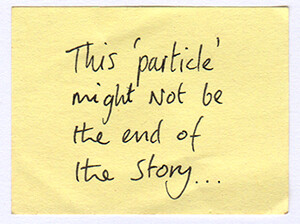
But, to be clear, we are ruling out concepts based upon the current level of technology in subatomic detection. On reviewing the history of ever-smaller ‘atoms’ being sporadically revealed, ought that knowledge impel us to stick a large lurid post-it note onto our current concept of primary particles to remind us that…


However, if the technological capabilities of our colliders continue to improve and yet we are still unable to infer any internal constituent structure from the ensuing data, then that post-it note ought to shrink and fade along with our aching expectations.


Reasonable?


3. Mass-energy + spacetime

On 4/11/2019 at 1:44 PM, Boydstun said:

In general relativity, including in its combine with quantum field theory at the event horizon of a black hole (Hawking radiation), mass-energy is one thing and spacetime with all its curvatures is another thing. Mass-energy is an entity. Distribution of mass-energy in spacetime determines how spacetime will curve.


More basic than the Standard Model’s 17-or-so ‘indivisibles’, standard GR+QFT identifies _really _only two ‘fundamental ingredients’ (forgive me Boydstun if I’m interpreting things over-simplistically here):

  1. Mass-energy (absolute existent)
  1. Spacetime (relative existent)


The initial question of this entire topic presupposed such a stripped-down model (for better or worse). “Fundamentally, is there only spacetime?’’ could now be re-posed in the following way…

If the simpler model is valid, might these twin existents (mass-energy + spacetime curvature) be best conceived as either:

  1. Utterly separable;

…or…

  1. Both parts working together as a mutually generating dichotomy;

…or…

  1. Neither — it’s a false dichotomy (‘mutual dichotomy’ being contradictory + ‘separable’ being meaningless within a context of relational existents).


I suspect the correct answer for now is conceptually ‘utterly separable’ because that’s the way we currently perceive things to be (via colliders and calculations) — that is until actual reciprocality can be proven beyond reasonable doubt (+ any conceptual contradictions are ironed out ~ apropos Macken’s theory).


Do you think that’s a fair way to put it (and if so may we conclude the topic on that note)?


7 hours ago, A.C.E. said:

My purpose on this thread is to learn a wee bit more about reality, specifically to better conceptualize the relationship between space, time and entity (as evidenced by physical science, epistemologically grounded in perception).

My understanding is that physical scientists can detect no structure to space. This fits with my perception, and my logic, which suggests that space is not material. It is that which matter occupies. Many physical scientists don’t like this concept of space, because it flies in the face of materialist theories like the Big Bang. But it’s actually the only concept that fits with all the known facts.

On ‎5‎/‎12‎/‎2019 at 6:00 AM, A.C.E. said:

Reasonable?

  1. and 2. seem reasonable.

On ‎5‎/‎12‎/‎2019 at 6:00 AM, A.C.E. said:

3. Mass-energy + spacetime

On ‎4‎/‎11‎/‎2019 at 7:44 AM, Boydstun said:

In general relativity, including in its combine with quantum field theory at the event horizon of a black hole (Hawking radiation), mass-energy is one thing and spacetime with all its curvatures is another thing. Mass-energy is an entity. Distribution of mass-energy in spacetime determines how spacetime will curve.


More basic than the Standard Model’s 17-or-so ‘indivisibles’, standard GR+QFT identifies _really _only two ‘fundamental ingredients’ (forgive me Boydstun if I’m interpreting things over-simplistically here):

  1. Mass-energy (absolute existent)
  1. Spacetime (relative existent)

This here seems correct.  Although your division into “relative” versus “absolute” is a little odd to my mind.  All of existence is absolute.   The distance between A and B absolutely IS… it just is not something separable in any way from A and B.

On ‎5‎/‎12‎/‎2019 at 6:00 AM, A.C.E. said:

If the simpler model is valid, might these twin existents (mass-energy + spacetime curvature) be best conceived as either:

  1. Utterly separable;

…or…

  1. Both parts working together as a mutually generating dichotomy;

…or…

  1. Neither — it’s a false dichotomy (‘mutual dichotomy’ being contradictory + ‘separable’ being meaningless within a context of relational existents).


I suspect the correct answer for now is conceptually ‘utterly separable’ because that’s the way we currently perceive things to be (via colliders and calculations) — that is until actual reciprocality can be proven beyond reasonable doubt (+ any conceptual contradictions are ironed out ~ apropos Macken’s theory).


Do you think that’s a fair way to put it (and if so may we conclude the topic on that note)?


Spacetime is not “separable” in any way from the entities in existence, as entities relationships in space and time are not “dispensable” in any conceivable way.  The spacetime relationships exist always between entities because no entity is outside of space or time and every entity has a spacetime relationship with every other entity.

So 1 is out.

Existence is not a “dichotomy”, spacetime is not a “part” of existence anymore than an attribute or property of an existent is an independent  “part” of existence rather than some “aspect” of the existent. (these sorts of things are conserved among entities and can be exchanged between them etc., but they still are “of” entities at any one time).  Things are, and the things collectively possess relationships (special kinds of attributes or properties of composites).

So 2 is not really coherent

Yes, I have to go with 3.

And No, I do not believe that 1. is how we perceive of things at all.

…

Hypothetical exercise, in the way of story telling, to convey a sense of something:

Suppose just for a moment that irrespective of what we think, believe, or feel, the universe were such that utterly separate fundamentally DIFFERENT stuffs existed.  Say “protomatter”, and “negamatter”.  The universe was such that these could be converted one into another,  and the quantities such as energy and mass would be conserved, but these were the only two stuffs, no third stuff existed. At ant one time, the stuffs are only what they are, and not what they are not.  Consider this as absolute metaphysical fact.

No imagine, a person sitting in a nice warm and comfortable room spending hours upon hours meditating upon existence, and finds this “dichotomy” of stuffs to be distasteful.  The person proposes that the universe “really” is made of a third stuff, which is everywhere, literally making up or filling the nothing which is observed as the temporary absence of specific spatial relationships among the protomatter or negamatter, (whenever particular spatial relationships between the protomatter and negamatter which previously were “occupied” are now unoccupied e.g. C was 2 meters beside B  but now “currently no entity X” satisfies the relationship of 2 meters beside B").  Moreover, this third stuff, (call it mono-fundamento-matter) has three states of “existence”, one where it behaves like “protomatter”, another when it behaves as “negamatter” and yet a third (dormant state) when it behaves as if it did not exist at all, but has a potential to become protomatter or negamatter.  This person reframes the equations which are used to describe known processes and behaviors of protomatter and negamatter to apply to the various states of mono-fundmento-matter.  Because we actually observe those things which actually exist behaving in the way they do and actually observe the absence of anything in the spaces where there are no things behaving or existing, this brilliant person has described the universe in a way which is consistent with what we observe, simply by introducing the third “unifying” stuff, mono-fundamento-matter.  The errors here are the reification of nothing with something, and the erroneous unification of two stuffs as “merely” two “states” of a singular monolithic stuff.

Observe, this kind of error, can ALWAYS be embraced in the absence of something like Occam’s or Rand’s razor, no matter what the actual absolute metaphysical reality of the universe.  In the example case here, two metaphysically real and distinct stuffs along with the fact that the INFINITE number of possible spatial relationships are not ALWAYS filled… is transformed into a complete fantasy which is nonetheless consistent with observation… and merely requires the mathematical patchwork of all the math regarding what IS known, and what IS consistent with reality as it actually is.

We can go farther, instead of just unifying the two stuffs and the nothing, one can unify everything in existence and not in existence, everywhere and always into merely a single thing (for fun lets call it EXTENZ) which has as its properties and attributes all the observed entities and relationships, properties, attributes, actions and events, that are were or ever will be, as the mere localized expression of EXISTENZ’s infinite potentiality… we are all not separate things and there are no separate events… metaphorically… all that IS are but bumps on the back of the great whale which we are too puny to see… illusory of the oneness the sheer unity of it all. 


The kind of error here, is that “the one stuff running though it all” is simply NOT OBSERVED AS RUNNING through it all… if the universe were metaphysically different and exhibited some common thread existing metaphysically running through it all, there might be some observation providing a reason to make the above type of proposal, but absent an observed perceivable reason in reality, “beauty or taste” simply is no way to guide scientific knowledge, and if anything it threatens the kind of errors above. 

Here concepts are multiplied by “desire”, clearly being multiplied beyond necessity,and violating Rand’s razor, as well as crossing well into “the arbitrary”… complete unmitigated and unjustified fantasy.

Thank you very much SL,

 I really appreciate the effort gone into the story-telling, it works well as a clear explication — very helpful indeed.


My last post seems to have ended on a bum note!

Of my three alternatives regarding the best conceptualization for the spacetime/entity relationship, SL went with 3, whereas I had plumped for 1.


Let’s see who is right and why…


After absorbing the analogy of ‘proto-matter’ + ‘nega-matter’ and the intentionally spurious introduction of ‘spacetime-filling’ ‘mono-fundamento-matter’ the habitual errors are exposed as clear as a clanging bell:

  • The reification of nothing with something (exhortatory spacetime-filling).
  • We need actual observable evidence of the unification of stuffs, otherwise keep conceptually separate (as they are objectively observed to be).


The story continues into the realms of ‘extenz’ with a further such unification of everything and nothing, underscoring the absurdity of a meta-melding into meaninglessness (meaning = contradistinction).


NB, an interesting way to look at it — the pull towards conceptual unification has the air of keen razoring — why have two concept when one will do. However, this intuition is perfidious: unobserved unification is an additional intruder/usurper which itself necessitates razoring away.


1. Utterly separable?

I had written:

I suspect the correct answer for now is conceptually ‘utterly separable’ because that’s the way we currently perceive things to be (via colliders and calculations)…


But I was wrong.


‘Utterly separable’ is not the way we currently perceive of spacetime & entities. We naturally perceive space and time as the indispensable dimensions of (and between) entities.

I was confusing this natural perception with that common naive conceptualization of entities being contained within pre-existing space and time. This childish conception is further cemented by talk of ‘empty space’, Kantian a priori, etc., and so it deftly takes on the mantle of a pure percept rather than the infectious proto-concept that it is.


More to the point, our concepts must match observable reality!

We ‘see’ space and time as abstracted out from observed entities, we experience these dimensions as utterly relational and therefore un-separable from entities/events.


I’ll risk letting you in to my germinating thought process on reading of SL’s reply:

…Oh but I was speaking conceptually, not actually — arghhh whoops! There’s my mistake laid bare — there ought not be any difference: objective actuality is the only valid building-block for concepts.


Therefore SL is correct, spacetime (space–time) is actually relational and thus can not garner ‘ separate concept status ’ from entities (mass-energy).


NB, our maintenance of separate words for ‘spacetime’ and ‘entities’ doesn’t amount to ‘separate concept status’ because ‘spacetime’ is still a legitimate abstraction, similar to any mathematical abstraction derived from observable entities and their relationships.


2. Both parts working together as a mutually generating dichotomy?

On 5/13/2019 at 10:00 PM, StrictlyLogical said:

Existence is not a “dichotomy”, spacetime is not a “part” of existence anymore than an attribute or property of an existent is an independent  “part” of existence rather than some “aspect” of the existent. (these sorts of things are conserved among entities and can be exchanged between them etc., but they still are “of” entities at any one time).  Things are, and the things collectively possess relationships (special kinds of attributes or properties of composites).

So 2 is not really coherent


Agreed, as I’ve just argued, a relational existent isn’t a ‘separable part’ or ‘conceptual concrete’ so it follows that spacetime shouldn’t be thought of as ‘one part’ of a ‘dichotomy’ with entities.   


3. Neither?

By process of elimination we find ourselves going with the third alternative (I suppose I could have offered a fourth ‘both 1&2 option’ ~ but two wrongs don’t make a right!).


To reiterate…


If the simpler model is valid, these ‘twin’ existents (mass-energy + spacetime curvature) are best conceived as:

Mass-energy (absolute entities) acting in a spacial–temporal (‘spacetime’) relationship.


Simple really, and I think this fits in with the spirit of SL’s…

On 5/13/2019 at 10:00 PM, StrictlyLogical said:

The spacetime relationships exist always between entities because no entity is outside of space or time and every entity has a spacetime relationship with every other entity.


It also chimes with MisterSwig’s insistence that “…space is not material”.


Good — I feel cleansed!


Now, shall we end the topic here ~ an initial foray into conceptualizing spacetime? 

(Or are there still flaws in my reasoning)?


P.S. As we are in the forum’s Physics and Mathematics department, I’ll remind inquisitive minds of the previous links to John A Macken’s physics-heavy work; The Universe is Only Spacetime: Particles, Fields and Forces Derived from the Simplest Starting Assumption + his recent draft summary — Single Component Model of the Universe.

If you think this represents a route towards a fuller understanding of the physical universe ~ or not ~ please post below.


1 Like

5 hours ago, A.C.E. said:

Simple really, and I think this fits in with the spirit of SL’s…

On 5/13/2019 at 1:00 PM, StrictlyLogical said:

The spacetime relationships exist always between entities because no entity is outside of space or time and every entity has a spacetime relationship with every other entity.


It also chimes with MisterSwig’s insistence that “…space is not material”.

We appear to be getting closer together in our concepts of space. But I still struggle with the notion of space as a sort of matterless medium for matter. I agree that no entity is outside of space, i.e., material objects must be in space. Any physical thing takes up and moves through space. But does this mean that space must have matter, or things, in it?

I question whether space is a real relationship. Distance, yes. But space seems like something more fundamental. How is a square foot of space relational? There is the square foot of space that relates to my position in my room in California on the planet Earth as it spins and orbits the Sun. Then there is the square foot of space that I just passed through while riding the Earth through the galaxy. Isn’t the former idea mistaking airspace for space-space? Is the space through which entire celestial bodies and clusters move also relational in nature?

I consider the hypothetical of matter filling all of space. If that were the case, how could anything move? Wouldn’t motion be impossible if reality were a solid mass of material particles? Doesn’t existence necessarily require a nonmaterial medium for the movement of material stuff?

55 minutes ago, MisterSwig said:

matterless medium for matter

Your concept of “medium” cannot form the basis for the concept “space” if your concept “medium” already relies upon (perhaps subconsciously) your preconceived notions of space.  A medium after all, is something which is homogeneous and “occupies” space… eventually this reduces to space occupying itself and space is space, neither of which is particularly helpful in your endeavor.

55 minutes ago, MisterSwig said:

no entity is outside of space, i.e., material objects must be in space

Yes “outside of space” is an anti-concept, yes, but this does not imply that everything is technically IN space. 

No thing can be without any spatial relationship whatever to any other thing.  The terms “outside of” or “inside of” space are somewhat misleading, since space is a relationship.  In a sense “A outside of B” and “A inside of B” are applicable only to existents A and B, and “outside” and “inside” are themselves spatial relationships. 

That said. common usage, of spaces in spaces is completely analogous to saying distances are greater or smaller or that a length of one thing could not span the entirety of the length of another thing so one “distance” could “fit inside” another… but “distance” as such does not fit in or occupy anything.

Spaces, volumes, areas, distances, and positions designate existing or possible relationships between things.

55 minutes ago, MisterSwig said:

I question whether space is a real relationship. Distance, yes. But space seems like something more fundamental. How is a square foot of space relational? There is the square foot of space that relates to my position in my room in California on the planet Earth as it spins and orbits the Sun. Then there is the square foot of space that I just passed through while riding the Earth through the galaxy. Isn’t the former idea mistaking airspace for space-space? Is the space through which entire celestial bodies and clusters move also relational in nature?

Space in multiple dimensions is a consequence of the three degrees of freedom of distance between things.  Distance is a vector quantity, it has an x component, a y component and a z component.  A square foot is a quantity in mathematics as is volume.  They are no more measurements of *stuff* or a quantity of stuff, than distance between any two things is a measure of a “length” of *stuff*.

We speak of how “much” distance, or there being “more” distance between things, but that does not imply “more stuff” of any kind.  It merely designates a relationship whose magnitude varies.  A two dimensional relationship (or a relationship with two degrees of freedom) and a three dimensional relationship (or a relationship with three degrees of freedom) also can be measured and magnitudes measured and assigned, but there is no “stuff” involved.

Between you and the door you can say the distance is equivalent to  20 feet, which also means 20 1 foot rulers could span the distance. 

Now a stuff like water can occupy a 1-foot cube because of the constraints on the spatial relationships of the atoms and molecules, imposed by the forces of the electron shells, covalent bonds, etc create.  They to not pass through one another, nor the walls of a container, so a certain amount (number or mass) of water molecules occupy a measured space of say a cubic foot.  A pool in your back yard might be defined as having a volume of 2000 cubic feet, which also means 2000 units of 1 cubic foot of water could “fill” the pool.  The relationships between all of the material composing the walls of the pool are such that they span 2000 cubic feet.

There is no dichotomy between distance and space.

55 minutes ago, MisterSwig said:

I consider the hypothetical of matter filling all of space. If that were the case, how could anything move? Wouldn’t motion be impossible if reality were a solid mass of material particles? Doesn’t existence necessarily require a nonmaterial medium for the movement of material stuff?

?? If reality wasn’t what it is… it would not be reality…

Consider the imaginary case of two particles which can have a relationship distance… if they have attributes, like mass or electric charge, they will attract and maybe repulse each other…  these forces depend upon the distance, so the forces felt by them change as the distance changes…  nothing observed about these two particles requires the concept of some medium… distance fully suffices.


1 hour ago, MisterSwig said:

If that were the case, how could anything move?

It would be like ether, and would basically be classical physics in all contexts. 

The problem I think is assuming that space is “empty” (SL addresses this I think). Maybe empty of matter, but that doesn’t mean nothing is there. What is there? I don’t know enough about quantum mechanics to say, but there is something physical everywhere, and every where. 

But even if there is no room to move as in your counterfactual example, couldn’t everything move together? Things could swap places, or momentum could transfer. That’s what classical physics would say probably before quantum mechanics. So in a way, yes, there has to be something non-tangible going on, except it would be because we need to account for how things are so dynamic.


50 minutes ago, Eiuol said:

The problem I think is assuming that space is “empty” (SL addresses this I think). 

Yes .. but not in the way you think.  I have stated that space is not a something which in turn is occupied by a nothing.  Your next statement is incorrect in my opinion.

50 minutes ago, Eiuol said:

Maybe empty of matter, but that doesn’t mean nothing is there.

It is true that nothing cannot be anywhere… but it is also true that every “there” can happen not to have anything.

The error I think, is your premise that each “there” requires occupation, and your consequent distaste for its “occupation” with a “nothing”.  It is TRUE that a “nothing” cannot OCCUPY anything.  BUT it is not true that every “there” needs to be occupied.

Thinking of space as a relationship completely solves the conceptual and aesthetic issue…

The “there” defined as two meters to the left of the top of the basketball, WAS a relationship fulfilled by the golfball (say two days ago) but since you removed the golfball, the atmosphere filled that relationship, until two hours ago you removed the atmosphere (using a cold bell jar to evacuate as much air as possible and then cause the remaining gases to condense at near absolute zero…), after turning off the lights, every few milliseconds, a cosmic ray, or an atom from the very sparse vapor pressure in the bell will occupied the relationship of “there” i.e. two meters to the left of the top of the basketball, at other specific times nothing else in the universe happened to have that relationship with the top of the basketball, better put, each and every other thing in the universe had relationships to the top of the basketball which were other than “there”… there being no more things in the universe … we conclude there are more “theres” than there are things.

Be assured, the “there” will be occupied when and if a next entity happens to have that relationship with the top of the basketball… so it makes sense to conceive of the “there” always, at some times as a potential relationship and at other times as an actual one. 

Does it really need to be thought of as a relationship though? I mean, wouldn’t it still be fair to consider it physical, in the same way that information is physical, and exists independently of any conceptual operation? This would mean that being physical depends upon a “there”, or must be grounded to something possibly measurable (spacetime is measurable in principle). Not that I mean occupying space, occupying space implies matter; I’m saying that matter is not the only kind of physical thing. 

My earlier thought was how atoms are mostly empty of matter. We don’t say that there is nothing between the electron and neutron, except to say that there is nothing we can touch. I know that although the position of an electron can only be estimated with a probability, because of the uncertainty principle for things of that small a magnitude, there is some phenomena going on in the entire spread of where electrons could go. That might be an electric field, or other kind of field, which isn’t matter, but observable and physical.

My angle here is partly psychology. In terms of observing the world and the mental operations that go on in your brain at the neural level, space and time are unified. Your hippocampus processes space and time in the same way and in the same sense. For sure, the existence of a mental operation doesn’t therefore mean that the conceptual representation itself is physical. But I can explore the idea. If space and time can be observed as one, even if we don’t have absolute certainty what happens at a specific space and time, then I don’t think there can observations without something physical. Uncertainty is baked into quantum mechanics, that’s where limits of understanding can occur. But it looks like spacetime isn’t near the quantum level, both for physics and psychology. It’s really at or near the perceptual level, so perceptual evidence is fair.

As one of the earlier posts said, the OP just sounds like a reformulation of relativity. 

1 hour ago, StrictlyLogical said:

The error I think, is your premise that each “there” requires occupation, and your consequent distaste for its “occupation” with a “nothing”. 

The premise is that all physically real things are measurable in principle. The issue I have is an informationless location, spacetime that cannot be measured in principle. And of course, I question if spacetime should be thought of as a relationship. We might agree, but the precision I want is very difficult to express.

I’ve only recently really started to dive into quantum mechanics, so there might be some errors in there.

1 hour ago, Eiuol said:

something possibly measurable

What would a measurement of a “there” consist in? 

It could not consist in measuring things “there”, because you would be measuring THINGS which happen to BE “there”, and you would not be directly measuring the THERE. 

You could not measure some “attribute” or “property”, since “attributes” and “properties” are attributes and properties of THINGs, and don’t want to measure things that happen to be there, you want to measure the sheer “there”.

Here comes the difficult part, if there is a measurable thing that IS THE THERE, where is it AT?  Is the “there” a thing AT the “there” .. i.e. is it AT itself?  What kind of thing can be AT itself and what does that mean?  If not “being there” but “being THE THERE”, where is it?  Nowhere?  Where is the nowhere? 

But you want to measure a THERE so it must be a WHAT… and a WHAT always is SOMEWHERE…


A philosophically coherent conception of “space” as a measurable thing rather than a measurable relationship is something I have yet to see. 

“Empty space” does indeed have attributes.  The permittivity of free space is a physical constant relating to an electric field’s ability to spread through empty space.  The permeability of free space is a physical constant relating to a magnetic field’s ability to spread through empty space.   It just so happens that the speed of light, sometimes itself regarded as an independent physical constant, is actually predicted and calculated as the inverse of the square root of the product of the permittivity (Greek epsilon )and permeability (Greek mu).

In the equation below the subscript 0 denotes the attribute of empty space.  Space filled with some other material will have different values and a different propagation speed of light.

c0=1/√μ0ε0

Space is not empty.

30 minutes ago, Grames said:

Space is not empty.

Are you saying “space” is filled with something and therefore not empty?

or

Are you saying space is filled with itself?

or 

Are you saying there is no space to fill to begin with?

or

Are you saying there is space, you can’t fill it, but there is always something in it? 


You used the word “empty”, what is the meaning of the concept to which the word ( as you use it) refers?

If you merely said that there are electric fields permeating throughout all of space, that would seem true.  You seem to be saying something else.

You base you conclusion that space is not “empty” because of the permeability and permitivity of what… compared to what?

1 hour ago, StrictlyLogical said:


Space-time has measurable attributes in addition to curvature.  If it has attributes then it is an existent.  Space-time is not a type of nothing, nor is it a discrete entity.

1 hour ago, Grames said:

Space-time has measurable attributes in addition to curvature.  If it has attributes then it is an existent.  Space-time is not a type of nothing, nor is it a discrete entity.

Entities are in Space-time relationships… whatever attributes or entities are observed anywhere, they are in those Space-time relationships, they are not Space-time itself.

Just now, StrictlyLogical said:

Entities are in Space-time relationships… whatever attributes or existent observed anywhere are in those Space-time relationships, they are not Space-time itself.

Space-time is not merely a relationship, it is an existent in itself.  For all we know it may even be compound existent, made of more fundamental existents.   Wikipedia can provide an introduction to the topic with the article Zero-point Energy .