Hsieh's Own-Goal on the Subject of Beauty and Objectivity

Here’s an interesting segment from Diana Hsieh’s philosophyinaction site in which she unintentionally demonstrates the subjectivity of judgments of beauty, and the emotional commitment to the belief that one’s subjective judgments are objective, by attempting to smuggle in her own subjective preferences (or her own subjective dislikes) as the universal “objective” standard of aesthetic judgment:

http://www.philosoph…2-07-29-Q3.html

First of all, Hsieh isn’t really discussing beauty so much as the lack of ugliness or repulsiveness.

Anyway, Hsieh summarizes her opinion:

“My Answer, In Brief: Standards of beauty for people and other creatures are properly based on the fundamental normative standard: the life of the organism, including its health. Nonetheless, within that range, people can have different personal preferences.”

The “range” of differences of appearance of “healthy” people and creatures is unlimited, and therefore, by Hsieh’s standards and “range,” practically all judgments of beauty are “personal preferences” – in other words, subjective!

Rather than investigating the history of the concept of beauty or making any attempt to define it, Hsieh’s mistake is that she begins by apparently merely introspecting about her own personal, subjective preferences, and she starts with the predetermined desire that judgements of beauty should have an objective basis, and then attempts to force beauty to conform to the “objective” standard that she has subjectively chosen – that of the “life” and “health” of the organism. (You could say that she does aesthetics much in the same way that the Chinese did foot-binding).

She gives the example of people breeding animals for the purpose of aesthetic appeal – for their beauty – but notes that such breeding often results in unhealthy animals. Thus she tries to beg the question by attempting to equivocate and confuse the issue by asserting that poorly-bred dogs’ health issues are “not attractive.” Well of course such health issues are not attractive! No one has asserted that they are! Rather, people are asserting that the dog’s appearance is beautiful.

Using Hsieh’s standards, does something which is judged to be beautiful magically cease to be beautiful when we discover that it’s possessor is in some way not healthy? What about conflicting cases of animals’ features? For example, when one breed of dog is healthy when displaying long, thin features and large, dark eyes, but another similar-looking breed is unhealthy when bred to display the same features, before judging either dog’s beauty, is Hsieh actually suggesting that we would first have to research the breed of the dog and its health status before saying, “That is a beautiful dog”?

Hsieh seems to have great difficulty staying focused on the issue of beauty. For example, not only does she confuse the judgment of an animals health with judgments of its beauty, but she also later states that “once someone opens their mouth they’re not so attractive anymore.” Really? People’s stated opinions affect Hsieh’s judgments of their physical beauty? Wow, that’s quite an admission of allowing one’s judgments to be tainted by irrelevant information! Not only is Hsieh’s argument one based in the attempted rationalization and projection of her own subjective tastes, but it’s also based in the whimsy of allowing her judgments of beauty to be swayed by accidental associations with phenomena which are not necessarily related to an entity’s appearance: An animal’s appearance may have nothing to do with its health or illness just as a dumb blonde’s appearance may have nothing to do with the content of her intellect or character.

The folly of attempting to rationalize one’s subjective judgments as being “objective” results in evading the reality that beautiful things can be “unhealthy,” and that very ugly and repulsive things can be perfectly healthy.

One last thing. Hsieh’s position, as stated in her podcast, is that others are just “really wrong” when they disagree with her judgments of beauty. It’s very interesting, and highly amusing, that, like many other Objectivists, Hsieh apparently believes that she has somehow become infallible on the subject of judgments of beauty. Why is it that so many Objectivists with very little knowledge or experience in aesthetics never question their own tastes or ponder the possibility of their own aesthetic ineptitude, but instead are absolutely certain that they have somehow willed themselves to acquire very refined and purely objective tastes, and that they’ve done so with little or no effort? What does it say about Objectivism when ten different Objectivists have ten different judgments of something’s aesthetic value, and each is asserting that his or her own judgment is objective while claiming that all of the others are being subjective and “really wrong”?

Philosophers in the past have observed and commented on people’s strong, blinding, emotional commitment to the unwarranted assumption of their own aesthetic objectivity and superiority of judgment. I wonder if Hsieh is aware of these philosopher’s statements, and that she is doing little more than inadvertently providing evidence to support them.

J
This should end well.

Yeah, this is such an absurd criticism it’s hardly worth addressing. But go ahead and try to demonstrate that the range of good health is “unlimited”. I postulate some limitations here:

Rotten Teeth

Excess adipose tissue (as a symptom of underlying ill health–some people are naturally curvier than others)

Skin lesions

Dried-out, split hair

Fungus-infected nails

So, those being things that can objectively knock you out of being beautiful, possessing the converse adds to your beauty. If you have superb teeth, are athletically lean and muscular, have flawless skin, great hair, and well-maintained nails. These are all objectively good things. The greater the degree to which you have them, the more beautiful you are, objectively.

Now, what IS subjective in beauty is things like, what’s your hip-to-bust ratio? Do you have long legs? A strong jawline? Stubby hands? These are personal preferences.

Yeah, this is such an absurd criticism it’s hardly worth addressing. But go ahead and try to demonstrate that the range of good health is “unlimited”.

I DID NOT say that the “range of good health is unlimited.” Rather, I said that “the ‘range’ of DIFFERENCES OF APPEARANCE of ‘healthy’ people and creatures is unlimited.”

I postulate some limitations here:

Rotten Teeth

Excess adipose tissue (as a symptom of underlying ill health–some people are naturally curvier than others)

Skin lesions

Dried-out, split hair

Fungus-infected nails

That which might APPEAR to you to be rotten teeth may not be. Anything which might appear to be an ailment isn’t necessarily an ailment. It isn’t necessarily harmful or unhealthy.

Btw, by what objective standard does a certain amount of “adipose tissue” become “excessive”?

So, those being things that can objectively knock you out of being beautiful, possessing the converse adds to your beauty. If you have superb teeth, are athletically lean and muscular, have flawless skin, great hair, and well-maintained nails. These are all objectively good things. The greater the degree to which you have them, the more beautiful you are, objectively.

No. Having leanness, muscularity, good skin, etc., does not necessarily make one beautiful, nor does the lack of them make one ugly. One can have all of those things and still be ugly, and one can lack them and still be beautiful. Issues that have NOTHING TO DO WITH HEALTH can render leanness, muscularity, etc., irrelevant when it comes to judgements of beauty: The minor differences in the shapes and proportions of different individuals’ facial and body features can have great impact on our judgments of beauty despite having no relationship to health. Beauty is an issue of FORM, not of adding up details which indicate health.

Now, what IS subjective in beauty is things like, what’s your hip-to-bust ratio? Do you have long legs? A strong jawline? Stubby hands? These are personal preferences.

Exactly, and our judgments of human beauty ARE judgments of such ratios, proportions and lines. They are the essence of judgments of beauty, and, therefore, judgments of beauty are subjective.

Btw, by what objective standard does a certain amount of “adipose tissue” become “excessive”?

This called to mind a local story, I’m not sure if it’s being covered nationally, of a woman who was using Fix-A-Flat (the temporary tire repair stuff in a can) for butt injections. Here’s a picture:

http://www.hlntv.com/article/2012/07/27/fixaflat-butt-injections-murder-charge-oneal-ron-morris?hpt=hp_bn15

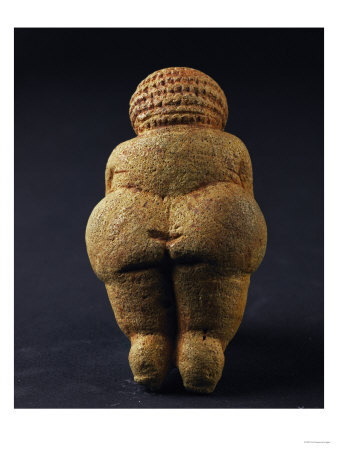
I also thought of the Venus of Willendorf, but I had a teacher way back when who was adamant that it represented the ideal of female beauty in its time and place. I’ve never been quite convinced, but when I saw it in person in Vienna I got that lump in the throat that comes with seeing something so iconic. Like the Mona Lisa or Michelangelo’s David.

I suppose this would be a good place to cue up Baby Got Back.

The “range” of differences of appearance of “healthy” people and creatures is unlimited,

No.

More particularly:

Man may be justly proud of his natural endowments (if they are there objectively, i.e., rationally), such as physical beauty, physical strength, a great mind, good health. But all of these are merely his material or his tools; his self-respect must be based, not on these attributes, but on what he does with them. …

If a man says: “But I realize that my natural endowments are mediocre—shall I then suffer, be ashamed, have an inferiority complex?” The answer is: “In the basic, crucial sphere, the sphere of morality and action, it is not your endowments that matter, but what you do with them.” It is here that all men are free and equal, regardless of natural gifts.

–Ayn Rand, The Journals of Ayn Rand, The Moral Basis of Individualism, p. 291.

As in ethics, so in esthetics: value is an aspect of reality in relation to man. Value means the evaluation of a fact (in this case, of a certain kind of human product) in accordance with rational principles, principles reducible to sense perception. This is precisely the pattern one follows in esthetic evaluation. One reduces esthetic principles to the nature of art, and art to a need of human life, i.e., to the primary of ethics; which in turn reduces to one’s acceptance of the axiom of existence.

Like goodness, therefore, beauty is not “in the object” or “in the eye of the beholder.” It is objective. It is in the object—as judged by a rational beholder.

–Leonard Peikoff, Objectivism:The Philosophy of Ayn Rand, Chapter 12, Art

No.

Yes.

Man may be justly proud of his natural endowments (if they are there objectively, i.e., rationally), such as physical beauty, physical strength, a great mind, good health. But all of these are merely his material or his tools; his self-respect must be based, not on these attributes, but on what he does with them. …

If a man says: “But I realize that my natural endowments are mediocre—shall I then suffer, be ashamed, have an inferiority complex?” The answer is: “In the basic, crucial sphere, the sphere of morality and action, it is not your endowments that matter, but what you do with them.” It is here that all men are free and equal, regardless of natural gifts.

–Ayn Rand, The Journals of Ayn Rand, The Moral Basis of Individualism, p. 291.

I understand how people might go about objectively measuring and rating things such as “physical strength,” “a great mind,” and “good health.” That’s easy enough. But I have yet to hear of an objective system for measuring beauty. Are you suggesting that Rand, you, or anyone else has identified an objective method of measuring beauty which isn’t actually based on your own subjective preferences? If so, let’s hear it!

Rand claimed that beauty was “a sense of harmony,” and she discussed the human face as an example. She asserted that when looking at a face which is “lopsided, [with a] very indefinite jawline, very small eyes, beautiful mouth, and a long nose, you would have to say that’s not a beautiful face.”

First of all, technically, all human faces are a bit “lopsided,” and most people think that beauty includes some asymmetry (they tend to see perfect symmetry as cold, inhuman, artificial, etc.). So, by what objective standard would Objectivists propose that we measure lopsidedness and how much of it is acceptable or required in a beautiful face, and how much results in ugliness?

People from different times, cultures and races have thought that “indefinite jawlines” were beautiful. By what objective standard would you propose that we measure and rate the sharpness versus indefiniteness of a jawline and its beauty ranking?

“Small eyes” are ugly? Objectively, how small can eyes be before they’re ugly? What objective principles of proportion are being used to make such claims? Is there anything to back up any of these assertions?

What does Rand mean by a “beautiful mouth”? Beautiful by what objective standard? And precisely how long can a nose be before it’s objectively deemed to be ugly? What are the objectively proper proportions of the attributes of the human face, and by what objective standard were those proportions established? What percentage of deviation from objectively proper proportions is acceptable, and how was that percentage objectively arrived at?

Finally, in the quote I provided above, Rand says that “you would have to say that’s not a beautiful face.” Why is she claiming to know what others must think? Was she not aware of the fact that other rational people did not share her tastes, and would not necessarily “have to say” that a face was not beautiful just because she judged it to be not beautiful?

Btw, notice that Rand, unlike Hsieh, does not attempt to tie beauty to health. Instead, she discusses judgements of the types of proportions and relationships that Jennifer earlier correctly identified as being subjective. Facial asymmetry, an indefinite jawline, small eyes and a long nose are not health issues (nor are they necessarily ugly – ask the average caricaturist to draw a face which is lopsided, small-eyed and long-nosed, and yet beautiful, and he’ll have no difficulty doing so). So, Hsieh’s foray into attempting to objectify her subjective aesthetic tastes by equating beauty with health is a deviation from Rand’s Objectivism.

As in ethics, so in esthetics: value is an aspect of reality in relation to man. Value means the evaluation of a fact (in this case, of a certain kind of human product) in accordance with rational principles, principles reducible to sense perception. This is precisely the pattern one follows in esthetic evaluation. One reduces esthetic principles to the nature of art, and art to a need of human life, i.e., to the primary of ethics; which in turn reduces to one’s acceptance of the axiom of existence.

Like goodness, therefore, beauty is not “in the object” or “in the eye of the beholder.” It is objective. It is in the object—as judged by a rational beholder.

–Leonard Peikoff, Objectivism:The Philosophy of Ayn Rand, Chapter 12, Art

Rand stated that “in any given context, only one answer is true.” So, when two or more “rational beholders” disagree about which objects are beautiful – which is very common – how would Peikoff propose that we objectively determine which person is correct? Where is Peikoff’s proof to back up his statement about judgments of beauty? Objectivism encourages us not to take a person at his word, but to demand proof, no? So, where does Peikoff identify a method of objectively measuring and evaluating beauty?

What Rand said about music is true of beauty – that we can’t tell, neither to ourselves nor to others, and, therefore, cannot prove, which aspects of our aesthetic experiences are inherent in the object and which are contributed by our own consciousnesses. Until Leonard Peikoff (or anyone else) identifies a method of objectively measuring and evaluating beauty, then, just as Rand said about judgments of music, judgments of beauty “must be treated as a subjective matter.” Merely asserting that such judgments are objective is not enough.

J

P.S. – I noticed that a few paragraphs after the one that Old Toad quoted from OPAR, Peikoff incorrectly asserts that Aristotle was the father or Romanticism and that Kant was the father of Modern art. Wow, what a blunder. If anyone was the father of Romanticism, it was Kant, and, as I’ve discussed in depth here on OO in the past, Kant’s notion of the Sublime is the essence of Rand’s art and “sense of life.” It is the signature aesthetic style of all of her novels.

J

A beautiful illustration of “[a] declared inner war”, allegorically written, of course.

I understand how people might go about objectively measuring and rating things such as “physical strength,” “a great mind,” and “good health.” That’s easy enough. But I have yet to hear of an objective system for measuring beauty. Are you suggesting that Rand, you, or anyone else has identified an objective method of measuring beauty which isn’t actually based on your own subjective preferences? If so, let’s hear it!

Perhaps you will find this helpful, J:

In regard to the concepts pertaining to evaluation (“value,” “emotion,” “feeling,” “desire,” etc.), the hierarchy involved is of a different kind and requires an entirely different type of measurement. It is a type applicable only to the psychological process of evaluation, and may be designated as “teleological measurement.”

Measurement is the identification of a relationship—a quantitative relationship established by means of a standard that serves as a unit. Teleological measurement deals, not with cardinal, but with ordinal numbers—and the standard serves to establish a graded relationship of means to end.

…

Teleological measurement has to be performed in and against an enormous context: it consists of establishing the relationship of a given choice to all the other possible choices and to one’s hierarchy of values.

…

–Ayn Rand, Introduction to Objectivist Epistemology, Concepts of Consciousness, pp. 32-35.

I suggest you read (or re-read) this material, as it seems to be at the root of your questions (and animosity).

I suggest you read (or re-read) this material, as it seems to be at the root of your questions (and animosity).

I would suggest that you read it, and then try to follow it in answering my request that you identify an objective method of measuring and rating beauty (which isn’t based on your subjective preferences). The comments that you quoted from Rand are the position that I’m coming from: Objectivists have not employed Rand’s views on measurement when discussing beauty – they haven’t identified a “standard” which “serves to establish a graded relationship of means to end” despite my asking them to do so.

Clearly, you don’t have such a standard by which to judge beauty, and telling me to re-read Rand’s views on such standards won’t get you any closer to identifying such a standard.

As for your accusation that I’m displaying animosity, perhaps you’re projecting? I’ve displayed no animosity. I’ve simply been pointing out others’ errors on the subjects of beauty and objectivity.

J

Beauty is a kind of value judgment. As a value judgment, the standard of man’s life ultimately dictates the standard of beauty. More particularly, the objective standard of beauty is the physical nature of man qua man. The metaphysically given standard of beauty includes limited ranges of symmetry, proportions, hair colors, etc., all of which are identifiable with the nature of man qua man, and, ultimately, correlated to man’s life as the standard of value. Among other things, visible manifestations of good health contribute to a judgment of beauty, whereas visible manifestations of ill health detract, because these are directed to the requirements of man’s life.

What dictates the limited ranges? Ultimately, man’s life qua man. For example, being relatively big or tall for a man can be considered a good attribute, but being too tall can shorten a man’s life, and be considered bad. It should be understood, of course, that the standards for beauty are somewhat different for man qua man and woman qua woman, but the same principle and ultimate standard applies.

The measurement of these kinds of values, including beauty, is teleological, according to the objective standard of man’s life.

The less relevant a physical characterisitc is to success in man’s life qua man, the less relevant it is to objective beauty. For example, blondes may be a bit more popular, but this is far down the telelolgical scale of physical attributes directed to success in life, which means it can become a matter of personal, even subjective preference.

BTW, no projection is needed regarding your animosity here, J. Nicky, for example, immediately noted it regarding your opening post. Animosity, including ad hominem, bursts and oozes from your opening post and others on this thread. Nevertheless, I hope you and others may find my post helpful, and I would value any mutually respectful and civil discussion.

1 Like

I do not think it was supposed to be an end-all “Answer”. I think it is relevant when judging the appearance of animate creatures to consider the essential features of that creature, with health being a *consideration* where applicable. What makes a human, human? This is how philosophy is done with Objectivism *anyway*, by considering some concretes, and breaking up a concept into constituent parts. Part of an aesthetic judgment involves health - health has an appearance. No, it’s not the whole picture, but it’s a piece of the picture. In the same way, we’d consider health as part of morality - health allows you to exist. But morality is not judged on health alone!

Also, the ITOE quote is pretty good, because it talks about teleological measurement, a fundamental part of judging values. Aesthetic judgment is related to value, so also involves teleological measurement. Tone it down a bit - I think OT does have standards in mind (and I respect his insights quite a bit), just opted to mention some quotes first. That quote is a good starting point of discussion.

1 Like

Beauty is a kind of value judgment. As a value judgment, the standard of man’s life ultimately dictates the standard of beauty. More particularly, the objective standard of beauty is the physical nature of man qua man. The metaphysically given standard of beauty includes limited ranges of symmetry, proportions, hair colors, etc., all of which are identifiable with the nature of man qua man, and, ultimately, correlated to man’s life as the standard of value.

Please identify the limited range. I’ve seen some very unnatural hair colors that I thought were quite beautiful. Some of the world’s greatest designers must have had the same judgments because they chose the hair colors for their models’ runway appearances. Apparently you’re saying that our judgments of their beauty were wrong?

As for ranges of symmetry and proportion, I’ve seen (and even created) very distorted images of humans which are beautiful. See images of some of the characters from the film The Incredibles for examples of beauty in distorted human forms. Art is often stylized to make humans appear more beautiful than they can be in reality. Beauty exists way outside of any proposed limited range of health and fitness.

Among other things, visible manifestations of good health contribute to a judgment of beauty, whereas visible manifestations of ill health detract, because these are directed to the requirements of man’s life.

What dictates the limited ranges? Ultimately, man’s life qua man. For example, being relatively big or tall for a man can be considered a good attribute, but being too tall can shorten a man’s life, and be considered bad. It should be understood, of course, that the standards for beauty are somewhat different for man qua man and woman qua woman, but the same principle and ultimate standard applies.

The measurement of these kinds of values, including beauty, is teleological, according to the objective standard of man’s life.

In the above, you’ve eliminated the concept of beauty and replaced it with the concept of health and fitness. Your having done so is an inadvertent admission that beauty is not objectively measurable. All that you’ve done is found something that is measurable and renamed it “beauty.” In doing so, you’re not talking about the same thing that Rand was talking about when discussing beauty.

Let’s apply your proposed standard of beauty to Rand’s example which I quoted earlier. Are you taking the position that proportionally smaller eyes, longer noses and indefinite jaw lines “can shorten a man’s life, and be considered bad”? Including when exhibited by healthy octogenareans who, by definition, haven’t had shortened lives?

Eleanor Roosevelt is almost universally considered to have been very ugly, yet her features didn’t deviate from any limited range of health and fitness. Her ugly features were not in any way visual manifestations of illness or shortness of life. In fact, her ugliness, and that of similar-looking people, often gives people the impression of a sort of rugged durability. Conversely, delicate things are often beautiful.

So, what you’ve done, in addition to replacing the concept of beauty with the concept of health and fitness, is to engage in comfirmation bias – you’ve haven’t gone out looking for examples of beauty or ugliness which falsify your proposed health-based standard of beauty.

And how would your standard of entity qua entity apply to the judgment of beauty of arrangments of inanimate objects? What would it mean to judge the beauty or ugliness of a sunset qua sunset, landscape qua landscape, or a still life of rocks qua rocks? If you were to suggest that I apply the standard of pattern qua pattern to a wallpaper design, how would that get me any closer to objectively determining that the design’s forms, proportions and colors are beautiful versus ugly?

J

Perhaps you are conflating “objective” with “universal”? Either way, I’m sure it can be agreed upon that human beauty must at least fall within the constraints of human beauty. From there we can deduce that it is possible to come up with objective and even universal standards for human beauty, even if we can’t define them that well with the current understanding of the human brain. Even still, as others have demonstrated, crude limits are still possible based on simple observation.

Perhaps you are conflating “objective” with “universal”?

No, I’m not.

When two people look at an object, and one thinks that it is beautiful and the other thinks that it is ugly, would you say that it is possible that both of their conflicting judgments could be objective, or must one of them necessarily be, as Hsieh put it in her podcast, “really wrong”? Do you agree that if there is a truly objective standard by which to judge beauty, then the statement of Rand’s that I quoted earlier – “In any given context, only one answer is true” – must apply to judgments of beauty, and therefore anyone claiming to be making objective judgments of beauty must also be claiming that anyone who disagrees with him or her must be wrong?

Now, since you bring up the idea of people conflating different concepts, I wonder it you’re conflating necessity with sufficiency? In other words, your position appears to be that a prerequisite of beauty is health – i.e., that health is n__ecessary to beauty – and, therefore, you are concluding that that which is healthy is beautiful – i.e., that health is sufficient for beauty. If that’s your position, then it isn’t logically valid.

Either way, I’m sure it can be agreed upon that human beauty must at least fall within the constraints of human beauty.

My agreement with your statement above would depend on what you mean by “the constraints of human beauty.” As I’ve already stated, a very distorted human form can be beautiful. Would you say that a very distorted human figure falls within “the constraints of human beauty”?

From there we can deduce that it is possible to come up with objective and even universal standards for human beauty…

No, we cannot deduce that. It does not logically follow that any and every type of judgment of any entity or its attributes must have an objective and/or universal standard as its basis if we limit the scope of judgment only to a certain class of entities. What is true of judgments of, say, flavors, is true of judgments of beauty even if we apply constraints to the flavors being judged. For example, one could say that the flavor of sausages must at least fall within the constraints of sausage flavors. We cannot deduce from that the conclusion that your favorite sausage brand is objectively and/or universally better than someone else’s favorite brand – we cannot deduce that it is possible to come up with objective and universal standards for sausage flavors.

That’s not the way that philosophy works. One does not begin with the desired conclusion that judgments of beauty or sausage flavors, or what have you, must have an objective and/or universal basis. Rather, one begins by exploring the type of judgment which is being discussed, and leaves open the possibility that such judgments might be partially, highly or purely subjective by their nature. One should not allow one’s dislike and rational rejection of subjectivity in other realms to taint one’s identification of the nature of that which is being investigated.

…even if we can’t define them that well with the current understanding of the human brain. Even still, as others have demonstrated, crude limits are still possible based on simple observation.

My position is that the classification of judgments as objective versus subjective doesn’t allow any leeway based on predictions of the future. You either have and are capable of clearly idenfifying an objective standard of judgment, or you don’t. There’s no “someday we’ll discover a standard” allowed, because the same assertion could be made about any and every other class of subjective judgments, thus granting the status of objectivity to subjectivity, and rendering both terms meaningless.

J

Here’s an interesting segment from Diana Hsieh’s philosophyinaction site…

Hsieh seems to have great difficulty staying focused on the issue of beauty. For example, not only does she confuse the judgment of an animals health with judgments of its beauty, but she also later states that “once someone opens their mouth they’re not so attractive anymore.” Really? People’s stated opinions affect Hsieh’s judgments of their physical beauty? Wow, that’s quite an admission of allowing one’s judgments to be tainted by irrelevant information! Not only is Hsieh’s argument one based in the attempted rationalization and projection of her own subjective tastes, but it’s also based in the whimsy of allowing her judgments of beauty to be swayed by accidental associations with phenomena which are not necessarily related to an entity’s appearance: An animal’s appearance may have nothing to do with its health or illness just as a dumb blonde’s appearance may have nothing to do with the content of her intellect or character.

J

Jonathan,

To be fair, I think Ms Hsieh was talking of the *sound* of a voice in "once someone

opens their mouth…"- not the content of that person’s intellect. As one who is very

aware of people’s vocal delivery, I can relate to that. It influences my perception

of an otherwise stunning woman.

Otherwise, my opinion is that Ms Hsieh is “over-objectifying” beauty.

Ayn Rand pushed the objectivity - the identity, observation and purpose - of aesthetics, to its limits

… and past it, I believe.

For which I’m personally in grateful admiration. Without her work, many would have stayed

ignorant of the true nature of much art - and why we need it so badly.

However, not everything in art (or beauty) is purely objective, it seems.

To push the boundaries is a noble intention, but to go too far, will fail, I think.

For me, I’m happy to leave that small quantity of my subjectivity (in beauty, aesthetics)

intact - as yielding its own distinct and necessary pleasures.

Hello J,

My position is that the classification of judgments as objective versus subjective doesn’t allow any leeway based on predictions of the future. You either have and are capable of clearly idenfifying an objective standard of judgment, or you don’t. There’s no “someday we’ll discover a standard” allowed, because the same assertion could be made about any and every other class of subjective judgments, thus granting the status of objectivity to subjectivity, and rendering both terms meaningless.

The ultimate, objective standard of value is man’s life. Every kind of particular value judgment–from beauty and love to stylized cartoons and rock arrangements–is measured relative to his standard. But because man does not measure such relationships to his life with a protractor or ruler does not make the measurement subjective. Within limited ranges, which are established by the requirements of man’s life, personal preferences are possible and optional. That ranges are possible, and rational men can differ as to the ranges of certain values such as beauty, does not make unlimited, subjective judgments of beauty valid or justifiable.

OT