It means the opposite of “objective.” I am not trying to be disrespectful, but an Objectivist should know what “objectivity” and “non-objectivity” mean, particularly as a moderator of an Objectivist forum. An unintelligible, amorphous, obscure, indefinite and ambiguous collection of smears on a canvas, which has to be given meaning arbitrarily through an enigmatic code of mysterious symbolism hidden from a rational mind, is definitively not an example of art under Ayn Rand’s aesthetic theory. Perhaps the meaning of the author’s paintings can only be revealed to a distinct class of art critics, but I, for one, cannot distinguish most of them from this doodle:
I don’t think I would refuse to sell to a person who holds collectivist beliefs (I value some as friends for their other attributes). I was thinking more about resisting collectivist organizations who benefit as the median between artist and collector. Ayn Rand was warning corporations against funding their own demise. I don’t want to alienate most of the art world (by refusing to sell to or through them) but if I can find a more individual based audience I would offer my work to them first.
I have a sense that you started this thread because you were looking for confirmation from people who call themselves Objectivists that your work is art according to Ayn Rand’s definition. Is there any truth to my hunch?
I appreciate confirmation, but if my work isn’t considered art I may find value in embracing certain rules when producing future work. I need to study Ayn Rand’s definition of art more thoroughly.
The ‘better to be hated’ is a good one to be reminded of, and thank you for the compliment.
I love Romantic Realism. I have been doing in-depth studies of anatomy, especially feet and hands recently. But, I don’t think I can dedicate myself purely to romantic realism for the rest of my career.
Its funny, the work Howard Roark sighted were pieces I made about 7 years ago, before I had heard of Ayn Rand. I view them as experiments in color and gesture and find beauty in the enigmatic quality of them. There is an energy to them that I don’t want to loose as I become technically more proficient.
It means the opposite of “objective.” I am not trying to be disrespectful, but an Objectivist should know what “objectivity” and “non-objectivity” mean, particularly as a moderator of an Objectivist forum. An unintelligible, amorphous, obscure, indefinite and ambiguous collection of smears on a canvas, which has to be given meaning arbitrarily through an enigmatic code of mysterious symbolism hidden from a rational mind, is definitively not an example of art under Ayn Rand’s aesthetic theory. Perhaps the meaning of the author’s paintings can only be revealed to a distinct class of art critics, but I, for one, cannot distinguish most of them from this doodle:
Are you exaggerating or do you really not see the objects in the paintings?
How does that site work when it comes to selling? If you put up a high-quality graphic file, will they sell things like prints for you; or does it require the artist to do more ?
Deviant Art and its affiliates offer printing and shipping services. They take 75% of the sales of art prints through their website. You can also buy advertising on their site, and interact with the community to attract interest.
I am wondering if my art could be of value to some of the ‘Individuals’ who also value Ayn Rand’s philosophy. Will it diminish my individuality to align my art making with Romantic Realism?
For what it’s worth, I like some of your work, and would almost consider buying it, almost. What I mean by that, I could explain better by example, so I will.
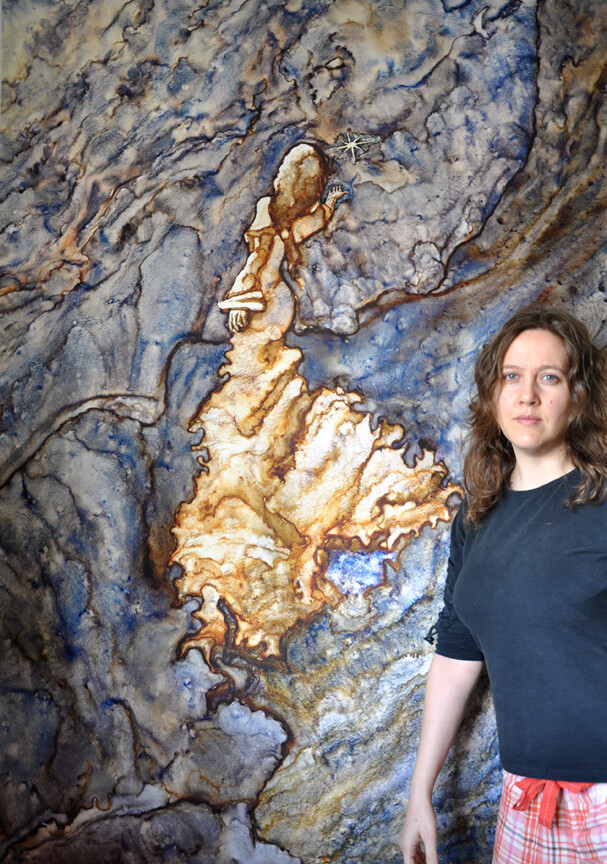
In respiration, I see a tree and a woman straining against an unstoppable force. The concept, the flowing hair and leaves, I really like. The trees branches are bending almost to the point of splintering is well done. What is missing for me is that the woman’s posture doesn’t look like she is bracing and enduring in the same way as the tree, nor is she doing it effortlessly enough to be a contrast. THe story doesn’t feel internally consistent for me. The other and more important concern for me is a lack of context. The tree has no choice to be out there on that cold windy cliff, but she does. So why is she? It doesn’t need to be overly obvious…just a facial expression or a more clear, emotion conveying posture might do it. Inkling does a much better job of this. She’s reaching for a star, which is a bit cliche, but at least I understand her. I get it. A lot of the others just miss the mark by a little bit.
I don’t dig on flower paintings, but those paintings especially, demonstrate significant ability which makes me think that you could pull off more subtly with regard to your human subjects. Overall, your style I like, but for it to turn my head, I need more meaning.
I’m not speaking for objectivism and actually consider myself less knowledgable about objectivist esthetics than any other part of the philosophy so please just take this as an explanation of what about your art appeals to me personally and what does not.
Are you exaggerating or do you really not see the objects in the paintings?
Why would I exaggerate? Sorry, but I am being honest. I saw a face in a couple of his paintings, or something like that, but there is definitively more to art than barely spotting the shape of an object in a blurred jungle of incomprehensible smears.
An unintelligible, amorphous, obscure, indefinite and ambiguous collection of smears on a canvas, which has to be given meaning arbitrarily through an enigmatic code of mysterious symbolism hidden from a rational mind, is definitively not an example of art under Ayn Rand’s aesthetic theory.
I absolutely agree with this. Many of these works appear to be stains which only vaguely connote real entities. I can’t help but compare them to the works of Bryan Larsen which, though I know very little about artistic technique, appear to me to have required tremendous effort and talent to produce. They portray a brilliant sense of life, and combine the selectivity of art with realism approaching the quality of a photograph in many cases. Art should fearlessly convey meaning, not deliberately attempt to obscure it from the viewer using visual tricks and “hidden messages”.
I don’t think I would refuse to sell to a person who holds collectivist beliefs (I value some as friends for their other attributes). I was thinking more about resisting collectivist organizations who benefit as the median between artist and collector. Ayn Rand was warning corporations against funding their own demise. I don’t want to alienate most of the art world (by refusing to sell to or through them) but if I can find a more individual based audience I would offer my work to them first.
That makes sense.
I appreciate confirmation,
So do I!
but if my work isn’t considered art
By you, or by someone else?
I may find value in embracing certain rules when producing future work.
Somebody else’s rules?
I need to study Ayn Rand’s definition of art more thoroughly.
That could be useful, but I think when push comes to shove you’re going to have to make your art whether or not it satisfies someone else’s definition.
The ‘better to be hated’ is a good one to be reminded of, and thank you for the compliment.
I love Romantic Realism. I have been doing in-depth studies of anatomy, especially feet and hands recently. But, I don’t think I can dedicate myself purely to romantic realism for the rest of my career.
It seems to me you are on a path of creating _your art, whatever that may be. I encourage you to continue on that path regardless of what any critics have to say about it.
Its funny, the work Howard Roark
I believe you mean “the person who is posting under the name Howard Roark”.
sighted were pieces I made about 7 years ago, before I had heard of Ayn Rand. I view them as experiments in color and gesture and find beauty in the enigmatic quality of them. There is an energy to them that I don’t want to loose as I become technically more proficient.
That makes sense to me. They all appeared to me as studies, rather than complete works.
I admire your courage to show your work here knowing that it will receive mixed reviews at best.
I like your style. If you want to appeal to Objectivists your message has to be positive, inspirational, integrated. A great artist is a great thinker. You don’t have to draw figures full of anatomical details. If you can say something worth saying with simplicity - it would be impressive. I would buy it. The more profound the message - the more precisely translated into visual form - the better the art. That is hard to find. So be clear about what is that you are trying to say and analytical about how all of the elements support that message. It does not have to be obvious (I like that it was not with few of your pieces). Think of your audience as smart enough to get it but it has to be intelligible in the end.
I kinda have to agree with Howard here. One of Objectivism’s criteria for art is that it be intelligible. I can see something in the five images that were linked, but most of them in the gallery, I couldn’t really tell for sure what I was supposed to be seeing.
I liked some of the paintings(particularly Inkling), even though I prefer more realism. Let me also add that in most of the pieces I had no trouble seeing what you were going for. To compare your work with random smears of color is really unjust.
I also think you have alot of skill/talent. You have a really “good eye”.
…If you want to appeal to Objectivists your message has to be positive, inspirational, integrated. A great artist is a great thinker. You don’t have to draw figures full of anatomical details. If you can say something worth saying with simplicity - it would be impressive. I would buy it. The more profound the message - the more precisely translated into visual form - the better the art. That is hard to find. So be clear about what is that you are trying to say and analytical about how all of the elements support that message. It does not have to be obvious (I like that it was not with few of your pieces). Think of your audience as smart enough to get it but it has to be intelligible in the end.
This has been the most valuable response for me so far. I will contemplate it repeatedly.
I am not trying to be disrespectful, but an Objectivist should know what “objectivity” and “non-objectivity” mean, particularly as a moderator of an Objectivist forum.
Great. I was not trying to be rude either, when I asked. It is just that the particular 5 or 6 paintings that I linked to above (the one’s Sophia listed in her post) were all clearly objective; so, with my experience with dealing with various misunderstandings of Objectivism on the forum, I had to clarify what you meant.
Perhaps the meaning of the author’s paintings can only be revealed to a distinct class of art critics, but I, for one, cannot distinguish most of them from this doodle:
This may be true of some; however, not of the ones that were specifically praised here, and most certainly not of the 5 or 6 that I linked to. Apart from the ones mentioned/linked, there were others that were clearly objective.
I kinda have to agree with Howard here. One of Objectivism’s criteria for art is that it be intelligible. I can see something in the five images that were linked, but most of them in the gallery, I couldn’t really tell for sure what I was supposed to be seeing.
First, isn’t that an exaggeration? The gallery has about 50 paintings. Check it out again and tell me if the content of about 20 isn’t clear enough. May not be what you like to see, but at least one can tell what the artist is saying. Another (say) 10 are also clear enough, if one pauses to try to figure them out.
Nobody in this thread said that they thought every – or even most – of the paintings were great. So, perhaps what divides the opinion here, is that one set of people looked at them and saw a few they liked, and the others looked at them and focussed on the ones they did not.
Sometimes I realize I am too harsh on Objectivists. The fact that many in this thread can appreciate her work is a good thing.
That’s a real shame. The fact that some of us like a few of the paintings on that long list should really not be the criteria by which you judge the philosophy (or its proponents). You should focus more on the content, less on the preferences of people who may or may not understand that content themselves.
I’m actually very curious as to how you’ve gotten that look. It’s incredibly natural, like it’d be possible to break open a geode and find your artwork inside.