What is art, and how do you judge what is art? That’s an important question. First of all, I would emphasize again Ayn Rand’s observation that art, like anything else is an entity of a particular nature. How do you arrive at a proper concept of what art is?
The same way you arrive at any other concept: By watching many concretes, omitting their differences and abstracting the essence of it.
Starting with the definition of art provided by Ayn Rand and then work your way down deductively to judge concretes will not work - no one can arrive at correct conclusions doing it this way. One has to arrive at concepts inductively - by observing numerous concretes in reality and abstracting what they have in common. Without this process, a sentence like “Recreation of reality according to an artists metaphysical value judgement” is completely empty, it could mean everything and anything. One has to start by observing cases in reality.
One essential thing about art is that it brings to a perceptual level concepts and ideas which are normally abstract and are not visible.
Things like “A Benevolent world”, “pride”, “freedom”, “safety”, “hope” are not things you can normally see or hear. But art concertizes them for you, gives them a physical form giving rise to an emotional reaction in line with how those ideas are in relation to the observer’s values. This is the inductive way to form the concept of “art” - to learn the specific nature of art.
One needs to notice that different art forms (literature, dancing, painting, music) have this same essence - they concretize some abstract idea or concept which relates to man’s values. (Of course, “Table” is a concept too, but it is not art if someone paints a table, even though it does concretize the concept).
Art gives physical form to ideas and emotions central to man’s life - not just to any random idea. This is why art triggers an emotional reaction - because things like “safety”, “benevolent world”, “pride”, “luxury” and even “loss” are important to man’s life.
Man has a psychological need to have concretization of these “deep” ideas - even from the days men lived in caves they drew pictures concretizing ideas central to their existence - like men bravely hunting an animal. They wouldn’t draw sticks, or a dead man surrounded by bears - but only those ideas which corresponded to the emotional state required for survival (bravery).
Art is Re-creation of reality according to an artist metaphysical value judgement - it means that an artist creates something that he considers important and which is inspiring to him - something that combines elements of that which exists (reality) but according to his implicit metaphysics - his view of the essential nature of the world and of man and how they relate to one another.
For example, if a composer writes a victory marsh he is implicitly describing his view of man’s relation to the world: Man is a creature fit to succeed in a world that has obstacles which can be overcome. If the victory marsh is full of music describing suffering - his view of the world is that it is a harsh place.
If a dancer moves with open, fully extended body movements he (or she) are transmitting their view of man as having freedom of action in this world. If a dancer moves randomly, like a jungle ape-dance they are describing their metaphysical view of the world as an unknowable flux in which man is a helpless animal.
It can get to much more complex ideas, but the above explains the essence.
So now keep that in mind, and consider the following examples:
-
A painting realistically imitating a random street scene
-
A painting of a garden of blossoming flowers. (for example: http://www.dinotopia.com/images/art/garden_of_hope.jpg )
-
A painting showing a fearsome warrior facing a dragon in a defiant position
-
A painting of bread
1 and 4 are not art. 2 concretizes beauty (and in the case of the link I gave - also grace and safety). 3 concretizes bravery.
Is #1 a selective recreation of reality according to an artist metaphysical value judgement? No. It expresses none of the artist’s view of the world, it deals with no abstract subject. More so, the painting copies the street rather than creating something new. Art is a creative process. A bread by itself conveys no idea central to man’s life or to the nature of the world.
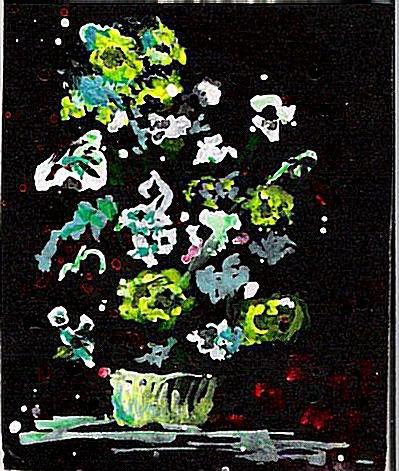
So now what kind of abstract idea does a painting like the tubes of paint or the spots of flowers concretize for you? No idea. It is a random object presented in a semi-random way. When an artist has an idea to communicate all the details in the painting are chosen by the execution of this idea as the standard. If an artist wants to express grace, he will not choose red for the color of the sky in the painting I linked. If an artist wants to describe courage he will not choose a background of blue sky with peaceful birds flying around. He must choose a dramatic background that brings the character to the center of the painting’s focus.
An artist cannot randomly select err… This one! and then select a background to bring out the object’s colors. That’s not art. That’s a random recreation of reality, not selective recreation of reality, and certainly does not communicate any idea relating to metaphysics.
With that in mind, I’ll answer Jackethan’s post.
Okay. The definition of art is a selective recreation of reality based on the artist’s value judgments.
This:
[Jackethan’s first attached image of a vortex of colors]
Is “Something piled together.”
This:
[Jackethan’s second attached image of MisLemonn’s (blots of) pot of flowers]
Is quite obviously a pot of flowers.
I answered this just above. A drawing of an object does not make it art. Art concretizes an idea. Your use of the definition can only be rationalistic if you do not go through the inductive process of abstracting what art is from many instances of it.
This:
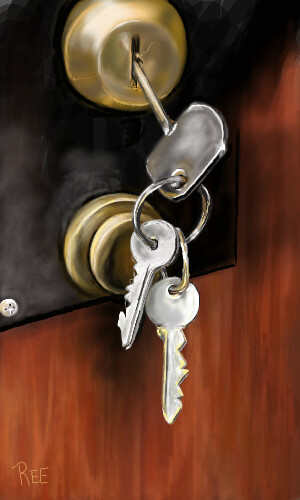
[Jackethan’s last attached image of “Unlocked” by Maria Schauffers]
Does not suck me in. And “Sucks you in” is not an objectively definable criteria for art criticism, unless you can describe just what the hell “Sucks you in” means.’
What I meant by that was that the blurring of the background, the emphasis of the shine of the keys achieved a high degree of focus on the object and its beauty. Compare that to a a painting of a rusty pair of keys that can barely be distinguished from the background - That would not create a focus on the keys.
It is more difficult to determine the abstract idea here, in her panting (unlike a warrior and a bear), but what she describes metaphysically is the beauty of the world as seen by a peaceful consciousness. Peaceful - because one would have to be very relaxed to observe a pair of keys in such high focus - similarly to how a child would do it. Furthermore there is significance to the object - keys. Suppose instead of keys she would paint a sidewalk or a dead cat in the same focus - it would no longer communicate a peaceful state of mind nor beauty. The nature of keys (shiny and in well kept condition) is significant here - keys unlock something - something valuable to the unlock-er.
Suppose she would paint the most ordinary pair of keys, without any shine or blurring of background - that would simply be like a picture and would have no artistic meaning.
The tubes of paint are also quite obviously tubes of paint. Please show how that is -not- art. It looks like a selective recreation of reality to me.
That’s because you are using the definition in a rationalistic way.
Please learn the difference between the phrase “This is bad.” and “I don’t like this.”
Don’t get me started now.
The criticisms of MissLemon’s ART is getting pretty ridiculous.
What is ridiculous is the agnosticism in this thread.
"The agnostic viewpoint poses as fair, impartial, and balanced.
…
The agnostic miscalculates. He thinks he is avoiding any position that will antagonize anybody. In fact, he is taking a position which is much more irrational than that of a man who takes a definite but mistaken stand on a given issue, because the agnostic treats arbitrary claims as meriting cognitive consideration and epistemological respect." (Leonard Peikoff on Agnosticism: link)
In this case the replace 'arbitrary claims" with “arbitrary art” (or attempt at art). Here agnosticism takes the form of “Who are YOU to judge what is art and what is not? Let’s say everybody’s stuff are art, and then we will be fair, non-insulting and everybody will get along”.
I know you looked at it for 2 seconds and went "OMG, THE TUBES HAVE FUZZY EDGES, THE FLOWERS ARE MADE UP OF SPLOTCHES OF PAINT, THE ARTIST DIDN’T TRY FOR AN EXACT COPY OF THE SUBJECT. THIS IS ALL BAD ART."
Well, I guess this is one thought that might occur to someone looking at them. As for me - I don’t take realistic copying of objects as a standard of art (as I explained). The paintings simply did not communicate any central idea, trigger no emotion (other than resentment that I am expected to treat it as art, but this is beside the point). The drawing of the woman - I can call it art. It vaguely, in a small amount reflects some state of mind or view about the world. (However, it is still more random than having a clear central idea. The expression does not express any particular state of mind, character trait or emotion clearly. I would still call it art if the technique was the same level but a clear idea was communicated).
But going by that standard, a movie is not art unless the director uses no camera tricks, lens tints, or perspective changes. By that standard a painting is not art unless it’s indistinguishable from the actual subject. This is not what Ayn Rand meant when she said that modern art is not art.
Realism was never my criteria for judging if her paintings are art or not, though obviously some level of realism is necessary to communicate any artistic idea.
Edit: fixed a sentence that had an unclear meaning.