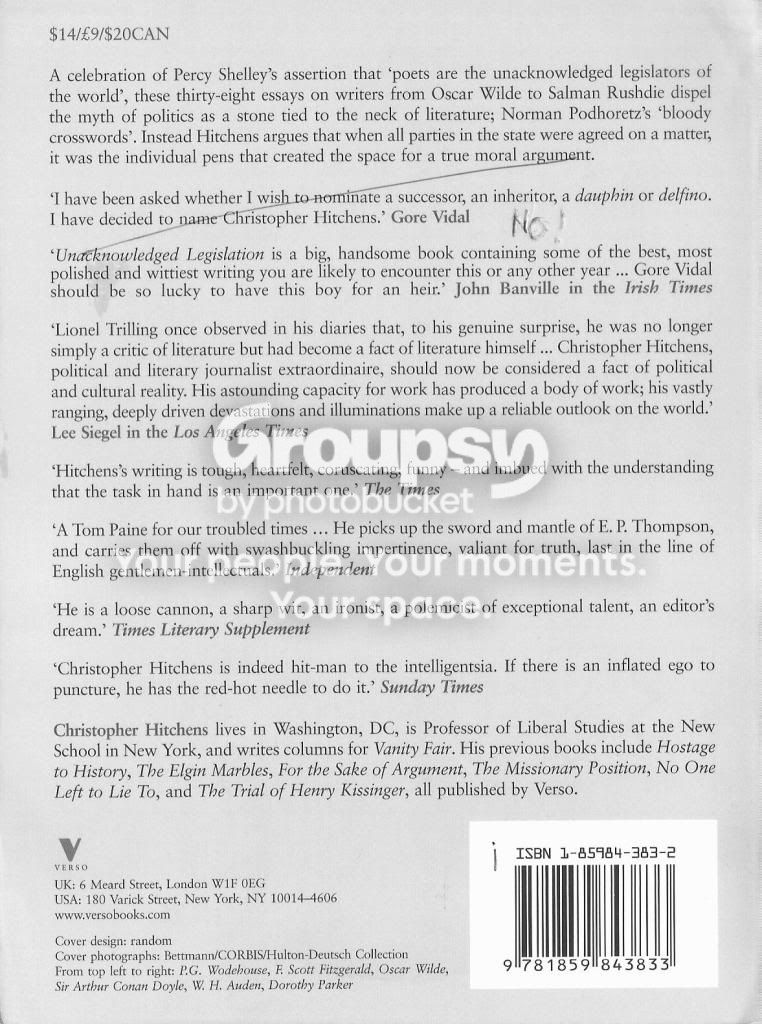
He probably didn’t have a web-site to market 
More seriously though, when it comes to books, lectures and so on, Dr. Peikoff’s potential market is people who are looking for further development of Rand’s ideas. It makes sense to stress that aspect, particularly when it is true (i.e. that most of what he has done is organize and elaborate Rand’s ideas).
Hmmm… it’s interesting. When speaking of an “intellectual heir” to Rand (in the sense you’ve meant), do I imagine someone who “organizes her ideas”? Or an intellectual of similar stature? The former, while perhaps necessary, sounds… somewhat uninspiring. Almost bureaucratic. No, I think that I’d be looking for something closer to the latter; a profound mind with an unparalleled command of reason and rhetoric. Someone able to take us the next step down the path that Atlas Shrugged, et al., began. Am I judging Peikoff unable to do such a thing? No. That would be unfair. But I’d at least say that I don’t think he’s yet accomplished anything worthy of being Rand’s “intellectual heir” on a historical scale.
To go back to Plato, we don’t speak today of all of his students or generally pronounce them Plato’s “intellectual heirs,” no matter how faithful they were to his initial teachings. Those who get mentioned, in my experience, do so on the basis of their own genius.
Regarding marketing… I see what you’re saying, and I mostly agree. Certainly he needs to reference Rand in some manner. But can we agree that, at best, “intellectual heir” is a problematic formulation? Objectivism’s strength above all is that it’s grounded in reason. When I hear “intellectual heir” and my reaction is “but no; one cannot inherit ideas; this is nonsensical,” then it seems to work contrary to its purpose, which is to entice Objectivism’s natural market – those who prefer their philosophy to make sense. In short, Peikoff’s styling himself as Rand’s “intellectual heir” has always made me less likely to approach him and his ideas, not more.
Further, it leads me to worry that Peikoff does really believe himself to be Rand’s intellectual heir in the sense of having received a unique title carrying special privileges. You can see that kind of viewpoint manifest in this thread, here:
Assuming you are talking about philosophical topics, I would conclude that only Peikoff is a true “expert.” […]
Peikoff cannot name a successor to him because he is not convinced that anyone else has his expertise.
And here:
Rand selected [Peikoff] as the “owner” of the philosophy, and he has been given the right to do the same.
Hierarchy at the “top” is important to guide the spread of the philosophy, to identify the errors of others, etc.
If Peikoff has similar views – and his use of “intellectual heir” at least puts me on notice that he may – then it will be hard to reconcile them with my beliefs that no one owns a philosophy, and that there is no hierarchical authority to “identify the errors of others” apart from my own mind. In my confusion, I might even conclude that Peikoff himself is irrational. Whatever he gains, marketing-wise, can’t be worth this, can it? And if he’s *really* Rand’s heir in the historical sense, then why not just market himself the same way that Rand marketed herself? Write things that shake people to their core and blast them with their honesty and insight. If he wrote Atlas Shrugged Pt. II (not literally that, but something on par, whether fiction or non-), do we think it wouldn’t sell today, for some reason? Or if he’s incapable of doing something like that, lacking the skill or the genius or etc… then–again–in what sense is he Rand’s “intellectual heir”?
Let him write Atlas Shrugged Pt. II. We’ll read it, and then, should it prove worthy, we’ll adjudge him (fairly) Rand’s “intellectual heir” in the sense that you’ve been supporting. But till then, his use of the term only raises fears in my mind (perhaps groundless?) that he believes himself to have some sort of special, particular “ownership” of Objectivism which is not, in truth, in reality, available to anyone.