Massive 8.9 Earthquake Japan. Major Tsunami hitting multiple islands/c

I found this today:

The radiation released, peaked at just over 3000 microSieverts (= 3 milliSieverts). Within a few hours it was down to 800 microSieverts. Source: HKN TV

What does that mean?

Ambient radiation, such as occurs on a sunny day, exposes one to about 1 - 4 milliSieverts.

Radiation sickness starts to show at 1-2 Sieverts —a 1000x higher exposure than ambient.

Even the peak Fukushima plant radiation emission only slightly exceeded common ambient levels. People are being evacuated and terrorized over a release not much more dangerous than a day at the beach.

Safety standards at nuclear plants call for levels below 5 milliSieverts, nearly 1,000th of the dose (1-2 Sv) that begins to cause radiation damage to humans. The standard is lower than is naturally found in some regions where generations of people have been living with no unusual cancers, e.g. Ramsar in Northern Iran - 260 milliSieverts.

Do you have a source for that?

Two things I notice about the news reports I’ve heard:

  • they speak of damage to the steel and concrete containment structure, but do not specify the nature of the damage. The containment structure is meant to take damage – that’s its job. The reports do not make clear if the structure is doing its job or not. They do add something to the effect that “it cannot be ruled out” that the structure is breached in some way, but it is not clear if this is in the "everything is ‘possible’ " sense, or if there is some shred of evidence that there is a breach
  • they speak of high radiation levels near the plant, and very low radiation (but higher than normal) levels around Tokyo, but they do not specify how near the plant they talking about. As far as I’m aware, the radiation level right at the plant can be very different from what is (say) three blocks away.

Al Jazeera and ABC news so far have had the most accurate and least sensational reporting on the nuclear situation from what I have seen so far, Drudge report being on the other end of the spectrum as extremely sensational. From what I understand the levels have risen and declined, but that its pretty much contained to close proximity. I think lower radiation has spread a fair bit however. ABC had stated a US military chopper quite a long distance out had gotten some soldiers with radiation that needed to be dealt with, but they didn’t clarify if the chopper had been closer earlier. I know yesterday they said something like 100 people had officially been tagged with radiation that needed to be scrubbed when they were doing screenings for people. Either way they are handing out pills and the like and basically doing everything they can think of to make sure all of their bases are covered.

@Sophia

If you could provide an actual source link that would be much appreciated, simply quoting that bit and telling us roughly where its from doesn’t do us much good.

The MIT NSE (Nuclear Science and Engineering) Information Hub page does not just contain the “Modified version of original post written by Josef Oehmen” (mentioned on the Objective Standard blog). It’s dedicated to information on the reactors.

So far:

Explanation of Hydrogen Explosions at Units 1 and 3

Damage to Fukushima Daiichi 2 [World Nuclear News]

Status Update – 3/14/11 at 1:00 pm EST (Source – The Federation of Electric Power Companies of Japan (FEPC))

Modified version of original post written by Josef Oehmen

Edit to add: From Explanation of Hydrogen Explosions at Units 1 and 3:

"Unit 2 explosion

Recent information indicates that unit 2 may have suffered a containment breach. Pressure relief of unit 2 was complicated by a faulty pressure relief valve, which complicated the injection of sea water and the evacuation of the steam and hydrogen. It is reported that the fuel rods were completely exposed twice. More details to follow."

The MIT site has been updated:

Unit 2 Explosion and Unit 4 Spent Fuel Pool Fire

Explosion at Unit 2

Fire at Unit 4 spent fuel pool

Reactor spent fuel pools

And a link to Information on the Japanese Earthquake and Reactors in That Region at the Nuclear Energy Institute (includes diagram of reactors).

NHK Tokyo, Japan Live TV

Do you have a source for that?

I read it on yahoo news canada site but I can’t find it again atm.

I think the calculation stands.

The highest number for radiation levels on the edge of the plant I could find was 8217 microsieverts per hour (if you herd a bigger number - you can just plug it in into the same calculation) and it was reported that that number dropped to a third after some short period of time.

But lets go with 8217 microsieverts=8 milliSieverts which is 3 above the safety standards at nuclear plants but still below the dose that begins to cause radiation damage to humans.

(100 mrem = 1 mS)

1 mrem = 10 micro Sv.

8milisieverts=800mrem

per hour

It would take 60h at the plant to reach light radiation sickness level.

Light radiation sickness begins at about 0.5–1 Sv or 50–100 rem or 50,000–100,000 mili rem.

document linked to wikipedia - ionizing radiation:


1 mrem Approximate daily dose from natural background radiation, including radon

2.5 mrem Cosmic dose to a person on a one-way airplane flight from New York to Los Angeles

10 mrem Annual exposure limit set by EPA for exposures from airborne

emissions from operations of nuclear fuel cycle facilities, including power

pants, uranium mines, and mills

66 mrem Average yearly dose to people in the United States from human-made sources

100 mrem Annual limit of dose from all DOE facilities to a member of the public who

is not a radiation worker

110 mrem Average occupational dose received by U.S. commercial radiation workers in 1980

244 mrem Average dose from an upper gastrointestinal diagnostic X-ray series

300 mrem Average yearly dose to people in the United States from all sources of natural

background radiation

1 to 5 rem Level at which EPA Protective Action Guidelines state that public officials

should take emergency action when this is a probable dose to a member of the

public from a nuclear accident

5 rem Annual limit for occupational exposure of radiation workers set by the U.S.

Nuclear Regulatory Commission and DOE

10 rem Estimated level at which an acute dose would result in a lifetime

excess risk of death from cancer 0.8%

25 rem EPA guideline for voluntary maximum dose to emergency workers for

non-lifesaving work during an emergency

75 rem EPA guideline for maximum dose to emergency workers volunteering for

lifesaving work

50 to 600 rem Level at which doses received over a short period of time produce

radiation sickness in varying degrees. At the lower end of this range, people

are expected to recover completely, given proper medical attention. At the top

of this range, most people will die within 60 days
Update at the MIT site:

A Primer on Spent Fuel Pools

Spent nuclear fuel pools

Sophia, you are right about the levels measured in Tokyo (and the so called exposure to foreign rescue workers, and US soldiers on the carriers offshore) being entirely insignificant. The coverage of both amounts to scare mongering by the media.

But there are some inexact claims in the quote you posted:

Ambient radiation, such as occurs on a sunny day, exposes one to about 1 - 4 milliSieverts.

That’s misleading. Ambient radiation exposes one to that amount of radiation damage in a year, not a day. In contrast, the levels at Fukushima are usually reported in mS/hour, or microS/hour, from what I noticed.

The exposure from those levels should be added up for each hour, to determine the overall exposure of a person, and compare it to the overall natural exposure of the average earthling in a year. As far as the workers at the plant go, that math will result in dangerous levels of exposure.

Safety standards at nuclear plants call for levels below 5 milliSieverts, nearly 1,000th of the dose (1-2 Sv) that begins to cause radiation damage to humans. The standard is lower than is naturally found in some regions where generations of people have been living with no unusual cancers, e.g. Ramsar in Northern Iran - 260 milliSieverts.

260mS would be the radiation one would be exposed to if they spent the entire year in the most radioactive spring itself. People living in the area are exposed to about 10mS/year, five times the global average.

Also, the highest level of radiation measured at the plant site was of 1000 mS/hour, this (Wednesday) morning. One hour of exposure to that is enough to cause radiation sickness. That’s why the plant was evacuated, and they plan on using helicopters and fire trucks to keep spraying water instead.

According to this pro-nuclear blog, the situation appears to be stabilizing. The most important question seems to be whether there is good reason to suspect that the containment retains its integrity.

The repeated hydrogen explosions at all of the reactor structures is evidence of the loss of water covering fuel rods, fuel rods in a reactor core and fuel rods in a storage pool. The fuel rods in a spent fuel storage pool are actually located in the superstructure of the buildings not at ground level. According to the MIT NSE website the spent fuel storage pools are located inside the containment structure. In order for the storage pool to be refilled with water, leaks would have to be repaired from inside the containment or water would have to poured into the pool faster than the sum of the leakage rate and the boil off rate.

My speculations:

  1. Nobody is going to go inside the containment because radiation levels are now too high. No repairs will be made from inside.

  2. Water replenishment piping is damaged or of too low capacity to supply water fast enough to refill the pool or even cover the rods again.

  3. Attempting to refill the pool at slow rates simply supplies more water that gets split into H2 and O2 gasses which explode again.

  4. Zircaloy cladding is coming off the fuel rods, deduced from the hydrogen explosions, the spikes in radiation levels and the radioisotopes detected.

  5. There is no way to fix this.

edit: This is mostly pertaining to Dai-ichi #4.

The reactors aren’t critical, there’s no fission going on. Decay heat production will decrease over time, until eventually the water will stop boiling altogether. All they have to do to prevent a total melting of the core is to continue pumping sea water until that happens.

  1. Attempting to refill the pool at slow rates simply supplies more water that gets split into H2 and O2 gasses which explode again.

That definitely won’t happen. The radiolysis of water is very different from electrolysis (the reaction you’re describing). It results in H2, H2O2, and some other stuff (H, HO radicals, etc.), but no O2. The reason for these explosions was the mixing of hydrogen released from the reactor with oxygen outside of it. The explosions did not occur inside the containment.

Also, the highest level of radiation measured at the plant site was of 1000 mS/hour, this (Wednesday) morning. One hour of exposure to that is enough to cause radiation sickness.

The numbers I saw were in micro SV not mili SV. In today’s paper:

The government’s nuclear safety agency said the radiation levels briefly reached 10 millisievert per hour at the plant’s entrance at 10:40 am local time, but added that it was possibly due to radioactive substances emitted from the No. 2 reactor.

That is 10mSv not 1000mSv.

I am not against taking precautions - I was trying to put the numbers in the right perspective. Here in BC some people started stockpiling potassium iodide and of course papers started reporting that.

That definitely won’t happen. The radiolysis of water is very different from electrolysis (the reaction you’re describing). It results in H2, H2O2, and some other stuff (H, HO radicals, etc.), but no O2. The reason for these explosions was the mixing of hydrogen released from the reactor with oxygen outside of it. The explosions did not occur inside the containment.

The current plan is to put water onto the spent fuel pools of units #3 and #4 by the crude means of a helicopter dumping water or a riot control water cannon truck.

A MIT NSE post states that “The pools are often located near the reactor (in the upper floors of the containment structure for a BWR Mark-1 containment).”

Therefore the containment structures are breached.

Regardless of whether the explosions that breached the containment structures were initially inside or outside the containment structures, there is now free admixture of gasses inside and outside of what was the containment. The normal atmospheric proportion of oxygen is present throughout the structure even if radiolysis is not a significant source of free oxygen gas. If enough of the structure has been destroyed and cleared away and the winds are high enough, then perhaps the hydrogen concentration can be kept below the lower explosive limit for an H2 O2 gas mixture. The plant’s location on the coast ensures that there are frequently sea breezes blowing.

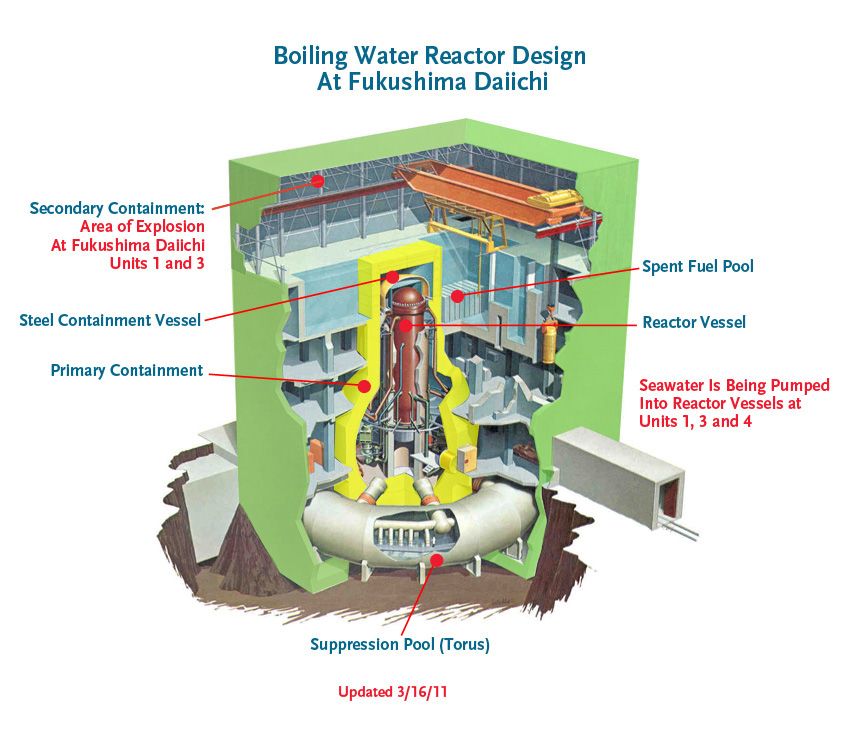
An image that helps to understand what’s occuring: Boiling Water Reactor Design At Fukushima Daiichi

From the MIT site’s post, “Modified version of original post written by Josef Oehmen”

First & Second Barriers : “The solid fuel pellet (a ceramic oxide matrix) is the first barrier that retains many of the radioactive fission products produced by the fission process.  The Zircaloy casing is the second barrier to release that separates the radioactive fuel from the rest of the reactor.”

Third Barrier : “The core [above] is then placed in the pressure vessel. The pressure vessel is a thick steel vessel that operates at a pressure of about 7 MPa (~1000 psi), and is designed to withstand the high pressures that may occur during an accident. The pressure vessel is the third barrier to radioactive material release.”

Fourth Barrier : "The entire primary loop of the nuclear reactor – the pressure vessel, pipes, and pumps that contain the coolant (water) – are housed in the containment structure.  This structure is the fourth barrier to radioactive material release. The containment structure is a hermetically (air tight) sealed, very thick structure made of steel and concrete. This structure is designed, built and tested for one single purpose: To contain, indefinitely, a complete core meltdown. To aid in this purpose, a large, thick concrete structure is poured around the containment structure and is referred to as the secondary containment.

Both the main containment structure and the secondary containment structure are housed in the reactor building. The reactor building is an outer shell that is supposed to keep the weather out, but nothing in. (this is the part that was damaged in the explosions, but more to that later)."

NHK TV news feed in English translation via nico nico. Was showing the helicopters in action.

edit: Broadcast is live from minutes 00-30 of every hour, repeat recording of last half hour from 30-00.

New posts at MIT NSE:

Introduction to Radiation Health Effects and Radiation Status at Fukushima

What is radiation? Where does it come from and what is it used for?

Ionizing radiation and its effects on the human body

What are the health effects of various doses/dose rates?

Radiation released from reactors at Fukushima and what it means

How to minimize radiation exposure

Radiation dose rate history at the Fukushima Daiichi site perimeter

Helicopters Dropping Water on Affected Reactors

Detailed document (PDF) on the design of the Boiling Water Reactor (BWR) Systems from the Nuclear Energy Institute

That NEI site has a page dedicated to “Information on the Japanese Earthquake and Reactors in That Region”

The fuel in the spent fuel pools is the concern now. This is outside of the pressure vessel and primary containment, and the secondary containment is breached.