Metaphysics, once a queen, now a slave: physiological gatekeeping

Ayn Rand made metaphysics, once the queen of the sciences, a slave to the senses: stripped of her crown, forced to fetch data for the senses.

That last phrase is a more or less poetic or figurative statement, not meant to be taken in the strict literal sense. The rest is definitely metaphorical. “Once the queen of the sciences” obviously comes from Kant.

I’m not saying that the senses literally force metaphysics to fetch data for them. It says that Rand repurposed metaphysics to “serve” us sensory, empirical data, and systematically, to feed data, validated by perception, to epistemology for thinking. Metaphysics governs knowledge in the sense that it determines the first proper channel toward determining truth, which is via the senses. Thus it eliminates other potential channels for data, such as faith, intuition (not Kantian intuition), revelation, or mystical insight, which do not partake in the senses. Metaphysics does not literally serve data, but it does delimit what data counts as valid for thinking. 

In a sense, Rand turned metaphysics into a customs officer, sitting at the border between sensing and reasoning, denying entry to data that lacks the appropriate credentials. It is a gatekeeper for reason. Metaphysics is no longer grounds from which truths are generated, but as a regulator of the proper way to determine truths. Metaphysics, for Rand, is negative: it puts up a palm and says, “Only this far, and no farther.”

This results in what can be called “physiological gatekeeping.” This implies that those who are blind, deaf, or neurologically divergent aren’t allowed to engage in the epistemological process. And people who report meaningful albeit unverifiable insights from imagination and intuition, as well as aesthetic or spiritual experiences, are excluded from Ayn Rand’s framework. If someone says they “heard it from God,” that person is automatically dismissed. And even if 1,000,000 people get together to state that they heard God’s voice, they are also automatically dismissed because they are either liars or delusional. Their physiology or psychology does not match the proper model for determining truths. Rand’s epistemological apartheid determines who is right, therefore good, and who is wrong, and not just wrong, but wrong-headed therefore evil. The thinking methods of the vast majority of humans is delegetimized by Randian metaphysics. They are epistemologically corrupt humans. 

For Rand, human greatness is thus affirmed, but only on the condition that you are not like most humans. 


41 minutes ago, Cave_Dweller said:

This implies that those who are blind, deaf, or neurologically divergent aren’t allowed to engage in the epistemological process.

No, such people can still use whatever senses they have.

What are your grounds for including “neurologically divergent”?

45 minutes ago, Cave_Dweller said:

For Rand, human greatness is thus affirmed, but only on the condition that you are not like most humans.

Someone who believes in “God” or otherwise uses faith is making a very bad mistake, but may still be capable of greatness.


On 4/6/2025 at 5:56 PM, Doug Morris said:

No, such people can still use whatever senses they have.

What are your grounds for including “neurologically divergent”?

Someone who believes in “God” or otherwise uses faith is making a very bad mistake, but may still be capable of greatness.


Your last comment reaches toward the extreme of what Rand’s axioms are implying about the blind, deaf, and neurodivergent. Her metaphysics lays down the rules for thinking. The primacy of the senses is one of those, of course. Faith in God is the extreme case that requires no sensory data at all. The blind and deaf have invalid senses simply because one of them doesn’t work. Rand’s metaphysics and ITOE don’t comment on these cases at all, leaving, in the case of the blind, an epistemic blind spot in her theory in which sight is given top priority as evidenced by measurement-omission. 

The deaf weren’t raised to use words in the 1950s to 60s, only signs and, as I’ve seen for myself, miming (moving their bodies around to communicate an idea). And while I’m sure the 21st century has developed our conceptions of deaf people’s capabilities, including the ability to learn higher educational degrees, this understanding was sadly lacking in the 1950s - 60s. So Rand’s theories leaves a deaf spot for the hearing impaired.

Rand’s system assumes a neurotypical cognitive functioning. The neurodivergent often perceive differently, cognize differently, are better with pattern-recognition, intuition, and non-linear (lateral) thinking. The neurodivergent don’t focus on details first - which is a requirement for Randian epistemology. They focus on the big picture first. They conceptualize through images, impressions, and kinesthetic impressions. They make intuitive leaps. Are highly spatial in their reasoning and not so much verbal, whereas Rand’s epistemology is conceptual (verbal). 

Rand’s epistemology and metaphysics reflect Rand’s preferred way of thinking, not necessarily everybody else’s, including those who are otherwise functional humans. 

Rand would disagree with you that someone who believes in God is capable of greatness. Faith in God, for Rand, is incompatible with reason. Faith in God requires dependence upon a higher power, which goes against individualism. Religions also disvalue earthly achievements. Greatness, for Rand, is either accomplished through a self-driven mode of achievement, or else the result will be something that is not the product of greatness. 


This Objectivist questions the idea that “gatekeeping” is one of his tactics, but then in the end he uses it.

Ayn Rand on Helen Keller:

I suggest that you consider what an enormous intellectual feat Helen Keller had to perform in order to develop a full conceptual range (including a college education, which required more in her day than it does now),

2 hours ago, Cave_Dweller said:

Rand would disagree with you that someone who believes in God is capable of greatness.

Ayn Rand considered Victor Hugo and Fyodor Dostoevsky to be great authors well worth reading.  Both believed in “God”.


19 minutes ago, Doug Morris said:

Quote


Ayn Rand on Helen Keller:

I suggest that you consider what an enormous intellectual feat Helen Keller had to perform in order to develop a full conceptual range (including a college education, which required more in her day than it does now),


Helen Keller is an excellent example of the refutation of knowledge as limited to conventional sense perception. Broadening Rand’s theory of concept-formation would be required to remove the refutation. 

Quote

Ayn Rand considered Victor Hugo and Fyodor Dostoevsky to be great authors well worth reading.  Both believed in “God”.

This is another example of Ayn Rand refuting herself. 


CD says that “metaphysics, for Rand, is negative: it puts up a palm and says, ‘Only this far, and no farther’.” Well, no, that is not what metaphysics is most fundamentally for Rand.

It is written that “metaphysics is nothing other than the philosophy of the fundamental principles of our cognition.” But that was not written by Rand; rather, by some pre-Kantian German philosopher, one with some influence on Kant. There have been thinkers who think in the way CD would have us believe is Rand’s thought. But no, Rand’s fundamental conception of metaphysics did not involve guidance for good thinking.

Rand’s was in the tradition of Aristotle’s metaphysics as “the study of being as being” which is known to any beginning philosophy student. Hers is even not terribly far from Christian Wolff’s idea of general metaphysics as a “science of being in general, or insofar as it is being.”  Rand’s conception of metaphysics most fundamentally is “the study of existence as such.”

CD has it that “Rand repurposed metaphysics [from what model epoch?] to ‘serve’ us sensory, empirical data, and systematically, to feed data, validated by perception, to epistemology for thinking. Metaphysics governs knowledge in the sense that it determines the first proper channel toward determining truth, which is via the senses.” Could we have some specific text of Rand’s supporting the proposal of this as her view?

Some philosophies have metaphysical axioms. They never have the same role as axioms in geometry. They can be closer to the very different role of axioms in an area of physics when those are put into an axiomatic organization of the area, such as mechanics or thermodynamics. Rand’s philosophy has metaphysical axioms. Not put to work as in geometry or in physics. She portrayed her metaphysical axioms as “touchstones” of knowledge. From her metaphysics, one can, for one utility, look at other metaphysics and see places it goes wrong. There was a metaphysics that began with the concept of “nothing” which it took as whatever is contradictory. It then defined “something” as that which is not nothing. That is contorted and not in tune with what is prior to what, logically and in order of learning. So sayeth one in step with Rand (and many other philosophers) on the priority of general existence over nonexistence.

One can have various special interests for taking up metaphysics. On might be led to it from religious training, of course. When we die, do we go on existing but in some new form? or do we just go clean out of existence? One might have a sense that there is something metaphysical about great sculpture and come looking into metaphysics. One might come looking from interests in mathematics or science. Or ethics. But metaphysics is not something parasitic on those things (though it should certainly be informed by physical sciences and rightly situated with them). Nor is it parasitic on epistemology. It is needed for right epistemology as it is needed for right comprehension in so many arenas. But to challenge Rand’s metaphysics, challenge it head-on. Lock horns with the metaphysics itself. Refute any arguments that have been offered, for example, showing that certain metaphysical tenets cannot be denied without self-contradiction. Talking about a metaphysics as screening for this or that mistaken source of knowledge is not getting on the diamond and actually playing ball.

1 Like

1 hour ago, Boydstun said:

CD says that “metaphysics, for Rand, is negative: it puts up a palm and says, ‘Only this far, and no farther’.” Well, no, that is not what metaphysics is most fundamentally for Rand.

It is written that “metaphysics is nothing other than the philosophy of the fundamental principles of our cognition.” But that was not written by Rand; rather, by some pre-Kantian German philosopher, one with some influence on Kant. There have been thinkers who think in the way CD would have us believe is Rand’s thought. But no, Rand’s fundamental conception of metaphysics did not involve guidance for good thinking.

Rand’s was in the tradition of Aristotle’s metaphysics as “the study of being as being” which is known to any beginning philosophy student. Hers is even not terribly far from Christian Wolff’s idea of general metaphysics as a “science of being in general, or insofar as it is being.”  Rand’s conception of metaphysics most fundamentally is “the study of existence as such.”

CD has it that “Rand repurposed metaphysics [from what model epoch?] to ‘serve’ us sensory, empirical data, and systematically, to feed data, validated by perception, to epistemology for thinking. Metaphysics governs knowledge in the sense that it determines the first proper channel toward determining truth, which is via the senses.” Could we have some specific text of Rand’s supporting the proposal of this as her view?

Some philosophies have metaphysical axioms. They never have the same role as axioms in geometry. They can be closer to the very different role of axioms in an area of physics when those are put into an axiomatic organization of the area, such as mechanics or thermodynamics. Rand’s philosophy has metaphysical axioms. Not put to work as in geometry or in physics. She portrayed her metaphysical axioms as “touchstones” of knowledge. From her metaphysics, one can, for one utility, look at other metaphysics and see places it goes wrong. There was a metaphysics that began with the concept of “nothing” which it took as whatever is contradictory. It then defined “something” as that which is not nothing. That is contorted and not in tune with what is prior to what, logically and in order of learning. So sayeth one in step with Rand (and many other philosophers) on the priority of general existence over nonexistence.

One can have various special interests for taking up metaphysics. On might be led to it from religious training, of course. When we die, do we go on existing but in some new form? or do we just go clean out of existence? One might have a sense that there is something metaphysical about great sculpture and come looking into metaphysics. One might come looking from interests in mathematics or science. Or ethics. But metaphysics is not something parasitic on those things (though it should certainly be informed by physical sciences and rightly situated with them). Nor is it parasitic on epistemology. It is needed for right epistemology as it is needed for right comprehension in so many arenas. But to challenge Rand’s metaphysics, challenge it head-on. Lock horns with the metaphysics itself. Refute any arguments that have been offered, for example, showing that certain metaphysical tenets cannot be denied without self-contradiction. Talking about a metaphysics as screening for this or that mistaken source of knowledge is not getting on the diamond and actually playing ball.

I locked horns with Rand’s metaphysics in a previous thread recently, where I stated that she leaped from the realm of logic to the realm of metaphysics without justifying that leap. 

You should re-read the material you wrote above to see where Rand generated axioms and corollaries for the purpose of validating knowledge. As “touchstones of knowledge,” her metaphysical axioms are used to determine what constitutes knowledge. The axioms are regulating the knowledge-gathering process. They are gatekeepers for the knowledge-gathering process. Touchstones are standards of validation. Metaphysics became a frozen regulatory structure.  

Yes, she did write that metaphysics is the study of existence as such. However, that’s as far as it went. No studying was actually carried out. From that point, it was all about regulating knowledge. She asserted a tiny set of axioms, declared them self-evident and irreducible, and then reoriented metaphysics away from studying existence qua existence and toward regulating epistemology. Metaphysics for Objectivism is not a field of study in its own right, but a prohibitor of metaphysical inquiry. 

From what epoch did other forms of metaphysics appear? All of them, I think. From the ancient Greeks to the present day. Even the anti-metaphysics of the postmoderns is doing metaphysics in a way, because by rejecting metaphysics they are at least engaging in it. 

Here is a list of the epochs in which metaphysics was studied in its original form, as a science:

  1. Ancient Greek metaphysics, Epoch: ~600 BC – 300 BC.
    2. Medieval metaphysics, Epoch: ~300 AD – 1500 AD.
    3. Early modern rationalist metaphysics, Epoch: 1600–1750 AD.
    4. Empiricism and skepticism (still doing metaphysics), Epoch: 1600–1800 AD.
  2. Kantian criticism: Metaphysics of Morals, late 18th century.
    6. 19th Century Idealism.
    7. Analytic Metaphysics, Phenomenology and Existentialism, and Postmodernism Anti-Metaphysics, 20th - 21st century. 


1 Like

And at 6.5 we should have at least Whitehead. In 7 it is the “analytic metaphysics” that’s got the substance and adventure today and for a long time now. * And something like that can be done with Rand’s metaphysical layout. The philosophy is there, and it can be developed in creative analyses and compared with other philosophies, analyses and comparisons and connections never closely done to this point. (Excepting my regular work for 35 years now*****). There is a chapter on the Objectivist metaphysics in The Blackwell Companion to Ayn Rand, by a professional philosopher. What is wrong with arguing with that as a layout of the sort you (and I) are interested in? Is it nothing worthwhile on Rand’s philosophy to critique because not written by Rand? That would be a wooden-headed way to figure out what was Euclidean geometry and what was other geometry, merely Was it written by Euclid?

And there is the work I have done in analyses of Rand’s metaphysics. Thomas was right: “Being is divided in various ways.” So there goes the layout of the divisions in Rand’s metaphysics I have made in the past: actual/potential; concrete/abstract; categories of entity/action/attribute/relationship. Then there is my attempt on the relations between Rand’s entity and Arisotle’s ousia. And my original arguments for the axiomatic qualifications of the varieties in which Rand’s “Existence is Identity” is cast under her categoreal division, her categories.

* _–A World of States of Affairs;The Four Category Ontology; Metaphysics, Meaning, and Modality; Metaphysical Emergence; The Fragmentation of Being; Writing the Book of the World; Metaphysics and Science; The Metaphysics within Physics; A Metaphysics for Scientific Realism; Combining Science and Metaphysics; Why Science Needs Metaphysics; Scientific Metaphysics; Form, Matter, Substance; Contemporary Aristotelian Metaphysics. _These volumes are strewn around my library and give the lie to the idea that irrationalism and postmodernism are what is the order of the day in contemporary Anglo-American philosophy, even leaving aside all the tremendous work that has also been done the last few decades in Anglo-American studies of classical philosophies. Close comparison of any of these with Rand’s metaphysics can be illuminating, just staying with what are fundamentals of Rand’s metaphysics.


On 4/6/2025 at 11:33 PM, Cave_Dweller said:

I locked horns with Rand’s metaphysics in a previous thread recently, where I stated that she leaped from the realm of logic to the realm of metaphysics without justifying that leap. 

. . .


Requirement of leaps between logic and metaphysics is already presuming settlement of issues debated across the history of logic. In Objectivist scholarship, the serious beginning is Leonard Peikoff’s dissertation (AB). Illuminating debate continues: Categories of Being – Essays on Metaphysics and Logic (2012). I continue to study the history of logic and this contested relationship (work with Bolzano and on Kant is within here and here) and proper location of Rand’s thought within it. 


CD, Rand’s thoughts in metaphysics surely do unfold hand over hand with interest in epistemology in Galt’s Speech and in ITOE (and in “Kant versus Sullivan” perhaps). I want to mention to you that it also unfolds hand over hand (so three hands really) with interest in value theory in Galt’s Speech, in “The Metaphysical versus the Manmade,” and in “Causality versus Duty.” It remains that there is a flat general metaphysics layout in her philosophy, which can be examined and debated, and a second layer of metaphysics entering with the entry of life in an inanimate world. There is a doubling back I’ve suggested from the latter to the former. It is plausibly consistent with what Rand wrote, but my own addition. That is that disjunction is not in a world without life. Conjunction is, but disjunction not. So standard conversions between the two are really crossing realms in an utterly silent way. I don’t know any problem from that logical convertibility silence, but it is stuff for me to think over in the future. Also, I have maintained that class membership is not something in the world, but an effective tool of thought over the world. I think you have also said something along this line. Rand’s distinctive structure for empirical concepts in terms of magnitude structural relations are dimensioned classes. Magnitude structures (think synthetic geometry) and perceptual-level similarities can be in the mind-independent world (even comparative similarities), but the membership relation is only a powerful tool in the head. Then too, the mere substitutional sense of ‘A is A’ is only a susceptibility in the world for mapping self to self by any sufficient intelligence arriving. A is A in the predicative sense of “a thing is something specific” or “or a thing is a certain what” is, on the other hand, character in the world even without any discernment of it.

14 hours ago, Cave_Dweller said:

Ayn Rand made metaphysics, once the queen

Not queen. God. Mystic philosophers use metaphysics the exact same way religious leaders use a god: as an arbitrarily formulated entity that must never be questioned. And they assume the same role religious leaders assume: that of prophets. Messengers of that god. People who are uniquely able to know that god, and are never to be questioned by those who lack that mystical ability.

Rand, as a rational philosopher, declares all philosophy subject to rational inquiry, and the product of each individual’s rational inquiry. ONLY the product of each individual’s rational inquiry. NEVER the product of another’s revelation, never to be accepted on faith.

Not sure what metaphor that deserves, in fact I’m pretty sure we should dispense with the flourishes and just say that Ayn Rand considered philosophy the most important endeavor there is, and she thought that every rational individual should prioritize developing their personal philosophy.

P.S. If you wish to use metaphors, Rand changed who gets to rule philosophy. She removed Kant and all the academic philosophers who follow him from the role of supreme rulers (and I’m happy to refer to the whole lot of them as old queens, if that’s the term you wish to insist on), and placed the individual in charge instead. She democratized philosophy … not in the sense that she gave the majority the right to create philosophy, but in the sense that she gave the individual that right.

It worked like a charm, btw. Rand, by herself, is currently more popular than all of academic philosophy combined. Her only challenger in terms of copies sold is that idiot Harari … but everyone who reads his books forgets the trite that’s in them the second they finish. Go ahead, test this: try to think of something insightful Harari said, off the top of your head. Good luck. Also, the only reason he sells anything is because he disguised his bestseller as history. If people knew it was just trite academic philosophy, no one would’ve bought it.

That of course no longer works. So the newest thing many of them are trying now is packaging the same nonsense as “the ancient philosophy of Stoicism”. And sure, it moves some copies, because Stoicism (actual Stoicism, like the stuff that Daily Stoic dude talks about on Youtube) is interesting. But the “Stoicism” books the academics are coming out with are more Marxism than Stoicism.

Materialist and religionist metaphysicians are both dualist, Rand implicitly. In religious framing the soul or the self is a separate entity from god or the supreme soul and the materialists see consciousness(awareness) as an entity distinct from the universe of matter the ultimate source of truth.

All the cool kids are are bailing on materialism, just like the physicists post quantum. I bet there were more copies of the Bible and the Bhagavad Gita at Los Alamos than other works.

19 hours ago, Cave_Dweller said:

The neurodivergent often perceive differently, cognize differently, are better with pattern-recognition, intuition, and non-linear (lateral) thinking. The neurodivergent don’t focus on details first - which is a requirement for Randian epistemology. They focus on the big picture first. They conceptualize through images, impressions, and kinesthetic impressions. They make intuitive leaps. Are highly spatial in their reasoning and not so much verbal, whereas Rand’s epistemology is conceptual (verbal). 

It is possible to come up with ideas in a variety of ways, including the ones you attribute to the neurodivergent.  Ayn Rand is not denying or contradicting or criticizing this in any way.  But to prove anything about how good or bad an idea is, or in what ways, we need conceptual analysis.  (If the conceptual analysis is simple, it may be hard to distinguish from insight.)


Isn’t that what Kant was on about?

On 4/7/2025 at 2:49 PM, Doug Morris said:

It is possible to come up with ideas in a variety of ways, including the ones you attribute to the neurodivergent.  Ayn Rand is not denying or contradicting or criticizing this in any way.  But to prove anything about how good or bad an idea is, or in what ways, we need conceptual analysis.  (If the conceptual analysis is simple, it may be hard to distinguish from insight.)


You need conceptual analysis, and the neurodivergent don’t exactly excel at this. So while people can come up with ideas in a variety of ways, some of these ideas can’t be self-validated. 


On 4/7/2025 at 6:55 AM, stansfield123 said:

Not queen. God. Mystic philosophers use metaphysics the exact same way religious leaders use a god: as an arbitrarily formulated entity that must never be questioned. And they assume the same role religious leaders assume: that of prophets. Messengers of that god. People who are uniquely able to know that god, and are never to be questioned by those who lack that mystical ability.

Rand, as a rational philosopher, declares all philosophy subject to rational inquiry, and the product of each individual’s rational inquiry. ONLY the product of each individual’s rational inquiry. NEVER the product of another’s revelation, never to be accepted on faith.

Not sure what metaphor that deserves, in fact I’m pretty sure we should dispense with the flourishes and just say that Ayn Rand considered philosophy the most important endeavor there is, and she thought that every rational individual should prioritize developing their personal philosophy.

P.S. If you wish to use metaphors, Rand changed who gets to rule philosophy. She removed Kant and all the academic philosophers who follow him from the role of supreme rulers (and I’m happy to refer to the whole lot of them as old queens, if that’s the term you wish to insist on), and placed the individual in charge instead. She democratized philosophy … not in the sense that she gave the majority the right to create philosophy, but in the sense that she gave the individual that right.

It worked like a charm, btw. Rand, by herself, is currently more popular than all of academic philosophy combined. Her only challenger in terms of copies sold is that idiot Harari … but everyone who reads his books forgets the trite that’s in them the second they finish. Go ahead, test this: try to think of something insightful Harari said, off the top of your head. Good luck. Also, the only reason he sells anything is because he disguised his bestseller as history. If people knew it was just trite academic philosophy, no one would’ve bought it.

That of course no longer works. So the newest thing many of them are trying now is packaging the same nonsense as “the ancient philosophy of Stoicism”. And sure, it moves some copies, because Stoicism (actual Stoicism, like the stuff that Daily Stoic dude talks about on Youtube) is interesting. But the “Stoicism” books the academics are coming out with are more Marxism than Stoicism.

That “queen” reference comes from “Metaphysics, however, has always been the queen of the sciences.”
(Critique of Pure Reason, A ix). I’m not aware of any philosophers who treated metaphysics like a god; rather, metaphysics was treated like a pure authority. But they do have arbitrarily formed entities that are part of the rationalist tradition of philosophy. I don’t know, however, that starting with the senses, as Rand and Locke, is any less arbitrary. Their justifications for this grounding are weak, because it means starting with subjective impressions. They may be valid subjective impressions, but they are still subjective. It is like saying that the external world put something in us that we call real. 

For Locke, the external (and internal) world impresses itself upon our tabula rasa minds, but he didn’t explain very well how these impressions become knowledge. Furthermore, his starting-place with a hypothetical “tabula rasa” blank slate mind isn’t exactly scientific. It wasn’t, and has never been, scientific fact. So, even as a champion of empiricism, his starting-point is just as arbitrary as that of the rationalist school. 

Similarly, Rand insisted that perception gives us reality directly, but she too glosses over the mechanism of how the mind can abstract concepts such as entity or identity from raw perception without some interpretive framework already being in place. Her claim that “existence exists” is meant to be self-evident, but it doesn’t solve the deeper issue of why we call what we perceive “real” rather than just experienced.


On 4/7/2025 at 1:28 AM, Boydstun said:

And at 6.5 we should have at least Whitehead. In 7 it is the “analytic metaphysics” that’s got the substance and adventure today and for a long time now. * And something like that can be done with Rand’s metaphysical layout. The philosophy is there, and it can be developed in creative analyses and compared with other philosophies, analyses and comparisons and connections never closely done to this point. (Excepting my regular work for 35 years now*****). There is a chapter on the Objectivist metaphysics in The Blackwell Companion to Ayn Rand, by a professional philosopher. What is wrong with arguing with that as a layout of the sort you (and I) are interested in? Is it nothing worthwhile on Rand’s philosophy to critique because not written by Rand? That would be a wooden-headed way to figure out what was Euclidean geometry and what was other geometry, merely Was it written by Euclid?

And there is the work I have done in analyses of Rand’s metaphysics. Thomas was right: “Being is divided in various ways.” So there goes the layout of the divisions in Rand’s metaphysics I have made in the past: actual/potential; concrete/abstract; categories of entity/action/attribute/relationship. Then there is my attempt on the relations between Rand’s entity and Arisotle’s ousia. And my original arguments for the axiomatic qualifications of the varieties in which Rand’s “Existence is Identity” is cast under her categoreal division, her categories.

* _–A World of States of Affairs;The Four Category Ontology; Metaphysics, Meaning, and Modality; Metaphysical Emergence; The Fragmentation of Being; Writing the Book of the World; Metaphysics and Science; The Metaphysics within Physics; A Metaphysics for Scientific Realism; Combining Science and Metaphysics; Why Science Needs Metaphysics; Scientific Metaphysics; Form, Matter, Substance; Contemporary Aristotelian Metaphysics. _These volumes are strewn around my library and give the lie to the idea that irrationalism and postmodernism are what is the order of the day in contemporary Anglo-American philosophy, even leaving aside all the tremendous work that has also been done the last few decades in Anglo-American studies of classical philosophies. Close comparison of any of these with Rand’s metaphysics can be illuminating, just staying with what are fundamentals of Rand’s metaphysics.

However, I don’t know how influential those books are. Postmodernism rules the day. 

I haven’t read _The Blackwell Companion to Ayn Rand. _If I can locate a copy that doesn’t cost a small fortune, I’ll take a gander at it.

Quote

That would be a wooden-headed way to figure out what was Euclidean geometry and what was other geometry, merely Was it written by Euclid?

Not even Leonard Peikoff is that wooden-headed. 

As you no doubt know, Aristotle was less then clear regarding what he meant by ouisia. But it is likely just another product of our cognitive processes being projected onto reality. 

On 4/7/2025 at 2:49 PM, Doug Morris said:

It is possible to come up with ideas in a variety of ways, including the ones you attribute to the neurodivergent.  Ayn Rand is not denying or contradicting or criticizing this in any way.  But to prove anything about how good or bad an idea is, or in what ways, we need conceptual analysis.  (If the conceptual analysis is simple, it may be hard to distinguish from insight.)


Can anybody give a detailed conceptual analysis of “existence exists” and “consciousness is conscious”?
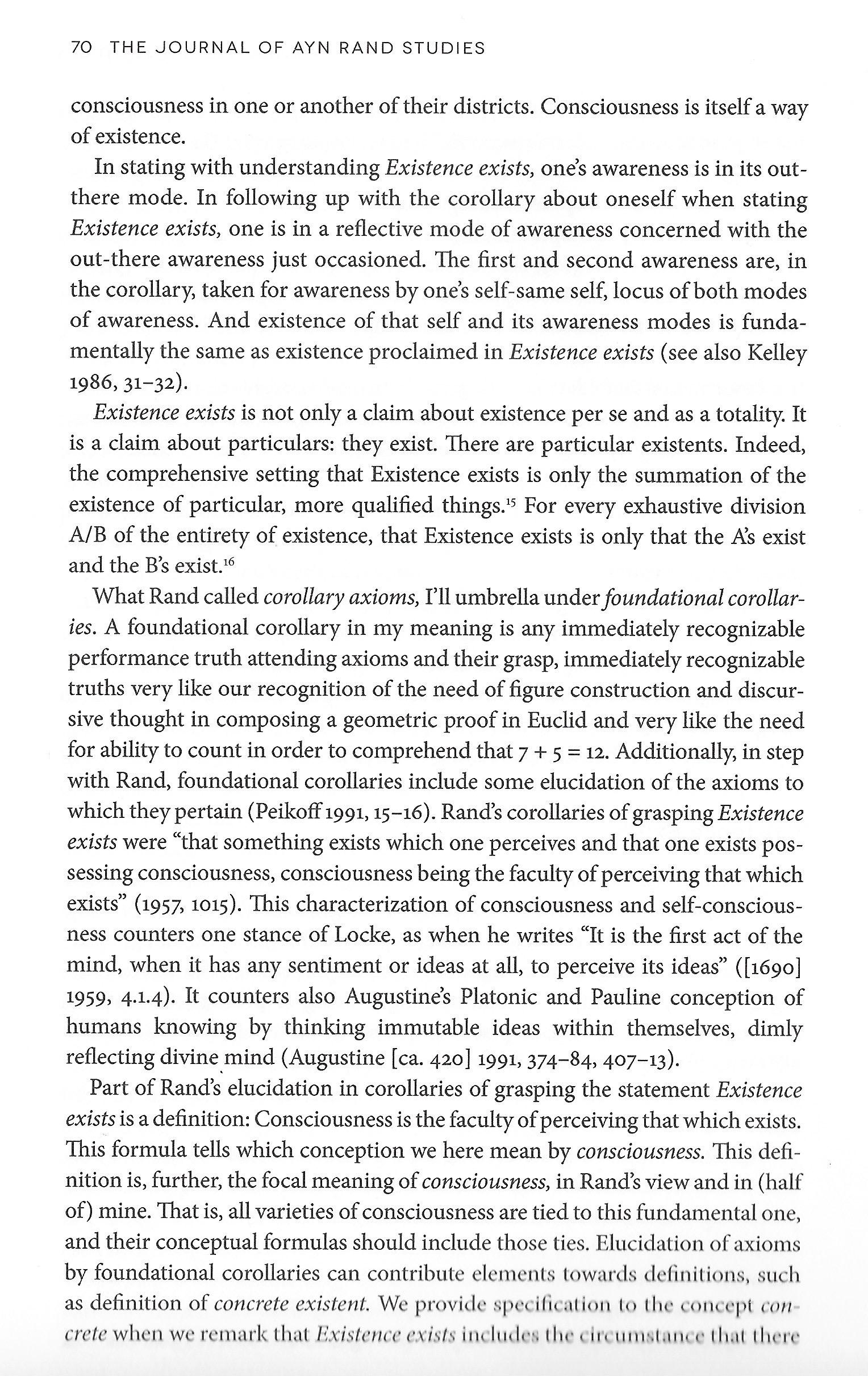
1 Like

2 hours ago, Cave_Dweller said:

You need conceptual analysis, and the neurodivergent don’t exactly excel at this. So while people can come up with ideas in a variety of ways, some of these ideas can’t be self-validated.

“Neurodivergent” is a pretty broad category.  Anyone who can’t do the conceptual analysis on their own just needs to get help from someone who can.


5 minutes ago, Doug Morris said:

“Neurodivergent” is a pretty broad category.  Anyone who can’t do the conceptual analysis on their own just needs to get help from someone who can.


It is a broad category. But I don’t count so-called “high-functioning autism,” because I believe it is a myth, so that helps me narrow it a bit.

On 4/7/2025 at 8:06 PM, Cave_Dweller said:

. . .

As you no doubt know, Aristotle was less then clear regarding what he meant by ouisia. But it is likely just another product of our cognitive processes being projected onto reality. 

Entity and Ousia


On 4/7/2025 at 9:56 PM, Cave_Dweller said:

Can anybody give a detailed conceptual analysis of “existence exists” and “consciousness is conscious”?
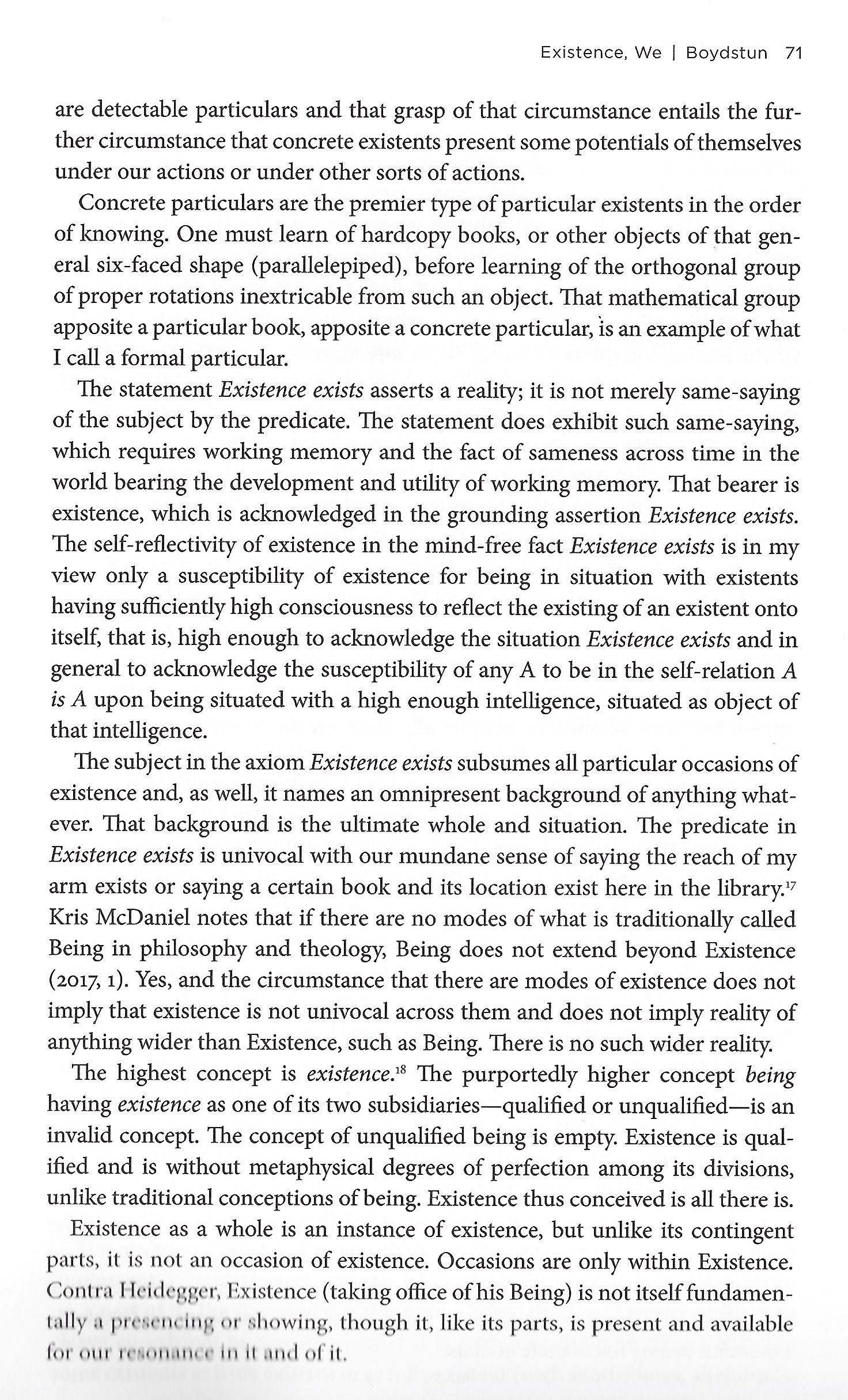
The latter is useless unless it is understood (in its context in ITOE) as a statement of an “A is A” in the predicative sense where “conscious” is to be taken as already having the understood sense “awareness” and “awareness” is understood to be “awareness of something” (as in Plato . . . —I have a fun historical compilation, later, if there is interest), or, in Rand’s case: “Consciousness is awareness of existence.”

I attach excerpts from my fundamental paper “Existence, We” which contains further explication.


On 4/7/2025 at 8:06 PM, Cave_Dweller said:

However, I don’t know how influential those books are. Postmodernism rules the day. 

. . .

Those ARE THE influential books in academic philosophy, which is to say, philosophy, not Halmark-cards culture or pulpit-culture. Postmodernism rules not at all in contemporary Anglo-American philosophy. I attend the lectures of meetings of the American Philosophical Association, and I keep up with what is being published by the academic presses in philosophy. Since around 1998, I attend those lectures. No one talks of postmodernism. Perhaps it was once something of notice in philosophy, but no more. Philosophers have told me it was more a deal in literature. Play-philosophy, not the real stuff cutting-edge today. I would not recommend aiming to write a Ph.D. dissertation on something concerning Postmodernism. Well, unless one’s advisor were one of the philosophers who make money writing books about the wrongness and strength of postmodernism in the culture, alarming the culture of something not seriously there in philosophy, let alone dominating it. In the big river of professional philosophy, postmodernism must have drowned a good while back.

10 hours ago, Boydstun said:

Entity and Ousia

The metaphysics of Rand and Aristotle have internal consistency. But aren’t they true only internally? And is internal consistency the same as external truth? I could possibly only agree that, given their fundamental premises, this follows from that. But it follows from nothing that an entity is the primary existent. 

Rand’s implied argument for causality goes something like this:

A thing is what it is (law of identity).
Action proceeds from the nature of the thing.
Therefore, actions are determined by identity.
Therefore, causality (regularity in action) is a corollary of identity.

But this presumes that entities must act in accordance with their nature. That is not logically necessary from the bare statement “A is A”.

In Kantian terms, Rand is seeking the unconditioned - the law of identity - as a principle that is dependent upon nothing else. The result is transcendental illusion, where reason projects its own structure onto reality and treats it as objectively real. “Existence is identity” is a synthetic a priori claim treated as a given metaphysical reality. It is synthetic a priori because:

  1. Identity is not contained in the concept of existence. “Existence” only points to the fact that it exists, not that it has identity, much less that it must act in accordance with its nature. When I talk about “it,” I am not referring to anything specifically. “It” could even be a Leibnizian monad, a Platonic Form, or an Aristotleian ouisia. However, this formula is not derived from experience. 

  2. “Existence is identity” is treated as a priori in that it is granted absolute (universal and necessary) status. But this is only by fiat. This formula is necessary to make Rand’s metaphysics work, and that is all. It is not derived from reality, as necessity and universality cannot be derived from reality. It is NOT self-evident that existence is identity or even has identity. This formula must therefore be formed by deduction, but Rand did not do so. The necessity of Rand’s axioms is not necessary for existence, only for the coherence of her system. 

Here is a possible Kantesque transcendental deduction for the principle “A is A” as a condition for experience: 


Quote


It is not to be overlooked, indeed must be considered as a first principle (though not, thereby, an unconditioned absolute in the metaphysical sense), that in order for any manifold of intuition to be gathered into a unity of experience, there must be a rule — or, better, a rule-governed synthesis — through which that manifold can be subsumed under the unity of apperception, which is itself not empirical, but the condition for the possibility of empirical cognition. Now, this unity (which does not arise from the data of sense, but is rather that which makes such data comprehensible under a single act of consciousness) presupposes a capacity to recognize, across the flux of appearances, that something is what it is — or, more precisely, that in every judgment that ascribes predicates to a subject, the subject must remain numerically identical with itself through the various determinations attributed to it.

If, however, the object of representation were not subject to such a rule — if, that is, the object could not be regarded as self-identical (not merely in appearance, but in the structure of the cognition that posits it) — then no cognition could arise at all. For cognition is not merely the passive reception of data but the active synthesis of that data according to concepts, and such synthesis presupposes the possibility of distinguishing one representation from another under a unifying concept. Yet the very possibility of distinguishing depends upon the prior possibility of identifying — that is, upon the thought that this manifold, so far as it is related to a single object, refers back to a unity which is numerically and conceptually one and the same throughout. Thus, the concept of identity — far from being an abstract logical principle imported from outside experience — is implicated in the very structure of the understanding’s operation upon appearances.

One might be tempted, particularly from the standpoint of empiricism or even from that species of rational dogmatism which would assert such principles a priori in a metaphysically realist fashion (as, for example, in the doctrine that “existence is identity”), to assume that identity is simply given, a direct intuition of the mind in contact with reality, and thereby beyond all need of further justification. But this would be to mistake what belongs to the transcendental conditions of the possibility of experience for a metaphysical postulate. The necessity of the principle of identity — that is, that a thing is what it is and cannot, in the same respect and at the same time, be something else — arises not from the supposed ontological structure of things-in-themselves (of which we can know nothing), but from the necessity of the unity of consciousness in the synthesis of representations. That is to say, identity is not a property of objects as they are in themselves, but a requirement of objectivity as it appears to us under the conditions of sensibility and understanding.

The original synthetic unity of apperception — that which must accompany all my representations if they are to have the character of knowledge — would be impossible unless each representation could be referred to the same I think. And this act of reference (which is not empirical but transcendental) is only possible if the object represented is assumed to be identical with itself, such that its various predicates do not refer to numerically different things, but to one and the same. Hence, the principle of identity is a necessary presupposition of the unity of the object in experience, and therefore of experience itself.

Accordingly, we are entitled — though only within the limits of possible experience — to affirm that the principle of identity, A is A, is not merely a tautology in the formal logical sense, but a transcendental condition for the possibility of cognition. It is not known because it is derived from the concept of existence per se, nor because it is found in immediate intuition, but because without it, no object could be posited as such, and thus no judgment, no experience, no knowledge could ever arise.


Even if there were no mind-independent objects, Objectivism would be a self-consistent system with utility in the discernment of objects.

On 4/8/2025 at 4:23 AM, Boydstun said:

Thank you for presenting this challenging material for me (and others) to ponder. Are you asking me to fix the problems within the arguments? Either way you answer, I am happy to help you out with these passages. But in order to help you, I must first demonstrate that I understand it.

I commend you first on your understanding of Rand’s statements. I agree that in stating that “existence exists,” one is engaging in an out-there mode. But why start with an out-there mode in all this? Why choose this mode as your grounds, and should I leave it unexamined? 

I don’t see where you justify starting with an out-there mode. So I don’t see why your choice of “self-evident” should begin with the out-there mode of awareness. Nor do I see any justification for your statement that concrete existents are premier in the order of knowing. This is assumed, not justified. I understand that yours is not an attempt to take on Rand’s theories, only to present them under analysis. But my preferred mode of analysis is more like that of scrutiny. 

One thing that sticks out like a sore thumb for me is your taking of the “highest” (most general) concept, “existence,” as at the same time encompassing everything that exists and also as an “omnipresent background,” which I take in the sense as a substance. Because there is nothing to substance, literally. It is substanceless when regarded as Being, per Heidegger. “Existence” is at once an “omnipresent background” and an “ultimate whole,” which in either case must be the unconditioned in experience. “Existence exists” is univocal. I detect here a conflation of the inguistic with the ontological. It is a question, furthermore, by what means “existence” was chosen as the most general concept over that of “something.” And a logical highest concept is not equivalent to an ontological ground. You can’t get to an unconditioned background by pushing your concepts higher. If “existence” is treated as both the condition of everything subsumed under that concept; however, if existence is encountered within experience by, let’s say, pointing all around oneself and saying “this is existence.” “Existence” is thus constituted within experience, which is to say that it is not the widest reality out of reach of any possible perception. Your forcing “existence” to carry a lot of weight: logical, ontological, and cosmological. 


On 4/8/2025 at 10:45 AM, Boydstun said:

Those ARE THE influential books in academic philosophy, which is to say, philosophy, not Halmark-cards culture or pulpit-culture. Postmodernism rules not at all in contemporary Anglo-American philosophy. I attend the lectures of meetings of the American Philosophical Association, and I keep up with what is being published by the academic presses in philosophy. Since around 1998, I attend those lectures. No one talks of postmodernism. Perhaps it was once something of notice in philosophy, but no more. Philosophers have told me it was more a deal in literature. Play-philosophy, not the real stuff cutting-edge today. I would not recommend aiming to write a Ph.D. dissertation on something concerning Postmodernism. Well, unless one’s advisor were one of the philosophers who make money writing books about the wrongness and strength of postmodernism in the culture, alarming the culture of something not seriously there in philosophy, let alone dominating it. In the big river of professional philosophy, postmodernism must have drowned a good while back.

Anglo-American (analytic) philosophy, is however not highly influential on American or British society. It is, in fact, as invisible as it gets. Postmodernism rules the social scene, even if it has stopped producing influential papers within certain academic circles.

2 hours ago, Cave_Dweller said:

Anglo-American (analytic) philosophy, is however not highly influential on American or British society. It is, in fact, as invisible as it gets. Postmodernism rules the social scene, even if it has stopped producing influential papers within certain academic circles.

Can you exhibit postmodernism ruling the social scene? In America Jesus is a big driver, as ever. My interest is in science and philosophy. Influence on wider society are not their interest for me or reason for being in my sights. There is not one single friend I have made here in Lynchburg, VA, these last 15 years we have lived here who would know or care anything of postmodernism. And they get on just fine. They have lives, make families, and love each other. All just fine without influence from academic philosophy or postmodernism. They love me for my scholarship and my books—that’s an important part of me, they’ve noticed—but also because I know how to do (and do) non-bookish productive things, like cooking and splitting firewood. Postmodernism is not ruling this social scene, and this scene is what matters—the alpha and omega—notwithstanding high trash such as postmodernism and the intellectuals fixated on defending us from it. Postmodernism is not driving this society. And in the realm of philosophy, it is not driving jack either.