Necessity and Form in Truths

The idea that the forms or formalities inherent in the physical world alone determine human knowledge would pose significant challenges to mankind’s ability to discover truths that require going beyond direct empirical observation and formulating abstract conceptual models or hypotheses.

If human beings could only passively derive knowledge from the physical formalities present in their immediate empirical experience, without the capacity for active conceptual reasoning and hypothesis formation, then major scientific advances like resolving the heliocentric versus geocentric models of the solar system would have been extremely difficult, if not impossible.

15 minutes ago, tadmjones said:

Non contradictory identification isn’t as much an art as it is a crucible. In its most physicalist form , the chemical reactions in a crucible do not follow the play of art and the molecules don’t produce any contradictions of identity.

There’s more involved here than chemical reactions (and the fact that we can identify them). These reactions also appear to be predictable and regular. Observed regularities do not automatically confer certainty or truth. Science’s self-correcting progress stems from rational conceptual change that goes beyond mere cataloging of patterns, but also the imposition of rules as conceptual, abstract models.

By restricting science to just collating observed regularities, we potentially rule out entire domains such as theoretical physics, cosmology, evolution, etc., where unobserved processes are central.

The result is Leonard Peikoff declaring that science should be subservient to philosophy (meaning, his philosophy). And that, if quantum physics doesn’t seem to obey the laws of observation, and identity breaks down, then something is wrong with QM.

Back in the 1920s, QM physicists would’ve agreed on principle. But 100 years of experiments have failed to disprove the break down of causality and identity in the realm of quanta.

Come to think of it, somewhere in my reading I found where Ayn Rand asserted that steady-state cosmology is true based on the principle that things cannot come into or go out of existence. If this is a result of her axiomatic, absolute thinking process, then according to Peikoff, cosmologists should give up and accept steady-state based on Rand’s axioms.

28 minutes ago, Boydstun said:

Under that good principle, the conception that an elementary particle came from vacuum space while maintaining that such space is nothing is false.

Yes, this is leading to big problems for your metaphysics. Because it’s a fact (A is A) that virtual particles come and go from empty space. The Casimir Effect demonstrates a tiny attractive force between two closely spaced metal plates. QFT explains this force arising from the exchange of virtual photons between the plates, even though no real photons are emitted.

The Lamb Shift observed a slight shift in the energy levels of hydrogen atoms. The shift can be explained by the interaction of the electron with the virtual “cloud” of particles surrounding it.

Objectivists should not try to be physicists (and vice versa).

Introduction to “Necessity and Form in Truths”

Part 1 – Leonard Peikoff

Part 2 – Morton White

Part 3 – Quine, Objectivism, Resonant Existence – A

Part 3 – Quine, Objectivism, Resonant Existence – A’


Part 3 – Quine, Objectivism, Resonant Existence – B

What are the right relationships between metaphysics today and modern science? The Analytic-Synthetic dichotomy of the Logical Empiricists and Quine’s refutation and replacement of their dichotomy are bound up with contemporary skepticism towards metaphysics and differing ideas about the relationships of philosophy to science and of logic to reality.

Rand took metaphysics to be the study of existence as such, which is faithful to a traditional conception of metaphysics as the study of being as being. Metaphysics so conceived pertains to all things. It pertains to all things in ordinary experience or in science, which latter makes available more experience and more subtle targets of knowledge. I propose  that metaphysics can, alongside logic and mathematics, rest on ordinary experience and on information attained in empirical sciences.

Against Kant and others, such as Morganti 2013, I propose that metaphysics need not be a priori to fulfill its distinctive modern functions vis-a-vis other disciplines. Metaphysics can be in important part from reflection on knowledge gotten in those disciplines. Metaphysics can sift for principles to which all rational disciplines and their findings conform or set as norms of performance. Metaphysics can aim for setting the fullest context of knowledge, and that without itself uncovering potentials and limits of concretes as in science. And without itself uncovering possible structure in the formalities of situations as (I say is done) in mathematics. Rather, metaphysics can have the job of forming an explicit widest frame for fuller comprehension of findings in those disciplines. Whether such a metaphysics can also set the reality-base for logic employed in ordinary, scientific, and mathematical thought is yet another criterion for the goodness of the metaphysics.

Metaphysics need not and should not in these activities also propose any new ontological finds deeper than anything found in the sciences, such as substances other than those of chemistry, physics, and science of materials. Metaphysics should not try to cook up some special metaphysical concept of time, but address only the time of physics and ordinary experience. One may and should look, I suggest, in the course of any experience or inquiry, to metaphysics for the integrated whole that one is holding, sourced from all areas of experience.

Rand and Peikoff, however, maintained that the concept existence, as one might enlist it in the assertion that “existence exists” or “there are existents” does not mean specifically physical existence (ITOE App. 245–48). In their view, it means only a “that” exists; it means something exists. If that is all one means by “existence” as such, then I say metaphysics could not be a keeper of widest context and general norms worth employing. 

One does not need to have language and express understanding that existence is what one is taking physical actions with and in or that existence is identity in order to implicitly know “existence” is those things in all one’s early activities and experience (and one doesn’t need to have the concept of experience to be having experiences). Learning of alleged sorts of existence that are not physical existence comes later, after acquiring language. To know that existence is physical existence—to know unsupported objects fall, for example—is prelinguistic. We have scientific developmental cognitive psychology on that now for decades. It is far past time to leave behind our folk conjectures on such early developments supplemented with old psychological conjectures of, say, William James.

When I was teaching adults to fetch a ball I rolled across the floor, I was engaging physical existents, and when I say “existence exists,” I am generalizing from such physical specifics, and I still mean them, such physical things, first and foremost by “existents.” Under explicit assertion, “existence exists” is assertion of some physical existence. If we reject the notion of a physicality-not-yet-committed “existence” in “existence exists,” it is more plausible that a Randian metaphysics can be an integrated unity from all experience and thought and a pertinent constraint-from-the-whole on the various parts of reality for pruning some absences of fact alleged as fact.

An example of such pruning would be from the ancient metaphysical principle “nothing comes from nothing.” Under that good principle, the conception that an elementary particle came from vacuum space while maintaining that such space is nothing is false. Again, that all mass-energy of the universe came into existence from nothing preceding it can be pruned as false. Ex nihilo creation of the world by an intelligent being is quashed by good metaphysics.

Yet metaphysics can still have things to learn from advancing physics. When physics explicated and experimentally set up situations of chaos in the classical regime in the last three decades of the twentieth century, philosophy could wake up to the aspect that fully deterministic situations do not always allow of realistic in-principle predictability and that ability to control the chaotic action did not require significant predictability. 

From our widest-world assessment of advances in science for their import for metaphysics, however, we must understand the science for ourselves, or at least get report of the science by a qualified authority. One should not just take on board the pronouncements of others about the import for metaphysics.

In Rand’s metaphysics, existents as such have broad subdivisions such as actual or potential, current or past or future, entity or its attribute or activity (animate or inanimate), individual or collection or assembly, natural or man-made, causal (often scientifically lawful) determinations of entities or of their attributes or activities. In Rand’s metaphysics also, existents have magnitude structures we implicitly capture in perceptual-level similarities and in our concepts, concepts in her analysis, being a type of set implicitly structured by suspension of particular measure values within characteristic ranges along dimensions common among collections of particular existents.

Right metaphysics can set a science in right relations to other sciences and set out its right relations to reality. A metaphysics such as Rand’s can be a protector of science by defending realism in science and by refuting mystical and skeptical degradations of science. Metaphysics can tackle integration of the specific findings of all the different sciences, assimilating them into a comprehensive network of conceptual dependencies. Then too, general metaphysics can offer integration across and guidance to detailed philosophies of each science.

Kant would have metaphysics be conceived as “nothing other than the philosophy of the fundamental principles of our cognition” (1763 2:283). Furthermore, two dozen years later: “Metaphysics is a speculative cognition by reason that . . . rises entirely above being instructed by experience. It is cognition through mere concepts (not, like mathematics, cognition through the application of concepts to intuitions)” (KrV Bxiv).

Rand, and I also, and many moderns deny there is any such thing as a priori knowledge, knowledge entirely independent of any experience. Rather, I say, any knowledge we have derives ultimately from our interactions with the physical world and coordinations with other people in the world. That is the source of our knowledge in the physical sciences as well as in mathematics and logic. This is not to deny that some of our rational thinking is intimately tied to the capacity for thought; it is only to say that that thinking, such as deductive inference, is not entirely unentangled with physical experience in its emergence and continuance (contra Ichikawa and Jarvis 2013 and Casullo 2012).

Kant had logic as a priori and as analytic. Logic, in his view, provides the way to make previous knowledge distinct (Lu-Adler 2018, 90). That is the facility of logic as analytic. Kant stressed that logic (i.e., deduction) does not have for its function or power the gaining of new knowledge, and logic does its job of rendering distinctness without rendering new content.

I notice that the notion of logic providing only improvement in old knowledge does not in fact entail that logic is a priori. Contrary to Kant’s view, analyticity might obtain even were that skill to have issued from interactions with the world, not from dictates and organization of Kantian faculties of reason and understanding. I should mention too that right philosophical analyses of conceptual dependencies, which is so much a task for philosophy, is more than being analytic in the sense of drawing out implications of whatever stipulations. Conceptual dependencies of concepts won through ordinary experience, science, and mathematics trace reality in our grasp.

Kant’s reason for thinking that pure logic and pure mathematics must be a priori is because the only way he imagines they could issue from empirical interactions is as empirical generalizations, whose character cannot yield the manifest absolute impossibility-of-exception universality had by logical and mathematical principles. Aristotle might enter the friendly point: “To accept as a sufficient starting point that something always either is or happens in a certain way, is not to take things up in the right way.” (Phys. 252a32–33).

“If we now put aside all cognition that we have to borrow from objects, and merely reflect on the use just of the understanding in general, we discover those rules which are necessary without qualification, for every purpose and without regard to any particular objects of thought, because without them we would not think at all. Thus we can have insight into these rules a priori, i.e., independently of all experience, because they contain merely the conditions of the use of the understanding in general, whether pure or empirical, without distinction among its objects. And from this it follows at the same time that the universal and necessary rules of thought in general can concern merely its form and not in any way its matter.” (Kant/Jäsche 1800, 12; cf. KrV A52–55 B76–79)

“The boundary of logic is determined quite precisely by the fact that logic is a science that provides nothing but a comprehensive exposition and strict proof of the formal rules of all thought [including discursive thought not entirely independent of the senses]” (KrV Bix). “This science of the necessary laws of the understanding and of reason in general, or what is one and the same, of the mere form of thought as such, we call logic.” (Kant/Jäsche 1800, 13). Logic is a canon “and as a canon of the understanding and of reason it may not borrow any principles either from any science or from any experience; it must contain nothing but laws a priori . . . ” (ibid.).

“Logic is a science of reason, not as mere form, but also as to matter; a science a priori of the necessary laws of thought, not in regard to particular objects, however, but to all objects in general; – hence a science of the correct use of the understanding and of reason in general, not subjectively, however, i.e., not according to empirical (psychological) principles for how the understanding does think, but objectively, i.e., according to principles a priori for how it ought to think.” (Kant/Jäsche 1800, 16)

Judgments might fail to adhere to logic set down from the faculty of reason, Kant thought, because of unrecognized spoiling influences from the senses on judgment (Kant/Jäsche 1800, 37; see also KrV A293–94 B350–51). The sensory inputs themselves are not erroneous, in Kant’s view, for only judgments can be true or false. Kant is here staying near Descartes’ view that errors all arise from allowing our will to outrun our understanding.

One might think it a bit odd that logic should be among the norms for right judgments without its principles having arisen from interactions with the world. More basically, one should question, as did Bolzano, how logic can be normative for cognition if logic is not for the purpose of attaining truth.

Kant took some experience to be necessary in order that reason get going in logic. This is analogous to the old Leibniz thought that some sensory experience is needed to trigger access to innate ideas. Not natural or popular logic, but “only artificial or scientific logic [not natural or popular logic] deserves this name [logic], then, as a science of the necessary and universal rules of thought, which can and must be cognized a priori, independently of the natural use of the understanding and of reason in concreto, although these rules can first be found only through observation of that natural use.” (Kant/Jäsche 1800, 17)

Our contemporary students of elementary logic may add to Bolzano: right deductions aid in the pursuit of truth only by giving the rules for preserving truth of premises to truth of conclusions. Necessity in deductive logic, I should clarify, is not that we necessarily follow the rules of valid inference. No, necessity in deductive logic is otherwise in two ways: (i) If we want to preserve truth of premisses to conclusions, we must follow the rules of logical deduction. That is a necessity-for, a necessity for attaining an end. That has nothing to do with the other necessity in deductive logic: (ii) Rules of deductive inference are necessarily right. Rand could say, and I do say, that this necessity, a necessity-that, is from the obdurate everywhere fact that existence exists and is identity and logic is conformed to that circumstance, the widest necessity-that. That first-figure syllogisms are necessarily right is due to the fact that identity (here, particular-to-classed collection character) is a formal feature belonging to concrete existents (once collections are rendered classes and particulars their members).

I say contra Kant: The necessities in the formal disciplines stem ultimately from formalities that are not sourced most fundamentally in mental operations. The necessity-thats of formal disciplines attach to existence and to effective mental operations forged by utility of those formalities. Formalities belonging to situation (mathematics) and to passage and character (logic) are the Ur-springs of necessities in the formal disciplines. The necessity of truths in the formal disciplines—necessity absolute and differing from necessities in empirical generalizations—are inherited from the necessity-that of existence and of the formalities belonging to fundamental categories of existence.

That Existence exists, I should add, is true because it states a fact. It is not true only because any item of thought can be mapped onto itself. That is to say: That Existence exists is not true due to it being a tautology. Rather, that things are susceptible to our mapping them onto themselves is because Existence exists and is identity and part of that identity is the affordance (by highly intelligent animals) of having itself mapped onto itself. 

(To be continued.)

References

Aristotle c. 348–322 B.C.E. Physics. J. Sachs, translator. 2011. In Aristotle’s Physics – A Guided Study. New Brunswick: Rutgers University Press.

Casullo, A. 2012. Essays on A Priori Knowledge and Justification. New York: Oxford University Press.

Ichikawa, J.J. and B.W. Jarvis 2013. The Rules of Thought. New York: Oxford University Press.

Lu-Adler, H. 2018. Kant and the Science of Logic. New York: Oxford University Press.

Kant, I. 1763. Inquiry Concerning the Distinctness of the Principles of Natural Theology and Morality. In_ Immanuel Kant – Theoretical Philosophy 1755–1770._ D. Walford and R. Meerbote, translators. Cambridge: Cambridge University Press.

——. 1781(A), 1787(B). Critique of Pure Reason. W. Pluhar, translator. 1996. Indianapolis: Hackett.

——. 1800. Jäsche Logic_._ J.M. Young, translator. 1992. In Immanual Kant – Lectures on Logic. Cambridge: Cambridge University Press.

Morganti, M. 2013. Combining Science and Metaphysics – Contemporary Physics, Conceptual Revision and Common Sense. New York: Palgrave Macmillan.
On 4/28/2024 at 9:47 PM, SocratesJr said:

Yes, this is leading to big problems for your metaphysics. . . .


On 4/29/2024 at 6:46 AM, Boydstun said:

To my recent remark “Under that good principle [‘nothing comes from nothing’], the conception that an elementary particle came from vacuum space while maintaining that such space is nothing is false,” SocratesJr ignores the qualifier “while maintaining that such space is nothing”.

SJ writes: “Yes, this is leading to big problems for your metaphysics. Because it’s a fact (A is A) that virtual particles come and go from empty space. The Casimir Effect demonstrates a tiny attractive force between two closely spaced metal plates. QFT explains this force arising from the exchange of virtual photons between the plates, even though no real photons are emitted. The Lamb Shift observed a slight shift in the energy levels of hydrogen atoms. The shift can be explained by the interaction of the electron with the virtual “cloud” of particles surrounding it.”*

I do not maintain that space is nothing. I’ve written a hundred times to the contrary. One did not need to wait on the discovery of quantum field theory and the richness of the vacuum to know that empty space is an existent. Anyone who ever attempted to sit in a chair which had been pulled away should face up to the fact that empty space is not nothing.


Introduction to “Necessity and Form in Truths”

Part 1 – Leonard Peikoff

Part 2 – Morton White

Part 3 – Quine, Objectivism, Resonant Existence – A

Part 3 – Quine, Objectivism, Resonant Existence – A’

Part 3 – Quine, Objectivism, Resonant Existence – B


Part 3 – Quine, Objectivism, Resonant Existence – Bα

In this section 3B of “Necessity and Form in Truths,” I’ll relate the distinction between the analytic and the synthetic in the sense the distinction is made in mathematics, which is different from the distinction under those same names in philosophy. We’ll then look at: Kant on mathematics, cognition, and experience; Neo-Kantians; Logical Empiricism to Carnap v. Quine on the analytic-synthetic distinction; Leonard Peikoff’s tackle of ASD in philosophy (addition to Part 1 of this study); and my own treatment of it in philosophy.

There are distinct analytic-synthetic divides of methods within mathematics, philosophy, and chemistry. In philosophy divide of analytic and synthetic methods results (by champions of ASD) in a corresponding divide in kinds of truth. In mathematics the division of analytic and synthetic methods correlates with a division of perspective on mathematical objects. Our concern here will be with the analytic-synthetic divides in mathematics and philosophy. No chemistry here.

When one learns Euclidean geometry in high school, one is proceeding by the Synthetic mathematical method: one begins with elementary true conceptions and propositions, and from those, with help from instruments (unscaled straight-edge, paper and pencil, and compass) for constructing labeled diagrams, one demonstrates additional propositions. For example of such a theorem: the sum of angles in any triangle is 2R, two right angles, where 2R is the angle a compass staked on a line sweeps from one intersection of its circle with that line to one side of the stake, the sweep to the intersection of its circle to the other side. This truth 2R of triangles is a truth of the Euclidean plane (which are the planes of our local physical space for residence and action), and it is known true only because of such a demonstration.

A pre-dawn hint of Analysis in mathematics appears in Aristotle in his discussion of the reductio ad absurdum argument, which he remarks is exemplified in proof that the length of the diagonal of a square is incommensurable with the length of the sides (Pr. An. 41a25–30). If it is hypothesized that the length of the diagonal is commensurable with the length of the sides of that square, then it follows that there is a number both odd and even. Not merely odd or even, but both, and this is absurd. Therefore, the length of the diagonal in relation to the length of the sides is not a commensurable relation. Bringing this use of the nature of numbers to geometry expands our geometric knowledge.

From the Pythagorean Theorem we know how to compute the hypotenuse length of any right triangle: square the length of sides, add those two products, and take the square root of that sum. A right triangle having sides of length 3 inches and 4 inches, will have a hypotenuse of 5 inches, which one may easily verify. 9 + 16 = 25, and the square root of 25 is 5. But if we start with the diagonal of a square being 5 inches, the sides of the triangle formed by that diagonal and those two sides of the square must be of equal length. 5 is the ratio 5/1. Try as we might to calculate the length of the square-sides for a diagonal of 5 inches (or any other rational number), we will not find a side value that is a rational number yielding exactly the diagonal length of 5 inches. Try for the length of the sides 3.5 (=7/2) inches. It yields for the diagonal/hypotenuse 4.94974746831 inches. Try 3.6 (=18/5) inches for sides. It yields 5.09116882454 inches for diagonal/hypotenuse.

From many trials, getting closer and closer to exactly 5, we might guess ( i ) if we keep going, we’ll get to exactly the 5 inches; so keep the trials going. That would be a lot like an empirical method, such as searching for a new long-range force of nature or a certain sort of new elementary particle. Or like me looking online for a picture of a certain one of my great grandmothers (they had photography at that time). Or we might ( ii ) learn by distinctively mathematical methods, such as the one mentioned by Aristotle, that there are no rational-number side-lengths that can form a diagonal/hypotenuse of exactly 5 inches. Therewith, we conclude, in the regular jargon: The length of the diagonal of a square and the length of its sides are incommensurable.*** **That is, there is no stick, however small, that can be used to measure the diagonal and the side such that those two line segments both have lengths that are some counting-number of repetitions of the tiny stick. (See further, Lützen 2022, 20–22, and Burnyeat 2000, 28n42.) 

Hellenic Greeks had no conception of numbers as a continuous succession, and they did not have our conception of laws of nature as laws giving a dependence of one quantity on another. They did not have the conception of algebraic variables. (An algebraic variable is a standing open possibility of particular values in some specified range of numbers.) They did not have the conception of analytic functions of a continuous variable such as “The area of a circle is pi times the circle’s radius squared” (area as a function of radius). They had synthetic geometry and mathematics of magnitudes. They did not attain analytic geometry or other analytical mathematics, such as our Real Analysis, Complex Analysis, Fourier Analysis, Functional Analysis, and Global Analysis.

Building upon work of Hellenic Greeks (Pythagorus, Eudoxus, and Menaechmus), Alexandrian Greeks (Euclid, Archimedes, Apollonius, and Diophantus) prepared the way towards what we now call analysis in mathematics (Boyer 1956, 21–39). Analytic geometry full-tilt was invented by Fermat and by Descartes. The latter was “led to the invention of analytic geometry largely by the desire to extend and systematize the traditional geometrical solution of equations of degree greater than four through the intersection of curves of order higher than two,” that is, beyond the results of Archimedes (ibid., 34, further, 39, 42, 64).* 

Further clearings for the revolutionary awakening won with attainment of analytic geometry by Descartes/Fermat were from Omar Khayyam (c. 1100) and Fibonacci (1202), with their emphasis on the interrelation of arithmetic and algebra with geometry (Boyer 1956, 42–44).

Richard Suiseth (c. 1345) and Nicholas Oresme (c. 1323–82) facilitated the way to analytic geometry by investigations into applications of arithmetic series to hypothetical changes in speeds of bodies in successive time intervals, where time is the independent variable for the dependent variable, which is speed (ibid., 45–51). Letting the time go to infinity puts useful infinite arithmetic series into the human mind. Such would be 1/2 + 2/4 + 3/8 + 4/16 + . . . yielding 2 as its grand sum (scheme for this series: terms are speeds in successive intervals of time with doubling speed from the first time interval in the second time interval, which has a quarter the time of the first interval; tripling speed of the first interval in the third time interval, which has an eighth the time interval of the first; . . . . Beginning to grasp infinite series is engaging dependencies among variables (in our example, value of velocity in a dependence on passage of time), and it is getting the mind closer to attaining integral calculus, which falls under Real Analysis.

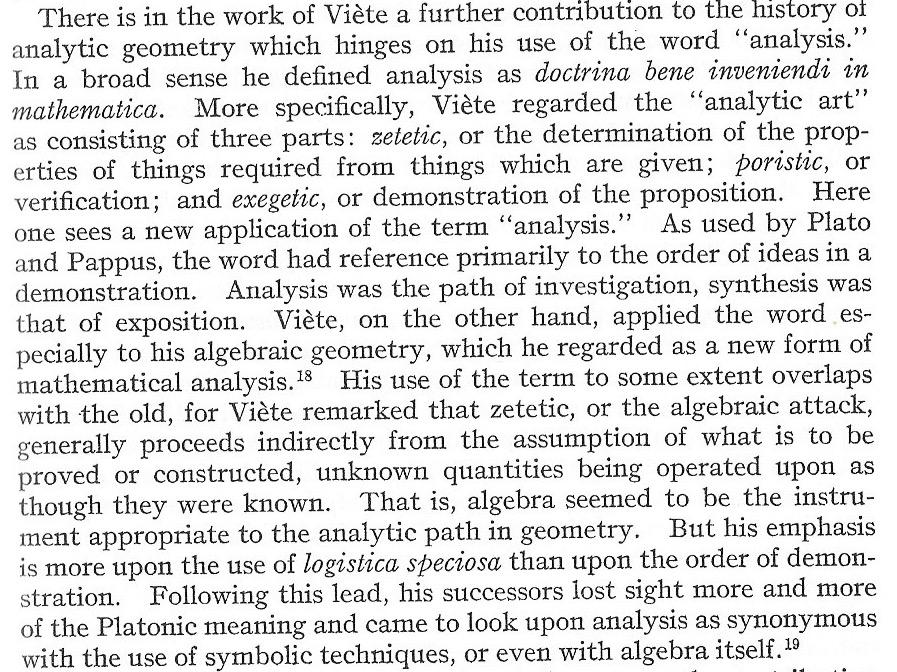
François Viète (1540–1603) introduced the idea of a parameter in algebra, allowing expressions with variables to be studied with arbitrary constants in them, where, for earlier algebraists, particular numbers had stood. This gives a handy wider vista on equation forms, with particular values of the arbitrary constants giving a further layer of restriction and determination on the equation form (further, Witmer 1983, 5–8). Rand mentioned the relation of concepts, in her analysis of them, to the variables of algebra. Her particular analysis of concepts brings them into even greater intimacy with algebra because she took concepts to be classes on characteristic quantified dimensions of the object of the concept. The cognitive economy and empowerment that Rand stressed for conceptual rendition of the world is also true of algebra. 

Consider one of Galileo’s later equations of free fall, which today we write: h = 1/2 gt2.*  For various heights, one can compute the time t it will take a falling body to reach the ground (h = 0). The h and t are algebraic variables in the equation. The g is a constant, with certain physical units (viz., acceleration, i.e., time rate of change of velocity), a constant which has a particular constant value near the surface of the earth. On another planet having a different mass, that constant will have a different particular value. In this context, g is an example of a parameter.

Oresme in 1350 had described the laws of motion as giving a dependence of one quantity on another. In Galileo’s studies of motion is understanding of a relation between physical traits as variables. 

Analytic geometry, uncovered by Descartes 1637, is not simply application of algebra to geometry. It is that, but a fine, rich weaving between algebra and geometry. In analytic geometry, we assign coordinate systems to the plane or space and therewith characterize loci such as curves and surfaces algebraically and with functional variability. I observe that which sort of coordinate grid we use—rectangular, polar, etc.—is our choice for our convenience in operations of algebra and calculus rendering a characterization of the object being described. Synthetic-geometric curves and surfaces and other physical manifolds to which we bind our analytic methods are what they are independently of our analytic apparatus and any choices of convenience we make in characterizing the mind-independent analytically.

Analytic mathematical techniques are objective, in Rand’s sense of the term. In my ontology, we should say that such things as shape are in the world independently of our discernments of shape. Indeed, physical space and its relations in are in the world in that way. They are there just as in our synthetic geometries express them more directly and our analytic geometry less directly. From the latter, the former can be recovered and even enlarged. The synthetic relations of physical space (or spacetime) are belonging-formalities, as I have set out in “Existence, We”. Analytic geometry is a tooling-formality.

In the remainder of installments in this section 3B, I’ll fulfill the journey and adventure set out in the first paragraph of this installment. But allow me to jump ahead and at least note some new vista of mine. Physical space is an existent, a physical one, I’ve long stressed. But it is not an entity. It is a formality in the category of situation of entities. It is taken in with our perceptions of concretes. The objects of geometry have the feel of entities (and of relations), and I call them Ents. They can have physical instantiations, but they are not entities, because they are, in physical instantiation, belonging-formalities of concretes, rather than themselves concretes.

I’ll be taking up Kant, his characterization of geometry, the arenas of mathematics in his Critical philosophy, and his analytic-synthetic distinction in that philosophy in the next installment. But indulge me some further jump-ahead note to my own bottom-line picture (a jump-ahead for some cushion at least should I die before reaching the promised fulfillments of this essay). There is at least one sensible distinction that proponents of the ASD had sleeping in that distinction. In knowledge physical, mathematical, and logical, I say, there is always necessity-for (which is for and from our living mind and is in the character of truth as a recognition of fact) and necessity-that of fact. There is difference of the necessity-that in the physical and in the mathematical and in the logical. The necessity-that in mathematics lies in belonging-formalites of situations of concretes, in contrast to the full necessity-that of concretes in empirical knowledge. The lens of logic on the world is like the lens of analytic mathematics on the world, but the parallel in logic of the relation between analytic to synthetic in mathematics is as between logic and exclusion-identity in the world. Exclusion-identities are among belonging-formalities in the categories of passage and character.

(To be continued, as I expect to continue living and with growing mind a good while.)

References

Boyer, C. B. 1956. History of Analytic Geometry. Mineola, New York: Dover.

Burnyeat, M. F. 2000. Plato on Why Mathematics is Good for the Soul. In Smiley 2000.

Descartes, R. 1637. La Géométrie – The Geometry of René Descartes. 1925. Mineola, New York: Dover.

Lützen, J. 2022. A History of Mathematical Impossibility. New York: Oxford University Press.

Peikoff, L. 1967. The Analytic-Synthetic Dichotomy. In Rand 1990.

Rand, A. 1990 [1966–67]. Introduction to Objectivist Epistemology (ITOE). Expanded 2nd edition. New York: Meridian.

Smiley, T., editor, 2000. Mathematics and Necessity. Oxford: Oxford University Press.

Witmer, T. R. 1983. Introduction to Viète’s The Analytic Art. Mineola, New York: Dover.

—Addendum: Boyer 1956, p.65—

Stephen the jaunt into your vista reminded my of your example of counting the spaces between one’s fingers , first palm down flat on a surface and then when gripping the rim of a glass from above in an extended umbrella shape. I count the same spaces as they align with same edges of the individual boundaries. Nine of which are easily grouped together in a perceptual visual field , lol.

Is that example of the same concept of a physical space as you incorporate in your system , or in the leap is the concept ‘more’ pointed to a metaphysical substrate a kin to ‘volume filled’ by a concrete entity? 
 

Does  space ‘inside’ an empty pot become incorporated or absorb the water when filled , does the water bring its space and displace the preexisting space ‘in’ pot before the presence of the water in the pot , or does the concept not have a referent  to a locality other than relationally between entities?

7 hours ago, tadmjones said:

. . . I count the same spaces as they align with same edges of the individual boundaries. Nine of which are easily grouped together in a perceptual visual field , lol.

. . .

Does  space ‘inside’ an empty pot become incorporated or absorb the water when filled , does the water bring its space and displace the preexisting space ‘in’ pot before the presence of the water in the pot , or does the concept not have a referent  to a locality other than relationally between entities?

Tad, I’ve not been able to understand your example. Where does the number of spaces 9 come from in the example you are posing? If I start thinking of attending to both hands, one open flat on a table and the other hand in the cylindrical configuration of its fingers, then I understand there are a total of nine spaces between the ten fingers, but I’m thinking that that is not your example, and I’m just not getting your example. Can you elaborate further on your example to jog me into getting what it is?

You mentioned some spaces easily grouped together in a perceptual visual field. I should perhaps mention that in the two examples I posed for getting the idea of a formality attaching to physical situations of a physical concrete, I’m just talking about what is there, which one does perceive, but it is the what-is-there part that I’m talking about. These are relations in the world, physical relations between physical particular occasions of masses (fingers, which have masses).

The space inside an empty pot is the same item whether it becomes filled with water or remains empty. Being filled with water means that that space comes have an additional concrete entity with which it has a relation. It retains its relation to the pot and to that adds its relation to the water (the relation: filled-with).


Stephen in counting the spaces ‘between’ the fingers , I get ten. The five spaces ‘between’ the fingers and thumb in the glass gripping posture are in the same perceptual range as the four corresponding spaces of the prone posture on a flat surface hence the grouped nine , the tenth I count as the space ‘between’ the outer edges of the thumb and pinky when prone. I suppose I am playing with ‘between’, trying to beat Xeno at his game.

As to the water in the pot , the empty space in a pot is just the pot without the water? Space in this sense is just the apprehension of the pot as entity and empty regards only apprehending the pot? I am trying to understand how your space has a physical dimension/component, does the stream of water from the tap ‘have’ a space it brings to the pot, does the existence of the volume of water necessitate it ‘having’ a corresponding space in which it ‘exists’ and if so how does that not ‘interact’ with the empty space in the pot?

6 hours ago, tadmjones said:

Stephen in counting the spaces ‘between’ the fingers , I get ten. The five spaces ‘between’ the fingers and thumb in the glass gripping posture are in the same perceptual range as the four corresponding spaces of the prone posture on a flat surface hence the grouped nine , the tenth I count as the space ‘between’ the outer edges of the thumb and pinky when prone. I suppose I am playing with ‘between’, trying to beat Xeno at his game.

. . .

So, as I understand you a bit, you are looking at a summation of spaces in the two different configurations. This is getting to be a big detour off the point of the illustrations, which was only to illustrate a couple of plain cases in which one is picking up geometric formalities attending entities (one’s hands) one is observing. But that is alright. When I post the next installment of the sweeping study “Necessity and Form in Truths”, I’ll head that post with the linked outline of the essay itself as I did upstream here.

The endpoint of all this, of course, is to enter the fray over the analytic-synthetic distinction as in Kant on up to the logical empiricists and to the treatment of that distinction as treated by Quine and by Peikoff, and as well to enter the fray over the right relationships between metaphysics, mathematics, and physics. In his essay the Analytic-Synthetic Dichotomy, Peikoff treated the notion of contingency in the so-called synthetic truths of his era as merely hand-me-down from God-posing settings of so-called contingency from Medievals and from early moderns (such would be Descartes, Malebranche, Leibniz, and Berkeley). He then flicks away such contingency as primacy-of-consciousness error. Well, of course. But. The burning distinction in his and our own time is not between a lack of necessity (and intervening creative consciousness) in contingent truths and possession of necessity in analytic truths. No, the burning question had become what is the difference of necessity empirical truths and formal truths such as in mathematics or logic. Fortunately, for my study, in understanding more fully what led to Peikoff’s take on truths of contingent, empirical facts, aI have not only what Peikoff wrote in that well-known essay, but what he wrote pertaining to the issue, in his Ph.D. dissertation and in his detail views on philosophers and issues in his lectures now transcribed in Founders of Western Philosophy – Thales to Hume.

We don’t have to be coarse-grained about the difference or deny it. And we don’t have to call the varieties of necessities by old names that really obscure what we are getting at now, today, in the context of our knowledge of the physical sciences, neuroscience, and mathematics. Also, I expect to criticize (and suitably replace) Quine’s coarse-granularity in his booting and replacement of the analytic-synthetic distinction. Also, and sooner, diagnose the errors of Kant bearing on his distinction of the analytic-synthetic distinction, and replace the strong points he supports by his fantastical view of geometry and physics with a better supporting system.

But back to the illustrations of physical formalities (and, really, synthetic geometry as not gone on to analytic geometry) in such things as hands. For the hand flat on the countertop, we can also take note of a space by arc from the thumb to the little finger with no other fingers lying on the arc. Then we shall have noticed before us five fingers with five spaces between them. That fifth space is not such an obvious one as the four; some peoples use base 8 in their arithmetic computations rather than base 10 because counting of the four spaces between the five fingers is a salient thing to count.

So as to not fix on fingers of hands, but to indicate the more general phenomenon in spatial relations here in view, I’d like to mention that the same formalities of spatial situation can be seen in the lines of a musical staff. Cut out some staff to have a bit of staff on a chip of paper or simply draw the five parallel line segments on a chip of paper. Between the lines are four spaces. Taking into account the less obvious, we can notice the space from the top line to the bottom line, with no lines intervening in this space, if we consider the path from the top line going round back of the paper and then back on the front side up to the bottom line. And corresponding to fingers configured into a cylindrical arrangement, we roll the piece of paper with the five parallel lines into a cylinder (whose center-line is parallel the drawn lines) and find plainly a number of spaces equal the number of lines. (Let the formerly top and bottom lines be coincident in the rolled up paper, yielding 4 lines and 4 spaces or leave a space between the formerly top and bottom lines in the rolled up paper, yielding 5 lines and 5 spaces.)

6 hours ago, tadmjones said:

, , ,

As to the water in the pot , the empty space in a pot is just the pot without the water? Space in this sense is just the apprehension of the pot as entity and empty regards only apprehending the pot? I am trying to understand how your space has a physical dimension/component, does the stream of water from the tap ‘have’ a space it brings to the pot, does the existence of the volume of water necessitate it ‘having’ a corresponding space in which it ‘exists’ and if so how does that not ‘interact’ with the empty space in the pot?

The space in the pot is itself the same whether empty or occupied with water. The diameter of this portion of space is a certain physical quantity and is the same whether occupied with some water or not. The height of this space is the same whether occupied with some water or not. If the pot is two-thirds full of water, the height of the space is the sum of the height of the water level and the height of the space from the surface of the water to the top of the pot, which in sum is the height of the interior of the pot. Water from the tap is passing through other portions of space and coming to rest in the space of the pot. (And just say No to supplanting physics with metaphysics. That would be a regression and a spoilage in human knowledge.)

Taking a larger picture of what is going on in my concept of formalities that belong to concretes and which are the fundamental contrast class of a concrete (just as potentials belong to actuals and are the fundamental contrast class of actuals): The form thing in my ontology is a constituent in existence whether or not a mind is discerning it. But this form is not a return to Aristotle’s form-matter metaphysical pair. Then too, form as belonging to concretes in my ontology is nothing coming into the world only by mind, as Kant had it, nor compatible with Leibniz’s view that all relationships are mental. I have been able to muster illustrations of form in my special sense. My sense of form at work is at odds with the usual idea (which was Rand’s also) of taking the fundamental contrast class of the concrete to be the abstract. I took a new turn with form in my system, and the ramifications are in the exciting remaining development I’m presently and the next few years giving this philosophy which is closely related to Rand’s.*


1 Like

In my usual awkward way I think I was trying to point to what feels like epistemic mismatch in the idea(s) of space as describing an area between delineated boundaries of entities and the ‘part’ of the universe each entity ‘occupies’.

Space : the phonal frontier