On 7/24/2024 at 8:29 AM, hedonic said:
Homo sapien is an aggressive primate species sharing a common ancestor with Hominini genera. Objectivism reifies Homo sapien into humanity by rejecting the primacy of nature and ignoring that humans are essentially apex predators which have eliminated all competition. Objectivism corresponds to this struggle for existence only by framing humanity in heroic terms rather than the brute Darwinian reality.
Did Rand ever specifically address Darwinism and On the Origins of Species?
6 hours ago, hedonic said:
Well that is what I’m primarily interested in . What Ayn Rand herself said about Darwinism and natural selection. She seems to have been silent on this subject for the most part.
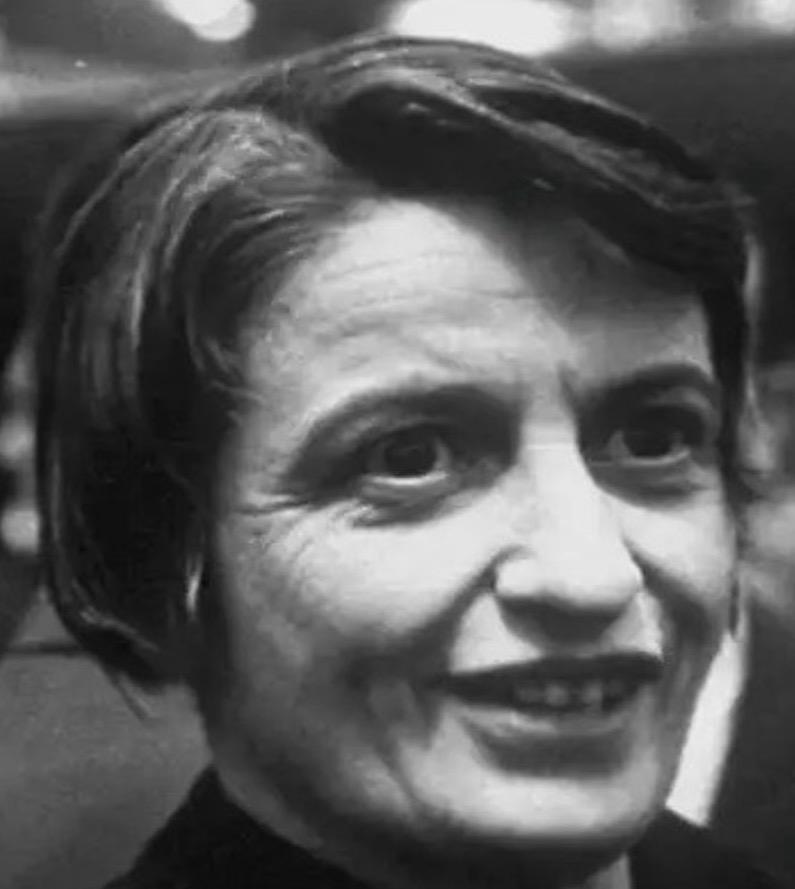
@hedonic There are a few places where Rand addressed Darwin’s achievement directly. On one occasion, in presenting “The Objectivist Ethics”, she added a footnote of clarification, by way of tuning to Darwin, probably at the urging of her younger associates. You can spot that note easily; it is the only footnote. That concerns the reduction of long-recognized teleological actions at the vegetative level to the process of natural selection in the modern understanding. That is, a benefit to life of a poplar tree, for example, routinely comes about, but not by an intentionality (God or nature-spirit) or irreducible final causation behind the suitable outcome. I say “added” because Rand had earlier read her essay at a public-intellectual venue at University of Wisconsin in Madison (photo attached) with the caveat in her footnote absent.
That is not your main focus in this thread of relationship of Rand’s view of human beings and Darwin’s, given his scientific advance. Lots of philosophers tried to report out implications of the Darwinian revolution, usually its implications for religion, ethics, and politics, as you surely know. I mentioned some German ones upstream, and I imagine you know the English ones (which Rand mentioned in her essay “For the New Intellectual”, which you can readily access). The top implication you draw about human beings from your assimilation of Darwin is that humans are the top predators. That is not enough. Native Americans had the intelligence to set grass on fire such that a bunch of buffalo would stampede themselves off a cliff so that these humans could get food and clothing from the buffalo. It is plain that it is high human intelligence that makes his kind the top predator (NOT that more than anything else, he is consumed with predation) and tops at adjusting his surroundings and consumptions to his kinds’ needs and desires. What makes you think Darwin says or implies otherwise?
One thing that Rand rejected when imputed from biology of animals to man was instinct (as you may know if you have read Rand’s text that is Galt’s Speech in Atlas Shrugged or N. Branden’s The Psychology of Self-Esteem or Peikoff’s Objectivism: The Philosophy of Ayn Rand). So far as I know, instinct theory was nothing affected by Darwin’s revolution. Correct me if I’m wrong on that. Rand took the same view taken by Schopenhauer on instinct in humans: it is displaced by intelligence in humans. Schopenhauer kept himself educated on the latest discoveries in biology, but his life ended just before Darwin’s first book on evolution. The issue of instincts in humans preceded the revolution and continues to the present. Instinct in humans has certain more particular specifications by Freud for his special endeavor. As you may know, Rand rejected Freud’s picture of the human psyche. You can read about that in the book by N. Branden I mentioned, should it interest you.
There is a place where Rand speaks of the far past of humans where she should have been using actual anthropology, brain evolution, and so forth. But, perhaps falling into the error you have proposed, hedonic, she instead imagines (rather as in Plato’s use of myths) an individual who makes some crucial original step of great benefit to subsequent human kind. When I find that text, I’ll let you know.
For now let me leave you one text in which Rand spoke directly of modern evolutionary understanding. This is from an essay with a somewhat metaphorical title “The Missing Link”.
Quote
I am not a student of the theory of evolution and, therefore, I am neither its supporter nor its opponent. [All of her followers were supporters of Darwinian evolution.] But a certain hypothesis has haunted me for years; I want to stress that it is only a hypothesis. There is an enormous breach of continuity between man and all the other living species. The difference lies in the nature of man’s consciousness, in its distinctive characteristic: his conceptual faculty. It is as if, after aeons of physiological development, the evolutionary process altered its course, and the higher stages of development focused primarily on the consciousness of living species [and on brains and communication, I’d add!], not their bodies. But the development of a man’s consciousness is volitional [which is supported by distinctive brain process, I’d add!]: no matter what the innate degree of his intelligence, he must develop it, he must learn how to use it, he must become a human being by choice. What if he does not choose to? Then he becomes a transitional phenomenon—a desperate creature that struggles frantically against his own nature, longing for the effortless “safety” of an animal’s consciousness, which he cannot recapture, and rebelling against a human consciousness, which he is afraid to achieve.
For years, scientists have been looking for a missing link between man and animals. Perhaps that missing link is the anti-conceptual mentality.