Pleasure and Value

4 hours ago, StrictlyLogical said:

Rather than offering no explanation whatever: The fact that the most central and important aspect of Objectivist philosophy, namely Objectivist ethics, has been debated in the manner clearly on display above on this forum is thoroughly disheartening to me.

“Disheartening” is a good word to use here. I feel both disappointed and upset that this is your reply, and quite frankly I think it is unjust.

As for content…

I don’t even know what “the manner clearly on display above” is meant to express. Do you mean that people are presenting arguments and attempting to validate them via reason and evidence? Is that the manner you’re talking about?

And in what way do you believe that the Objectivist Ethics “has been debated”? Do you think that I or anyone else has been arguing against them, as such? Overthrowing egoism? Enshrining altruism? Is it that you believe so strongly that David Kelley’s understanding of “life as the standard of value” is correct that you cannot conceive of another position – even a mistaken one that could be held in honest error? (If you consider your position correct in any event, why can’t you simply defend it, or show the flaws in mine, or in any other? Why must you resort to this instead?)

Hell, I can’t even agree that the Ethics (let alone Kelley’s precise understanding of “life as the standard of value”) constitutes “the most central and important aspect of Objectivist philosophy.” It’s a sloppy way of thinking to begin with, honestly, but if pressed I would say that Objectivist Epistemology is both more “central” and “important.” And I think Rand would concur, as expressed in the quote of hers I’d paraphrased earlier, writing:

Quote

I am not primarily an advocate of capitalism, but of egoism; and I am not primarily an advocate of egoism, but of reason. If one recognizes the supremacy of reason and applies it consistently, all the rest follows.

This—the supremacy of reason—was, is and will be the primary concern of my work, and the essence of Objectivism.

The very manner of debate you deride is both a testament to the supremacy of reason and an ongoing attempt to apply it consistently. If you consider yourself a reasonable person, you should support these efforts rather than castigate them.

******************

6 hours ago, DonAthos said:

(I don’t doubt that [holding “the choice to live” as pre-moral or amoral] is a popular notion among Objectivists, and one I subscribed to myself not so long ago. I was looking for a thread from a few years back in which I relied upon this very argument, but did not happen upon it in my cursory search. Maybe I will find it later. I should like to review what I said and thought at the time.)

It’s funny. I spent more time looking for the thread I’d mentioned – because I was taking this discussion seriously and attempting to discuss these issues with StrictlyLogical earnestly, in a good faith effort that now appears wasted – and finally found it.

But in my search, I came upon another thread first: one that doubtless put me on the path of thought (or led me further down that path) that finally led me to this present thread. In it, the subject of conversation was not cheesecake… but ice cream. Allow me to spend a moment to relate this thread, as it has intriguing parallels to our own current discussion (posts edited, but the full thread can be found here for context).

The OP asked:

On 7/22/2014 at 11:13 AM, Kierkegaard said:

What I got out of Rand’s “The Objectivist Ethics”, is that ultimately what is moral to man is that which “really” (that is to say actually, reasonably, and in accordance with reality) promotes his own life. From here the good and happy life is one which one is living to advance and maintain one’s own life.

[…]

My first problem with this is what it says about preferences and the way that one lives life. Both of these can be simply summarized in one (true) example: my adoration for ice cream. I absolutely love ice cream, it’s great, it’s delicious, I like it. However, does this mean that I have a “rational” reason for eating ice cream or valuing ice cream? This is not a reason that has anything to do with forwarding my own life, it is simply something arbitrary that I experience from the act of eating ice cream, but this is a feeling from wholly non-rational sources. Is this irrational from an Objectivist standpoint?

There were a number of replies, but one intrepid forum member attempted to explain his position over several posts. Here is an (edited) compendium:

Quote

I think the key is to simplify the complexity of:  standard of value being life, the quality of life, and over the long range, by this simple procedure which is a bit mathematical.

Imagine a graph - a curve, projecting into the future a number of years until your reasonably predicted death, not just of your status as living or dead, but of the quality of life you lead.  It will have happiness as a major factor but whatever factors actually go into it, imagine it varying over the years directly with your quality of life.

Now (this is where the math comes in) image the area under that graph.  If you extend your end point where it stops (extend your life) the area increases, if you shorten the end point (cut your life short) the area decreases.  If you increase the quality of your life at any point, with a spike or a nice peak, it will contribute to the area under the curve.  Conversely if you decrease the quality of your life at any point, the area under the curve will decrease.

The area under the curve is what you are trying to maximize when you are taking Objectivist ethics into account. Particular actions can and will cause peaks and/or valleys at various points in the curve and can influence the end point of the curve.  The key is to measure the quality of life based on objective standards and to realize that actions affect it and also the end point of your life.

So for ice-cream, you can have some every week, and the end point will likely not move, but the entire graph will raise a little.  This is good.  If you go cold turkey… well the graph would drop and your end point might extend somewhat, but I would guess not much (unless your have weight problems or sever life threatening lactose intolerance or whatever).  If you ate it 3 times a day I think your graph would increase upward by a little more than it would if you had ice cream once a week, but I think your end point would move much closer…i.e. it would shave years off your life.

So there is a sweet spot where your graph area can be maximized, and I think it includes a case of eating some amount of ice cream!!

[…]

Incidentally this kind of analysis can “account” for or illustrate cases where a person may choose to save their own child while risking the price of his/her own life.

[…]

Life has quality and quantity.  One must take into account the effect on both when determining “what values to pursue”.

[…]

The point is length of life only… i.e. literally the “time before you die” is not equivalent to “life as the standard”.  THIS is not meant to provide an answer but to point to the fact that more than one variable must be taken into consideration.

If one perhaps squints just a touch, he might see in this argument future echoes of the present conversation, including criticism of “life-as-survival,” per Kelley, and a suggestion of the kind of “maximization” I have been arguing for (with softwareNerd’s help). In fact, the word “maximize” is itself used above – so I recant my apology for stealing that word from softwareNerd and offer it instead to this insightful poster.

Well, some members of the forum did not respond very favorably to this approach, but I could see great sense in it. So I wrote in defense (emphasis added):

On 7/25/2014 at 10:45 PM, DonAthos said:

I think (though he may correct me if necessary) that [this forum member] is not attempting to lay out a full theory of valuation, but just observing that in general it is not enough to base ones values on life-as-bare-physical-survival; that the quality of life is also a vital factor.

Come to that, I think he’s correct. And while I wouldn’t personally attempt to plot out my values on a graph, and don’t take that as a serious suggestion, I think that’s a valid way of looking at the reasoning involved, metaphorically. Much as one may try to find the most profitable point on a supply and demand curve, we seek to maximize our experience of life – even if that may mean losing a few years on the back-end for a richer experience throughout.

The actual means by which an individual determines his own values and subsequent decisions (down to eating a bowl of ice cream) are complex and depend on a lot of context and specific information. But the point is that we do not decide whether or not to eat ice cream alone according to whether it is judged to extend or shorten one’s years on the planet; the quality of the years we live, quality experienced in part at least as physical pleasure (such as ice cream may provide, according to one’s own taste), is highly important to ethical reasoning.

So it is clear that these ideas have been percolating inside me for quite some time. And I have that forum member, at least in part, to thank.

He responded to my description of his views, in fact, writing graciously of my post:

Quote

That’s the sanest thing I’ve read today on this forum.  Thank you. 


You understood my point perfectly and its intended scope.

I only wish that member were still on the forum today. This conversation in particular could desperately use his patience, civility and insight.

10 hours ago, StrictlyLogical said:

… is thoroughly disheartening to me.

On the forum people will routinely shock you with their gross lack of understanding (in your judgement) of some very basic topic.

It is not a big deal if they’re newbies or if they clearly do not understand a lot about Objectivism. Shock implies you expected much, much better (in your judgement). 

Emotionally, it is a let down. I first feel it as: “I expected better from you; I thought we shared a certain understanding”. Then, I think “if this person is so clueless, and the other guy showed he was clueless two months ago, … … is there anyone who really gets it?” It’s quite alienating and disheartening.

To clarify: this is not about any other post you made here, and not about agreeing or disagreeing with you on the core of this thread. I just empathize with the emotion, and wanted to say so.

On 1/9/2017 at 0:46 PM, DonAthos said:

But suppose that one cannot convince himself (finding the argument a bit tenuous and ad hoc) that he ought to have a slice of cheesecake because he may one day be faced with an impending plague of rats, and in such a time of extreme stress he would be reliant upon the emotional robustness that the physical pleasure of eating this slice of cheesecake would confer.

Godel of Incompleteness Theorem fame did, but maybe you meant sane people. :stuck_out_tongue: After he was already famous, he grew mentally ill - paranoid all the time, and it got worse in time. Eventually, he stopped eating all food unless he knew who made it, for fear of being poisoned. Then he starved to death after some incident when no one was able to feed him.  Whatever pleasure there was, he didn’t care.

On 1/9/2017 at 0:46 PM, DonAthos said:

I should note that I have known people who appear to take “health” (and perhaps “survival”) so seriously that they never are willing to “indulge” in something like a slice of cheesecake.

I do. Then again, some things I do people may call an indulgence. Once a year, for example, I’ll eat some greasy, delicious, too-fried chicken, but I don’t have the impression I’m ignoring my health for a day. I don’t see it as balancing later pains with pleasure now, I actually would deem it not an adverse health risk to eat that. Once a year may be no issue at all. I wouldn’t indulge on bad movies to laugh at, unless I took it as bettering my comedy skills. I’d never do ecstasy, and see no benefit at all regardless of how good it is.

If you have no reason to do something besides “it’s pleasurable”, that’s fine! It’s just not fine if you do it instead of a greater value. Sex with non-romantic partners is the most controversial way to apply that idea, you might get more mileage out of that context.

On 1/9/2017 at 7:48 AM, DonAthos said:

So, too, the dentist, such that eventually the mild pain of a regular cleaning may be borne for the sake of avoiding worse pains later, or to continue to enjoy the pleasures that having healthy teeth affords. It may be, in time, that the child can pronounce going to the dentist as “good” and eating too much ice cream as “evil” (though “bad” is more likely, but amounts to the same) – just as an adult might – because he finally and thoroughly understands the actual relationship these activities have with pleasure and pain, long-term.

I like the dentist, it’s a good “pain”. Sometimes it may hurt, but knowing its purpose erases or alters it. What doesn’t kill me makes me stronger, as Nietzsche said. Psychological strength.

On 1/9/2017 at 7:48 AM, DonAthos said:

Kelley’s written position

I didn’t read the other pages of Kelley’s position, but for now, he seems to say that ethics, broadly construed, only sensibly springs from survival. No moral act will destroy you - or if it did, your ethics would be wrong. Flourishing is a further elaboration, as in survival isn’t the whole story. There is value hierarchy, so if reading Buzzfeed were more important than watching Hamilton on Broadway, that’s a sacrifice, even though both help you survive to some degree.

P.S. Regarding divorcing pleasure from ethics… Do you mean ignoring? Well, it is possible to use pleasure as a conceptual ladder to reach the concept good, then pull up the ladder to use pleasure as one way to measure good. The ladder metaphor is not mine, it’s from WVO Quine originally.

8 hours ago, Eiuol said:

I didn’t read the other pages of Kelley’s position, but for now, he seems to say that ethics, broadly construed, only sensibly springs from survival. No moral act will destroy you - or if it did, your ethics would be wrong.

I wonder if this really implies he thinks suicide is always immoral. For example, most secular people see the sense in opting to end one’s life if one is suffering from a disease that is going to kill you pretty soon, and where your only prospect is some months of increasing suffering before you die. In Oregon, a majority of voters agreed. Not to appeal to majority opinion, but I’d find it surprising if an Objectivist were against suicide in that situation.

8 hours ago, Eiuol said:

Godel of Incompleteness Theorem fame did, but maybe you meant sane people. :stuck_out_tongue: After he was already famous, he grew mentally ill - paranoid all the time, and it got worse in time. Eventually, he stopped eating all food unless he knew who made it, for fear of being poisoned. Then he starved to death after some incident when no one was able to feed him.  Whatever pleasure there was, he didn’t care.

Eiuol, I am so inexpressibly tired I… can’t express it.

But I thank you for at least a moment of levity. Even an emoticon sticking its tongue out at me may be, at times, enough. (And I’m sure I probably deserve it.)

8 hours ago, Eiuol said:

I do. Then again, some things I do people may call an indulgence. Once a year, for example, I’ll eat some greasy, delicious, too-fried chicken, but I don’t have the impression I’m ignoring my health for a day. I don’t see it as balancing later pains with pleasure now, I actually would deem it not an adverse health risk to eat that. Once a year may be no issue at all. I wouldn’t indulge on bad movies to laugh at, unless I took it as bettering my comedy skills. I’d never do ecstasy, and see no benefit at all regardless of how good it is.

Just to run down the list:

It happens that I had fried chicken for dinner last night. (Too fried? What is “too fried”? LOL)
I watch movies of all kinds, including many that are roundly considered “bad.” I feel no shame and make no apology.
I have never tried ecstasy and I have no plans to try it.

I don’t know what all of that amounts to – whether it pronounces me as some sort of demonic Hedonist or something – but if we’re looking for “inductive evidence” as to my relationship to pleasure, or something, there it sits.

8 hours ago, Eiuol said:

If you have no reason to do something besides “it’s pleasurable”, that’s fine! It’s just not fine if you do it instead of a greater value. Sex with non-romantic partners is the most controversial way to apply that idea, you might get more mileage out of that context.

Ah - hahahahaha! No thank you! :slight_smile: We’ll not be having the sex discussion again today. (Maybe someday, but not today.)
Anyways, yes – I agree that “if you have no reason to do something besides ‘it’s pleasurable,’ that’s fine.” I don’t know how far our agreement goes, but I believe that follows from what I’ve argued.

I also agree that when one loses out on a greater value for a lesser one, well, that’s a bad exchange. That’s a “sacrifice” in the full meaning. And it is immoral.

But part of what I am arguing, at least, I believe could be expressed as “there is value in pleasure.” (Which I think coheres with “if you have no reason besides pleasure…” which recognizes that there is “reason” in pleasure.) This is not to say that any thing or action which promises pleasure is therefore a value; that’s the very point at which we need ethical reasoning, to decide whether X pleasurable activity is actually a value (in full context and long-term, given everything that it factually entails).

But I believe that the recognition that “there is value in pleasure” (that, in fact, the very idea of “value” itself originates in pleasure) is a key insight which is ordinarily missing from Objectivist ethical discussion. (And if it is not “ordinarily missing,” then that’s okay, too. I don’t need to be novel, only correct.) I further hold that the value that we find in pleasure does not come from pleasure’s role in survival (i.e. as “fuel”), but from the nature of pleasure itself qua man’s biological reality. We do not assess the situation and say, “Ah – survival is a good (or the good), therefore I shall value pleasure, because that helps me to survive”; rather we experience pleasure and say, “WOW! What was that!? That was good (a wholly new concept to me; Mind. Blown.). I want more of that! Which means… that survival is good, too! (And I had better figure out how to survive.) Because that’s the only way I can get more of that pleasure stuff!”

I would go further to say (at least in the spirit of exploration; my ground is increasingly tenuous, as I have yet to work this all out) that when we speak of some “greater value,” in the face of which it would be moral to forego some experience of pleasure, that this greater value in itself must ultimately be rooted in an experience of pleasure. Come to it, a greater experience of pleasure. That is, we eschew some pleasure not because pleasure is not valuable: but because pleasure is valuable, and by foregoing this Level One Pleasure today, I expect to realize a Level Two Pleasure tomorrow (or a Level One Pleasure over the next week, or etc., but greater in totality. Or “maximized”).

That is a topic which probably I’ll have to explore in greater depth, later.

8 hours ago, Eiuol said:

I like the dentist, it’s a good “pain”. Sometimes it may hurt, but knowing its purpose erases or alters it. What doesn’t kill me makes me stronger, as Nietzsche said. Psychological strength.

I don’t want us to get too sidetracked down the “Buddhist meditation and thumbscrews” road again (and I should stipulate, Eiuol, that I endorse both yoga and meditation – which I think I mentioned elsewhere, too).

But I agree with you that having that context in mind – knowing its purpose – does alter the pain of getting a tooth drilled. “Erase”? I cannot go that far. (Are there people talented such that they can will themselves not to experience, as such? Perhaps. Yet I would expect limits.)

For all of that, I do not like the pain, in itself. Do I like going to the dentist? Yes. Because I like what going to the dentist does for my life (in its full sense, inclusive of pleasure). Yet I still do not like the pain. And if technology evolved to the point where I could reap the benefits of dentistry without the pain normally associated with it, I absolutely would, because just as there is value in pleasure, there is disvalue in pain.

(As an addendum, this is not to say that there isn’t value in “psychological strength,” and being able to deal with such pain as exists.)

8 hours ago, Eiuol said:

I didn’t read the other pages of Kelley’s position, but for now, he seems to say that ethics, broadly construed, only sensibly springs from survival. No moral act will destroy you - or if it did, your ethics would be wrong. Flourishing is a further elaboration, as in survival isn’t the whole story. There is value hierarchy, so if reading Buzzfeed were more important than watching Hamilton on Broadway, that’s a sacrifice, even though both help you survive to some degree.

If what I say about Kelley’s position does not ring true to you, based on your reading of him, I’m happy to concede any potential point; my interest is not in “proving David Kelley wrong,” but showing the flaws in a specific position. I associate that position with Kelley because I do believe that he holds it (or at least that the monograph I’d linked makes a case for it), but I am far from an expert on his writing or personal philosophy.

I should also note that I believe that Kelley is linked to the “survivalist” view elsewhere and by others, so that I am not alone in my interpretation – take that for what it is worth. And I should further note that Kelley himself, in the linked material, appears to distance himself from “flourishing” qua “life as the standard of value.” Which isn’t to say that he doesn’t believe that all of the benefits of “flourishing” are available through “survival as the standard of value” – I’m sure that he does (else why would he endorse a survival ethic?) – but we should recognize that there are, at least, camps who contend that “survival is the standard of value” (and I put Kelley in that camp) and those who believe that “flourishing” or etc., is the standard of value, contra the survivalist view.

I will know more about my own view as we work through this thread – and maybe over time – but my suspicion is that neither of those two camps, as stated (survivalist vs. flourishing) satisfies my current position.

8 hours ago, Eiuol said:

P.S. Regarding divorcing pleasure from ethics… Do you mean ignoring? Well, it is possible to use pleasure as a conceptual ladder to reach the concept good, then pull up the ladder to use pleasure as one way to measure good. The ladder metaphor is not mine, it’s from WVO Quine originally.

I don’t know that I have the time or temperament to assess this “conceptual ladder” at the moment, but let me just say that I would think it an error to finally decide that some concept of “the good” has nothing to do with the experience of pleasure. Or any concept of “the good” which does – which has nothing to do with the experience of pleasure (and I mean as understood and applied, with respect to ethical reasoning, not simply in terms of origin) – is going to be a flawed concept.

44 minutes ago, softwareNerd said:

Not to appeal to majority opinion, but I’d find it surprising if an Objectivist were against suicide in that situation.

Well, then… you just might be surprised! :slight_smile:

7 hours ago, DonAthos said:

(Too fried? What is “too fried”? LOL)

Deep fried and then some. :slight_smile: The Platonic Fried Chicken.

7 hours ago, DonAthos said:

For all of that, I do not like the pain, in itself. Do I like going to the dentist? Yes. Because I like what going to the dentist does for my life (in its full sense, inclusive of pleasure).

Well, I’m thinking that pain and pleasure can also be “bad pleasure” and “good pain”. They are just as sensible such that good pains are pleasurable and bad pleasures are painful. Or in other words, pain the stimulus is better understood as discomfort yet desirable in some instances. That could be part of a pleasurable state of mind, and then pain itself in that case is something you like. So then the dentist pain, while uncomfortable, is something you’d like because feeling it -means- you’ll be healthier. 

7 hours ago, DonAthos said:

Or any concept of “the good” which does – which has nothing to do with the experience of pleasure (and I mean as understood and applied, with respect to ethical reasoning, not simply in terms of origin) – is going to be a flawed concept.

I didn’t say that, I mean that pleasure would end up as one measurement of many, and non-essential. The concept “pleasure” helps attain the concept “ethics”, then loses its weight as a standard. This says nothing about if a particular pain or pleasure is good or bad. “Mere pleasures” are often underrated as far as I see, and that’s for people in general, not just Objectivist-ish people. Eating chocolate, watching Seinfeld, sex, these seem like mere pleasures, no reason to do them other than pleasurable/enjoyable sensation. If pleasure was your ladder, I’m saying it will remain as one way to measure value. But, the child’s earlier conception of good/bad will be quite new after climbing up. 

It may be worth noting that Nietzsche had an idea that historically, guilt sprang from pain and fear of pain - as far as people often did good out of feeling they owed something to someone else. “Debere” means “ought” and “owe” in Latin, that’s how we get the word “debt”. They would do so from fearing physical retaliation. Even more, pain tends to make memory of an event stronger, today we know this is one reason a person adopts learned helplessness - pain is remembered so well, some people stop trying to overcome it later. So the feeling of guilt grew into feeling one owed a singular deity, as if abstracting away particular people that enforce those debts. It’s easy to see Christianity developing from worrying about pain, and over-valuing and glamorizing pain. If we followed a path of developing morality starting at pleasure, with pleasure as an early indicator of good as Rand thought, then we still get somewhere very different. Even if it isn’t essential later.

3 hours ago, Eiuol said:

:slight_smile: The Platonic Fried Chicken.

I cannot tell you how much of my youth was spent searching for the ideal breast and thigh…

3 hours ago, Eiuol said:

Well, I’m thinking that pain and pleasure can also be “bad pleasure” and “good pain”.

I don’t like it, not one bit.

I mean, there is a sense in what you’re saying, but if we’re trying to suss out the reality of pleasure and pain and their relationship to ethics, then I want to be very clear about these matters. “Bad pleasure” and “good pain” is not talking about the sensations in themselves, but a situation which incorporates some element of pleasure/pain and a whole lot of other context.

If we mean to isolate pleasure and pain for examination – and I would argue in the sense that Rand intends, saying that this is the means by which man first evaluates, discovers “value,” and becomes aware of “good or evil” – then pleasure is quite literally “the good” and pain “evil.”

3 hours ago, Eiuol said:

They are just as sensible such that good pains are pleasurable and bad pleasures are painful. Or in other words, pain the stimulus is better understood as discomfort yet desirable in some instances. That could be part of a pleasurable state of mind, and then pain itself in that case is something you like. So then the dentist pain, while uncomfortable, is something you’d like because feeling it -means- you’ll be healthier.

“Good pains,” such as you mean, are not pleasurable qua sensation. (Pleasure may be taken emotionally/cognitively, depending on circumstance.) And the same for “bad pleasures,” which are not painful qua sensation. (If they were, we would have a lot less to worry about in life.)

A person may reasonably desire some painful experience for the benefit he knows it will confer him, or eschew a pleasurable experience for the same reason – but we know this, and we know that we agree about this. It doesn’t help anything, but only serves to confuse the central issues of this thread, to therefore argue that “pleasure can be painful” and vice-versa.

The dentist pain (which doesn’t need “uncomfortable,” or etc.; “pain” is self-descriptive) is something you’d “like” so long as it must be borne for the sake of being healthier; if the dentistry, and all benefits thereto, was available without that accompanying pain, we would not then say, “Oh, but dentist pain is a ‘good pain’ – one I’ve always liked feeling. I don’t want to get rid of it!”

No. The pain in itself is bad, and if the benefits of dentistry could be had without that pain, all else being equal, that would accordingly be the rational and moral choice.

3 hours ago, Eiuol said:

I didn’t say that, I mean that pleasure would end up as one measurement of many, and non-essential. The concept “pleasure” helps attain the concept “ethics”, then loses its weight as a standard. This says nothing about if a particular pain or pleasure is good or bad.

Maybe it’s for want of not reading the author you’d cited, but I’m not tracking this point about ladders and such. Can you give some concrete examples to help elucidate your meaning?

3 hours ago, Eiuol said:

If we followed a path of developing morality starting at pleasure, with pleasure as an early indicator of good as Rand thought, then we still get somewhere very different. Even if it isn’t essential later.

With respect to whether or not pleasure remains “essential” to value, morality and the good (though I should acknowledge here that, while I have started with “physical pleasure” for the sake of both simplicity and centrality, really my thesis eventually means to expand to all kinds of pleasure, inclusive of emotional, cognitive and spiritual pleasures), what do you make of the quote I’d provided in the OP, wherein Rand wrote:

Quote

The form in which man experiences the reality of his values is pleasure . . . . A chronic lack of pleasure, of any enjoyable, rewarding or stimulating experiences, produces a slow, gradual, day-by-day erosion of man’s emotional vitality, which he may ignore or repress, but which is recorded by the relentless computer of his subconscious mechanism that registers an ebbing flow, then a trickle, then a few last drops of fuel—until the day when his inner motor stops and he wonders desperately why he has no desire to go on, unable to find any definable cause of his hopeless, chronic sense of exhaustion.

This sounds essential to me. It is not alone that we discover value by way of pleasure, but that our ongoing ability to value (let alone enjoy existence) depends on continuing to achieve pleasure!

And while Rand uses the term “fuel” here, which conjures the notion that these experiences may be valued for the sake of survival, again I say no. I do not wish for pleasures so that I may live; I wish to live so that I may continue to enjoy the multitude of the world’s pleasures, physical and otherwise, which taught me to value in the first place.

I agree it does not make sense to talk of “pain that is pleasurable” or “pleasure that is painful”. It is also true that the pain necessary within something that’s good for us is not good in and of itself. Similarly, a pleasure that is part of an experience that is bad for us is not good in and of itself. 

This also illustrates that “good” is very different from “pleasurable”. Pleasure is the “felt good” so to speak, but feelings can deceive. Pleasure is also in the moment, or at least of shorter contempt than “the good”. If the good is the area under the curve, pleasure is the height at any particular point.

1 hour ago, softwareNerd said:

I agree it does not make sense to talk of “pain that is pleasurable” or “pleasure that is painful”. It is also true that the pain necessary within something that’s good for us is not good in and of itself.

I agree that this is true.

Quote

Similarly, a pleasure that is part of an experience that is bad for us is not good in and of itself.

Here I disagree. The pleasure component, viewed in isolation (“in and of itself”), is good. If it were not, we could have no experience of the good at all. Pleasure and pain are, by nature, charged with respect to value. They are both “physical sensations” or, as Eiuol likes to put it, “stimuli,” and the thing that both characterizes and differentiates them is that one is positive (or good) and one is negative (or evil/bad). This charge does not depend upon what we desire, or decide, or even upon the larger context in which we encounter these sensations, but upon our own nature and the reality of what these sensations cause us to experience.

No situation in reality will be of pure pleasure (or pure pain), and thus no situation can be evaluated without respect to the full context in which we will be able to say that the situation, on the whole, is either good or bad. But we still can recognize the moral character of pure pleasure and pure pain in the abstract – this is how we learn of “good” and “evil.”

Quote

This also illustrates that “good” is very different from “pleasurable”.

“Good” and “pleasurable” are different words representing different concepts: pleasure is a physical sensation and good is a moral evaluation. So too are “good” and “life” different words representing different concepts. But that does not mean that there is no specific relationship either between “good” and “life,” or between “good” and “pleasure.”

For instance: “the good is not possible without life.” This is true.

And: “the good is not possible without pleasure.” This is also true.

I also mean to argue that the way to assess whether some action/value is “good” is with respect to maximizing one’s experience of pleasures (both physical and non-physical – most importantly including happiness) over the course of one’s life – that this, and neither “survival” nor “flourishing,” is the true way to interpret “life as the standard of value.” If I am correct, then this would be another relationship between pleasure and the good.

Quote

Pleasure is the “felt good” so to speak, but feelings can deceive.

Certainly, pleasure is the “felt good.” And that “felt good” is the source of our very conception of good, our ability to value, and our ability to evaluate; that is to say, “felt good” is the source of our every other type of good. (And speaking more broadly, there is no kind of good which is not “felt,” either in terms of sensation, which is physical pleasure, or emotion, which is non-physical pleasure. It remains to connect physical pleasure to non-physical pleasure, which I have not yet undertaken, but mean to in the near-ish future.)

Neither pleasure nor pain can “deceive.” We may experience pleasure and mistakenly conclude that whatever experience that caused the pleasure is, on the whole, good. (Just as the child may mistakenly conclude that the pain of the dentist’s drill means the dentist ought be avoided.) But the experience of pleasure (or pain) does not deceive us – it is what it is.

There is an analogy to draw here, I suspect, with the validity of the senses.

1 hour ago, softwareNerd said:

Pleasure is also in the moment, or at least of shorter contempt than “the good”. If the good is the area under the curve, pleasure is the height at any particular point.

As we move from physical pleasures to non-physical pleasures, such as joy or happiness, we encounter pleasures with greater longevity. It is my project, eventually, to demonstrate that all of the area under the curve is sensibly a form of pleasure, and also sourced in (and reliant upon) our capacity for physical pleasure.

25 minutes ago, DonAthos said:

It is my project, eventually, to demonstrate that all of the area under the curve is sensibly a form of pleasure, and also sourced in (and reliant upon) our capacity for physical pleasure.

Sure, if you want to use the terms that way, it’s fine, but what’s the point? I mean: let’s say all the area under the curve is pleasure. What are the implications for action?

10 hours ago, softwareNerd said:

Sure, if you want to use the terms that way, it’s fine, but what’s the point? I mean: let’s say all the area under the curve is pleasure. What are the implications for action?

Years ago in the course of a contentious discussion – and part of what sparked me towards this series of thoughts – a forum member said, “I dislike decisions motivated by pleasure instead of an objective standard of values.”

The point of using the terms that way is 1) I think my usage is justified by the facts, and 2) I would like to elucidate the actual relationship between “pleasure” and “an objective standard of values.”

Regarding “implications for action,” I cannot guarantee that I could identify them all, or yet understand every (important) implication of what I’m discussing; hopefully this thread, and further conversation, will help in that effort. But here’s what I believe, at present:

I believe that the kinds of confusions expressed in that “contentious discussion” referenced above, and also about ice cream (i.e. whether it is moral to eat ice cream) linked earlier in this thread, are fairly common in Objectivist discourse and ethical reasoning, because if people believe that their actions must be motivated by “life as the standard of value,” and if they mistake what “life” means in that phrase (as “survival,” for instance), then they will be hard-pressed to justify decisions such as eating ice cream (or cheesecake).

Yet I believe that if we understand (as we ought) that the means by which we “enjoy” life is via pleasure, and if we understand (as we ought) that “life as the standard of value” includes that we enjoy our lives, then, in context, we will be able to understand that an occasional slice of cheesecake is justified for the sake of the pleasure it provides. It will clear up the confusion of Objectivists who wonder whether they can, in reason, link eating a particular scoop of ice cream to their long-term chances for survival, and it will hopefully inform the thinking of those Objectivists who are otherwise skeptical of a pursuit of pleasure, in demonstrating that acting for the sake of some experience of pleasure is not, in itself, necessarily either “hedonistic” or immoral.

It will help to fulfill Galt’s observation that the purpose of morality is to teach you “to enjoy yourself and live” – a purpose inadequately addressed by the interpretation of “life” in “life as the standard of value” as “survival” alone.

What is more, the relationship between pleasure and value I mean to argue for will help to explore and explain the topic of “justifiable suicide” that recently launched multiple threads on this very forum, with prominent forum members arguing that suicide is always immoral. (Those threads were the specific impetus for me to create this thread.) It is only by understanding the role of pleasure (and with respect to suicide, also pain) to one’s enjoyment of, or “experience” of, life, that one can reach Peikoff’s understanding that sometimes suicide is “justified.”

In short, the implications for action are that people will be more cognizant of the role of pleasure and pain in their ethical reasoning. This will mean that when a loved one is dying from some awful disease, their Objectivist relatives will not tell them that an assisted suicide is necessarily immoral – but will be more supportive, in demonstrating understanding that, yes, life is meant to be enjoyed, and absent that, survival itself is not necessarily of value. Also, I would expect somewhat more cheesecake to be eaten, and somewhat less guilt to be experienced for it.

In short short, the point is: more enjoyment, less suffering.

6 hours ago, DonAthos said:

…  a forum member said, “I dislike decisions motivated by pleasure instead of an objective standard of values.”

The pleasure and pain that we experience at points in time have immediate causes. These causes are not perfectly independent causes. They have causal links between them.

Suppose C1, C2, C3, C4…are various immediate causes of pain/pleasure P1, P2, P3, P4. Also, suppose C1 and C2 have a very tight causal relationship, where there is no way to enact one without the other. Finally, suppose P1 is positive and P2 is negative. 

Action that enacts cause C1 cannot be viewed in isolation, because (we assume) it implies C2. Consequently, though we can analyze P1 and P2 in isolation, it makes sense to analyse them as a sum. 

When a rational person says what you’ve quoted, they’re probably saying that they dislike making decisions base on P1 and P2 in isolation. They take the causal-linkages into account as well. 

(Other’s may have an irrational, stoic or ascetic approach, but rational folk can say what you’re quoted and be perfectly right.)

2 hours ago, softwareNerd said:

(Other’s may have an irrational, stoic or ascetic approach, but rational folk can say what you’re quoted and be perfectly right.)

I didn’t say that a rational person couldn’t. (Though in this case, it happens that the quote does not source from a rational person – or at least, it was not a person acting in a reasonable fashion at the time; rather, it was an expression of contempt for pleasure as a source of motivation, as such. But it is probably best not to try to recreate an entire other thread within this thread, lest such recursion collapse space-time itself.)

Indeed, I consider myself a rational person and I’ve said as much as the “rational version” of this quote several times over the course of this thread, fully taking such “causal links” into account. The example of a child who avoids the dentist chair due to the pain he expects is one such example; we could say of it that the child ought not be motivated by dislike of pain, but an objective standard of values.

Yet, as in my discussion with Eiuol, if the benefits of dentistry were available (let us say through Dentist Two) without the pain associated with Dentist One – all else being equal – it would be perfectly sensible to be motivated by dislike of pain to go with Dentist Two. Such a decision would be _consonant with _ “an objective standard of values” – which is part and parcel to everything I’m arguing in this thread.

But apart from that quote, what did you make of my attempt to answer the questions you’d posed? You’d asked, in part, what the implications for action might be in adopting my understanding – and I tried to demonstrate some. What did you make of that?

22 hours ago, DonAthos said:

“Bad pleasure” and “good pain” is not talking about the sensations in themselves, but a situation which incorporates some element of pleasure/pain and a whole lot of other context.

This is true, it wouldn’t be talking about sensations in themselves as good, or to characterize the sensation of pain AS pleasure. If anything to conflate pleasure and pain at all leads to the life-denying and pleasure-denying parts of Christianity. To be an ascetic is to see pleasure a platonic path to sin; sensations in themselves acquire value, either negative or positive. I recall some saint, I forget who, that thought torture was good for the receiver, so pain in itself was good. Not interpretation of pain, but the stimuli. Rand doesn’t analyze this twisted logic of a devout Christian ascetic - except to call it anti-life. Nietzsche tried to analyze deeper motivations. He’d be worth reading, even if you disagreed with him.

I would say that neither pain nor pleasure are good or bad stimuli. Red isn’t a bad stimuli, purple isn’t a good stimuli. A child may find that pleasure is nice, therefore good, but as an adult, the child needs to grasp “good for what?” Then pain/pleasure ceases to be an essential. It becomes possible that a pain IS good, or that a pleasure IS bad. Stimuli provide information but lack a value.

22 hours ago, DonAthos said:

Maybe it’s for want of not reading the author you’d cited, but I’m not tracking this point about ladders and such. Can you give some concrete examples to help elucidate your meaning?

Ok.

Take you tracing how one starts with pleasure to develop a theory of ethics. This is a starting point. There are whiskers on kitten, bee stings, dog bites, raindrops on roses. These aren’t complex, and the way a kid grapples with ethics. As adults, we know there is a lot more to the world of ethics, so it takes time to see the adult perspective. Early on, a kid starts to think about hurting feelings, what others like, ideas of fairness. Without starting at pleasure, it doesn’t make sense. A kid is building on the pleasure of ice cream or displeasure of spinach. Pleasure serves as a ladder to later conceptions of “good or bad” that are more essential than pleasure. A kid understands more and more, until becoming an adult and forming ethics theories. At the top of this ladder, it’s the concept “ethical”. At the very least, pleasure remains a measurement. The “ladder” is still there, but it doesn’t -need- to be essential to the concept ethical.

The cited link is only 1 page.

The main point: as important as pleasure is to the development of ethics and the concept ethics, it doesn’t end up as the essential nature of ethics.


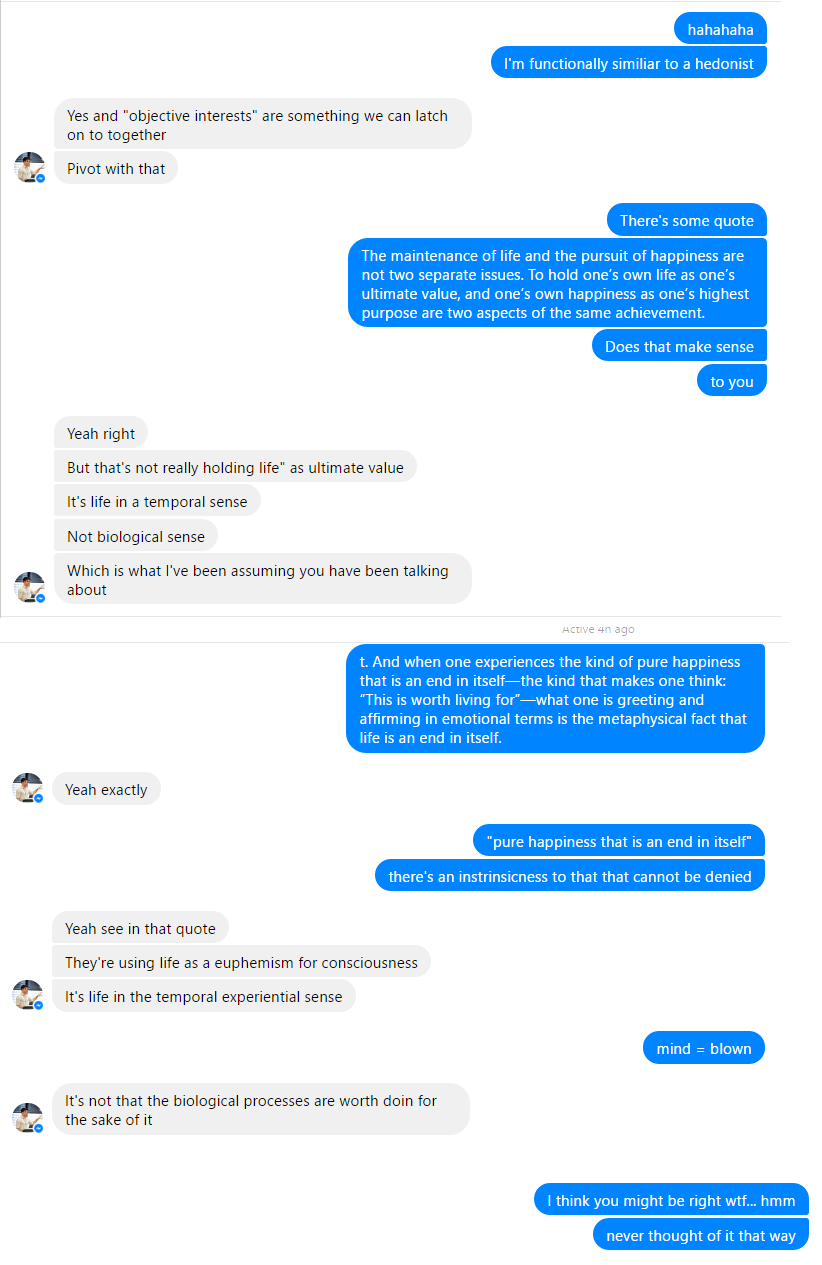
Wow! I will write a full response later, but I want to first say that this is so strange because your thoughts are along the lines of what I have been thinking. I want to show you a chat thread I had just yesterday with a philosopher friend. He said to me that Rand said ‘life’ as a euphemism for as ‘experential consciousness’. It struck a chord with me because it gets to the root of it in my mind.

Here is the conversation thread:

I think you’re on to something.


Step back for a moment and really think about this…

We are trying to justify enjoying ourselves for the sake of enjoying ourselves. I think therein lies an obvious absurdity.

On 11/01/2017 at 2:33 AM, DonAthos said:

Pleasure is no mere “fuel,” which implies that it is a support on some journey. But a journey to where? Live in order to… keep living? Survive for the sake of survival, for its own sake? No. Pleasure may well be a fuel, but that isn’t the point of it. The reason why such pleasures give men the will to carry on is because it is for the sake of those pleasures that we carry on. The experience of pleasure is the destination of our journey. It is where we mean to go, again and again and again; for it is in such pleasures, in such moments, that we say YES – this is what life is, what it can and ought to be, and why it is of value in the first place.

Exactly! 

This reminds me of a short recording of Rand.

https://www.youtube.com/watch?v=Ki12zyW2zac


Quote

There is no such thing as the purpose of life. Life is the purpose of life. You should enjoy your life. You should be happy in it. Your proper moral obligation is to pursue the highest form of happiness possible to you, and can prove your choice to yourself in rational terms.

And I’ll amend that life is experience through consciousness and value in consciousness is experienced through pleasure.

Pleasure is the purpose pleasure! There are some constaints about our nature that we must abide by to maximize ‘the area under the curve’ as Softwarenerd so elegantly explained, but god damn it, the only bloody justification for maximizing the area under the curve is the experience of it!

Quote

Any person who attempts to prescribe the happiness of other people is a monster and has no claim to morality at all.

This would appear to be a contradiction because Rand’s ethics is supposed to prescribe to us what will make us happy, right? In the full sense, she never meant to tell us what we should pursue concretely. Ethics is just the ground rules. Since material and spiritual functioning rely on certain factors, we cannot ignore those factors if we wish to pursue pleasure (Psychological pleasure AND physical pleasure). It’s the meta-values that allow us to maximize the area under the curve by not setting our bliss against our well-being.

When she says “and can prove to yourself rationally”. I don’t think she meant that you can prove that the cheesecake is rational to eat, but that you can prove rationally that your meta-values are set in accordance with your nature and not against it. If you set the meta-values against your nature qua man, you will necessarily not be maximizing the area under the curve.

If life-as-survival were the standard, then suicide would never be permissable, and we know Rand expressed the view that when ‘life proper to man’ were impossible suicide is justifiable. She clearly doesn’t mean life-as-survival.

I think the following is also illuminating…

Quote

Just as the pleasure-pain mechanism of man’s body is an automatic indicator of his body’s welfare or injury, a barometer of its basic alternative, life or death—so the emotional mechanism of man’s consciousness is geared to perform the same function, as a barometer that registers the same alternative by means of two basic emotions: joy or suffering. Emotions are the automatic results of man’s value judgments integrated by his subconscious; emotions are estimates of that which furthers man’s values or threatens them, that which is for him or against him—lightning calculators giving him the sum of his profit or loss.

But while the standard of value operating the physical pleasure-pain mechanism of man’s body is automatic and innate, determined by the nature of his body—the standard of value operating his emotional mechanism, is not. Since man has no automatic knowledge, he can have no automatic values; since he has no innate ideas, he can have no innate value judgments.

I distinguished between psychological and physical pleasure. I think Rand made the same distinction but called it  positive-negative emotion and pleasure-pain.

But I disagree here somewhat. Some things give me positive emotions, and I have no idea why, and it has nothing to do with life as my standard of value. I enjoy music. I enjoy dancing. Some people do not. I enjoy the sound of the French language, and I dislike the sound of Chinese. Some people experience the opposite. I like skinny girls, some people like plump girls. Whence come such emotional responses? Values. Whence come those values??? If they are not chosen, they are either random, conditioned by environment or innate, but in every case where such values are unchosen they are pretty arbitrary.

I think many such values are innate. I know this goes against Objectivist doctrine.

And after years of self doubt, repression and wondering how I can justify what I want, I feel like I’m coming round to embracing the absurdity of the arbitrary desires I have. “Screw it. It gives me joy. What more justification do I need?”

On 13/01/2017 at 2:17 PM, softwareNerd said:

I agree it does not make sense to talk of “pain that is pleasurable” or “pleasure that is painful”. It is also true that the pain necessary within something that’s good for us is not good in and of itself. Similarly, a pleasure that is part of an experience that is bad for us is not good in and of itself. 

This also illustrates that “good” is very different from “pleasurable”. Pleasure is the “felt good” so to speak, but feelings can deceive. Pleasure is also in the moment, or at least of shorter contempt than “the good”. If the good is the area under the curve, pleasure is the height at any particular point.

Agreed, but I think it is possible to experience ‘pain’ or ‘discomfort’ with a positive emotional veneer. When I’m lifting weights, the pain definitely accompanied with a positive emotional response It feels pretty awesome to feel the burn. When I’m on the bike, I embrace the burn in my legs, I feel a sense of power when I’m pushing hard, and the ‘discomfort’ has a positive veneer.

It is possible to psychologically embrace the suck, so to speak.


There is a movie that really drove home the importance of emotions and pleasure to me. It actually really helped me recognize how much everything we do comes down to feelings. Logic and reason is the means to get what we want, but what we desire is the positive feelings we get from certain experiences: be it the experience of dancing, or something more abstract like the experience of beholding one’s hard earned achievement. In either case, without the psychological rewarding feeling, the meaning would be stripped. Imagine life without feelings, positive or negative. Even negative feelings are important. They lets us experience the reality of losses. It makes our values mean so much more. Sometimes we need some valleys to get to higher peaks, I think. That is better than flattening out the graph. Never caring enough about anything.

Here are two clips from the movie Equilibrium that were very powerful moments for me. The premise of the movie is human emotions are stripped with a drug, positive and negative, so that society can be peaceful. But in doing so, they lose the whole purpose of being alive.

“It’s circular. You exist to continue your existence. What’s the point?”

Exactly.

https://www.youtube.com/watch?v=amY6wjfU48k

https://www.youtube.com/watch?v=lmG57WlIpEc

“It’s as vital breath. Without it, without love, without anger, without sorrow, breath is just a clock, ticking.”

Amazing.

Art is banned in this society and Preston here stumbled upon hidden art contraband. You can see all this stuff in this room, the art, the pictures, the Newton’s craddle, all this stuff some people often think of as trivial, is not trivial at all, it’s rhyme and reason is how it makes us feel, and how things make us feel is not only not trivial, it’s the most profound thing there is.

For me, a very technical minded person, this realization has opened up a flourishing in my appreciation for art, music, everything. I no longer poo poo it all like I used to and I’ve already felt so much richer for it. Embracing my feelings, and now trying to learn to embrace my desires.

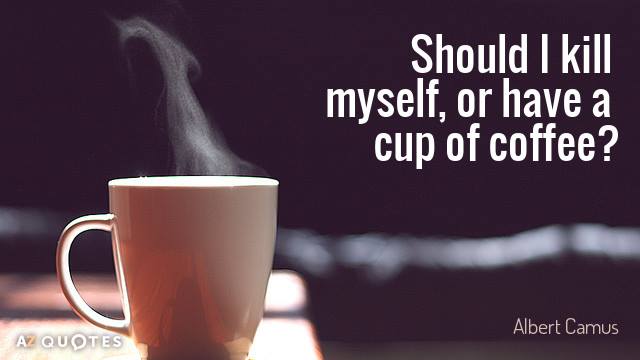
A hilarious quote with a kernel of truth to it

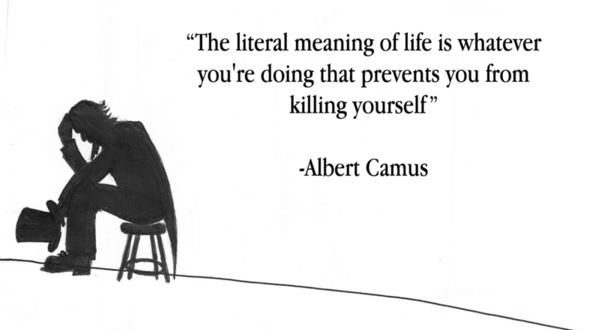
Albert Camus said the fundamental question of philosophy is whether or not you should commit suicide. Not sure I agree, but isn’t it a legitimate question? Why live at all?

I find your arguments convincing but I’m still on the fence if it’s amoral.

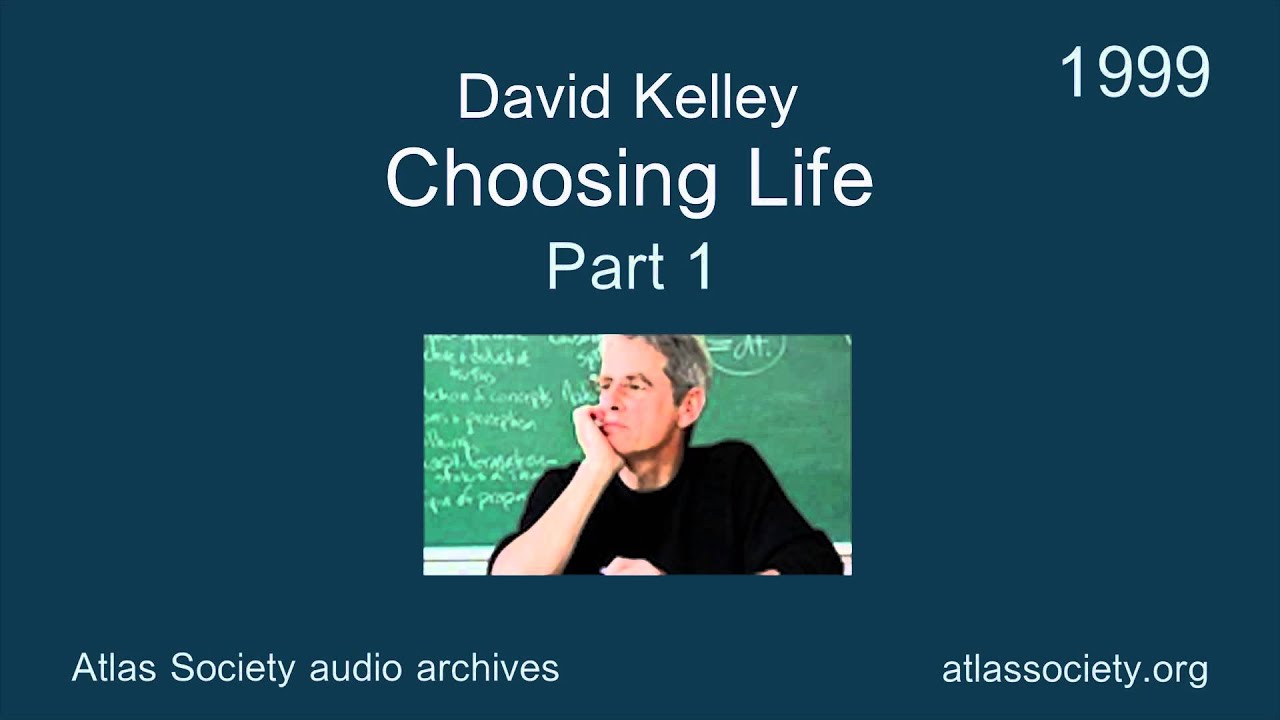
I have heard Kelly’s explanation in his lectures ‘Choosing life’ but I can’t remember what his conclusion was. I do remember he pointed out the absurdity of trying to condemn a man morally for not wanting to live.

For someone who doesn’t want to live, he says really the thing to do is to get them to connect with values. In other words, to get them to do things they enjoy… and we come full circle back to pleasure being the whole point - could one even say that it’s the only reason anyone would choose to live.

Quote

Principles of morality tell us how to live well. But if one doesn’t wish to live well, all of this is moot.

For anyone interested in these lectures they are on YouTube:

I am listening to this lecture again, and it is very interesting. It has so much more meaning in the context of my recent questions about value and pleasure.

Have a coffee… or suicide? :slight_smile: