I’m sure you have all heard it said many times that the nations of Eastern Europe were better off under socialism. This is a misconception that has been coming up a lot lately and is in need of some attention. Even my usually respectable International Relations lecturer raised the possibility that free market reforms have had an adverse effect on the economies and people of the former Marxist experiment states.
The graph below, called the liberalization Index, demonstrates the extent to which seven former socialist states have undergone economic liberalization. The boundaries of the index range from 0 (least liberal) to 1 (most liberal). As you can see Russia and Ukraine have been the most reluctant to adopt liberal reforms while the Czech Republic, Hungary and Poland have welcomed free enterprise.
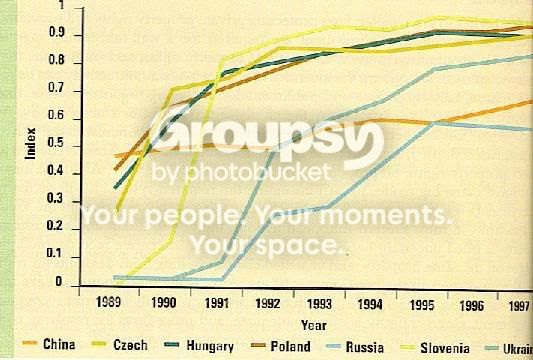
From World Bank, World Development Indicators
Now observe the level of growth experienced by the nations that have embraced a free market compared to those that haven’t. Between 1991 and 2000 Poland has had an annual GDP growth rate of 4.4, Hungary 2.2, and the Czech Republic 1.3. Contrast this to the situation in Russia, with -3.5, and Ukraine, at -7.4. Furthermore, all but Russia is experiencing greater growth than during the soviet era when Hungary was moving at 0.9 a year and Ukraine at -7.5. It is obvious that free enterprise is the recipe for growth.
This is not to say that problems are not being experienced throughout the former USSR. When a people are subject to the kind of collectivist atmosphere - that sees creativity punished, stagnation enforced, freedom of the mind suppressed, and inefficiency encouraged - for as long as the Eastern Europeans were, the cure is never immediate. But given time, and further liberalization, communisms leftovers will be overcome.