Rich people benefit from the poor being poor?

A recession gripped the nation’s economy beginning in 1893. Orders for Pullman cars fell off and management began a program of lay-offs and wage cuts. The cuts, applied not to managerial employees but only to the hourly workers, averaged 25 percent. Since Pullman wages were already close to the subsistence level, it was a recipe for disaster for the workers. So isn’t it their right to organize to achieve some bargaining leverage against their employer in order to earn a wage commensurate with the value of their work?

If orders for Pullman cars fell off 25%, I’d say a wage cut of 25% was a wage commensurate with the value of their work. Orders cause the wages. Now, I would go on to say this is a bad management practice to give a pass to all the management employees, it insulated them from a market pressure to perform better when those employees are the most important to overall productivity. There was a class prejudice at work here, a brute equation of a human being’s worth with the amount of money he earned, which led to an unjust sheltering of management. Most of the early labor battles were proxies for open class, race, religious or ethnic warfare. People were wickedly and self-righteously prejudiced in all kinds of ways back then, and a strike could be fight for justice by a catholic workforce against a protestant management who despised them.

It’s only voluntary in that the alternative can mean that by quitting you end up 1) losing your house and becoming homeless, 2) not being able to feed your family, 3) starting over at another company at a lower wage with less security, 4) losing your pension, 5) not being able to afford the insurance and you have a medical condition, or your family member does, etc. etc. etc.

Can mean…

It can also mean that you get a better job, build a better house, have more of what you value.

If one value’s the job, it’s in one’s best interest not to quit. Do you agree?

I’m not saying you should never quit, but just really sometimes that it can come at a real price. This is why coming together as a bargaining unit with your fellow workers makes real economic sense.

Of course it comes with a “price”. One might not be working. That is an independent decision.

As for “bargaining unit” you’ll have to explain your point more. Do you believe that one should be paid for the work one does as an individual or just get paid more because one has been then longer and never produced more work?

Not really the same thing I don’t think. How does a worker use this to leverage a better wage or working condition?

So, do you believe employers employ only for a body to occupy a space or are they actually looking for value in employee skills?

Pullman was a company town. Virtually the whole town was owned or controlled by the company. There was nowhere else to go without everyone leaving town en masse. When two business negotiate a business agreement, the business with the most leverage usually gets the better end of the deal. What is wrong with unskilled workers banding together to establish the leverage needed for negotiations with the employer? That’s just capitalism in action.

And if the company decided to fire everyone and make the same product in another town with lower costs to make a similar product, that’s capitalism too. They could be more competitive in the market place. That would reduce the costs for transportation for goods for those same people that all got fired. Do you believe that is wrong? Or is everything only about certain kinds of workers in your thinking?

A lot of heavy text in people’s posts, but overall I didn’t see mention of imperfect information.

Rich people do benefit from the poor being poor, perhaps not as a causal link, but they do causally benefit from people being uninformed or misinformed about their products. New York City restaurants for example balked at the idea of mandated published nutritional info on all menus. There is an administrative headache for sure, but part of the concern is that they don’t want the extremely fattening nutritional content being exposed. I’m personally happy to pay $1 - $2 more to order food at a restaurant when I can see the nutritional info.

How do you think the healthcare industry is so huge right now? You can bet that lack of pricing visibility contributed a great deal to it. You don’t know how much a procedure will cost, and there are too many people in the healthcare delivery chain to muddle the water. Some people’s jobs are just for the purpose of preventing you from knowing the pricing. And drug companies and insurance providers are filthy rich because of this.

Just some food for thought for you guys.

In reality, don’t workers have very little leverage in salary negotiations for most low to mid wage jobs? And without leverage, how can workers negotiate for the true value of their labor, and thus avoid exploitation?

Are these workers somehow helplessly dependent on others for their existence? How did they get to be that way? Is it someone else’s fault that their existence is dependent on someone else? Is not their leverage the decision to accept the job in the first place? A business (that requires employess) with no employees can’t exploit anyone and it won’t survive.

A lot of heavy text in people’s posts, but overall I didn’t see mention of imperfect information.

Rich people do benefit from the poor being poor, perhaps not as a causal link, but they do causally benefit from people being uninformed or misinformed about their products.

By the same token you could then say that rich people are injured by the poor. They suffer by not being able to sell their products to those who cannot afford them.

An wealthy owner of a Yacht building company does benefit from their being lots of poor people and dwindling amounts of rich people.

By the same token you could then say that rich people are injured by the poor. They suffer by not being able to sell their products to those who cannot afford them.

An wealthy owner of a Yacht building company does benefit from their being lots of poor people and dwindling amounts of rich people.

I’m going to start a business, and make sure that nobody is able to afford my stuff.

Oops… my above remark should read “doesn’t benefit”… not does benefit. Sorry.

Does this claim have any validity?

This is a Marxist theory, a theory that the top wealth in any system benefit from the poor being poor.

Examples of this theory include:

  • Rich people benefit from the poor being ignorant

  • Rich people benefit from the poor being desperate

Rich people are rich because of their innate abilities and superior virtue. They don’t need"poor people", who’re poor because of their stupidity or innate disabilities, to be anything.

Also, there is no such thing as the “people”. Its all individuals. There is no such thing as society. these are important logical considerations before answering such questions. Marxists, because of their innate evilness, conjure up hocus pocus theory to create fascism.

Rich people are rich because of their innate abilities and superior virtue. They don’t need"poor people", who’re poor because of their stupidity or innate disabilities, to be anything.

Also, there is no such thing as the “people”. Its all individuals. There is no such thing as society. these are important logical considerations before answering such questions. Marxists, because of their innate evilness, conjure up hocus pocus theory to create fascism.

This is so immature, I can’t imagine how this person manages to reach up to touch the keyboard.

Rich people do benefit from the poor being poor, perhaps not as a causal link, but they do causally benefit from people being uninformed or misinformed about their products. New York City restaurants for example balked at the idea of mandated published nutritional info on all menus. There is an administrative headache for sure, but part of the concern is that they don’t want the extremely fattening nutritional content being exposed. I’m personally happy to pay $1 - $2 more to order food at a restaurant when I can see the nutritional info.

So what? The restaurants are personally not happy to provide that info for you , for one or two dollars. So take a hike, you have no right to make them give you anything. You have the right to not eat at restaurants that don’t.

How do you think the healthcare industry is so huge right now? You can bet that lack of pricing visibility contributed a great deal to it. You don’t know how much a procedure will cost, and there are too many people in the healthcare delivery chain to muddle the water. Some people’s jobs are just for the purpose of preventing you from knowing the pricing. And drug companies and insurance providers are filthy rich because of this.

Some of the things that are lies, in your post:

  1. The healthcare industry is “too big”.

  2. There is a lack of pricing visibility. This is silly, prices are perfectly visible.

  3. The big, obvious lie: “Drug companies and insurance providers have higher profits than other industries.”

Actually, the healthcare industry is as big as it is because of the never before seen prosperity in the free world. Now, of course, that freedom is being attacked, by an ideology that promotes class envy, and considers prosperity, and the never before seen ammount and quality of healthcare these prosperous people get “too much”.

So what? The restaurants are personally not happy to provide that info for you , for one or two dollars. So take a hike, you have no right to make them give you anything. You have the right to not eat at restaurants that don’t.

You are right about my not having a right to make them give me that info.

Some of the things that are lies, in your post:

This is going to be fun!

  1. The healthcare industry is " too big".

I never said that, buddy. Yawn.

  1. There is a lack of pricing visibility. This is silly, prices are perfectly visible.

Okay, how much does an MRI scan cost you at Kaiser Permanente in New York? Call your HMO and ask them how much it will cost. Try to get them to send you a price list and you’ll get laughed at. They will answer with “it depends on your copay, the specific Kaiser office you’re going to, etc.” Ask them if you will actually get the MRI scan if you request it to be paid under your insurance program. They will answer “it depends on your past claim history, an approval process, etc.” You have a chance of not even receiving this procedure, even if your doctor requests it.

What about a PPO? What about under Medicaid? What about under Medicare? One reason that Government Pricing (Average Manufacturer’s Price, Average Sales Price, Non-Federal Average Manufacturer’s Price, etc) has been mandated by the Centers for Medicaid and Medicare Services is the lack of price transparency that has been created by drug manufacturers.

The easiest way to have perfect price visibility is to have no insurance and a great relationship with a doctor who is willing to give you a published price list for his procedures. Most people don’t get that luxury. So they’re left to deal with the above.

  1. The big, obvious lie: “Drug companies and insurance providers have higher profits than other industries.”

Do you know the profits of a drug company? Their ROI on an R&D’d drug is like 400%. Now, things like increased generic pricing competition, class action law suits, regulatory changes, etc, erode those profits, but ultimately drug companies are crazy profitable. I’m not going to cite statistics here, but the external consultant to full time employee ratios within drug companies speaks to their bank roll.

The insurance industry is a separate animal. Their margins are thinner than drug manufactuers’, but their entire business model fundamentally rests on taking you money and not paying you for care. That’s how they make money. In most cases, their policies grant people the care they need, but by design their purpose is to take in money and not pay it out.

And before you throw in the card about “competition will stop them,” ask yourself - can you really switch between an Aetna or a Cigna or a Kaiser or a Bravo Health? What about if you’re unemployed? What if you’re on COBRA? First of all, there are few options to choose from in a geographical location. You have a choice to move to a place with an insurance provider you like, but you don’t have the ability to invoke other insurance providers to become available.

But one of the above discussion matters anyway, because the fact that there exist insurance brokers that connect individual beneficiaries with actual insurance providers to navigate through all the paperwork proves the lack of visibility.

Actually, the healthcare industry is as big as it is because of the never before seen prosperity in the free world. Now, of course, that freedom is being attacked, by an ideology that promotes class envy, and considers prosperity, and the never before seen ammount and quality of healthcare these prosperous people get “too much”.

Needless conjecture and non-sequiturs.

And drug companies and insurance providers are filthy rich because of this.

Just some food for thought for you guys.

I’m with Jake on this.

First, I’m happy they are rich, if you say they are. They are there to help individuals get well. If they had dying customers, well, they would have bigger problems.

Now, as for rich, what are you calling rich? Their volume or their profit margin?

The insurance industry is a separate animal. Their margins are thinner than drug manufactuers’, but their entire business model fundamentally rests on taking you money and not paying you for care. That’s how they make money. In most cases, their policies grant people the care they need, but by design their purpose is to take in money and not pay it out.

I’m fine with that. If you’re not, same as before: take a hike. The only entity forcing you to have insurance is the government. Insurance companies offer a service, and as far as they are concerned, you can take it or leave it.

New York City restaurants for example balked at the idea of mandated published nutritional info on all menus. There is an administrative headache for sure, but part of the concern is that they don’t want the extremely fattening nutritional content being exposed. I’m personally happy to pay $1 - $2 more to order food at a restaurant when I can see the nutritional info.

Of course they should balk at that. And it is not because they assume their customers are too ignorant to realize that bacon & cheese stuffed potato skins are fattening. They balk because the government is making unwarranted demands on their business. If their customers demand nutritional information, then it is the right of the business owner whether or not to provide that information, and logically in their best interest to provide that for their customers. The customers always have the right to be patrons of the establishment or not. Nobody is forced to eat at any particular restaurant… yet, are they?

I happen to WISH that all restaurants provided this information. But I would never suggest a law mandating it. It is mandated for chain restaurants out here in Los Angeles to have the info. I like to track my calories consumed and calories burned each day, so I tend to go to places that I know have this information. Or I ask for it. Like you, I also would be OK with knowing that part of the price of my meal is including the hassle of them keeping track of and providing this information. But that is a much different sentiment than demanding it as a right for the greater good. (I must assume that you would agree this should be voluntary and not mandated by law, right?)

But specifically to your point of this example, this does not show how business benefits from people being poor. You’re using poor in the sense of having less knowledge, I know, but as I described above, in my case the business’ benefits from me being “rich” with information. If you use take the term “poor” to be used more traditionally and refer to people without a lot of money, then obviously mandating such extra costs associated with providing this information will necessarily push up the prices of their products and negatively affect the poor.

Wealth and prosperity can be created in the free market where people trade freely based on their own decisions according to their own self interests. Any encumbrance to that is what causes distortions. In a free market, the rich don’t get rich by making other people poor. People get to make themselves rich based on their own effort, labor, talent… and yeah, some luck thrown in there too. They can go poor by the lack of those same causes as well.

  1. The big, obvious lie: “Drug companies and insurance providers have higher profits than other industries.”

Actually, the healthcare industry is as big as it is because of the never before seen prosperity in the free world. Now, of course, that freedom is being attacked, by an ideology that promotes class envy, and considers prosperity, and the never before seen ammount and quality of healthcare these prosperous people get “too much”.

This (3) isn’t a point that should even matter. (whether a lie or not… as worded, it is not a lie because, yeah, they have higher profits than “other industries”. That is not to say that they have [unfairly?!?] high profits)

Though I agree with what he says here, Jake doesn’t need to justify the bigness of any industry. There is nothing wrong with profit. We hear the opposite claimed all the time and it is an out and out attack on capitalism. Profits are the point. Profits are good. Every business and person works precisely for profits.

“Obscene profits”

“Windfall profits”

“Outrageous profits”

These are things said by people philosophically opposed to capitalism. That is what should be pointed out. If one understands capitalism and free markets then you will cheer big profits. That means more investment, more competition in that field for innovation, more growth… And that actually leads to the product being more affordable. It is when a third (non-productive) party can step in by force (read Government) and can make demands and distort the free trade of products between free individuals that causes the types of twisted and complex issues we see in, say, the health care industry.

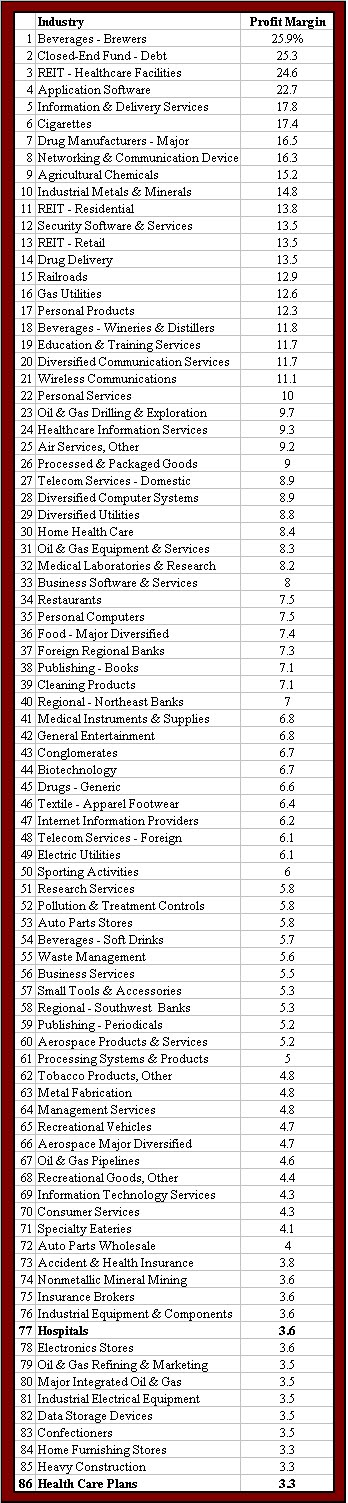
Anyway… Below is a chart of profits by industry. (source - I cannot personally vouch for the percentile accuracy, but I have no reason to doubt it)

Look at the #1 evil industry. “Hmm” says the government official… “Maybe we should put a special tax on soft drinks, eh?” Welcome to Atlas Shrugged.

But as I said, one shouldn’t look at that chart and think that the people at the top are somehow “the bad guys”.
We’re all in agreement on an individual level - no one has the right to make you do something you don’t want to do.

That said, insurance is one area that I would make a strong case for that everyone should have for a number of reasons:

  • You can get other people sick if you choose to not go to a hospital when you’re sick. You’re directly contributing to other people’s lack of productivity in doing so. From an individual perspective, people should individually make judgments on whether they’ll get other people sick if they are sick, but many times people don’t make the right judgments. I can’t tell you how many times I’ve gotten sick because of other people who didn’t choose to withdraw from society during their recovery.

  • Insurance is on principle a vehicle to control costs over time. In a perfect world, you keep paying money to an insurance company, and you get sick / cash out the insurance at some points so that you are able to exactly equate out to what you put in. In practice, it’s a lot more back and forth to actually achieve that goal, and a lot of slow down before you are physically able to get care, if at all. Having a universal healthcare system that’s designed correctly and avoids a lot of the administrative issues will greatly alleviate that. The trick, as always, is to design and implement that big system correctly.

  • You drive down overall healthcare costs by increasing the population pool, and mandatory insurance when you’re young and healthy will contribute to lower healthcare costs overall because of economies of scale and cost sharing.

First, I’m happy they are rich, if you say they are. They are there to help individuals get well. If they had dying customers, well, they would have bigger problems.

Now, as for rich, what are you calling rich? Their volume or their profit margin?

You… you serious? Look at the post right above yours.

*EDIT* Hey, new stuff from freestyle! I’ll respond to that after some meetings.

You… you serious? Look at the post right above yours.

Exactly.

What have you decided is “too much” profit margin? 10%? 20%? 50%? 3%?

If one doesn’t like the drug because one feels it costs too much or the company makes too much profit, I would recommend that one should voluntarily choose not purchase it. Alternatively, one should develop their own or put their money into a company that can develop one for oneself and others to generate the profit or the appropriate level of sacrifice that one desires.

Fortune 500 said that Health Insurance makes 2.2% profits.

We’re all in agreement on an individual level - no one has the right to make you do something you don’t want to do.

I don’t think we are. You claim this and then follow it up with “that said…” and begin speaking in collectivist terms.

Having a universal healthcare system that’s designed correctly and avoids a lot of the administrative issues will greatly alleviate that. The trick, as always, is to design and implement that big system correctly.

  • You drive down overall healthcare costs by increasing the population pool, and mandatory insurance when you’re young and healthy will contribute to lower healthcare costs overall because of economies of scale and cost sharing.

No. First, the trick is not “how to do it” it is “WHO DECIDES”. Your answer above is most definitely not the individual or private businesses. Your answer is quite clearly, the government.

Let me ask you some simple logic questions. In this Universal Healthcare System you are imagining, what is the EXACT percentage of profit to be allowed for? Who decides whether those profits go to doctors, employees or RESEARCH and INNOVATION? What is that perfect balance that we can trust only one entity to be responsible for?

And second: Why does this need to be spread across the entire nation? If this closed Universal Healthcare System will work so well for everyone, then why can it not first be proven in, say, a small town or a single large city somewhere? Or maybe even an entire single state? What is the magic number that you need for this Universal Healthcare system to work? 100,000? 3,000,000? 25,000,000? 300,000,000?

Answer those tricky little questions first, and then the “trick” of how to implement that big of a system correctly becomes almost comical.

We’re all in agreement on an individual level - no one has the right to make you do something you don’t want to do.

  • Insurance is on principle a vehicle to control costs over time. In a perfect world, you keep paying money to an insurance company, and you get sick / cash out the insurance at some points so that you are able to exactly equate out to what you put in. In practice, it’s a lot more back and forth to actually achieve that goal, and a lot of slow down before you are physically able to get care, if at all. Having a universal healthcare system that’s designed correctly and avoids a lot of the administrative issues will greatly alleviate that. The trick, as always, is to design and implement that big system correctly.

  • You drive down overall healthcare costs by increasing the population pool, and mandatory insurance when you’re young and healthy will contribute to lower healthcare costs overall because of economies of scale and cost sharing.

Again you contrdict yourself.

You say “We’re all in agreement on an individual level - no one has the right to make you do something you don’t want to do.”

and then you advocate mandatory (forced) cost sharing.

You cannot believe in forced participation in a program of “risk sharing” with others and individual rights at the same time.

This is so immature, I can’t imagine how this person manages to reach up to touch the keyboard.

What is immature about it? Can’t you point out where I am wrong instead of insulting. I am still a learner.