I have a fairly simple question for anyone who’s familiar with Objectivist Epistemology. Please correct if I’m wrong.
From what I understand, the Objectivist view is that man can only hold “4 or 5” units in his attention at once. Does that mean that he may hold 5 units, but never 6, or 8, or 9? Also, how did Rand reach the conclusion that the number is “4 or 5” ?
There can probably be some variation here depending on the person. Some people’s minds are much better able to grasp different concepts at the same time. I think the main point she made there was that there is a clear limit and that it is not much. Some people may be able to hold 6 at once, but never a hundred or a thousand. That is what she derives her argument from, I think.
From what I understand, the Objectivist view is that man can only hold “4 or 5” units in his attention at once.
[…] we will discover that the range of man’s perceptual ability may be greater, but not much greater , than that of the crow: we may grasp and hold five or six units at most.
Wow! I have to add this, even though it is a bit of topic, but it deals with crow epistemology in a literary context.
The principle of unit-economy—or the “crow-epistemology,” as Ayn Rand called the principle informally—has many further applications. As one more illustration, consider the issue of literary style. Some styles are praised as economical; the writer communicates a complex content by means of relatively few words. Other writers are prolix, weighing our consciousness down with more units than the content requires. At the evil extreme of this continuum is the writer who deliberately flouts the crow-epistemology; he seeks to subvert the reader’s consciousness by loading it methodically with more units than it can hold. For example, he gives you a seemingly endless sentence, with a jungle of qualifications, subordinate clauses, and parenthetical remarks erupting in the middle, all of which you must plow through and try to retain while you are still holding the subject of the main clause and waiting for the verb. After a few pages of such prose, the reader’s mind simply closes, and the words turn into meaningless verbiage. That is the crow-epistemology asserting itself. When the number of units on his mental screen becomes excessive, then, like the crow, man becomes helpless.
Logically enough, the world master of the anti-economy style is, in regard to the content of his ideas, the world’s greatest subverter of the conceptual faculty. For evidence of both points, consult the Critique of Pure Reason.
I don’t remember reading that before! (now that I check my initial reaction to it, it really isn’t laughable…)
From what I understand, the Objectivist view is that man can only hold “4 or 5” units in his attention at once. Does that mean that he may hold 5 units, but never 6, or 8, or 9? Also, how did Rand reach the conclusion that the number is “4 or 5” ?
This is actually a bit of general scientific knowledge, not a fact about Objectivism. The basic idea is that you can have [A B] in youe mind and clearly have separate A and B, also [A B C] end so on, but you cannot hold [A B C D E F G H I J K] in your mind and have each be separate entities. It might be a blurred list which you would re-crete in the form “A” (and the rest), “B” (and the rest) and so on. Or, you can subgroup, perhaps [A B (C D E F) G (H I J K)]. She says “five or six”. The official answer is seven, plus or minus two.
As David said, this is a general finding in psychology, used outside Objectivism too.
For instance, system analysts sometimes draw diagrams that show the components of a system, and then the subcomponents under each component, and so on… in something that looks like an organizational chart (or the outline for a paper). Traditionally, the seven plus/minus two rule has been used as a guideline that each level in an outline should not be broken down into more than seven sub-points.
I have a fairly simple question for anyone who’s familiar with Objectivist Epistemology. Please correct if I’m wrong.
From what I understand, the Objectivist view is that man can only hold “4 or 5” units in his attention at once. Does that mean that he may hold 5 units, but never 6, or 8, or 9? Also, how did Rand reach the conclusion that the number is “4 or 5” ?
Just an interesting aside. From a 1896 copyright by the Macmillin Company, in a book entitled: The Number Concept: It’s Origin and Development, written by Levi Leonard Conant, attributed by the author to a paper written by Sir John Lubbock, may be a contender for the origin of the crow story.
This is a public domain book available on Project Gutenberg for anyone interested.
Resurrecting the thread to share an interesting article about tribal peoples whose ability to remember quantities is limited by the absence of numbers in their languages.
It seems the number may be four-ish. Perhaps, the seven-ish number requires easy and distinct labels for the items remembered, and our natural ability to perceive numbers is no better than a crow’s.
Resurrecting the thread to share an interesting article about tribal peoples whose ability to remember quantities is limited by the absence of numbers in their languages.
It seems the number may be four-ish. Perhaps, the seven-ish number requires easy and distinct labels for the items remembered, and our natural ability to perceive numbers is no better than a crow’s.
I’ve heard that it goes down to about three under stress. The military organizes their soldiers into sets of three so that each level of commander only has to deal with three units (three soldiers, three squads, three battalions, etc.).
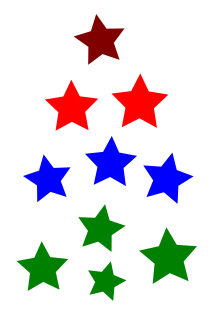
The ability to immediately grasp a small number of like things is called Subitizing, and is not unique to humans. A related mechanism is called Chunking. In the image below, it is easy to subitize the number of stars (differentiated by color). In addition we can, through chunking, see four “sets” of stars.
These types of cognitive limits are “not bugs, they are features.” From the standpoint of energy consumption and time there is very little evolutionary benefit to “knowing” that there are 42 crows as opposed to 38. There is an economical trade-off between knowing too much and too little.
It seems the number may be four-ish. Perhaps, the seven-ish number requires easy and distinct labels for the items remembered, and our natural ability to perceive numbers is no better than a crow’s.
It’s also partly that they have no need for quantities, so thinking about numbers is complex to them. But, there are clear difficulties in teaching math from this. The interesting thing is that while people may fail at tests that measure ability to remember, individuation is natural to all people. Also, there’s a difference between holding individuals in mind (individuation) and recognizing quantities as a whole (ennumeration). 4 is about the normal amount an adult is able to individuate. The 5 plus or minus two is not that same mental process. Remembering 7 items of a list, like days of the week or colors of the rainbow, isn’t so bad. If you tried to think about 7 balls with a different color each, you’d do poorly. You’d do poorly at thinking of the balls as individuals.
It seems that the focusing is limited to 4 perceived items in working memory at a time. Maybe up to 6 with extensive and intense training (think professional gamers).
It seems that the focusing is limited to 4 perceived items in working memory at a time. Maybe up to 6 with extensive and intense training (think professional gamers).
I would think the size of the crow is dictated by the nature of the particular individual. Perhaps with some focus, it could be expanded some, but I think that the ‘professional gamers’, just have a ‘larger crow’ in their area of competence to begin with.
I shared my post from earlier in the thread with the ARI Archivist and received the following response:
Quote
Thank you for that link! In looking up the crow epistemology reference that I was aware of, this is it (via Harry Binswanger and Jean Moroney, from HBL):
“Leroy, who though he expresses the opinion that ‘the nature of the soul of animals is unimportant,’ was an excellent observer, mentions a case in which a man was serious to shoot a crow. ‘To deceive this suspicious bird, the plan was hit upon of sending two men to the watch-house, one of whom passed on, while the other remained; but the crow counted and kept her distance. The next day three went, and again she perceived that only two returned. In time, it was found necessary to send five or six men to the watch-house to put her out in her calculation. The crow, thinking that this number of men had passed by, lost no time in returning.’ From this he inferred that crows could count up to four.”
Harry also added that “The crow experiment was reported in Nature in the late 19th Century, but it was anecdotal and I recall the actual observation (if it wasn’t made up) was in the late 1700s.”
Given the 1896 date of the book you noted, the cited Lubbock article could have been this one (though the author does not seem to be identified by name in the original article, his identity may have been known at the time).
 I don’t remember reading that before! (now that I check my initial reaction to it, it really isn’t laughable…)