The Falling US Dollar

Isn’t that something to be worried about? If not, why not.

(my concern is rooted in the fact that American government is not exactly an Objectivist government).

I would like to hear what you think.

I think that this is the same concerns everyone had in the 80’s about the Japanese taking over US interests. That threat never materialized.

As SNerd pointed out, 30% of the 30 Dow Jones industrial companies is a drop in the bucket of the value of the US economy.

Also, one should consider why most foreign companies / individuals want to invest in the US. It is because the US is still the best most vibrant economy, and they want a return on their money. THis implicitly means they want the system to keep working, but for them as well. The minute men have money, the better of them will start worrying about property rights (nominally their own of course, but it’s a start). I think this is a good thing.

Next, investors have to bring something to the operation of these companies or else they function merely as passive investors.

It is an indictment of foreign economies when they do not have vibrant enough investment vehicles to keep their money in house. This is hte case in the Arab countries which are rich off of oil wealth but have no other aspects to their economy. Some savvy arab businessman who has an intent to build up his own country’s economy, and learns why it is that the US economy is as good as it is, will be the best internal champion for capitalism within his country.

My company just did a JV with the Kuwaiti’s, effectively selling off a portion of our assets for cash and a stake in low cost feedstock (oil) source. In a way, that is a US company getting Arabian oil for cheaper than market prices, which benefits the US company, and helps to stabilize that oil supply.

I don’t pretend that there aren’t complexities and issues here, but I don’t see that as the looming specter that many do.
Buffet and Soros are wrong. However, your psychologizing accusation about them – assuming that they want to put others down and rule etc. – is unsubstantiated. I don’t want to take the discussion off topic; but, after multiple posts saying this, I just had to point it out.

Maybe you object to the use of the word “tyrant.” Okay, how about this: Soros and Buffett endorse the use of force against men to make them do their (Soros’ and Buffett’s) will.

Soros is clearly a tyrant one of these other-people-forcy things, as his manipulations of monetary systems and of our political process [sic] has shown. He may not want to rule from a state-sanctioned office, but he clearly wants to have a great controlling influence on the lives of his fellow man. Whether he believes that desire is a moral obligation or if he just wants to rule his fellow man is the subject of psychologization (?). The result is the same.

Buffett, by saying that he believes he should pay more taxes, rather than just paying more taxes (he can, you know) and keeping his mouth shut, is obviously implying that everyone else should also pay more in taxes. This universalizing of his personal moral code is a classic collectivist/altruist attitude, and implies a willingness to have force used against his fellow man to make him comply with Buffett’s will. Again, Buffett knows that he needs not sit in office to wield power in a statist nation, which is what his pronouncement supports.

But, you’re right, we digress…

Isn’t that something to be worried about? If not, why not.

(my concern is rooted in the fact that American government is not exactly an Objectivist government).

I would like to hear what you think.

From a purely economic perspective, the foreign buyers who take controlling interests can operate them two ways: get the businesses to run as profitably as possible, or any other way of running them that is not intended to lead to that result. If they do the former it is no problem because it is exactly the same thing that US investors would do. Government intervention in this case would be pure national chauvinism, would be quickly identified in the media as such, and I don’t think it would fly too well even if inferior competitors tried to take advantage of xenophobia. If instead the foreign buyers try anything of the latter, they’re going to get hammered in the marketplace as they will open the door to their competitors - especially now that those who had previously operated these businesses have become flush with cash and in search of somewhere to put it! The biggest economic issue isn’t that foreigners are buying control of the assets but that the getting hammered by less-profitable action will cause disruptions and temporary job losses. That certainly does bring the issue of the state of government into consideration, as there would then be a much stronger pretext for more insularity and general regulation “to preserve jobs and income” etc.

The political worries are more to do with particular businesses and the particular assets they hold. The catch-all “infrastructure” doesn’t help much as that includes things like utilities and privately owned/operated tollways where questionable behaviour is liable to get stomped on before the foreign powers’ political objectives are achieved. It is particular items, such as the security issues at international boundary points like ports as Adrock pointed out, that are problematic. There are also other businesses and assets I would be concerned about that aren’t subsumed under the infrastructure concept. In the same vein as the ports, unfriendly control over financial institutions can lead to a variety of undesirable outcomes (not just greater facilitation of money laundering and identity theft, but also industrial espionage on business accounts and similar market-related improprieties). Likewise, purchases of certain industrial businesses could be ways to circumvent the intent of restrictions against the export of sensitive technologies with military applications - one of the major Clinton scandals was a similar issue. Another class of businesses that may be of worry are resources. The unfriendly foreign governments may want to redirect the supply of resources to their own countries, even though this is less economically valuable than selling to the highest bidder, because the political benefit they see is stronger support from and greater nationalist fervor in their own people.

One thus first has to ask what the actual motivation of the buyer is: to invest and make a profit just like any other investor, or subvert the activities away from economic ends and towards political ends? Then, since your concern is rooted in the lack of proper government: what are our governments likely to do (especially for the latter class of scenarios)? As a positive, I have no doubt that people in government will start taking a closer look at particulars of purchases of technology or finance businesses, and then try to nix bad moves on genuine rights-defence grounds - but that try is open to being thwarted by higher office (again see Clinton). So, what happens next depends on who takes control of the White House. As another negative, there is no doubt in my mind that governments will make excuses for intervention, just as they have done before. What counts for this one is the answer to the first question, and added to by the actual nature and consequences of any political agendas behind purchases. The more obvious that there are improprieties afoot, the greater the backing for more general intervention and less weight behind opponents of intervention. The ball on that one is therefore in the foreign buyer’s court - which means, what do you think the medium and longer term political prospects for bad governments in places like China are? I am in no position to speculate much on that one.

JJM

Of the various factors that influence the current-account deficit, there is one that I do worry about: the savings rate in the U.S. (see this topic).

In a free market economy, I would not worry, as long as I knew that I was saving enough. If others were not saving, they would hit retirement and be really poor, live off their kids, etc. However, with our mixed-economy, when the chickens come home to roost, the government will hand them some of my grain!

Two specific aspects of this concern me:

  • Social security and Medicare: These two are not sustainable in the long run. Though many people say they’re concerned, they aren’t really pressing legislatures for a solution.
  • Federal Deficit: The government keeps spending more than its tax receipts, running up debt.

Given the size of the U.S. economy, these two problems are manageable today, but grow a little worse with every passing year. My fear is that there will be a reluctance to take the punch bowl away, and that no action will be taken until the problems are staring us in the face, and the “solutions” (i.e., taxing away more of my money) is really painful. While I hope that my kid never has to support me, it is likely that my kid will have to pick up the bill for some other kid’s parents.

[updated to add: As explained in the linked topic, I do not know that this is a problem; if it is, then it could hurt.]

Not sure if anyone else is watching, but the stock market is going to collapse today. Fed decided to cut the Fed Funds rate in reponse by 0.75% between meetings this morning. Could cut again at their meeting next week. This means: further devaluation of the dollar! Right now these goofs at the Fed are just being led into decisions by the stock market.

Not sure if anyone else is watching, but the stock market is going to collapse today. Fed decided to cut the Fed Funds rate in reponse by 0.75% between meetings this morning. Could cut again at their meeting next week. This means: further devaluation of the dollar! Right now these goofs at the Fed are just being led into decisions by the stock market.

Yeah I am trying to decide if I should stay up just to follow the US market. My market (Taiwan) crashed today and fell by almost 6%, effectively wiped out all my January earnings. Right now Europe with the exception of Germany is looking like they’re temporarily halting their skid.

Right now these goofs at the Fed are just being led into decisions by the stock market.

The message from the Fed is clear: they will play by the Keynesian book; other actors are advised to act accordingly.

I just blogged about this topic last night. Stunning, infuriating, stupid, boneheaded! What are they thinking?!!! @#$%(*&#$)(*!!!

I just blogged about this topic last night. Stunning, infuriating, stupid, boneheaded! What are they thinking?!!! @#$%(*&#$)(*!!!

Same thing they’ve been thinking since 1913 or so.

The message from the Fed is clear: they will play by the Keynesian book…

To tell you the truth, I believe Bernanke plays by more of a Chicago School-Milton Friedman-Irving Fisher book. Of course, this book shares a chapter with the Keynesian school titled ‘Monetary Policy.’

I just blogged about this topic last night. Stunning, infuriating, stupid, boneheaded! What are they thinking?!!! @#$%(*&#$)(*!!!

There is really only one way to devalue the dollar, and that is to print up a vast amount of them and inject them into the economy. Can someone explain to me how lowering the Fed rate does this? Is lowering the Fed rate a means by which the Fed injects dollars into the economy, maybe by making more printed dollars available to banks?

I definitely agree that they need to stop devaluing the dollar, regardless of the means by which they are doing it. As I pointed out in the “Is Capitalism Perfect” thread, so long as the dollar is not pegged to gold in any meaningful manner, this will keep happening. The Feds run out of money, and can’t tax higher due to a possible tax rebellion, so they “pay” for things by printing up a few billion greenbacks and buy things with it.

If it is inflation behind the drop in the dollar and the rise in gold, then I suspect we ain’t seen nothing’ yet – I mean, if the dollar has basically halved (and based on gold it has), then the 1000 point drop in the stock market this month won’t be the end of it.

Of course, I realize it isn’t quite that straight forward, since the dollar is not coupled to gold, but the rise in gold, the drop in the dollar, and the plunge in the stock market are all linked together. Anyone have access to the quantity of M1 that has been printed over the past five years or so, and can you point us to it with a link?

It is times like this, however, that make me glad I’m not in then market much. If I had more discretionary income I would be trying to make my millions, but possibly not in the stock market this year.

There is really only one way to devalue the dollar, and that is to print up a vast amount of them and inject them into the economy. Can someone explain to me how lowering the Fed rate does this? Is lowering the Fed rate a means by which the Fed injects dollars into the economy, maybe by making more printed dollars available to banks?

I believe your guess is correct. When the Fed claims to lower interest rates, what I think it really means is that they are either buying back more government bonds from banks at a higher rate or selling government bonds to banks at a lower rate. So when the Fed purchasing government bonds, it introduces more money into the banking system.

There is really only one way to devalue the dollar, and that is to print up a vast amount of them and inject them into the economy. Can someone explain to me how lowering the Fed rate does this? Is lowering the Fed rate a means by which the Fed injects dollars into the economy, maybe by making more printed dollars available to banks?

The FED has 2 primary levers of monetary policy. Interest rate control and what is known a “Open Market Operations”. In addition, in crises, the FED is lender of last resort so bailouts are a form of expansion of the money supply. OMO are the basic mechanism which few people know about. Basically the FED buys and sells govt securities on the open market. IF the FED buy govt bonds, it is essentially loaning money to itself and in the process increasing the money supply. It does not need to “print” extra money, that action is the same thing.

Yes. Consider only an “easing” phase, as is currently in progress. A “tightening” phase works in the opposite direction. Here are some details about easing:

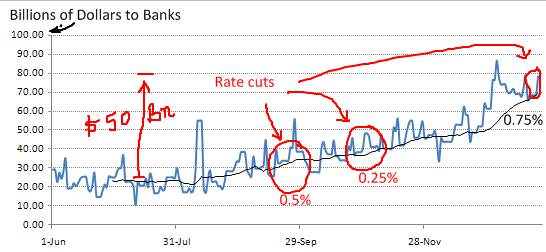
Every day, the Fed buys bonds from banks. i.e., The Fed gives the banks cash and the banks give the Feds bonds that they (the banks) previously bought. These are government bonds, “agency” bonds and “mortgage-backed” bonds. It is almost like a loan where the bank gives the Fed some bonds as security, and the Fed gives the bank cash. The Fed charges the banks for this loan.

The lower the rate that the Fed charges, the more desirable the trade is, to the banks. If the Fed charges an extremely high rate, the banks would say “no thanks”. If the Fed charges a very low interest rate, the banks want to get more loans – i.e. more cash from the Feds.

Here is a graph that shows the daily outstanding balances of such cash-infusions from the Fed to banks.

(Source: Federal Reserve)

To tell you the truth, I believe Bernanke plays by more of a Chicago School-Milton Friedman-Irving Fisher book. Of course, this book shares a chapter with the Keynesian school titled ‘Monetary Policy.’

That’s sort of like praising someone for being a great cyclist, while he’s over in the pool drowning don’t you think. :dough:

That’s sort of like praising someone for being a great cyclist, while he’s over in the pool drowning don’t you think. :dough:

I don’t understand this…

I don’t understand this…

I believe what he’s saying is that he may be great at economics (cycling), but his day job is monetary policy (swimming). :dough:

I’m trying to understand what Kendall was saying regarding the Feds not needing to print more greenbacks in order to tamper with the money supply. I guess the problem is that I don’t really understand bonds, except to say that I know it is possible to buy bonds from the government, which one can turn in for cash when their time has matured. So, I guess the issue there is what cash is the government giving to the matured bond holders – money that has been taxed or money that has been printed?

I suppose there are other means of messing with the money supply, say if there was a way to tie up or to release vast amounts of money (greenbacks) into the economy. I don’t know exactly how that would be done, however, but I suppose that if someone had some sort of financial instrument that required holding onto money as collateral, then that money could not be used for anything else – i.e. it would not be in circulation. But if that instrument were released from that condition, then all of a sudden that money could be used for something else and would effectively increase the money supply. One such way of doing this would be to lower the amount of cash banks must have on hand in order to give out loans. Say they have to have 25% cash reserves before they could lend out loans, and then this was changed to only requiring, say, 10% cash reserves; that would effectively release 15% of the banks holdings into the economy all of a sudden, which would have the same (short term) effect as increasing the M1 money greenbacks.

I’ve heard off and on over the years on stock programs that “we need more liquidity to get the markets going again”, which effectively comes down to increasing the amount of cash in circulation by one means or another, usually by the Feds. And more cash in circulation, whether by printing more money than gold or by releasing previously tied up currency or some other means, will eventually lead to a devalued dollar – in terms of what is actually out there chasing goods and services.

So, I think I’ve got it, at least in principle: There is more than one way to mess with the value of our hard earned dollars.

In short, even if they printed up vast amounts of greenbacks, but left them at the printing press where they would never go into circulation, it would have no economic effect. Fat chance of that happening; once the money paper is there, they will get it into circulation, have no doubt about that!

But the same (short term) effect would happen if, say, a trillionaire, kept his savings in his mattress, and then all of a sudden went on a buying spree spending everything he had just before kicking the bucket. That vast amount of money was not part of the “cash in circulation” formula that determines what the dollar is worth in actual practice so long as it was not in circulation. It would be like the gold rush days in California, when the price of a pick ax shot up to well over a thousand dollars because everyone was so rich they could afford to pay that kind of a price for it. Eventually, though, that sort of increase in the money supply filters down and throughout the economy and doesn’t cause any long-term inflation. But the Feds printing up greenbacks will cause long-term price increases, because they just keep on doing it – it’s not just a short-term, localized fluctuation; it’s everywhere and all of the time.

I’m trying to understand what Kendall was saying regarding the Feds not needing to print more greenbacks in order to tamper with the money supply.

http://en.wikipedia.org/wiki/Open_market_operations

I’m trying to understand what Kendall was saying regarding the Feds not needing to print more greenbacks in order to tamper with the money supply.

The money supply can be expanded without actually, in the literal sense, printing banknotes. This is achieved through the extension of credit. Think of it like when you take out a mortgage on a $300,000 home. The bank does not literally go to the back room, print 300,000 bank notes, and come out and hand you $300,000 in banknotes which you take to the home owner and hand him. The money is created first out of thin air as a credit against some amount of deposits that the bank holds and then transferred to the seller. Fractional reserve banking is a factor as well. If the Fed creates money by increasing the reserve account of a member bank, then that bank has the additional amount of money on its balance sheet that it is able to lend out 90% of due to FRB. If the Fed Funds rate is low, banks show a greater demand for the money because the cost of that money is inexpensive. This is the type of liquidity that a lot of financial gurus call for when bad times hit. They hope that this inexpensive money will trickle through down and be spent by consumers and businesses, thereby stimulating the economy. But this extension of credit is what allows the money supply to increase without the need for actual banknotes. The banknotes will be only be printed when demanded.

With the trillionaire example, since his money is under a mattress and not in a savings account, or stock brokerage account, or mutual fund or whatever, the money would not be counted in money supply statistics. So yes when he goes and spends it, there will be some effect. But the effect will be extremely small because the economy is so large. I think this is similiar as to one of the reasons why we were taken off the gold standard by Nixon. It was thought that Russia was able to mine a vast amount of gold and thereby dilute the purchasing power of it. But the amount of gold that Russia could have mined would take 100 years or more to double the supply of gold according to some, whereas the Federal Reserve can double or triple the money supply within a few years.