Truth In Politics Youtube Channel

44 minutes ago, MisterSwig said:

It’s okay to leave up all the videos of Dems accusing Trump of collusion but dare to say the election was stolen and your channel is terminated.

I think that is an appropriate way to moderate people. On a broad level I really think that people who claim the election was stolen really are undermining standards of rationality and actively promoting subversion. I don’t think it qualifies as force, but it certainly qualifies as something we should reject completely, something that should be kept out of our own spaces. 

I think the collusion accusations are valid, but if you think they are disingenuous, fine. But I think even if you disagree about the accusations, it’s nothing like rejecting procedures of the government itself. Questioning the government is one thing, outright subversion and looking the other way when it comes to violence is significantly worse and more dangerous. They are not comparable. In fact, the accusations themselves are well within what is permitted by the Constitution, it can’t be seditious because such accusations are an intended function of the government. 

52 minutes ago, MisterSwig said:

This isn’t about “severe violations,” it’s about protecting favored classes of people.

I think the favored class of people really just ends up as who has the most money to make legal threats. It’s pragmatic. Pulling videos by Manson risks lawsuits. Pulling videos by someone who talks about transgender issues in a cringey way doesn’t really risk lawsuits, even if the algorithm was only intended to capture the most egregious violators. That person doesn’t have enough money to be a threat. Easier to let them rot in appeal hell than improve the algorithm. 

50 minutes ago, Eiuol said:

On a broad level I really think that people who claim the election was stolen really are undermining standards of rationality and actively promoting subversion.

That is a non sequitur.

It’s not “undermining standards of rationality” to refuse to dismiss evidence that other people want dismissed. (In fact, I’d say it’s the virtue of independence at work.)

It certainly isn’t “actively promoting subversion.”

Saying “the election was stolen” doesn’t say what to do about it. As Peikoff puts it in The Ominous Parallels:

Quote

Practical crises confront a country with the need for action. They do not determine what the action will be. In the face of military ruin, economic strangulation, or governmental collapse, men may choose to investigate the disaster’s causes and to discover a more rational course of action for the future, i.e., they may choose to think. Or they may choose to hate, or to pray, or to beg, or to kill. On such matters, the crisis itself is silent.

As I’ve said before, I think storming the Capitol was a horribly bad thing to do (so bad, in fact, that I think it’s a lie to call the perpetrators “Trump supporters,” because what they did did not actually support Trump), but just because some people try to enact a very bad solution to a problem doesn’t mean we should deny the existence of the problem.

Even if you don’t think the election was stolen, the fact that reasonable people think it was, indicates that there is too much doubt about the accuracy of the results. There are good reasons for such doubt and it’s a mistake to dismiss those reasons.

The correct thing to do is to come up with a better solution. This might mean developing ways to ensure the integrity of future elections, and putting them into practice. Some state legislatures are already doing that. (I think it’s telling, though, that HR 1 systematically does the exact opposite, making it easier for the Democrats to steal future elections. If it passes, it will severely undermine confidence in those elections, and in the government as a whole. It also makes the Democrats look even more guilty of stealing the last election, because it systematizes the exact same methods they were previously accused of using to fraudulently enhance their vote counts in certain key states.)

1 hour ago, Eiuol said:

I don’t think it qualifies as force, but it certainly qualifies as something we should reject completely, something that should be kept out of our own spaces. 

I think censorship, including self-censorship of this kind, is evasion.

Contradictions cannot exist in reality. Therefore, it is reasonable to expect one’s knowledge, including philosophy, to integrate all facts without contradiction. That’s one of the main tenets of Objectivism.

I was raised as a Christian and with the edicts that you shouldn’t read certain books, listen to certain music, or watch certain movies. As a teenager I realized this was in contradiction with the First Amendment: if people aren’t supposed to see certain things or hear certain things, why is “freedom of speech” there? What justifies it? Christianity doesn’t have a good answer for this. Christians claim that “America is a Christian nation” but many of the ideas that the Constitution rests upon do not come out of the Bible.

Leftism doesn’t have a good reason for the First Amendment either. Leftism is just secularized Christianity anyway. But those who think that people’s thoughts create reality, think that, in order to remove something undesirable from reality, they need only remove it from people’s thoughts, by censoring it.

Censorship does not work. The underlying reality is still there. But more to the point, for Objectivists, censorship isn’t necessary. If you hold that the complete integration of your knowledge is both necessary and possible, then you don’t have anything to fear from the new facts you might learn.
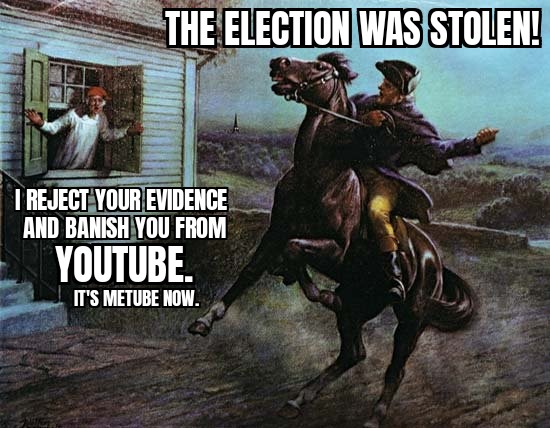
1 Like

The election was stolen.

There. I said it. 

Was it in jest? Am I soliciting subversion? 

Meanwhile, some think it was, some think it weren’t, and others like it in the pot nine days burnt. 

If this thread were on YouTube, would the algorithm flag OO for this post, or other discussions here?

I look at a world implementing what is being fought for, dreamed of, and wished for. It is not just delineated to the Black Lives Matter crowd, Antifa, or Trump-baa-baa-baa-aa-ckers. 

It’s not about the theft status of an election either. It is how to go about determining what qualifies as evidence. Fortunately, YouTube has an algorithm that will replace independent judgment ‘accurately’* 90% of the time. 

* what were the total number of channels suspended for a given infraction, and the evidentiary breakdown substantiating the accuracy, or lack thereof? 


45 minutes ago, necrovore said:

It’s not “undermining standards of rationality” to refuse to dismiss evidence that other people want dismissed.

I don’t know what non sequitur you are talking about, because I didn’t make an argument with the phrase you quoted. It was a statement. If you want my argument, this isn’t the place I want to present it because that’s not why I joined the thread.

Anyway, what you write here is true, but if people dismiss evidence that is provided, and offer weak evidence for _widespread and pervasive _fraud that would cause an election to be stolen, I think it’s because they have undermined standards of rationality. If I ran a social media platform, I would moderate these posts in some way, maybe by deletion, or something else. I’m not saying existing platforms always use good reasons to justify their moderation, but I think it can be appropriate to moderate posts like that and sometimes they do use proper justification. 

59 minutes ago, necrovore said:

so bad, in fact, that I think it’s a lie to call the perpetrators “Trump supporters,” because what they did did not actually support Trump

They did support him, literally. But anyway, you gave the same evidence twice in the same thread that the perpetrators were actually antifa, and I gave you refutations twice in the same thread. I and many other people have pointed out your very spurious relationship with evidence so I don’t think I can talk about this rationally with you (if you’re wondering, even though clearly I think some of your conclusions on this are irrational, I don’t think it’s a such a degree or pervasive enough that morally speaking I need to do anything at all other than respond to some of your posts.)

1 hour ago, necrovore said:

Censorship does not work. The underlying reality is still there. But more to the point, for Objectivists, censorship isn’t necessary. If you hold that the complete integration of your knowledge is both necessary and possible, then you don’t have anything to fear from the new facts you might learn.

I think this is playing fast and loose with the term censorship. Censorship can be equated with moderation, but I think it should be. I’ve changed my mind recently to think of censorship as strictly government enacted. I think that’s what the term refers to, and doesn’t need to extend beyond that. I don’t think there is a such thing as private censorship, there is only censorship performed by government institutions. People might colloquially say that a school banned a book like Harry Potter, thus are censoring free expression. In public schools, I think this might be true. But if these are private schools, what you would actually be saying is that the school holds negative value judgments towards student autonomy and specific values expressed in those books. It isn’t censorship if force is not involved in the thing in question still exists in the same form.

I think moderation is necessary and appropriate at times depending on the value judgments we are considering. I think it’s fine to for example completely ban all Q-anoners on private platforms, and that’s related to the kind of people that actively devalue a platform because of their views and don’t promote anything remotely helpful even through their disagreement. Censorship is never necessary, as in, the government should have no say in what you wish to say within the domain of individual rights. But moderation plays a role in maintaining healthy environments and forums for discussion. Not because certain ideas are scary, but because some people are toxic. 


I highly recommend this paper by Tara Smith. 

It is as an argument about anything we’ve discussed here, it’s a paper about a conceptual cleanup regarding terms used when discussing freedom of speech.

The Free Speech Vernacular: Conceptual Confusions in the Way We Speak About Speech

2 Likes

19 minutes ago, Eiuol said:

I think this is playing fast and loose with the term censorship. Censorship can be equated with moderation, but I think it should be. I’ve changed my mind recently to think of censorship as strictly government enacted. I think that’s what the term refers to, and doesn’t need to extend beyond that. I don’t think there is a such thing as private censorship, there is only censorship performed by government institutions.

If you were right then the term “self-censorship” would only be able to mean “the government censoring itself.”

But it is merely a terminological point. I prefer to call “government censorship” just that.

I also think there should be a term for when private citizens move to block others from having information, and though it may be legal and not an infringement of anyone’s rights, there still needs to be a word for it. In many cases it is very rude behavior, and censorship is also not the kind of behavior one would expect of a person who is confident in the rightness of their ideas.

19 minutes ago, Eiuol said:

But moderation plays a role in maintaining healthy environments and forums for discussion. Not because certain ideas are scary, but because some people are toxic.

It’s also a non sequitur to presume that, just because a person holds a certain idea, even a badly mistaken one, that they are rude or obnoxious or toxic or whatever.

It’s fine to remove posts that are merely rude or obnoxious (or illegal), and even fine to ban people who seem to only produce those kinds of posts, but it’s not fine to ban people on the basis of their ideas and then claim that it’s because such ideas must necessarily lead to rudeness or obnoxiousness.

(I suppose the sole exception would be if someone’s idea specifically was that they should have the right to be rude or obnoxious on someone else’s dime, but even then they’d have to try to put that idea into actual practice in order for me to think they should be banned.)

19 minutes ago, Eiuol said:

offer weak evidence for _widespread and pervasive _fraud that would cause an election to be stolen

An election can be stolen without “widespread and pervasive” fraud. Sometimes just a few thousand well-placed fraudulent votes can be enough to flip the outcome.

4 minutes ago, necrovore said:

censorship is also not the kind of behavior one would expect of a person who is confident in the rightness of their ideas.

Try to use a different word be, because if you don’t mean government censorship, don’t say censorship. What do you mean by censorship here if you aren’t talking about initiating force? What would be the rational goal of moderation? Don’t the goals of moderation involve how people are behaving, not the ideas that they say necessarily? I think that engaging in that kind of dialogue is toxic, or at least the person deliberately trying to inject that in the conversation. It’s poisoning the well.

23 minutes ago, necrovore said:

It’s also a non sequitur to presume that, just because a person holds a certain idea, even a badly mistaken one, that they are rude or obnoxious or toxic or whatever.

It might, it might not, but either way, that’s not the claim I made there. The person may be obnoxious or rude, and what makes someone obnoxious or rude is what they say. To express certain ideas is obnoxious - not because the idea leads to them being obnoxious, but because stating the idea is obnoxious. Obnoxious, as in against rational discourse and standards of communication or rhetoric. I’m saying that there are certain types of expressed ideas are part of rude and obnoxious behavior. 

2 hours ago, necrovore said:

2 hours ago, Eiuol said:

offer weak evidence for _widespread and pervasive _fraud that would cause an election to be stolen

An election can be stolen without “widespread and pervasive” fraud. Sometimes just a few thousand well-placed fraudulent votes can be enough to flip the outcome.

Yes it is possible as in Gore vs. Bush. But this election would have required multiple states committing the fraud. No single county or state could have changed the result, Biden was too far ahead in electoral votes. And of course, the fraud had to be meticulous enough to give GOP and edge in congress but not for the presidency.

All in all, the evidence is weak.

1 Like

2 hours ago, Eiuol said:

Try to use a different word be, because if you don’t mean government censorship, don’t say censorship. What do you mean by censorship here if you aren’t talking about initiating force? 

Unfortunately, even though you have a point that it ought not be used that way, you’re not going to win the “term usage” battle, it’s too ingrained. People say things like “don’t censor me” in a simple discussion. Some also call it private censorship. It does confuse the element of governmental force. So the only way out seems to be to say specifically “governmental censorship”, because they seem to define it as “to prevent or limit expression/communication” without regard to who is doing the preventing. It does not matter if it is your employer or the police (or even your decency that censors you).

The other issue that muddies the water is that there seems to be some crony relationship between government and Google Facebook et. al.  This relationship is used to imply that they are partially the arm of the government i.e. they are not exactly a private company. If that were true, then it would fall into the category of governmental censorship. But is it true?

All in all, what evidence is weak? What court examined the ‘evidence’? Courts determined the claims of vote counting malfeasance were too weak to be heard.

Zuckerberg gave hundreds of millions of dollars to facilitate and enhance the disruption of chain of custody of ballots , and then privately censors the discussion of those facts. Is that because his actions were well intentioned and he only seeks to maintain a non-obnoxious online community ?


2 hours ago, tadmjones said:

Is that because his actions were well intentioned and he only seeks to maintain a non-obnoxious online community ?

Yes. Or at least, he values tolerance so highly above anything else in online communities that all he wants is for everyone to get along. You don’t need some special conspiratorial motive here. Don’t ask loaded questions. (My saying yes is not admitting that he did disrupt the election).

8 hours ago, Easy Truth said:

People say things like “don’t censor me” in a simple discussion.

When they do, it becomes difficult to talk about anything to do with freedom of speech and censorship. If somebody insists on using the terms private and government in this context, that’s okay, as long as they are always specific about which one. Otherwise, conceptually, both ideas are blurred together. I think it’s better though to use different terms. That’s why I keep using the word moderation if I’m referring to privately determining what people can and cannot say on public platforms.

8 hours ago, Easy Truth said:

This relationship is used to imply that they are partially the arm of the government i.e. they are not exactly a private company. If that were true, then it would fall into the category of governmental censorship. But is it true?

I don’t think so, what past evidence do we have that Facebook or Google is willingly participating and even directly supporting the advancement of government censorship? Where do we have examples in the US of government censorship anyway? The FCC for sure, but I can’t think of anything Google has done. I would be surprised if Google has received substantial money from the government, but that doesn’t mean the terms for that money included censoring things for the government. Not any more than receiving Social Security means you are a statist who supports the welfare state philosophically.  Only that, it’s pretty easy to tell in the US the difference between a private entity, and a partially government operated entity. In China the distinction is blurry, where social media companies really do censor on behalf of the government. Then again, there is no such thing as a private company in China. I don’t mean that metaphorically - it’s a communist government after all.

If anyone is wondering about the term self-censorship, it would refer to needing to censor yourself because of what the government might do to you. It’s altering what you say under the threat of force.

13 hours ago, Eiuol said:

On a broad level I really think that people who claim the election was stolen really are undermining standards of rationality

Would you cancel people for advocating faith in god or for claiming to have evidence that the earth is flat?

“Undermining standards of rationality” sounds like you’re getting at motive, and that’s often a difficult endeavor. You’ll end up banning people simply for not being rational according to your standard of rationality, and then you risk forming an echo chamber of sycophants, like you see happening on the more cultish social media channels even within the Objectivist movement.

My policy would be pretty simple. No illegal stuff, because you have to obey the law. And no socialists, because they are the political enemy, fuck’em. The rest of the garbage can be segregated into the cesspool portion of the platform, where sewer rats and trash-pickers can go to be indecent. And if someone finds gold mistakenly dumped down there, well, they can petition to have it readmitted to the land of decency.

14 hours ago, Eiuol said:

and actively promoting subversion.

Subversion of what exactly?

14 hours ago, Eiuol said:

…I think even if you disagree about the [collusion] accusations, it’s nothing like rejecting procedures of the government itself.

Which procedures? Should we automatically accept election procedures, even if we think there is evidence of foul play?

14 hours ago, Eiuol said:

Questioning the government is one thing, outright subversion and looking the other way when it comes to violence is significantly worse and more dangerous

Are you saying that claiming the election was stolen is subversion of the government? One, an election process is not a government. And two, Biden wasn’t even part of the government when his supporters stole the election for him

.

.

.

.

.

.

.

allegedly.

14 hours ago, Eiuol said:

I think the collusion accusations are valid…

I think you’re wrong, but aren’t you rejecting the government procedure that found no evidence of collusion with Russia? By your standard it sounds like you’re subverting the government.

15 hours ago, Eiuol said:

Pulling videos by Manson risks lawsuits. Pulling videos by someone who talks about transgender issues in a cringey way doesn’t really risk lawsuits, even if the algorithm was only intended to capture the most egregious violators. That person doesn’t have enough money to be a threat. Easier to let them rot in appeal hell than improve the algorithm.

It sounds like you’re saying that someone at YT is reviewing channels to determine whether the owner might sue over being nuked off the platform. Do you have evidence for that theory?

34 minutes ago, Eiuol said:

That’s why I keep using the word moderation if I’m referring to privately determining what people can and cannot say on public platforms.

Do you mean private platforms? A public platform would be something like a public park where the public (via its reps in government) determine the speech code.

13 hours ago, dream_weaver said:

The election was stolen.

2 hours ago, Eiuol said:

That’s why I keep using the word moderation if I’m referring to privately determining what people can and cannot say on public platforms.

The problem with that is that having good manners can be mandated. The issue is where does voluntary behavior belong in this case. It’s really about agreeing to the voluntarily agreed on rules that’s the issue.

2 hours ago, MisterSwig said:

Do you mean private platforms?

Yeah, that’s what I meant. I misspoke. In my mind I was thinking large privately owned spaces where many people gather, not that the spaces are publicly owned.

Moderation and censorship are not the same thing. Slashdot for example has an excellent moderation system; people moderate each other’s posts, meta-moderation makes sure that moderation is fair, and trolls get voted down and hidden, but you can still see the downvoted troll posts if you want.

Censorship, by contrast, is when a person deliberately tries to prevent someone else from obtaining information. That’s my definition. This can be an infringement of rights in some cases (e.g., if you want to go to the bookstore to buy a book, but I stop you), but it can also not be (e.g., if I own the bookstore and decide not to carry the book or even order it – or if I buy up all the copies of the book in town, and burn them, so that you can’t get one.)

Even in cases where censorship isn’t an infringement of rights, I still think it’s bad. I have the right to buy TVs and smash them to bits, too, but that doesn’t mean it’s a good idea.

I would also argue that even deliberate removal of information isn’t necessarily censorship. Motive has to be considered. If I refuse to sell a book in my bookstore because I don’t want you to read it, that’s censorship, but if I receive death threats and decide to remove the book to stay alive, then I don’t think that’s censorship on my part, although in some cases it could be appeasement or cowardice. (I guess it depends on how much the police have been defunded.) The people issuing the threats are performing censorship, though.

It also wouldn’t be censorship if I decided not to carry a book in my bookstore because it wouldn’t sell, or because it was four feet tall, heavy, or super-expensive, or something like that. However, there are also cases where you can argue about what someone’s real motive is in not carrying a book.

Censorship is the right to restrict speech on your own property. If you own a tavern, you can post a speech code and demand obedience under penalty of banishment from that private property. Applied to public property, this right looks like government officials creating laws and regulations for speech on public property. When government officials create speech codes for private property, that is not censorship. That’s dictatorship.

The meaning of “censorship” pertaining to Roman censors is inapplicable to capitalistic nations today. The Roman censors were dictators, sometimes the Roman emperor himself assumed the role of censor. The only relevant aspect today is that the Roman censors were moderators of people’s morality. Today that function is performed by private property owners on their own private property, and by our government officials on public property.

2 hours ago, necrovore said:

Moderation and censorship are not the same thing.

Of course not, I even said that they aren’t. I’m not saying moderation as the alternative phrase for private censorship, I’m saying that everything moderation consists of is not censorship. Sometimes moderation includes leaving the posts up but down voting to de-prioritize posts that people see. Sometimes moderation includes deleting posts. In either case censorship usually refers to denying freedom of speech. That’s what people mean. Sometimes people view setting constraints to what they can say in any context as denying freedom in the same way as physically taping their mouth closed. When people claim that they are being censored, even in the private setting, they are claiming that their freedom is denied. Perhaps you know better than to say that your freedom is denied, but historically and currently people are referring to denial of freedom when they say censorship. So do I. That’s why I use different words.

So when I say moderation, I mean content control including what others say. When I say censorship, I mean the denial of freedom of speech. To say that censorship is trying to prevent someone from obtaining information is quite confusing. It could mean that you lock a document in a safe so that no one can see it. Is that censorship? Is telling a lie censorship? Is it censorship if a post is deleted not because the person is trying to prevent you from getting information, but because the person is trying to create a more polite environment? After all, you said motive needs to be considered. More specifically, I’m saying that your definition isn’t helping analysis. Sure, censorship often involves controlling the flow of information, but I think it’s neither important nor necessary.

To unload the question, isn’t it correct to say that Zuckerberg disrupted the election process by funding ballot ‘drop boxes’?