This essay of mine was first published in V5N2 of The Journal of Ayn Rand Studies – 2004.
Universals and Measurement
I. Orientation
Rand spoke of universals as abstractions that are concepts (1966, 1, 13). Quine spoke in the same vein of “conceptual integration—the integrating of particulars into a universal” (1961, 70). Those uses of universal engage one standard meaning of the term. Another standard meaning is the potential collection to which a concept refers. This is the collection of class members consisting of all the instances falling under the concept[1]. In the present study, the character of universals in the latter sense will be brought into fuller articulation and relief. That vantage will be attained by amplifying the mathematical-metaphysical requirements of Rand’s theory of universals as conceptual abstractions.
To begin I situate the topic of the present study within Rand’s larger system of metaphysics and epistemology. My core task for the present study will then emerge fully specified.
Rand’s system relies on three propositions taken as axioms[2]. (E) Existence exists. (I) Existence is identity. (C ) Consciousness is identification. Rand’s set of axioms conveys the fundamental dependence of consciousness on existence. Existence is and is as it is independently of consciousness, whereas consciousness is dependent on existence and characters of existence (Rand 1957, 1015–16; 1966, 29, 55–59; 1969, 228, 240–41, 249–50).
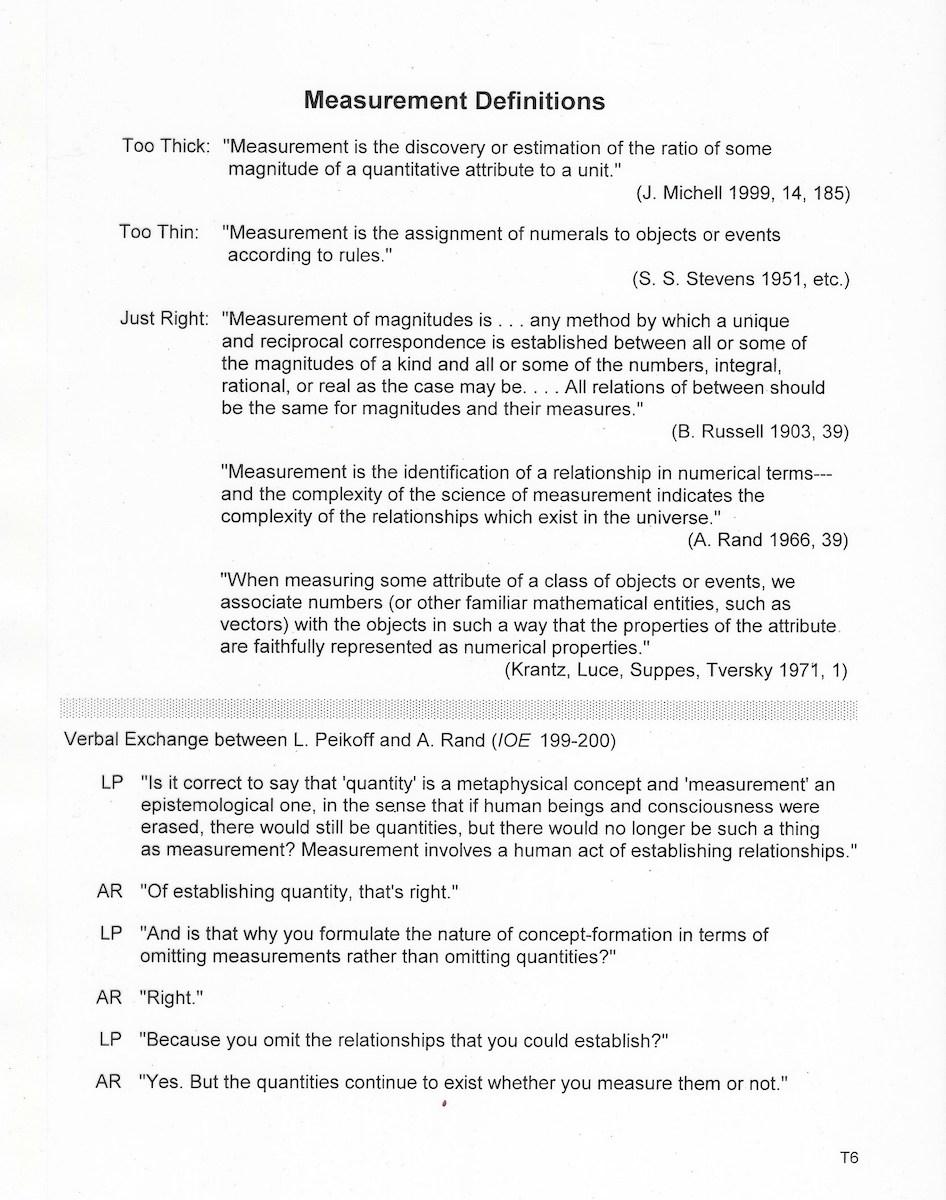
As part of the meaning of (I), Rand contended (Im): All concretes, whether physical or mental, have measurable relations to other concretes (1966, 7–8, 29–33, 39; 1969, 139–40, 189, 199–200, 277–79)[3]. Every concrete thing—whether an entity, attribute, relation, event, motion, locomotion, action, or activity of consciousness—is measurable (Rand 1966, 7, 11–17, 25, 29–33; 1969, 184–87, 223–25).
As part of the meaning of (C ), Rand made the point (Cm): Cognitive systems are measurement systems (1966, 11–15, 21–24; 1969, 140–41, 223–25). Perceptual systems measure[4], and the conceptual faculty measures. Concepts can be analyzed, according to Rand’s theory, as a suspension of particular measure values of possible concretes falling under the concept. Items falling under a concept share some same characteristic(s) in variable particular measure or degree. The items in that concept class possess that classing characteristic in some measurable degree, but may possess that characteristic in any degree within a range of measure delimiting the class (Rand 1966, 11–12, 25, 31–32)[5]. This is Rand’s “measurements-omitted” theory of concepts and concept classes.
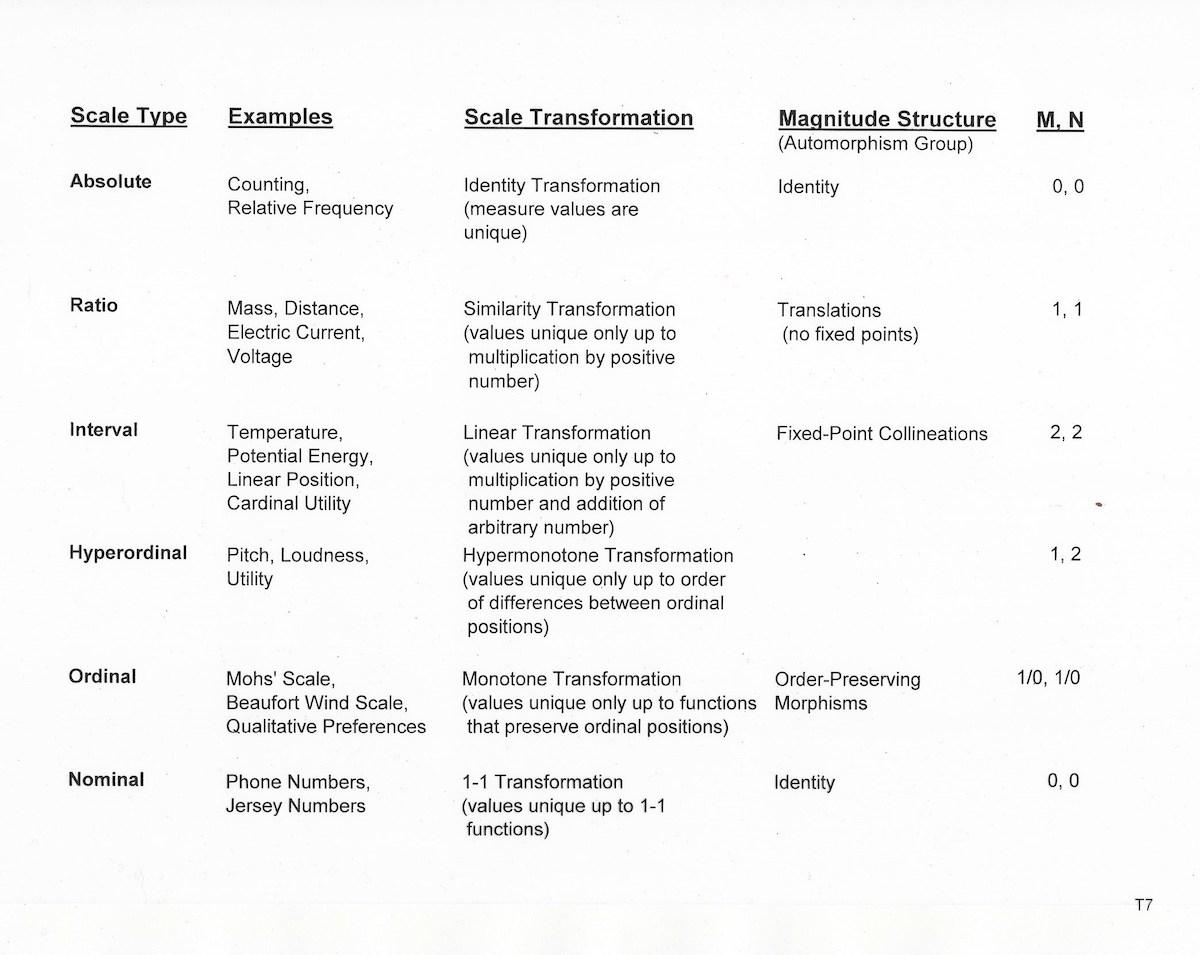
All concretes can be placed within some concept class(es). All concretes can be placed under concepts. Supposing those concepts are of the Randian form, then all concretes must stand in some magnitude relation(s) such that conceptual rendition of them is possible. What is the minimal magnitude structure (minimal ordered relational structure) that all concretes must have for them to be susceptible to being comprehended conceptually under Rand’s measurement-omission formula?
That is to say, What magnitude structure is implied for metaphysics, for all existence, by the measurement-omission theory of concepts in Rand’s epistemology? My core task in the present study is to find and articulate that minimal mathematical structure. With that structure in hand, we shall have as well the fuller articulation of the class character of universals implied by Rand’s theory of concepts.
Such mathematical structure obtaining in all concrete reality is metaphysical structure. It is structure beyond logical structure; constraint on possibility beyond logical constraint. Yet it is structure ranging as widely as logical structure through all the sciences and common experience.
The minimum measurement and suspension powers required of the conceptual faculty by Rand’s theory of concepts calls for neuronal computational implementation. Is such implementation possible, plausible, actual? This is a topic for the future, bounty beyond the present study.
We must keep perfectly distinct our theoretical analysis of concepts and universals on the one hand and our theory of the developmental genesis of concepts on the other. Analytical questions will be treated in the next section, and it is there that I shall discharge the core task for this study.
The logicomathematical analysis of concepts characterizes concepts per se. It characterizes concepts and universals at any stage of our conceptual development, somewhat as time-like geodesics of space-time characterize planetary orbits about the sun throughout their history. The analysis of concepts and universals offered in the next section constrains the theory of conceptual development, as exhibited in §III.
 a multicellular living being capable of nervous sensation and muscular locomotion. Surely the mathematically determinate form of the concept class animal is multidimensional (cf. Rand 1966−67, 16, 24−25, 42). My principle alleges that that multidimensional structure will have the structure of at least an ordered, distance geometry.