Already there is some disagreement over the problem itself, and I’ll respond to those posts later. First I want to tend to arguments made on the other thread. I’ll begin with Intrinsicist. He presented a fundamental counter position:
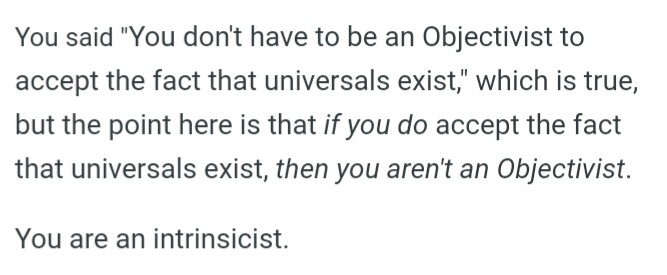
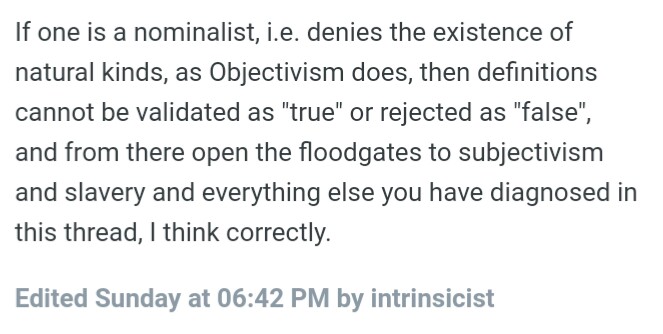
Intrinsicist’s clear position is that a believer in universals is an intrinsicist. With the apparent assumption being: a universal is an intrinsic existent.
But the assumption that universals are intrinsic is an unproven idea. It overlooks the entire problem that philosophers have faced for thousands of years, and it arbitrarily asserts the nature and location of universals: that they are intrinsic things within concrete entities. Thus, the problem is no longer: what are universals and where are they located? It’s not even: how do we know they exist and are they based in reality? No, the problem is seemingly reduced to a single yes-or-no question: do universals exist at all? People who answer “yes” are categorized as intrinsicists, even if they claim to be something else; and those who answer “no” are categorized as wrong, because, well, they are wrong.
With that simple question, Intrinsicist seems to divide the population into intrinsicists versus non-believers. When, really, all the question does is divide us into believers versus non-believers. He has not established that a believer is necessarily an intrinsicist. But perhaps in his own mind it is true, because to him a universal is an intrinsic thing.
Such a loaded definition creates a significant conflict. If universals are intrinsic, why can’t we find them existing in every object? Shouldn’t there be an identical “table” in every particular table? Why do we only find different tables of varying characteristics and measurements? Where is the real “table” thing that matches our general notion of a table? And if it doesn’t exist at the sensory-perceptual level, how am I made aware of it? Am I in some kind of mysterious communication with the realm of universals? Do I possess a sort of X-ray vision which allows my faculties to penetrate into the essence of an object?
That is the problem of intrinsic universals, which one faces after bypassing the problem of universals.
Intrinsicist goes on to argue against Rand’s theory, claiming she borrowed bits from the nominalists and stole from the realists:
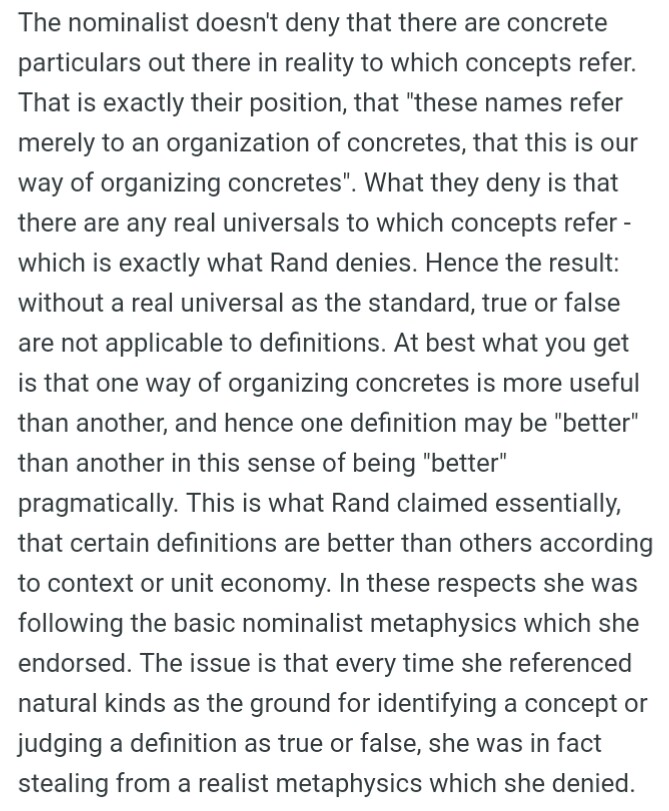
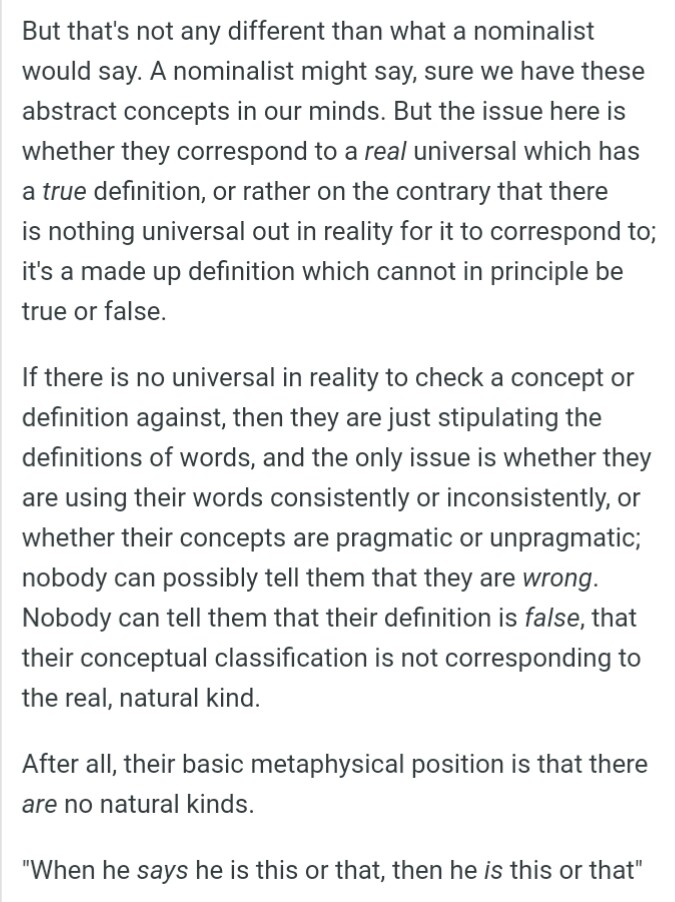
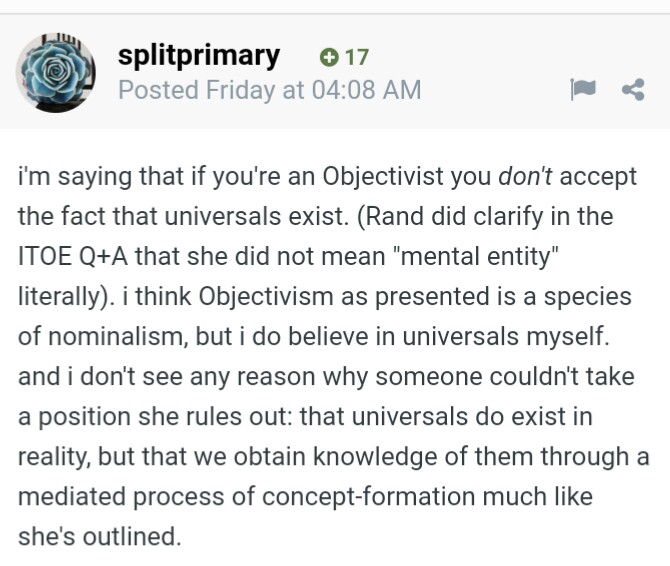
Intrinsicist attempts to place Rand with the nominalists by claiming they both deny the existence of “real universals to which concepts refer.” But what does he mean by a “real universal”? He means an intrinsic universal. So, yeah, she does deny the existence of intrinsic universals. But nominalists deny the existence of any sort of universals, which is not Rand’s position at all. As Dream Weaver pointed out, she states in ITOE that “concepts are abstractions or universals.” And the entire book is devoted to proving that position.
Meanwhile, Intrinsicist’s other claim is that Rand steals some aspect of realism whenever she references “natural kinds” as the basis for validating concepts. I question whether Rand ever used such wording in relation to “identifying a concept” or “judging a definition,” and I politely request that Intrinsicist provide a relevant quote as proof that she did. I suspect that “natural kinds” is actually another term for “real or intrinsic universals.” Intrinsicist uses it again later, apparently to describe a nominalist’s rejection of universals:
So, either Rand referenced “natural kinds” to validate concepts or she denied their existence. Which is it?
Does Objectivism in fact deny the existence of natural kinds? Well, that depends on what is meant by a natural kind. If it’s necessarily an intrinsic kind, then the answer is yes. If it’s an abstracted kind, then the answer is no.
Is an abstraction natural? Is it real? If so, why should Objectivists still be accused of denying the existence of universals?
Intrinsicist ultimately concludes that the abstractions in our minds must correspond to “real universals” out in reality, if we are to know truth from falsehood:
So, first, Intrinsicist defines universal as an intrinsic thing. Then when reality presents him with the problem of intrinsic universals, i.e., how do we have knowledge of these things, he ignores this problem too and maintains a total split between universals and concepts. In his view, we determine truth and falsehood by checking whether our concept corresponds with a real universal. Well, how do we do that? What is a real universal? In which way is it different from the abstraction in my head?
Dr. Binswanger, I think, identifies the underlying problem with this view in his book How We Know (p. 105):
Quote
The Realist notion of a “universal”–an existent that is non-specific–represents the improper separation of two axiomatic concepts: “existence” and “identity.” To be is to be something, to have a specific identity. To be nothing in particular is to be nothing at all–i.e., not to be. In Rand’s statement: “Existence is Identity.” [AS, 1016] But the Realist theory posits the existence of non-specific, generalized, “blurry” universals. (The only alternative for a Realist is to maintain, in defiance of plain fact, that the concretes referred to by a concept have to be identical in some respect, as if all shades of blue were identical, all lengths were identical, etc.)
I believe Intrinsicist’s notion of a “universal” is non-specific and blurry. If it exists out in the world as a real, natural thing, then show it to me. Or, if it’s invisible, demonstrate its effect on visible things.