Weak vs. Strong Emergence

Generally directed to those who understand the theory of emergent phenomena:


If strong emergence is a natural and real phenomenon then:

1.  Can we observe an emergent phenomenon, identify it, and have knowledge of it (say within a system)?

2.  Can we formulate descriptions of emergent phenomena, predictions for emergent phenomena, relationships between emergent and other emergent or non-emergent phenomena?

3.  Would emergent phenomena obey the law of identity?

4.  Would emergent phenomena obey the law of causality (according to Objectivism)?

5.  What makes an emergent phenomenon “irreducible”?  Could we understand how emergent phenomena arise or does it need to be unknowable?  If not unknowable does it need to be un”formulateable”? If not unformulatable does it need to be objectively unpredictable within formulatable limits?


I am trying to understand just what constitutes something “emergent.” E.g. The centroid of a set of three points is dependent upon the three points but does not exist as a centroid without the three points… so in some sense it emerges … but this is reification of an abstraction.  The centroid is only in my mind, it has no existential correlate entity, it does not exist “out there” and has no causal relationship to anything, i.e. it simply is “nonmergent” (simply is not).

Can anyone give me an example of something in reality which is emergent, in the “strong sense” i.e. not just an abstraction from a group, arrangement, configuration of non-emergent entities but an actual natural existent with properties and causation over and above those of the non-emergent  entities?


I’m looking for an example of something natural not supernatural.

impatient bump… :slight_smile:

One area to consider is dealing with compounds such as the properties of water contrasted with the properties of hydrogen and oxygen, or table salt contrasted with sodium and chlorine.


I recall hearing that we are able to predict these combined properties from the knowledge of its constituents.

I am trying to understand just what constitutes something “emergent.” E.g. The centroid of a set of three points is dependent upon the three points but does not exist as a centroid without the three points… so in some sense it emerges … but this is reification of an abstraction. The centroid is only in my mind, it has no existential correlate entity, it does not exist “out there” and has no causal relationship to anything, i.e. it simply is “nonmergent” (simply is not).

Can anyone give me an example of something in reality which is emergent, in the “strong sense” i.e. not just an abstraction from a group, arrangement, configuration of non-emergent entities but an actual natural existent with properties and causation over and above those of the non-emergent entities?

I’m looking for an example of something natural not supernatural.


1.  Can we observe an emergent phenomenon, identify it, and have knowledge of it (say within a system)?

Easily. I will give two examples, one simple one complex. The simple example is a wooden block in the shape of a cube. What is emergent is the overall cubic shape. This is a simple example because it is static, and because the shape of the cube was not caused by the substance (wood) of which it is made. A complex example is life. A living entity is dynamic and its shape and actions are mostly caused by the nature of the living substance (the cells, DNA and RNA etc) that comprises it.


Another example from physics is the phenomenon of temperature.  What exists is atoms and molecules in linear and angular motions, but taken in large quantities as in a solid body it is valid to speak of the temperature of the entity, and to treat the temperature as something that can be explained by the rules of thermodynamics instead of computing the individual trajectories, collisions and rotations of all the atoms and molecules which comprise the entity.

2.  Can we formulate descriptions of emergent phenomena, predictions for emergent phenomena, relationships between emergent and other emergent or non-emergent phenomena?


Yes, but we don’t always have the knowledge to make such predictions.  An emergent phenomenon may draw attention because it is a surprise, but being a surprise should not be an essential trait because it would be subjective.  One person may find surprising what another would not and so they would disagree on what was emergent.

3.  Would emergent phenomena obey the law of identity?

Yes.

4.  Would emergent phenomena obey the law of causality (according to Objectivism)?

Yes.

5.  What makes an emergent phenomenon “irreducible”?  Could we understand how emergent phenomena arise or does it need to be unknowable?  If not unknowable does it need to be un”formulateable”? If not unformulatable does it need to be objectively unpredictable within formulatable limits?

An emergent attribute or relationship does need to be irreducible, and that just means that it is not an attribute of any of the simpler components that make up an entity or multi-entity system.

A fallacy of division occurs when one reasons logically that something true of a thing must also be true of all or some of its parts.  For example, to assert that a cubic block of wood must be comprised of cubic parts is fallacious.  It is fallacious because there is no logically necessary relationship between the shapes of the parts and the shape of the whole.  


This bears repeating from the Wikipedia page: “If a system as a whole has some property that none of its constituents has (or perhaps, it has it but not as a result of some constituent having that property), this is sometimes called a strongly emergent property of the system.”


It is only because of the possibility of strongly emergent phenomenon that the fallacy of division is a fallacy at all.


In order to have emergence occur there needs to be whole comprised of multiple parts, and an attribute of the whole that does not exist in the parts.  The mass of a whole is not an emergent quality of its parts because the parts have mass, and the sum of the masses of the parts equals exactly the mass of the whole.

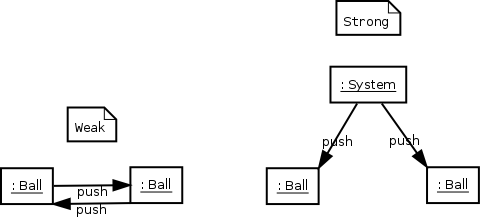
Let’s say I have two “plus balls”.

I take one ball and see what I can do with it. After some experimenting, I discover that it can roll on the ground, bounce against the wall, and squeak when I squeeze it in my hand.

Done playing, I put the ball back on the shelf next to the other ball. They push each other apart.

According to Wikipedia, “ Strong emergence describes the direct causal action of a high-level system upon its components ; qualities produced this way are irreducible to the system’s constituent parts.”

So, someone might say that this pushing apart is an emergent property that can not be explained in terms of explanations the individual balls (which involve rolling, bouncing, and squeaking).

This emergence is described epistemologically (in terms of reduction); let’s look at it metaphysically. It’s a relationship between two balls. Does the relationship exist outside of the balls? No. So how can the relationship’s explanation exist outside that of the balls? Every explanation about a ball describes its potential to have relationships ; with the ground, the wall, my hand. The system isn’t some third party that also gets a say. Saying that it is in control, but not its parts, would be some kind of reification.

Applying this to people:

If you say that a person has a strongly emergent property not reducible to their parts, what are you saying? Like before, the person doesn’t exist outside of the parts, so what of the explanation of the person? Would you be suggesting the person may cause their parts to do something that the parts are not individually explained to do? Then the explanations of the parts are incomplete ; the parts also have the capacity to have a person-relation.

But not every part is directly related to every other part; the entire relation is based on many smaller relations. This is reduction.

In short:
~Strong emergence says the system can’t be explained by the explanations of the parts.
~But the system is the relations the parts.
~The explanations of the parts must include these relations.
~So, the behavior of the system must be explained by the explanations of the parts.

So, strong emergence makes no sense to me.

1 Like

According to Wikipedia, “ Strong emergence describes the direct causal action of a high-level system upon its components ; qualities produced this way are irreducible to the system’s constituent parts.”

So, someone might say that this pushing apart is an emergent property that can not be explained in terms of explanations the individual balls (which involve rolling, bouncing, and squeaking).

This emergence is described epistemologically (in terms of reduction); let’s look at it metaphysically. It’s a relationship between two balls. Does the relationship exist outside of the balls? No.

Stop right there.  A relationship is in no way to be considered internal to, or an attribute of, a single object.   In your example the relationship exists outside of each ball when each ball is considered separately.  When considering the balls together, a relationship that did not exist when the balls were far apart comes into existence, or is at least now of observable magnitude.  Understanding the relationship as coming into existence is metaphysically something “new” or its ability to now be knowable/observable is “new”, either way there is something new and hence “emergent”.


In short:

~Strong emergence says the system can’t be explained by the explanations of the parts.

~But the system is the relations the parts.

~The explanations of the parts must include these relations.

~So, the behavior of the system must be explained by the explanations of the parts.

So, strong emergence makes no sense to me.

“Explanations of the parts” is vague because what is an explanation? If consideration is restricted to what are intrinsic attributes of the parts then relationships are not “of the parts” because they are not wholly possessed by or attributes of those parts.

The definition of strong emergence you used in October is different than mine: 

“If a system as a whole has some property that none of its constituents has (or perhaps, it has it but not as a result of some constituent having that property), this is sometimes called a strongly emergent property of the system.”
I would instead say that strong emergence is the idea that the system directly acts upon its components. In the case of two balls, “two” is not a strongly emergent property, because the fact that there are two does not cause them to pair up. Even though “two” is a property that none of its constituents has. A wooden cube is not strongly emergent because the cube-ness does not cause the wood to form a cube.


A relationship is simply an aspect of entities that we separate out by specialized focus. You wouldn’t say that an attribute is something new that causes an entity to have that attribute. To believe that the relationship is something outside of them is essentially to believe that it is not a relationship, but an entity of its own (which, in order to affect them, would need to have a relationship with them…).

‘two’ is not a property or attribute of any’thing’ , it is an abstraction that denotes a certain quantity of entities(quantity being another abstraction).

When one considers a single part in isolation from the whole from which it was extracted, one is in fact necessarily engaging in eliminative reductionism because any relationships that part was engaged in are eliminated from consideration by the isolation.

Your, rowsdower, objection to this isolation is that the “explanations of the parts are incomplete”.

Well, you can have completeness by consideration of the full context or you can have isolation by mental focus but you can’t have them both at the same time without contradiction.

I am distinguishing between weak and strong emergence; strong emergence is a “new causal level” (3rd post in this thread) whereas weak emergence is simply any system of relationships. You seem to say that every relationship is strong emergence. But there is a difference between acting within a system and being acted on by the reified system.

If an entity A behaves a certain way only in a context B (perhaps involving other entities) then A, before it is in context B already HAD the nature the identity such that A would behave in that certain way on context B.


Metaphysically, nothing emerges as to the nature of A, only we see it behaving in the way it must, but heretofore (absent the context B )  have not observed it.


The emergent behavior is not exhibited by A prior to context B but by no means can it be said that A already has the nature and identity such that once placed in context B it will behave in that certain way.


Once we know, A has such a nature and identity, it is a mere fact of A’s nature.


If I were a scientist armed with this knowledge I would ask the proponents of irreducibility to explain if it has anything to do with metaphysics whatever.  


To me irreducibility smacks of epistemology and seems to be more related with our ignorance than anything else.

If an entity A behaves a certain way only in a context B (perhaps involving other entities) then A, before it is in context B already HAD the nature the identity such that A would behave in that certain way on context B.


Metaphysically, nothing emerges as to the nature of A, only we see it behaving in the way it must, but heretofore (absent the context B )  have not observed it.


The emergent behavior is not exhibited by A prior to context B but by no means can it be said that A already has the nature and identity such that once placed in context B it will behave in that certain way.


Once we know, A has such a nature and identity, it is a mere fact of A’s nature.


If I were a scientist armed with this knowledge I would ask the proponents of irreducibility to explain if it has anything to do with metaphysics whatever.  


To me irreducibility smacks of epistemology and seems to be more related with our ignorance than anything else.

And yet the whole system can possess the properties which none of its part possess. Try to reduce the movement of the hunting lioness to the Brown movement of molecules in her body. You won’t be able to do that and not because of epistemology but because metaphysical difference between living and inanimate objects. it couldn’t be reduced even to  the biochemistry of the muscle contraction and the flow of ions in the synapses of her brain.  Such biochemical events could lead to any movement, epileptic fit for example. But there is a great difference between such a movement and goal orientated action, like hunting or writing post. The metaphysical difference is exactly in the different identity of the living and dead. 

Leonid


Can you give me an example of the kind of “emergence” you are speaking of where you know exactly what all the parts are at every level, exactly why they are doing what processes and functioning is occurring and exactly why the emergent property comes about, i.e. how reality culminates in the system’s exhibition of the property. 


Assuming the emergent property does not violate causation, please use an example for which there is no ignorance with regard to the causes of the emergent behavior.


After all nothing is causeless.  Or are you claiming emergent properties are causeless?

A relationship can be a cause. A relationship is an existent but not an entity. There is no principle that all causes are entities.

The relationship is what is caused. If something was furry you wouldn’t say its furriness causes this; if something made a noise you wouldn’t blame this on the noise. So why say that two balls being pushed apart is due to the relationship (which is, presumably, the fact that they are pushed apart)? A relationship is an aspect that we separate out, but it’s not actually separate. So I would say yes, only entities are causes.

This is only an aside…  I do not want to distract Leonid from providing an “knowable” example of caused emergence.


Grames, I do not know who your point about relationships being “causes” is directed to.  I think the niceties of what you speak of and rowsdower speaks of are so fine as to not create any consequences in reality given the same hypothetical situation, i.e. entities in relationships and the causal evolution which follows would likely not differ between you two although you would each point to slightly different things as being “causes”.


In the end, whether or not relationships are themselves causes, they clearly must be caused.  Relationships do not exist prior to the proper context, arrangement of entities etc. coming into existence.  Thus the relationship is caused by virtue of the context, and the arrangement of entities being itself caused. If there is a time T1 at which point an emergent property does not exist by virtue of the absence of the context, arrangement of entities, relationships, then the fact that the emergent property exists at time T2 means that it, through a chain of causation, IS caused. 


An emergent property does not cause itself backward through time.  Such a thing would be incoherent mysticism.


My understanding of Objectivist philosophy is that nothing is in principle unknowable, and that nothing is causeless.  I would like to understand what knowable and caused emergence IS according to Leonid.

cancel

StrictlyLogical-I already gave an example of emergent property which cannot be reduced to the properties of the parts. But I’ll repeat it. Think about many half-balls which can randomly interact with each other. None of them has a property of rolling. Suppose that flat surface of these half-balls is adhesive. When these two half-balls interact they create a new entity, a ball which has an emergent property of rolling. In this example the cause of emergent property is a process of self-organization of half-balls which creates a new entity, a ball with the new property, rolling. In spite that half-balls are parts of the ball, its property of rolling cannot be reduced to them. Law of causality is Law of identity applied to action. An emergent property is a property of the new object with identity which is different from the identity of its parts. In Ayn Rand words, man is not a collection of chemicals, and neither any living object. The new identity of the living objects defines their new causality which is self-causation. Btw, you are wrong when you assume that in Objectivism nothing is causeless. Existence as a whole for example has no cause. Read OPAR by Dr. Peikoff.

Grames said:

"A relationship can be a cause. A relationship is an existent but not an entity. There is no principle that all causes are entities. "

This has been implicit in many of your posts but I find it alarming that you hold this premise consciously. The stolen concept fallacy is based on ontological facts. It is an epistemic error to claim that relationships exist apart from the entities relating because it is an ontological fact that one must perceive and then isolate the entity acting and relating, before one can abstract the action/relationship. (“Relationships are relationships of entities” ITOE

Ironically this is the same root of your confusion concerning first-level concepts (and the primary point Searle seeks to disentangle). Objectivism does indeed embrace an entity based causation.

“Only entities are metaphysical primaries” ITOE

Grames:


Assuming premises:


A. Each of mind, consciousness, human being at any one moment in time is (or is embodied in) a natural system/entity and has a specific identity;

B. At that same moment in time a context (surrounding reality) interacting with A has a specific identity.


I am interested in your thoughts regarding the O’ist law of causation being

  1. universal (at all scales and applying to any and all natural systems/entities)

  2. undeniably single valued and

  3. a corollary of the law of identity. 


and how this applies to free will of a natural entity/system being the mind/consciousness/human being.

Law of causality applies to actions, not to entities. " The law of causation states that entities are the cause of action-not that every entity , of whatever sort has a cause , but that every action does; and not that the cause of action is action, but that the cause of action is entities." . ( OPAR pg 16). it is a corollary of the law of identity.  Not sure what you mean by “undeniably single valued” Volition is not an exception to the Law of Causality; it is a type of causation. ( ITOE 110)

In many instances the identity of entity is a such that entity can interact within  itself. This is a case of self-organization of matter.


"a process in which pattern at the global level of a system emerges solely from numerous interactions among the lower level components of the system. Moreover the rules specifying interactions among the system’s components are executed using only local information, without reference to the global pattern. In short pattern is an emergent property of the system rather than being imposed on the system by an external ordering influence.’’  Camazine et al. (2001)


In other words the interaction between parts of the entity is a cause of self-organization and emergent properties. From this definition follows that emergent property of the new system cannot be reduced to its parts. Consciousness and volition are emergent properties. Their cause is self-organization of the complex biological system, self-causation.