Who are the "true" Muslims?

Historically, there have been periods where the teachings have been questioned from within the Muslim communities. In general, the questions and questioners have not been well received. Christianity had its Thomas Aquinas. Earlier attempts to integrate Aristotle’s works with the Koran resulted in the rejection of Aristotle.


Having something similar to these enclaves on my back porch (Hamtramck, and Dearborn) heightens my concerns when these situations erupt. Hamtramck used to be a popular place to go shop for Polish meats and baked goods. The community has changed over the years, and recently the Muslim community through the political process, implemented the call to prayer being broadcast such that it can be heard throughout the city. The Polish community has all but left the area. On Packzi day, conversations often contain a rueful, I used to go to Hamtramck to pick them up, but not any more.


It would be nice to see articles like the ones you linked to coming across Drudge Report and other more frequented news dedicated websites.

Historically, there have been periods where the teachings have been questioned from within the Muslim communities. In general, the questions and questioners have not been well received. Christianity had its Thomas Aquinas. Earlier attempts to integrate Aristotle’s works with the Koran resulted in the rejection of Aristotle.

Nevertheless, the intellectuals of most Muslim sects can probably accept a larger role for reason within a generation or so. A thousand years ago, armed with just a couple of key ideas, the Mu‘tazalites were accepted to a certain degree in some areas. If those little ideas had stuck, Islam would be very different today. Instead they lost the intellectual battle. However, people routinely use reason every day, so what it takes is a key intellectual who can gain traction. There have been other movements too. Some Sufis had a very ecumenical approach, and influenced some break-away sects. The influence of modernity can have an influence because exposure to different ideas motivates people to try integrating those ideas with their own philosophy. So, under western colonialism you see some Muslim scholars hark back to the Mu’tazalite ideas, and read the Koran with fairly modern eyes. With the opening up of the middle-east, this is bound to happen again.


Another factor is the incentives of the “second estate”. Historically, aristocrats played a role in certain turning points of religious revolutions, because it suited them. [Consider the German princes backing Luther, and Henry VIII’s break with Rome.] It is unfortunate that the Saudis, with the most anti-reason school of Sunni Islam, ended up getting so rich on oil. Even if the few top leaders are more modern in their personal thinking, the power of their priests is so high that the rulers have a tiger by the tail. Al Sisi’s call to Egyptian intellectuals can be seen in this light: the second-estate trying to argue for a change in philosophy, because they see such a change favoring them. They need the priests to change tack in order to keep the population in line.


Having something similar to these enclaves on my back porch (Hamtramck, and Dearborn) …

I’ve not been to Hamtramck, but I don’t think it is a no-go zone. As for Dearborn, I’ve been there a few times and have never felt it less safe than a neighborhood of equal wealth. I’d be much more nervous in Chicago’s south side.

I think it is a good bet that the so-called “no go zones” that Fox and friends speak of are more akin to bad urban zones in the U.S. The problems tie into poverty and the welfare state, and clanning together around Islam is like clanning together around being black, or Korean or Vietnamese.


It would be nice to see articles like the ones you linked to coming across Drudge Report and other more frequented news dedicated websites.

Drudge caters to an audience who seek out a certain spin. So, practically, the only way to get such stories is to diversify news sources.

Many of the comments on this thread have been insightful, informative, and truthful. I only want to comment on something I heard not long ago in a broadcast interview, comparing the recent events related to Islam, and the regions dominated by Islam, as being in the midst of a war of reformation, similar to the one experienced in Europe in the 16th and 17th centuries. That one dragged on for quite a while, and the end results were not all that good. Another consideration is that some are using a term, Eur-Arabia, acknowledging the expanding presence of so many Muslims in Europe and Great Britain, many of them finding it difficult to assimilate. One can only hope reason prevails.

There are a number of parallels with Christian theological development in the Mu‘tazalites article mentioned. In a loose way, they resemble Calvin and Luther’s break with Catholicism. The problem of evil also reappears therein. Glimpses of the power of philosophy’s role in the culture at large show that it does cut both ways, influencing for the better or worse as reason is embraced or shunned.


“Man,” held Aristotle, “is the rational animal.” “Original sin” added Rand, “is a slap in the face of morality.” To embrace reason takes effort (moral), while there are those that hold man as inherently lazy (immoral). These, and other opposed issues are strewn about on the battlefield for man’s mind.


I did not mean to imply that Hamtramck is a no-go zone. The wealth issue may well play a role. It is a city within a city of Detroit - which in turn borders Dearborn. As a poorer neighborhood in general, it can be unsettling to go there. Being surrounded by Detroit doesn’t help this much. Charlie LeDuff, an investigative reporter, wrote a book “Detroit: An American Autopsy”. The Nation of Islam played a significant enough role in his reporting on the politics to add to many other things that I’ve been exposed to intellectually. My concern relates to the direction headed. Perhaps it’s still too early to tell. America, after all, is an unprecedented phenomenon.

1 Like

… reformation, similar to the one experienced in Europe in the 16th and 17th centuries. That one dragged on for quite a while, and the end results were not all that good.

This type of change probably has to take more than a single generation… youth rise up and change their fathers’ creed. One would have hoped that Islamic terrorism against the West would get Muslims moving, but change happens more when it hits one at home.


The Arab Spring has been an important catalyst to re-thinking. ISIS – by out-doing blatant muslim-on-muslim violence – is causing a re-think even inside Iran, where the government recently held an anti-terrorism conference [the scope may not sastify a westerner, but it is change that comes from elites fearing they might lose control]. The speech by the Egyptian president is in the same vein. In Pakistan, the army was shaken up recently by the attack on a school. Now, their elites are also trying to draw a line.


I’m hopeful that change will happen much quicker than in the Christian reformation. Today, ideas travel rapidly. Also, secular counter-examples (to emulate) abound. 

2 Likes

Hundreds of ‘No-Go Zones’ Across France Are Off-Limits to Non-Muslims

SNOPES has posted a response to this.

1 Like

From Snopes:

Likewise, Middle Eastern writer Daniel Pipes originally blogged about Zones Urbaines Sensibles back in 2006 and then revised his viewpoint after seeing some of them first-hand in 2013:

I had an opportunity today to travel at length to several banlieues (suburbs) around Paris, including Sarcelles, Val d’Oise, and Seine Saint Denis. This comes on the heels of having visited over the years the predominantly immigrant (and Muslim) areas of Brussels, Copenhagen, Malmö, Berlin, and Athens.

A couple of observations:

For a visiting American, these areas are very mild, even dull. We who know the Bronx and Detroit expect urban hell in Europe too, but there things look fine. The immigrant areas are hardly beautiful, but buildings are intact, greenery abounds, and order prevails.

These are not full-fledged no-go zones but, as the French nomenclature accurately indicates, “sensitive urban zones.” In normal times, they are unthreatening, routine places. But they do unpredictably erupt, with car burnings, attacks on representatives of the state (including police), and riots.

Having this first-hand experience, I regret having called these areas no-go zones.


I knew this wasn’t the first time I had heard of ‘no-go zones’, and it had some roots going back to what I consider a credible source (i.e., Danial Pipes).

Between here and Reblogged: No More Free Pass For Islam, you provide a more optimistic, albeit highly contingent, future.

… … a credible source (i.e., Danial Pipes).

I’m glad he corrected himself, and it shows his honesty. I too thought he was credible until I read what he said about no-go zones. I’ll never be able to trust him as much as I did. For a  journalist who specializes in this topic, his first stance showed a lack of the skepticism I’d expect. 


The problems of such zones flow primarily from regulations and the welfare state. In the name of helping the poor, they stifle opportunities. Leftists are materialist. To them if a group of poor people is getting more money from work plus government, that is a better thing than if that group were getting less just from private sources. But, that’s not so good for the soul. Some will make it through just fine, while others slip into a “culture of poverty”: relying on welfare, taking to crime, and so on.


When the poor are more readily identifiable –  because they look black or brown – it makes matters worse. If they are poorer, unskilled people, others see them as being members of that poor class and can be biased against them. This, in turn, can encourage the poorer group to seek identity in their blackness, or their previous nationality, or their religion. It is pretty natural for immigrants to “stick together”: live in certain neighborhoods etc. (Roll back the clock and you might see Italian versus Irish gangs in some American cities.)


In the short/medium term of 10 or 20 years, I think the biggest problem for Europe is how they handle the economic funk they’re in (also a problem for most of the world). If anything makes me pessimistic over this time frame, it is that they might compound their problems by trying more of the same old welfare state prescriptions, making matters worse for their poor.

1 Like

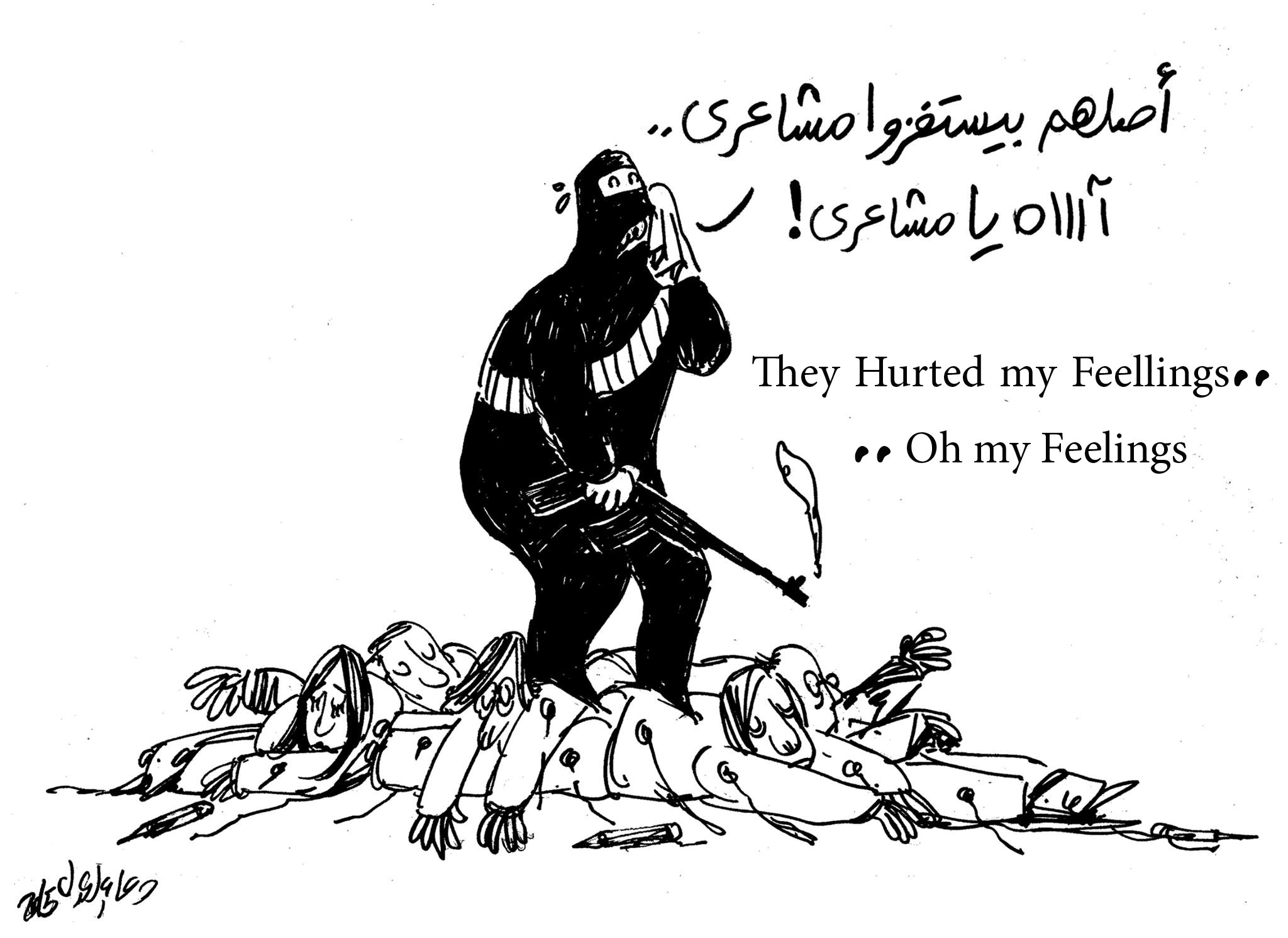
The middle east is going to provide a steady stream of awful stories. In Egypt, for instance, the Muslim brotherhood is a popular force. Al Sisi might ask scholars to re-think their scripture, but they’ve use blasphemy laws. Its a mixed bag and the best approach is to figure out how to help and cheer stream that are better than average. Here’s a link to some cartoon-reactions from the middle-east. Here’s one cartoon from an Egyptian newspaper:

Ok, we’ve delayed implementation of Sharia Law, perhaps the Muslim population hasn’t reached that level yet (or it is not an aim of Islam - i.e., world-wide submission to Allah).


Hamtramck, perhaps like much of greater Detroit, declines in safety for other causes (poverty, education, etc., ), that more rational folk go around, or stick to the freeway systems when passing through.

According to Pipes, his description of the French ‘sensitive urban zones’ sound better than many areas of Detroit. I’ve witnessed.


These thugs that killed Hebdo don’t fit squarely with Samenow’s book. I don’t consider bin Laden suicidal (in the sense of a suicide bomber). Most of the criminal acts discussed in the rest of his book were not this type of suicidal in nature.


Could the thugs have thought they could actually get away with it, is one question. Then I contrast them with a suicide bomber - they can’t really be thinking they will get out of it alive. This sells Samenow’s book short in this department.


How can one possibly try such a mentality on for size? It addles my brain. At this point, I’m back to what is it with Islam that keeps all of this circling back to Islam.


The “They hurted my Feellings” illustration resonates well with this exploration, or so I think.

At this point, I’m back to what is it with Islam that keeps all of this circling back to Islam.

There’s no denying that there is enough baggage in Islam to give terrorists legs to stand on. The first problem is that its prophet became a secular ruler too. Theologically, and as concerns the individual soul, he preached a form of Christianity (or at least in the Christian tradition). And, in this sense, there must have been many other similar “wise men” long lost to history.


However, he was a secular leader too, and a leader of a tribal culture. So, he had to lay down the law, and it is likely that he simply confirmed existing practices and punishments. e.g. Having multiple wives and marrying young girls was a practice across many cultures. Similarly, the Hindu “Dharma-shartra of Yajnavalkya” prescribes cutting of the hand of some thieves and the thumb plus finger of a cut-purse. When a Hindu  legal source has the traditional blessing of religion, one can shrug it off more easily; but when it comes from the Prophet himself, it has extra weight. Unlike relatively civilized middle-eastern areas – Iran or Egypt – he was born in an area that had little but tribes who raised flocks, and either exacted tolls from travelers or robbed them. Brigands perhaps, but that’s how many tribal societies are: property of another tribe is fair game.


So, there you have it: a prophet who is preaching the theology of the times - reaffirming that the God of Abraham is the one and only God, reaffirming the stories of Adam and Joseph and Moses, accepting Jesus a Prophet (but not as God, since that would violate monotheism), reaffirming resurrection and judgement day (which becomes the “practical” reason we should all be good). And, in its multi-faceted vision of God – made real by the many “Names of God” – he is also merciful and compassionate. Yet, you have the same person rallying his warriors to battle, and planning the next raid on a competing tribe!


Further, having started as a combination of church and state, it stayed that way. (Compare Christianity that did not become state religion until centuries later.) This meant that the early tradition continued in the same vein, building up a body of law, practices and punishments (often ascribed to the Prophet). 

Further, having started as a combination of church and state, it stayed that way. (Compare Christianity that did not become state religion until centuries later.) This meant that the early tradition continued in the same vein, building up a body of law, practices and punishments (often ascribed to the Prophet). 

Herein lies the rub. Christianity did not become entangled with the state until later. In this sense, separating the church from the state returned Christianity to the earlier traditions that formed their roots. In this vein, doing the same with Islam comes across as a much steeper hill to climb.

The country with the largest population is Indonesia. It has a relatively moderate form of Islam. Out of curiosity, I looked at the letters to the Editor section of its main English language paper. There wasjust one letter about Charlie Hebdo. Here’s the text:


After every tragedy, there is always the question of where to go from here.  

Will Charlie Hebdo survive, given so many leading cartoonists were taken out, and how many cartoonists will be willing to do this again knowing their cards have been marked by extremists? 

Unless the French government can provide significant support, the jihadists will have scored a resounding victory against any analysis and academic or artistic expression.  

A small group of people will have virtually dictated the direction of Western culture.


Got to admit, that’s a darn sight more rational than the Pope’s irresponsible comments. In the third-world, English language newspapers tend to have a more modern and upper middle-class audience. Still, one sees no Islamic apologetic in this letter. Browsing the opinion section , there’s a letter from an Indonesian Christian who has converted to Islam, and who is cursing all the terrorists who use Islam as their reason for murder. There is also an op-ed by a London-based Indonesian muslim saying the country should re-think its blasphemy laws, since they can and are used to suppress minority religions. 


Herein lies the rub. Christianity did not become entangled with the state until later. In this sense, separating the church from the state returned Christianity to the earlier traditions that formed their roots. In this vein, doing the same with Islam comes across as a much steeper hill to climb.


Though there is that history, there’s a very small conceptual switch that needs to be thrown. For starters, one has to see the Koran as the word of God as addressed to people of a particular time, and as transmitted verbally for a while before it was written down. Second, one has to see God’s various rules of good and bad as implying that humans can use their reason to understand God’s will. Muslim intellectuals have done this in the past and parts of this are already implicit in the thinking of millions of muslims (still a small minority).  [Here’s a PEW survey of muslims across various countries.]


Reason can be in short supply where local philosophy has not given it high priority. Consider, for instance, some Catholics in India who had the police arrest a skeptic under India’s blasphemy laws because he showed that their statue wasn’t really weeping after all, but was some type of capillary action from underground municipal water pipes. (I hope some catholics were getting cholera licking it up). Just because these Catholics converted (and they’re probably second or third generation) did not bring them into the modern world. Similarly, it is not just Islam that is a hindrance. Primitive, faith-based attitudes in general are equally to blame. 

For what it’s worth, I’ve found Ayn Rand’s philosophy-centric view of history to be largely unhelpful. While philosophy has a role in everything, a better framework is to look to power and practicality as the central driving forces of history.


There are certainly lots of examples where religions have been benign–the Founding Fathers come to mind. There are of course lots of examples of the opposite.


I personally divide up the world between personalities who are after power and those who are not. I bet the Indians in the above example had a cottage industry built up around their stupid statue, and wanted to put away the one who sought to kill the golden goose. I bet the head priest in the area was living large and building up power. Etc. This area of India, I would imagine, is not exactly Manhattan. Any tiny bit of notoriety is a gift from, well, God. There are no atheists in shit holes I guess…

While philosophy has a role in everything, a better framework is to look to power and practicality as the central driving forces of history.


Isn’t that just pragmatism, with power as it’s end?

1 Like

Perhaps the question is, What makes a Muslim a true-believer?

If a Muslim is merely an otherwise pragmatic person, identifying him/herself as Muslim, I would have few other options than to regard that person a pragmatic. From there, the person’s behavior could be measured in degrees of rationality. Does this person break into prayer, dropping to the floor in a prostate position five times a day? Do they attend mosque every Friday? How observant are they to the tenets of their faith?

To the lesser degree of rational behavior, do they lash out angrily to their wives, beat their daughters, or express support for Palestinian aggression against Israel?

Then, do they send messages to the international media, bragging about slaughtering Western journalists or cartoonists? This is a Muslim expressing his most profound belief in his faith, the waging of jihad. At this point, I would say such a Muslim(s) is pragmatic, if they are staying a safe distance from the front-line of the violence, but I would not judge them to be rational. Rather, they are playing fast and loose with the delusional minds at their disposal, in a quest for power, as any megalomaniac. 


CrowEpistemology, you challenged me to an argument under another thread, entitled, The Proper Means of Communication. At DonAthos behest, I take you up on your challenge. I will pose the same question several times asked, and several times evaded: How would you persuade a radicalized Muslim to live with infidels as brothers?

CrowEpistemology, you challenged me to an argument under another thread, entitled, The Proper Means of Communication. At DonAthos behest, I take you up on your challenge. I will pose the same question several times asked, and several times evaded: How would you persuade a radicalized Muslim to live with infidels as brothers?


I thought I answered that about 5 times, but here’s #6: you don’t. Terrorists with guns should be hunted down and killed. Duh.


As for the other 999,990,000 Muslims on the planet, we need to figure something out, don’t we? Insofar as we’re not engaged in an all-out world war right now, I would conclude that we are figuring something out and virtually all Muslims do in fact live in peace with non-Muslims.

Except the ones with the guns that kill the infidels.

Crow, you made distinct claims that persuasion is the means to end the violence from Muslims. What line of persuasion do you speak of? For the umpteenth times.


We in the real world want to know?


Crowepistology #96 Proper Means of Communcation:


“In the social-political context, persuasion absolutely should be your goal. That is, if your goal is to make the world safer…”


The context is the ending of Muslim violence against non-Muslim Westerners. This is merely one of several quotes. Put up, or shut up.

Crowepistomology,

Repeatedly you made claims that persuasion is the primary means of making the world safer from Muslim terror.


I thought I answered that about 5 times, but here’s #6: you don’t. Terrorists with guns should be hunted down and killed. Duh.


As for the other 999,990,000 Muslims on the planet, we need to figure something out, don’t we? Insofar as we’re not engaged in an all-out world war right now, I would conclude that we are figuring something out and virtually all Muslims do in fact live in peace with non-Muslims.

At least in this post you admit that you don’t have any clue what so ever about what you were talking about. Unfortunately, I don’t believe your sort of ignorance can be easily remedied, any more than a Muslim could be convinced that, while Allah may be great, his/her own life may be better.


So, rather than openly admit that your claims were nonsensical pipe-dreams, you berate any critic of Islam as “self-destruct idiots,” ranging from Salman Rushdie, to the jokers at Charlie Hebdo. You made claims that these lives deserved the terror they suffered, because they had something to say, and were neither ashamed nor afraid to say it. Instead, you lash back at your critics for challenging such short-sighted whimsy, attempting to frame them as bigots or right-wing fanatics. The guy in the ninja outfit sawing your head off won’t give rat’s ass about how many multicultural associates you have; to him, you are the infidel, and that’s all the reason he needs to make you the next special guest of his Youtube video. If this is not an all-out world war, it is certainly not a secret. Perhaps you can euphemistically call it some other form of war, but it is a war. And if the rest of us want to make jokes about Islam, or any other form of superstition, that is not only our lawfully protected right, but a moral option in so much as it makes a point,  and an emotional option as it makes us laugh. For now, the laugh’s on you.


As for the other 999,990,000 Muslims in the world, we don’t need to figure anything out, other than how we take care of our own affairs, and to protect our selves from them. The fact that the overwhelming numbers of Muslims can be pragmatic and peaceful in their affairs is all well and fine. Yet, there is a significant silence among the most influential Muslim leaders about putting their most distinct problem to rest. That problem is the massive killing of their own people in their own regions, while claiming to be a religion of peace. They need to figure out how to integrate with the modern industrialized global societies and accept the freedom in all its various forms that made our freedom and prosperity possible. By what ever means that goals is achieved, I doubt very much it will be achieved through Westerners persuading them to stop glorifying a 7th century warrior-prophet.


So, Crow, rather than angrily blaming people who do not agree with you, start with reality.
1 Like