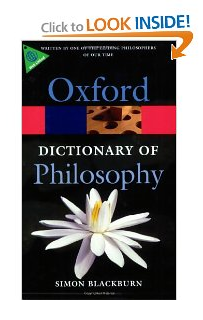
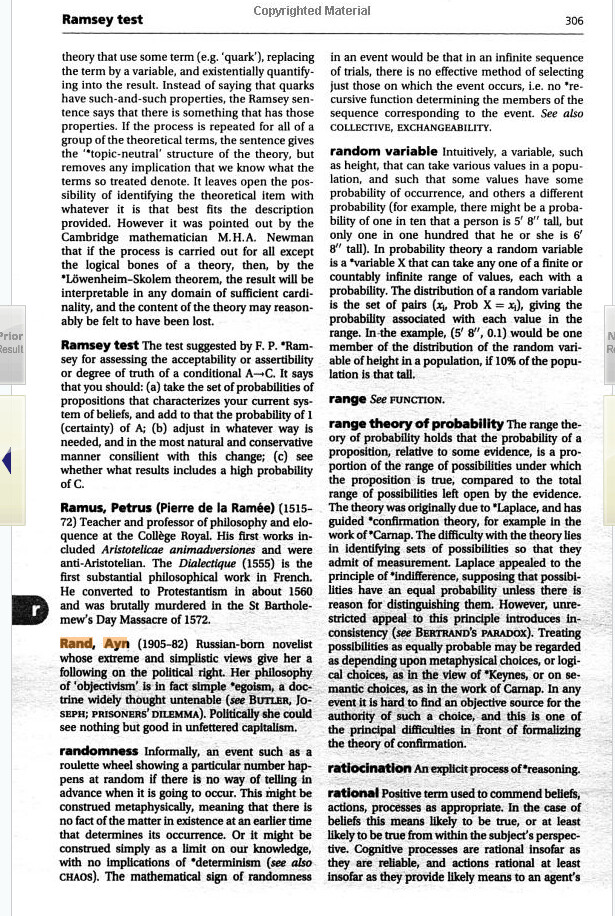
Today at the library I found this somewhat comical entry about Ayn Rand in the Oxford Dictionary of Philosophy:
Ayn Rand - Russian novelist whose extreme and simplistic views give her a following on the political right. Her philosophy of “objectivism” is in fact simple egoism, a doctrine widely thought untenable. Politically she could see nothing wrong with unfetted capitalism.
I have always been a individualist/libertarian but have during the last year been studying Objectivism due to the underdeveloped ethics(IMO) of libertarianism. What this passage got me thinking about is why the philosophical mainstream so quickly dismisses Ayn Rand and sometimes even go as far as to call her a lay-philosopher. I can think of many reasons off the top of my head, but what is the primary reason? Thanks in advance.
That’s interesting, given that you’d expect an Oxford work to be scholarly and objective, even if the author disagreed with the philosophy, but that was egregiously irresponsible. Do you know who wrote the entry?
It’s well-known that academic philosophy is dominated by various stripes of leftists and nihilists, so you wouldn’t expect anyone in the business to read and think outside their particular box. The main explanation, I think, for the hostility that academic philosophers have for Objectivism is that it rejects the central Kantian tenets of modern philosophy, and in fact she hardly engages the post-Kantians in her writings. Since her works are not published in the tedious academic philosophy journals and she doesn’t have an advanced certificate in philosophy, her ideas are not, by their rules of the game, subject to serious consideration. For scientific articles on e.g. physics or genetics I think it is a good principle to ignore works that aren’t published in peer-reviewed venues, because the subject matter does require specialized knowledge and there is a serious issue regarding whether to accept particular data and conclusions (for example, were the experimental results competently collected, does the experimental method have an acceptably low rate of error). That consideration is inapplicable to philosophy, which does not require special training or instrumentation – a philosophical claim can in principle be grasped and evaluated by any intelligent person. This is of course anathema to academic philosophers, who need to obscure the business of philosophy so that people think that special training is required to do it (thus justifying the continued existence of departments of philosophy and their pretense of rigor). What Rand has done is shown that they are wearing no clothes, which of course angers the academic nudists.
This is of course anathema to academic philosophers, who need to obscure the business of philosophy so that people think that special training is required to do it (thus justifying the continued existence of departments of philosophy and their pretense of rigor).
Pardon the humorous aside, but I can’t help but think of the philosopher’s conversation with Deep Thought in Douglas Adams’ “Hitchhiker’s Guide to the Galaxy”. They were of course very much against finding out the simple answer to life, the universe and everything.
Vroomfondel shouted, “We don’t demand solid facts! What we demand is a total absence of solid facts. I demand that I may or may not be Vroomfondel!”
Ayn Rand - Russian novelist whose extreme and simplistic views give her a following on the political right. Her philosophy of “objectivism” is in fact simple egoism, a doctrine widely thought untenable. Politically she could see nothing wrong with unfetted capitalism.
I saw something like this in a book entitled “Everything you need to know about Philosophy” . . . Objectivism was only mentioned under Aristotle, and only in one dismissive line. I find increasingly that my criterion for the seriousness of a book on philosophy has become how it handles Objectivism.
A lot of academic philosophers seem stuck on the worship of old dead guys, too . . . the older and deader, the more important their philosophy must be. Kant is seen as dangerously modern. Forget about Ayn Rand. They’d rather study Socrates, or, better, Hammurabi.
That’s interesting, given that you’d expect an Oxford work to be scholarly and objective, even if the author disagreed with the philosophy, but that was egregiously irresponsible. Do you know who wrote the entry?
It’s well-known that academic philosophy is dominated by various stripes of leftists and nihilists, so you wouldn’t expect anyone in the business to read and think outside their particular box. The main explanation, I think, for the hostility that academic philosophers have for Objectivism is that it rejects the central Kantian tenets of modern philosophy, and in fact she hardly engages the post-Kantians in her writings. Since her works are not published in the tedious academic philosophy journals and she doesn’t have an advanced certificate in philosophy, her ideas are not, by their rules of the game, subject to serious consideration. For scientific articles on e.g. physics or genetics I think it is a good principle to ignore works that aren’t published in peer-reviewed venues, because the subject matter does require specialized knowledge and there is a serious issue regarding whether to accept particular data and conclusions (for example, were the experimental results competently collected, does the experimental method have an acceptably low rate of error). That consideration is inapplicable to philosophy, which does not require special training or instrumentation – a philosophical claim can in principle be grasped and evaluated by any intelligent person. This is of course anathema to academic philosophers, who need to obscure the business of philosophy so that people think that special training is required to do it (thus justifying the continued existence of departments of philosophy and their pretense of rigor). What Rand has done is shown that they are wearing no clothes, which of course angers the academic nudists.
I didn’t see who wrote that particular entry but it was enough for me to view the rest of the book very skeptically. I am by no means an expert in Philosophy or Ayn Rand but I am 100% sure I could write a more accurate entry than that.
Today at the library I found this somewhat comical entry about Ayn Rand in the Oxford Dictionary of Philosophy:
Ayn Rand - Russian novelist whose extreme and simplistic views give her a following on the political right. Her philosophy of “objectivism” is in fact simple egoism, a doctrine widely thought untenable. Politically she could see nothing wrong with unfetted capitalism.
I have always been a individualist/libertarian but have during the last year been studying Objectivism due to the underdeveloped ethics(IMO) of libertarianism. What this passage got me thinking about is why the philosophical mainstream so quickly dismisses Ayn Rand and sometimes even go as far as to call her a lay-philosopher. I can think of many reasons off the top of my head, but what is the primary reason? Thanks in advance.
A few reasons spring to mind.
(1) She didn’t engage with the academic establishment. Admittedly, neither did Nietzche or the Greeks or lots of other folks. But this isn’t Ancient Greece, or even the 1800s. To be taken seriously today, philosophy almost has to emerge from an academic context. The situation isn’t really too odd - it happened in the sciences too. Folks today can’t just sit down in their attics and expect to pump out work that’s going to change the shape of physics. Perhaps mathematics is really more analogous. Note that you don’t hear about the work of pure mathematicians who work outside academia too much.
(2) She was explicitly contemptuous of much academic philosophy. To an extent it has simply returned the favor.
(3) Many of her views are seen as highly suspect or naive on their face. For example, her ethics just totally lack intuitive appeal for a great many people. Her claim to have a view of universals that is a form neither of nominalism, nor transcendent realism, nor immanent realism strikes most philosophers as misunderstanding the problem. Her characterizations of Kant and Aristotle just don’t jive with the way the philosophical community in general interprets their work.
(4) Philosophy has become a highly specialized discipline. It is ill equipped to deal with work that is as tightly interconnected as Rand’s. An ethicist who reads Rand can’t pry out her ethics and play with it in isolation from her metaphysics, and a lot of ethicists just aren’t all that interested in metaphysics.
In the end, these boil down to philosophers not finding Rand particularly interesting. That’s not a good reason for not engaging with her work, but I think it’s at least one thing motivating Rand’s lackluster reception in the academic community.
The question: Why isn’t Objectivism taken seriously?
The answer: Because those who don’t take Objectivism seriously fail to realize that “Existence is Identity, Consciousness is Identification” (from Atlas Shrugged). Its that simple! :lol:
The answer I get for “why isn’t Objectivism taken seriously” is that Objectivism presents an over-simplified view of the world, and that “things are not that simple”.
Peikoff was talking about something similar in his lecture “Why should one act on principle”; as I remember he was describing a certain trend of denying simple solutions not because they are over-simplified, but because people just refuse to accept the fact that some things can be simple.
For them reality is a mixture of concretes which cannot be integrated, and an attempt to form a “simple” principle is “over-simplification” of reality, which is too complex for us to grasp (or something).
I also noticed this motif in art (but just now connected the two).
Once I showed a friend of mine a painting by Bryan Larsen (How far we’ve come). He said that while it is pretty, this is not serious art, but something that a 14 years old girl would put as a poster in her room.
I guess that if life are depicted as something simple and enjoyable, and big achievements as something possible, then the view is considered to be childish or immature.
Nihilist things, art with vague meaning or art with a theme that describes something that is sure to exist (like historical events, or some detail of a life of boring routine) - those are serious.
I am wondering what is the premise at the basis of this view. (“Fun belongs to children. Us adults must be serious and dull”).
I have always been a individualist/libertarian but have during the last year been studying Objectivism due to the underdeveloped ethics(IMO) of libertarianism. What this passage got me thinking about is why the philosophical mainstream so quickly dismisses Ayn Rand and sometimes even go as far as to call her a lay-philosopher. I can think of many reasons off the top of my head, but what is the primary reason? Thanks in advance.
Rand was not “ordained” by any university or professional association. I guess that makes her a “lay-philosopher”.
Wow - I just happened to read this at a book store. It is easily the most NON-objective thing I’ve ever read in a book containing “dictionary” in the title.
Here are two screen grabs from the book cover and the entry in question.
I like how he says “could see nothing but good in…blah blah”, like theres plenty bad to see, she just wasnt capable of seeing it. Funny that his definition of “rational” is on the same page.
I posted an Amazon review. Granted, there is a selection bias skewing my review, since I have only read this entry.
The book is light on deep understanding. The author trusts that your interest in philosophy is merely superficial, and that you will simply take him at his word that some topics are not worth investigating. Take, for example, someone who has been more and more in the news these days - the author of Atlas Shrugged, Ayn Rand.
Someone interested in knowing what all the fuss is about might pick up this dictionary, and hope to get some guidance, or at least a general overview (similar to the first paragraph of a Wikipedia article). Instead they get the following:
In other words, “don’t bother, it’s extreme and simplistic, like the political right.” What’s the point of such condescension? What was the author’s intent behind this? How does this provide any educational value to the reader, or encourage further investigation?
It seems Wikipedia holds to a higher standard of objectivity and neutrality than Oxford University Press. One need only look to the philosophical motivations of Wikipedia’s founder to understand why.
Game theory definitely has it’s uses. Unfortunately the vast majority of the time it is used, in general, it is being used when it shouldn’t be. One of several reasons for that is many people that like to use game theory don’t fully understand what game theory is or when it should be applied/when it’s useful.
Today at the library I found this somewhat comical entry about Ayn Rand in the Oxford Dictionary of Philosophy:
Ayn Rand - Russian novelist whose extreme and simplistic views give her a following on the political right. Her philosophy of “objectivism” is in fact simple egoism, a doctrine widely thought untenable. Politically she could see nothing wrong with unfetted capitalism.
I have always been a individualist/libertarian but have during the last year been studying Objectivism due to the underdeveloped ethics(IMO) of libertarianism. What this passage got me thinking about is why the philosophical mainstream so quickly dismisses Ayn Rand and sometimes even go as far as to call her a lay-philosopher. I can think of many reasons off the top of my head, but what is the primary reason? Thanks in advance.
Actually, the fact that there is a society attempting to get her to be considered acceptable, shows that she isn’t already accepted.
You would have to define what you think “taken seriously” means. I don’t think there would have to be courses designed to study just her, but I do think being taken seriously would at least mean being studied in appropriate philosophy courses across the nation, such as 20th century philosophy, theories of ethics, etc. As such, as far as I know, she is not taken seriously, and the question is valid. (Or was, as it was stated in 2007. The OP doesn’t appear to be around anymore.)
There are many academic philosophers with a teaching position in the leading institutions who are engaging in very serious studies of Objectivism. They publish articles and books. Tara Smith, Allan Gotthelf, Kawaja and many others. Besides, there are philosophers who are not Ojectivists but work along Objectivists lines-like Nuzak.