Pity
At the end of Book IV of The Gay Science (1882), Nietzsche introduces the character Zarathustra. He has stayed in the mountains the last ten years, enjoying “his spirit and solitude” (GS 342). He has decided to leave his cave in the mountains and to descend, to “go under,” back to humans for whom his happiness may shine. The same setting out from the mountains is repeated as the opening of Thus Spoke Zarathustra (1883; Z I “Zarthustra’s Prologue” 1). Like Prometheus and the Christian God-the-Father, Zarathustra loves man and brings gifts to him (Z I “Zarathustra’s Prologue” 2).
“My disciples: like me you strive for the bestowing virtue. . . . / This is your thirst: to become sacrifices and gifts yourselves, and therefore you strive to amass all riches in your soul. / Insatiably your soul strives for treasures and gems, because your virtue is insatiable in wanting to bestow. / . . . / Indeed such a bestowing love must become a robber of all values, but holy and hale I call this selfishness. / There is another selfishness, one all too poor, a hungering one that always wants to steal; that selfishness of the sick, the sick selfishness.” (Z I “On the Bestowing Virtue”).
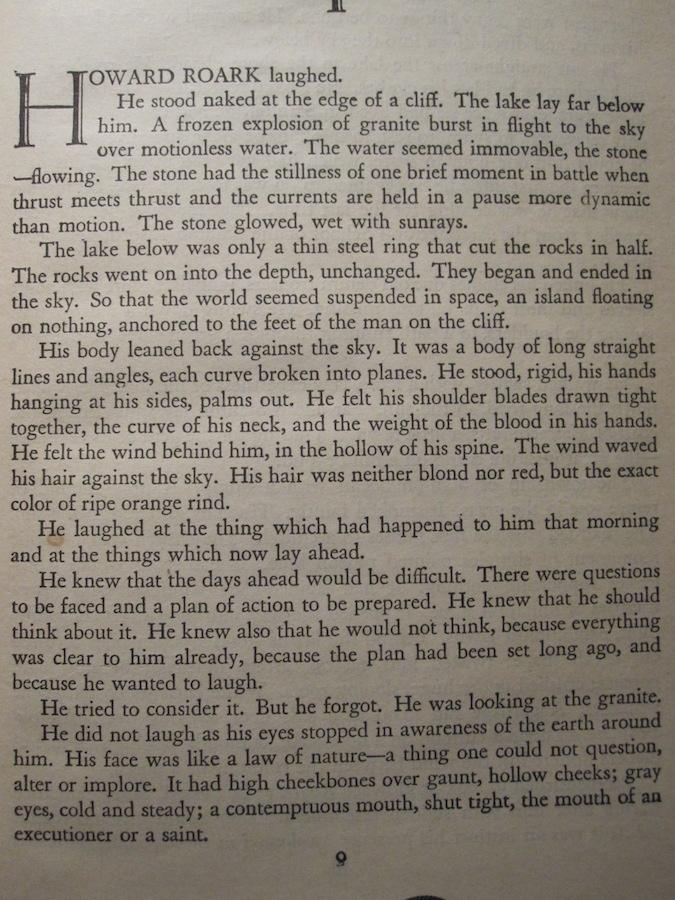
Howard Roark bestows gifts by his creations. He is life-giving. He does not, however, need to take away old virtues of others to give them his gift. Moreover, he does not aim primarily, by his creative work, to be a one who bestows gifts. He aims to bring about the creations.
Hopton Stoddard tells Roark the Temple of the Human Spirit shall be to “‘the human spirit as the creator and the conqueror of the ideal. The great life-giving force of the universe. . . . What I want in the building is your spirit. Your spirit, Mr. Roark’” (ET X 340).
Henry Cameron had said to Roark: “‘May God bless you—or whoever it is alone to see the best, the highest possible to human hearts’” (PK XI 137). Roark is one who pursues the best in his creations. He needs others of a certain character in order to create his buildings. He needs men of independent judgment, of honesty, of courage—men of integrity (PK XIII 166). For his buildings, Roark tracks down the best sculptor, one who is capable of showing in sculpture what men could and should be. Rand 1943 takes seeking the best, the highest, as a law of healthy, selfish life (ET XI 349). This law she calls a first law, this law to seek the best (ET XI 352; cf. Summa Theologica XIII Q94 A2).
Unlike Zarathustra and his hoped-for superhuman children of the future, Roark is not in the business of breaking people’s old tables of good and evil and finding new, more noble virtues. Roark does not take an interest in persons on account of their need of value-reformation. There are fellows of Roark’s spirit, having integrity in the full-bodied sense characterized in The Fountainhead (PK XI 140–41; ET X 333; GW I 442; GW IX 532). These are Roark’s brothers (ET X 332; GW III 576).
At his firm, Roark looks for and rewards only competence. Those who last a month are with him for life. “It was not loyalty to him, but to the best within themselves” (ET X 329). The way of life working at Roark’s firm and the way of life working under him on the Monadnock construction project is contrary the way of the world in general (HR I 547–49). Workers in step with Roark are in a crusade, although, unlike the disciples of Zarathustra and Jesus, the crusade is not the center of their aim.
By the designs of his buildings, Roark bestows life on the spirit of others—on clients and users (PK XI 141, HR II 550, 723) and viewers (ET VIII 305, X 327, HR I 543–45)—and on his own spirit (PK XI 138, ET II 231–32, XI 359). By his buildings and within the social process of their execution, Roark is life-giving. He is also life-giving in personal relations. Austen Heller says to Roark: “You’re the coldest man I know. . . . [Yet] I always feel, when I see you, that you’re the most life-giving person I’ve ever met” (PK XIII 166–67).
Roark is shown as life-giving by personal assistance to the talented young sculptor, Steven Mallory, who is fallen into drink and despair, who is without commissions in a world sot with vulgarity. Kent Lansing, a client of Roark’s and champion of his works, once remarked to Roark: “Men are brothers” (ET X 332). Between Lansing and Roark is the brotherhood of integrity in their intersecting commercial works (also, Wynand and Roark, HR III 576). Roark sees the sculptor Mallory as a spiritual confederate hurt in battle. Finding this man in despair, Roark’s eyes “were serene and they looked at Mallory quietly, a hard, clear glance of understanding—and respect” (ET XI 350). In that face, Mallory saw “the calmest, kindest face—a face without a hint of pity” (ET XI 350; cf. Roark and Wynand at site for future Wynand house, HR III 568–70).
In Fountainhead Rand uses the term pity interchangeably with compassion (ET XI 350). She uses both to designate a feeling towards those in need, but a feeling sour with disrespect. Through the voice of Dominique, Rand states that within her meaning of compassion there is a letting go from holding up one’s heart or spirit, that the antipode of compassion is admiration, and that there is something unsound in adopting compassion as the greatest virtue, given that compassion presupposes suffering (ET VIII 301).
Rand acknowledges that there is a lot of suffering in the world, though she would not make it a central concern of Roark to relieve suffering. Cameron says to Roark that Roark’s steps of success are going to be “a challenge in the face of something so vast and so dark, that all the pain on earth—and do you know how much suffering there is on earth?—all the pain comes from that thing you are going to face” (PK XI 137).
The idea that all the pain on earth comes from human behavior is puzzling (cf. last two paragraphs). I understand Rand’s thought when she describes Dominique’s climax in bed with Roark as taking pain and suffering, inverting them, and sweeping them “into a denial of all suffering, into its antithesis, into ecstasy” (ET VIII 301). That denial is a momentary sanctuary against suffering in life, all suffering, whether caused by humans or nature. That denial, of course, is not a denial of the existence of suffering outside the iron gates of the sanctuary.
Howard Roark suffers a great deal. He designs the Temple of the Human Spirit. He and Dominique walk without words through the completed silent temple on a night before its opening. The temple does not get opened for its designed purpose. It is to have its design modified and botched. Its purpose is rededicated, as a home for subnormal children, where twisted wealthy patrons will visit to enjoy a feeling of superiority. Roark says to Dominique, concerning the destruction of his creation: “I don’t believe it matters to me—that they’re going to destroy it. Maybe it hurts so much that I don’t even know I’m hurt. But I don’t think so. . . . I’m not capable of suffering completely. I never have. It goes only down to a certain point and then it stops. As long as there is that untouched point, it’s not really pain” (ET XII 366). Roark’s buildings each have their own personality, but all of them reflect his soul at its core. They are “innocent of pain” (HR I 544); they are a demanding joy (HR II 560).
Cameron was definitely speaking of pain and suffering such as what Roark has to endure in the fate of the Temple. Dominique asks Roark where does the pain stop. He replies: “Where I can think of nothing and feel nothing except that I designed that temple. I built it. Nothing else can seem very important” (ibid.). Dominique says that he should never have built such a thing to be delivered to such desecration. Roark: “That doesn’t matter. Not even that they’ll destroy it. Only that it had existed” (ibid.).
Hmmmm. Where have we heard that thought before? It was at the close of We the Living. Walking away from the country of death and tyranny, Kira has been shot, in the snowy wilderness, in her wedding gown. She rises and staggers on, whispering the name Leo, whom she had loved. She falls for the last time. She knows she had known something “deep under the little hole that dripped red drops into the snow, deeper than that from which the red drops came. . . . Life, undefeated, existed and could exist.”
Something wonderful had existed. Though it is ending, it had been. It is a fact nothing can change. That is one sanctuary of great emotional suffering. This refuge is also set out for Keating, in his memory of his first and only moments of true love, moments “of wonderful anticipation just before spring is to begin” (HR X 650).
Now in Rand’s story The Fountainhead, Roark’s pain and suffering in the course of his creative projects are due to wrongness in the minds and characters of some members of his society. The same is cause of the suffering he endures when Dominique leaves his arms and marries Keating (ET XV 399–400) and the pain he must carry the rest of his life over the friend he was not able to save (HR IX 749). Unlike in the novel, not all human pain and suffering stems from wrong ideas and choices. The best resolution I can make of Cameron’s statement is to see it as restricted by context in its meaning. Rand was referring, in Cameron’s statement, only to all the physical and emotional pain and suffering brought about in the world by wrong ideas and choices. There is plenty of it. Within that large ambit is the pain and suffering Roark will have to endure in the story.
Dominique is thoroughly revolted by the smallness, the smuttiness, of what most of humanity selects for their enjoyment. When it comes to humanity’s suffering, well, “as a matter of fact, one can feel some respect for people when they suffer. They have a certain dignity” (PK XII 49). One development from Dominique’s self-punishing marriage to Peter Keating is his painful realization of the void he is, of the nothingness of his self apart from his reflection of others (GW II 449–55). She says softly and honestly to him in this suffering over his hollow marriage and life, “I never wanted to take revenge on you, Peter. . . . / I don’t want you to suffer—I can’t feel anything else—but I feel that much” (GW II 456–57).
Peter later squarely faces the fact that virtually all the merit of his buildings has come about by his parasitism on Roark and past creators like Roark. He confesses this sincerely, with dignity, to Roark. Rand’s ideal Howard Roark tells Peter that no forgiveness from him is needed since he has not been hurt in any important way by Peter’s betrayals. Roark has no drive to punish Keating (HR VIII 623). If the terms egotist and kindness do not sit well together, then one needs to rethink these concepts, for Roark is man most egoistic and most kind (HR VIII 631).
Then Peter shows to Howard something he has in his briefcase, something not shown to anyone else. Peter has been doing a work entirely alone, purely because he wants to do it. Howard looks at the landscape paintings Peter has made in solitude and now has pulled from his case. He sees sadly what Peter had really already known: it is too late in life for Peter to develop the skills needed to bring what he feels in a scene onto the canvas (ibid.).
“When Keating had gone, Roark leaned against the door, closing his eyes.
He was sick with pity.
He had never felt this before . . . . This was pity—this complete awareness of a man without worth or hope, this sense of finality, of the not to be redeemed. There was shame in this feeling—his own shame that he should have to pronounce such judgment upon a man, that he should know an emotion which contained no shred of respect.
This is pity, he thought, and then he lifted his head in wonder. He thought that there must be something terribly wrong with a world in which this monstrous feeling is called a virtue.” (HR VIII 631–32)
Contrast that feeling with Roark’s spontaneous feeling towards Mallory, “a desire to lift him in his arms and carry him to safety” (ET XI 351). This feeling does not go by the name pity or compassion in Fountainhead.
When Dominique first sees the face of Roark, at the granite quarry, she sees “the cold, pure brilliance of the eyes that had no trace of pity” (ET I 217). That is a statement about his standard countenance, whether or not it is also something peculiar to his immediate attitude in first looking at her, seeing her and her glance. What is in his face responsive to seeing Dominique is a look of ownership, which is to say, the sexual pronouncement, Yes! (HR IV 582). Perhaps there is also some related sexual lack of pity, as in partners who play rough.
Eventually, at the end of their months-long love affair, Rand makes another mention of Roark’s lack of pity towards Dominique. This mention is a flag staked against the idea that bestowing love—including romantic love—entails loss of self and flows from pity on the object of love. It is a banner against unselfish love. Roark says to Dominique in the heart-rending scene in which they separate: “I love you, Dominique. As selfishly as the fact that I exist. As selfishly as my lungs breathe air. . . . I’ve given you, not my sacrifice or pity, but my ego and my naked need” (ET XIV 400).
It is a commonplace to say that romantic love needs to be unselfish and entails sacrifice. I am not aware of anyone ever saying that it requires or entails or is even compatible with pity. Nor compassion. It does entail concern for another, but presumably Rand was not challenging that in her challenge to romantic love tied to pity. Perhaps Rand was letting pity here stand for mere concern for another by way of challenging the idea that that concern is more basic to romantic love than is concern for oneself. Then again, perhaps Rand was relying on readers knowing romantic love does not rest on pity and hoping that would fortify her proposal of pity-free love in general.
In Roark romantic love and brotherly love are variations of a god-like, bestowing love. They are loves flowing from the needs of his own life, not from pity (unlike God-the-Father) or sacrifice (unlike Jesus).
Howard Roark is a kind person, in a certain sense (HR VIII 631). Ellsworth Toohey poses the question: “What is kinder—to believe the best of people and burden them with a nobility beyond their endurance—or to see them as they are, and accept it because it makes them comfortable?” (ET VIII 296). Roark is not kind in that second sense. His brotherhood is not fastened to kindness in that second sense. He expects something of human beings. So there are some human failings that can outrage him (GW IV 475), such as Mallory being driven down to bric-a-brac (PK III 35) or Cameron being destroyed (PK V 72–75; VI 78–80; XIV 185–86; HR V 593), though sometimes he brushes depravity aside and gets back to work (HR I 551–52). Roark is not contemptuous of humanity (ET XII 365; HR XIX 751). And his standing kindness does not entail pity.
Peter Keating is a lucky man. He gets to sell his soul three times over. Rather than marry the woman he loves, he sells his soul by marrying a woman who can bring him career advancement and the envy of men (PK IV 51–55; VI 82–84; HR X 650–51). He sells his soul in selling his wife to Wynand for a contract (GW III 468–72). He sells his soul to the control of Toohey in return for contracts, prestige, and consolation. The final installment of this sale is Keating giving over to the soul-breaker Toohey his generous friend Roark, by handing over his secret Cortlandt pact with Roark (HR XIV 686–89, 694).
In his best seller Sermons in Stone, Ellsworth Toohey predicts “a better world to come, where all men would be brothers” (PK VI 77). In his newspaper column, he speaks of anonymity and uniformity of brotherhood (ET III 238). This brotherhood is not a brotherhood of nobility or sainthood. It is a brotherhood of comfort, for people who are spiritually nothing by themselves (ET V 261; VIII 296). Saintly spirits, such as Dominique and Roark, are a threat to Toohey’s type of “humanitarianism” in which relations between people are more important than people (ET VIII 297; XIII 387).
Toohey is openly unkind to most every particular person he deals with. He preaches otherwise. “Kindness. That is the first commandment, perhaps the only one. . . . We must be kind to everybody around us. We must accept and forgive” (ET IX 312). Contrast with Roark’s first law (ET XI 349, 352). Contrast with the First Commandment.
In his early high school years, while still religious, Toohey talked about God and the spirit, but “he read more books on the history of the church than on the substance of faith” (ET IX 317). He excelled in original oratory and brought his audience to tears on the theme “The meek shall inherit the earth” (ibid.). Boys who were “suffering or ill-endowed” became his friends and spiritual wards. He consoled them with doctrines on the goodness of suffering, its moral superiority to happiness, the blessedness of belief over understanding, and the superiority of being a slower, less-inquiring student (ET IX 318).
At sixteen Toohey let go of religion and turned to socialism. Instead of God and the nobility of suffering, he talked about the masses. He preached love of the masses and profound self-sacrifice for them. He argued “that religion bred selfishness; because . . . religion over-emphasized the importance of the individual spirit; religion preached nothing but a single concern—the salvation of one’s own soul” (ET IX 319).
In a personal letter in 1946, Rand related her idea of Jesus as proclaiming “the basic principle of individualism—the inviolate sanctity of man’s soul, and the salvation of one’s soul as one’s first concern and highest goal; this means—one’s ego and the integrity of one’s ego.” One great corruption of that individualism in Jesus’ teachings comes with the code of ethics put forth as the means of saving one’s soul: “One must love or help or live for others.” Who put forth this second doctrine? “Jesus (or His interpreters).”
One of the first books Rand bought after coming to America was Nietzsche’s The Anti-Christ. Within this work, Nietzsche sets down differences he sees between the exemplar to be read from the life of Jesus and morality proclaimed by institutional Christianity. One difference is Christianity’s exaggeration of the amount of pity needed in the world. “Christianity is called the religion of pity. . . . Pity makes suffering into something infectious; sometimes it can even cause a total loss of life and of vital energy wildly disproportionate to the magnitude of the cause (—the case of the Nazarene). . . . Pity wins people over to nothingness! You do not say ‘nothingness’: instead you say ‘the beyond’; or ‘God’; or . . .” (AC 7; further, 17, 18, 26, 32, 33, 39–43).
There are several views of Nietzsche expressed in this work that Rand maintained in The Fountainhead, while leaving aside other Nietzchean doctrines, such as those I have replaced with ellipses points in the preceding quotation. Rand’s sensitivity to the possibility of incongruity between Jesus’ life and teachings, on the one hand, and Christianity, on the other, may have been taken home from The Anti-Christ. The particular doctrines in conflict in Rand’s eye, stated paragraph before last, are not among those in Nietzsche’s eye in Anti-Christ, but there is a prelude to the particular opponent-doctrines Rand stresses in Daybreak (132).
Notwithstanding Toohey’s omitting talk of God, his socialist sayings are generally warmly familiar to the religious. Hopton Stoddard found everything Toohey preached “in line with God’s law: charity, sacrifice, help to the poor” (ET X 335). Toohey continued to preach the blessedness of belief over understanding, belief over thought (ET X 388; GW VI 507; HR XIV 692). Mysticism and dialectical materialism, Toohey says, “are two superficially varied manifestations of the same thing. Of the same intention” (HR VI 600). Toohey is speaking for Rand when speaking of the continuity of religion and socialism. This idea was big with Nietzsche. “Who do I hate most among the rabble today? The socialist rabble . . . . The anarchist and the Christian are descended from the same lineage . . . . / Christians are perfectly identical with anarchists: their only goal, their only instinct is to destroy” (AC 57–58; see also D 132; Z IV “The Last Supper” 16; BGE 202).
Notice that Rand does not take religion to be uniformly against thought. Like Leibniz before her, Rand is pleased with the story and idea of humans being created in the image of God, specifically, in their capability for reason. “‘Man’s first frown is the first touch of God on his forehead. The touch of thought’” (HR XIV 693). Though he would not say it publicly, Toohey in no way intends to carry that value forward: “‘We’ll have neither God nor thought’” (ibid.).
Near the end of Fountainhead, Toohey is safe finally to bare entirely his true aims and methods and his true self to Keating. In the world Toohey works to bring about, he would “let all sacrifice and none profit. Let all suffer and none enjoy” (HR XIV 694). Catherine Halsey had been drawn to a career as a social worker because she wanted to help people (ET XIII 387), because she enjoyed helping the helpless and unhappy (ET IV 251–52). Catherine seeks her Uncle Ellsworth’s approval in all her choices. Once she developed a friendship with another girl who was a social worker. This girl was “intelligent, capable, gay and loved the poor” (ET XIII 383). Toohey did not approve of the friendship, and Catherine drops the girl. As time goes by, Catherine succeeds in giving up all her selfish desires (ET XIII 387). She comes to hate the poor people she serves (ET XIII 386).
Toohey reveals to Keating that altruism is a great tool for bringing people around to being ashamed of saying “I want,” thereby killing their joy in living (HR XIV 691). “Preach selflessness. Tell man that he must live for others. Tell men that altruism is the ideal” (HR XIV 690).
Catherine and Peter were truly in love when they were young. Peter jilted her for the social advantage of a marriage to Dominique. Six years later, Catherine has a government job in DC. By chance Peter runs into her in New York, and they have lunch. He tries to look back together with her on the true, first love they had and on the suffering he caused her by dropping her. Catherine responds, without feint: “‘Yes, of course I suffered. All young people do in such situations. It seems foolish afterwards. I cried, and I screamed some dreadful things at Uncle Ellsworth, . . . and then weeks afterward I fainted on the street one day without reason, which was really disgraceful. All the conventional things, I suppose, everybody goes through them, like measles’” (649). Peter thinks to himself. “He had not known there was something worse than a living memory of pain; a dead one” (ibid.).*
Self-pity is widely spurned in the world. It is spurned as well by Rand’s Roark (ET I 214–15). In popular culture, one sometimes sees pity upon another spurned as disrespectful by the one who is object of the pity. It is spurned by Joyce Heath in the movie Dangerous (1935) and by Police Chief Gillespie in the movie In the Heat of the Night (1967).
American Heritage Dictionary states two related meanings of the term pity:
- 1.Sorrow or grief aroused by the misfortune of another; compassion for suffering.
- 2.Concern or regret for one considered inferior or less favored.
It is that second one that is sometimes portrayed as disagreeable and is sometimes be discouraged in popular culture. American Heritage lists the following synonyms having in common that they designate grief or concern felt for someone in misfortune: pity, compassion, commiseration, sympathy, condolence, and empathy. It goes on state the differences in the usage of theses terms. “Pity implies a disposition to help but little emotional sharing of the distress. Compassion always favorably connotes broad or profound feeling for the misfortunes of others and a desire to aid them. Sympathy is as broad as pity but connotes spontaneous emotion rather than considered attitude. Empathy, with literary and psychological overtones, is a conscious involvement with a person’s situation in the sense of vicarious identification” (1976).
The preponderance of translators of Nietzsche into English render his Mitlied as pity, rather than as compassion. Josefine Nauckoff’s translation of The Gay Science alone plunks for compassion over pity.
Nietzsche wrote against the elevation of Mitlied, against making it a virtue, such as had been done by Christianity and by Schopenhauer (D 132–33, 142; GS 251; Z IV “The Cry of Distress”; AC 7). Major translators of Schopenhauer, E.F.J. Payne and R.E. Aquila, render his Mitlied as compassion. David Cartwright (1988) has argued that Mitlied in Schopenhauer should be rendered compassion and that in Nietzsche Mitlied should be rendered pity.
I should mention something about Nietzsche that I have left only implicit for too long. His call for ever-new tables of good and evil exempts the virtues of courage and intellectual honesty. His charges against good and evil are not charges against the noble and base. (I am indebted to Prof. Pippin for that point.) Courage and intellectual honesty belong to the essence of the noble. Pity does not.
Note
* Rand has tucked a personal image as a sign of true love into her literature. In his appeal to Catherine to share in the memory of how they were, Peter speaks of a precious moment when they were alone together sitting on a bench in Washington Square. It was snowing. He speaks of her woolen gloves. “‘I remember—there were drops of water in the fuzz—round—like crystal—they flashed . . .’” (HR X 651, PK VI 85). On the night Roark will first come to Dominique and take her, just before she hears his steps, “a spilled drop of perfume remained on the glass of the dressing table, a drop sparkling like a gem” (ET II 229). In We the Living, Leo and Kira meet a second time, on a snowy night, in front of the deserted mansion. As they part, he takes off her mitten, raises her hand to his lips, and kisses her palm. He departs, “while she was still standing motionless, her hand outstretched, until a little white flake fluttered into her palm, onto the unseen treasure she was afraid to spill (WL 75). In Atlas Shrugged, after John and Dagny first make love, on the sandbags in the Taggart tunnels beneath New York: she saw him stretched out beside her, in the granite vault, “as if his body were fluid in relaxation, she saw the black wedge of her cape flung across the rails at their feet, there were beads of moisture twinkling on the vault” (AS 957).
References
Aquinas, T. d.1274. Summa Theologica. A. C. Pegis, trans., V2, 1997 (1945). Hackett
Cartwright, D.E. 1988. Schopenhauer’s Compassion and Nietzsche’s Pity. Schopenhauer-Jahrbuch 69:557–65.
Nietzsche, F. 1881. Daybreak. R.J. Hollingdale, trans. 1997. Cambridge.
——.1882 & 1887. The Gay Science I–IV & V. J. Nauckhoff, trans. 2001. Cambridge.
——. 1883–85. Thus Spoke Zarathustra. A. Del Caro, trans. 2006. Cambridge.
——. 1886. Beyond Good and Evil. J. Norman, trans. 2002. Cambridge.
——. 1888. The Anti-Christ. J. Norman, trans. 2005. Cambridge.
Rand, A. 1959 (1936). We the Living. Signet.
——. 1943. The Fountainhead. Bobbs-Merrill.
——. 1957. Atlas Shrugged. Random House.