Milton Friedman, arguably one of the most influential economists of the last century and a hard-line capitalist was a proponent of UBI (Universal Basic Income). Ayn Rand on the other hand wasn’t an economist and seems to have little or no idea about economics in general. I haven’t seen any allusions to David Ricardo or John Maynard Keynes in her writings? Yet she insisted welfare and social security apparatus should be removed from claimants despite becoming a recipient of welfare herself later in life. Such hypocrisy! She should have kept her views private and confined herself to commenting upon derivative fiction of which she was undoubtedly an expert.
American economist Milton Friedman advocated a basic income in the form of a negative income tax in his 1962 book Capitalism and Freedom, and again in his 1980 book Free to Choose.
Apparently you are unaware of the fact that your views are now made public, available for anyone to read and comment on. You might ask an admin to erase you.
Apparently you are unaware of the fact that your views are now made public, available for anyone to read and comment on. You might ask an admin to erase you.
You appear to be unacquainted with the anonymity the inernet provides. If Ayn Rand expressed her views anonymously I’m sure they would have been forgotten very quickly _but she didn’t. _Not only did she write potboilers which are little more than exposition of her views, she appeared on national television and radio on several occasions.
I see, so you take dishonesty to be a virtue. You don’t have the decency to admit who you really are, when encroaching on the public domain. What makes you think you have to right to utter your rants in public? If we IP-tracked you and published your real name and address, would you then be morally bound to cease addressing philosophical questions?
I am definitely harmed and offended by your views, so please do not express yourself in public. This is a safe space, you are free to create your own private safe space. Or does your offer to retreat crucially depend on us outing you?
I am definitely harmed and offended by your views, so please do not express yourself in public. This is a safe space, you are free to create your own private safe space. Or does your offer to retreat crucially depend on us outing you?
My views on this subject are not going to harm anyone. Ayn Rand’s ham-fisted views on welfare, if enacted could lead to injustice and deprivation.
My views on this subject are not going to harm anyone. Ayn Rand’s ham-fisted views on welfare, if enacted could lead to injustice and deprivation.
Au contraire, your ham-fisted views on expression definitively lead to massive harm: oppression and death under dictatorships (Stalin, Hitler, Mao, Castro, Putin). Freedom of expression and open discussion is fundamental to a rational society, yet you attempt to act as a gate-keeper who filters out viewpoints that you do not understand and wish not to think about. In a just and free society, ideas are evaluated based on their merits and not based on a credo of credentialism.
Milton Friedman, arguably one of the most influential economists of the last century and a hard-line capitalist was a proponent of UBI (Universal Basic Income). Ayn Rand on the other hand wasn’t an economist and seems to have little or no idea about economics in general. I haven’t seen any allusions to David Ricardo or John Maynard Keynes in her writings? Yet she insisted welfare and social security apparatus should be removed from claimants despite becoming a recipient of welfare herself later in life. Such hypocrisy! She should have kept her views private and confined herself to commenting upon derivative fiction of which she was undoubtedly an expert.
American economist Milton Friedman advocated a basic income in the form of a negative income tax in his 1962 book Capitalism and Freedom, and again in his 1980 book Free to Choose.
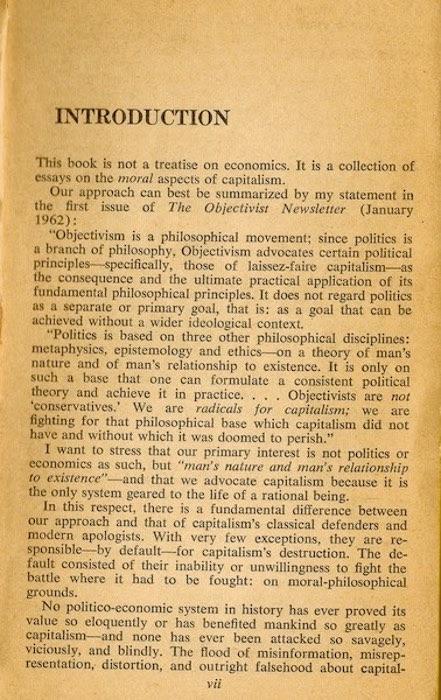
Part of the reply that Rand would give is from the Introduction to her 1965 book Capitalism: The Unknown Ideal. I don’t know if you have read that. Alan Greenspan was one of the contributors. Specialists in economic history also contributed.
You can’t seem to accept that Ayn Rand wasn’t an economist and not really qualified to comment on economic policy.
You can’t seem to accept that you are not a philosopher and are not really qualified to comment on philosophical questions such as “who is qualified to comment”. Also, you seem to be unaware that she did not comment on economic equation theories, she commented on moral issues which is exactly in her sphere of expertise. So-called “economic policy” is simply a set of premises from moral theory, mixed with presumptions of cause-effect analysis from social science studies. You cannot state what constitutes a good policy or a bad policy, if you do not have a theory of “good” and “bad”.
You can’t seem to accept that you are not a philosopher and are not really qualified to comment on philosophical questions such as “who is qualified to comment”. Also, you seem to be unaware that she did not comment on economic equation theories, she commented on moral issues which is exactly in her sphere of expertise. So-called “economic policy” is simply a set of premises from moral theory, mixed with presumptions of cause-effect analysis from social science studies. You cannot state what constitutes a good policy or a bad policy, if you do not have a theory of “good” and “bad”.
I’m stating an opinion not offering a recommendation to government.
Also was Ayn Rand really a philosopher and qualified to comment on philosophy even? From the brief biographical sketch I’ve read she didn’t have any formal training as a philosopher. Derek Parfit she wasn’t. She wasn’t even a great novelist.
A good supplement to that book issued about six decades ago is Capitalism in America – A History (2018) by Alan Greenspan and Adrian Wooldridge. The spell of laissez-faire in America was broken by the coming of grand-scale railroads, a long time ago.
The US, as you, @STENDEC, probably know, has an economy that is a mixture of free markets and government intervention in them. This mixture has produced the greatest standards of living the world has ever known. To this day, the US has, by far and away, the greatest productivity per capita of any country having an annual GDP of greater than 3 trillion dollars.
In the public debates going on (finally!) over balancing the budget, reducing social-welfare expenditures, and stopping inflation, the voices are overwhelmingly about hoped-for prosperity and worried-about deprivation. But Objectivists’ (and some other Libertarians’) main concern behind their positions on those policy issues are justice and protection of individual rights. Any talk to them, frankly, not addressing and challenging their ideas in those areas of morality are like water off back of a duck. It is parallel the situation of trying to convince Leibniz that this is not the best of all possible worlds: behind all the evidence and their tallies by either side, one does not reach Leibniz, because he has a core view that God made the world and would only choose to make the one that was best among worlds in their internal com-possibilities.
I’m stating an opinion not offering a recommendation to government.
Also was Ayn Rand really a philosopher and qualified to comment on philosophy even? From the brief biographical sketch I’ve read she didn’t have any formal training as a philosopher. Derek Parfit she wasn’t. She wasn’t even a great novelist.
As far as I know, Rand did not offer ever a recommendation to government on a matter of economics, she offered a recommendation to people, about government. But again, you presuppose without any evidence or reasoning that you are qualified to comment on or offer an opinion on a philosophical topic. You are not qualified to judge whether Rand was a philosopher, much less a good or bad one. For that matter, you are not qualified to judge Freedman or Galbraith are qualified to comment on economic policy.
In order to rationally argue about the question of “qualification to express a viewpoint”, you have to first state a moral principle telling us when people “may” or “should not” express an opinion. This is true whether or not you intend to use force to impose your view on others, or just intend to ridicule those who do not conform to your viewpoint. As it happens, in the current US most people do have the legally-recognized right to express their viewpoint, and if you go around shooting people who say things that you don’t like, you will probably be arrested and imprisoned (though this right is changing). Otherwise, if you simply intend to be socially obnoxious, then others may, depending on their personal whim, decide to ignore you as an irrational vandal, they may attempt to reason with you to get you to understand how your viewpoint is irrational, or they may counter with mirror-image arguments designed to clarify the absurdity of your viewpoint. There is a fourth option (hunting you down) which is off the table at least for Objectivists, but as you have said above would be a possible outcome under your philosophy.
As far as I know, Rand did not offer ever a recommendation to government on a matter of economics, she offered a recommendation to people, about government. But again, you presuppose without any evidence or reasoning that you are qualified to comment on or offer an opinion on a philosophical topic. You are not qualified to judge whether Rand was a philosopher, much less a good or bad one.
I don’t need to be qualified in anything to know that Ayn Rand was neither an economist or philospher. She was a novelist. Also how do you know I’m neither of these things? What I do know is fact however is that Objectivism isn’t a serious philosophy and is seldom mentioned in academic journals or periodicals. Its reputation as a cult might attract the interest of sociologists but otherwise its effect has thankfully been negligible.
I don’t need to be qualified in anything to know that Ayn Rand was neither an economist or philospher. She was a novelist. Also how do you know I’m neither of these things? What I do know is fact however is that Objectivism isn’t a serious philosophy and is seldom mentioned in academic journals or periodicals. Its reputation as a cult might attract the interest of sociologists but otherwise its effect has thankfully been negligible
You have yet to prove that you are free of the requirement to prove your own qualifications, or to evaluate the qualifications of others. I know these things in the same way that you know the things that you have asserted here: just saying makes it so. My justification for my conclusions about you derives from your demonstrable inability to give a valid response to a single one of my challenges to your baseless opinions. Hence this infinite regress into the land of un-examinable “opinion”.
was Ayn Rand really a philosopher and qualified to comment on philosophy even? From the brief biographical sketch I’ve read she didn’t have any formal training as a philosopher.
Ayn Rand actually did take at least one philosophy course, and also read philosophy on her own. She also put a lot of work into developing her own philosophy. She was really a philosopher.
5 hours ago, STENDEC said:
Derek Parfit she wasn’t.
I looked up Derek Parfit. He “shied away from meta-ethics”, which is like trying to build a house while shying away from having a foundation. It would be more apt to say of Parfit, Ayn Rand he wasn’t.
Objectivism isn’t a serious philosophy and is seldom mentioned in academic journals or periodicals.
Objectivism is a very serious philosophy. The reason it is seldom mentioned in academic publications is that it is radically different from currently dominant philosophies, and thus most professional philosophers don’t understand it. But this is gradually changing.