Economic Freedom's: Objectivists are working to save the world from tyranny--isn't that altruism?

8 hours ago, Economic Freedom said:

“Atlas Shrugged” came into being by means of purposeful choices. Please explain why that is not just a form of mysticism.

We have direct evidence that Ayn Rand wrote Atlas Shrugged.

There is no evidence of any sort of purposeful being guiding evolution.  There is no need to suppose such a being, since genetic mutation and natural selection are enough to account for evolution.

On 5/7/2022 at 6:21 PM, Economic Freedom said:

Recent data that Darwin couldn’t have known regarding how living organisms at the cellular level contribute to their own evolution, rather than being simply passive objects of random forces causing the extremely rare, beneficial mutation. 

The process of genetic change may be complicated and involve action by living cells, but this does not make any of it purposeful.

On 5/7/2022 at 6:21 PM, Economic Freedom said:

these data undercut any attempts to attribute the appearance of life and its speciation given Darwinian assumptions of slow, incremental changes over long periods of time.

So some changes were sudden, at least on a geological time scale.  This does not make any of it purposeful.

On 5/7/2022 at 6:21 PM, Economic Freedom said:

Information Theory, Evolution, and the Origin of Life

Here is an abstract of that book from PhilArchive:

Abstract

Information Theory, Evolution and The Origin ofLife: The Origin and Evolution of Life as a Digital Message: How Life Resembles a Computer, Second Edition. Hu- bert P. Yockey, 2005, Cambridge University Press, Cambridge: 400 pages, index; hardcover, US $60.00; ISBN: 0-521-80293-8. The reason that there are principles of biology that cannot be derived from the laws of physics and chemistry lies simply in the fact that the genetic information content of the genome for constructing even the simplest organisms is much larger than the information content of these laws. Yockey in his previous book (1992, 335) In this new book, Information Theory, Evolution and The Origin ofLife, Hubert Yockey points out that the digital, segregated, and linear character of the genetic information system has a fundamental significance. If inheritance would blend and not segregate, Darwinian evolution would not occur. If inheritance would be analog, instead of digital, evolution would be also impossible, because it would be impossible to remove the effect of noise. In this way, life is guided by information, and so information is a central concept in molecular biology. The author presents a picture of how the main concepts of the genetic code were developed. He was able to show that despite Francis Crick’s belief that the Central Dogma is only a hypothesis, the Central Dogma of Francis Crick is a mathematical consequence of the redundant nature of the genetic code. The redundancy arises from the fact that the DNA and mRNA alphabet is formed by triplets of 4 nucleotides, and so the number of letters (triplets) is 64, whereas the proteome alphabet has only 20 letters (20 amino acids), and so the translation from the larger alphabet to the smaller one is necessarily redundant. Except for Tryptohan and Methionine, all amino acids are coded by more than one triplet, therefore, it is undecidable which source code letter was actually sent from mRNA. This proof has a corollary telling that there are no such mathematical constraints for protein-protein communication. With this clarification, Yockey contributes to diminishing the widespread confusion related to such a central concept like the Central Dogma. Thus the Central Dogma prohibits the origin of life “proteins first.” Proteins can not be generated by “self-organization.” Understanding this property of the Central Dogma will have a serious impact on research on the origin of life.


This sounds very different from what you said.

 From the Wikipedia article on the Central Dogma:

The  central dogma of molecular biology  is an explanation of the flow of genetic information within a biological system. It is often stated as “DNA makes RNA, and RNA makes protein”,[1] although this is not its original meaning. It was first stated by Francis Crick in 1957,[2][3] then published in 1958:[4][5]

The Central Dogma. This states that once “information” has passed into protein it cannot get out again. In more detail, the transfer of information from nucleic acid to nucleic acid, or from nucleic acid to protein may be possible, but transfer from protein to protein, or from protein to nucleic acid is impossible. Information means here the precise determination of sequence, either of bases in the nucleic acid or of amino acid residues in the protein.

He re-stated it in a Nature paper published in 1970: “The central dogma of molecular biology deals with the detailed residue-by-residue transfer of sequential information. It states that such information cannot be transferred back from protein to either protein or nucleic acid.”[6]

 
Information flow in biological systems

A second version of the central dogma is popular but incorrect. This is the simplistic DNA → RNA → protein pathway published by James Watson in the first edition of The Molecular Biology of the Gene (1965). Watson’s version differs from Crick’s because Watson describes a two-step (DNA → RNA and RNA → protein) process as the central dogma.[7] While the dogma, as originally stated by Crick, remains valid today,[6] Watson’s version does not.[2]

Again, this sounds very different from what you said.
 

>We have direct evidence that Ayn Rand wrote Atlas Shrugged.

Such as eye-witness testimony of persons claiming to have witnessed Ayn Rand actually hand-writing the manuscript? That sort of “direct evidence”? Specify, please.

31 minutes ago, Economic Freedom said:

>We have direct evidence that Ayn Rand wrote Atlas Shrugged.

Such as eye-witness testimony of persons claiming to have witnessed Ayn Rand actually hand-writing the manuscript? That sort of “direct evidence”? Specify, please.

The woman who typed up the hand written pages Miss Rand wrote still walks amongst us.

53 minutes ago, dream_weaver said:

The woman who typed up the hand written pages Miss Rand wrote still walks amongst us.

You haven’t explicitly answered the question: Direct evidence such as eye-witness testimony?

>There is no evidence of any sort of purposeful being guiding evolution.

There’s also no evidence of any sort that a person named Ayn Rand engaged in teleologically mystical and goal-oriented action to write a book called Atlas Shrugged. Eye-witness testimony from someone claiming to have typed the manuscript? That’s not objective proof worthy of being accepted by an Objectivist; that’s just someone saying she did something or saw something. Imagine if we all accepted such eye-witness testimony as “proof” of anything! We’d probably have to accept the eye-witness testimony of survivors of extermination camps during WW2 (and there are many deniers who do not accept such eye-testimony as proof of anything except, in their view, the willingness of some people to lie); we’d probably also have to accept the eye-witness testimony of Ukrainians who say their cities and homes were shelled by the Ukrainian army or that Ukraine is a central hub (by virtue of its geographic location, as well as by virtue of the general anarchic and corrupt state of affairs in its own government) of child trafficking! Just imagine all of the ridiculous things we’d have to consider seriously as being plausibly true if we accept eye-witness testimony as evidence! It’s not fully and majestically Objective, so the whole issue is a non-starter.

The reason we don’t have to resort to such a mystical explanation as “someone named Ayn Rand intelligently-designed Atlas Shrugged by means of purposeful, goal-oriented action” is that the entire book, all 1160 pages, can be shown to have a non-zero probability of having appeared simply by pure dumb luck by means of naturally occurring forces. And you’ll have to admit that as long as there’s a non-zero probability of anything occurring, it probably will occur, given enough time. Right?

As far as the text itself goes, it can all be explained by very simple probability:

  1. The book is about 1160 pages (hardcover might have a different page count from paperback, but 1160 pages is not too far off the mark). 

  2. There are 26 letters in the English alphabet, and we use another character – a space – to separate groups of letters (called “words”) from one another. So if we include a space as a character, the English alphabet can be said to comprise 27 discrete characters. There are also punctuation marks, of which I include the following 11: period, comma, colon, semi-colon, exclamation point, question mark, apostrophe, open quote, close quote, open parenthesis, close parenthesis. We might include the open-and-close brackets and the diaresis but I’ll skip those since they don’t change the outcome by much. Also, I’m omitting the fact that there are actually 52 letters in the English alphabet, not just 26, because each letter has a majuscule (upper case) and miniscule (lower case) form.

So the total number of characters in English is the following:

26 letters;
1 space;
11 punctuation marks;
Total = 38 characters.

There are no physical or chemical constraints on any of those characters; i.e., any character can precede or succeed any other character. True there are mental constraints on the order of characters determined by mental considerations such as grammar, syntax, rules of spelling (e.g., in English, a “u” must follow a “q” 100% of the time, or in others, with a probability of “1”) but mental considerations are irrelevant in this calculation, which only considers physical or chemical constraints – the same kinds of constraints that come into play in biological systems. 

Now, how many characters are in the complete work known as Atlas Shrugged? Hard to say. I guess we could find an online version and do a character count but this is just a “back of the envelope” calculation, so I’m going to “guestimate.” I’ll guess that there at least 300 characters per page (probably more); since there are about 1160 pages, the total number of characters would be around 300 x 1,160 = 348,000.

Now: just taking into consideration laws of physics and chemistry – not “rules” of spelling, grammar, etc. – what is the probability that the entire string of text, from “Who is John Galt” to “traced the sign of the dollar” arose purely by dumb luck? It’s very easy to calculate:

Think of those 348,000 characters as being “slots” waiting to be filled by a character spit out by any physical force we imagine (naturally occurring ink blown by tornado, for example. It could happen, right? It’s not completely impossible, right?). So what is the probability that the first character we see in a current copy of the book – an open-quote, or " – could appear in the first position of the text (i.e., the first “slot”)? It’s not hard to figure out. If there are 38 characters, then the odds of one of those characters appearing in the first slot are one-in-38, expressed arithmetically as “1/38.” This means: there’s a 1-in-38 chance that the first slot in the text will be an open-quote.

The 2nd slot in the novel shows the letter “W” (i.e., “Who is John Galt?”). What are the odds of that letter appearing (after being blown in by some tornado or storm from a pool of inky substance that just happens to be lying around on the ground) by chance? Same as before: there are 38 characters total; “W” is one of those characters; so the odds of that character appearing in the 2nd slot are 1/38.

Now: what would the odds be of both of those characters appearing by chance? It’s a simple probability product: 

" = 1/38
W = 1/38
" and W (whether in temporal succession or simultaneously, it makes no difference for the calculation): the word “and” in probability means “times”, so we simply multiply the two probabilities:

" and W = " * W = 1/38*1/38=1/1,444. So there’s a 1-in-1,444 chance of a " and a W appearing by chance in the first 2 slots.

What about the 3rd slot, the letter “h” (“Who . . .?”). Same thing. It’s also 1/38. And so it is for every character in the entire string of text, from “Who is John Galt” to “traced the sign of the dollar.” Since we’re guessing there are about 348,000 characters total, the odds of the entire text string appearing by chance must be 1/38 multiplied by itself 348,000 times, or 1/(38^348,000). It’s a bit easier to conceive of the denominator if we convert it to base 10, so we do a little junior high school log arithmetic:

38^348,000 = 348,000*log(10)38

The log(10) of 38 is about 1.58 (i.e., 10^1.58 is about 38);

So 38^348,000 = 348,000*log(10)38 = 348,000*1.58 = 549,840; or

38^348,000 = 10^549,840

And since that number was in the denominator, we have the odds of Atlas Shrugged having come into existence completely by random processes and pure dumb luck as being:

one chance in 10^549,840, or 1/10^549,840,

which is NON-ZERO.

And because it is a positive Real Number, we cannot simply dismiss it as impossible (which would be a zero probability), and therefore there’s no need to trust unreliable “eye-witness” testimony as some sort of evidence in favor of a mystical force like “teleological, goal-directed action” to account for a 1160-page novel, which after all, is really just a very long string of characters, and ink is just ink; a liquid with chemical properties, capable of taking many shapes from completely random physical forces. We don’t need anything other than those physical forces and the chemical properties of liquid ink to account for a long text string like Atlas Shrugged.

>There is no need to suppose such a being, since genetic mutation and natural selection are enough to account for evolution.

Just as random physical forces, the chemical properties of liquid ink, and the ironclad math of simple probability are enough to account for the appearance of a long string of text we have named “Atlas Shrugged.” See above.

1 hour ago, Economic Freedom said:

You haven’t explicitly answered the question: Direct evidence such as eye-witness testimony?

She, who shall not be named directly in this thread by me, is an eye-witness. The information is available for those who have discovered how to query the available evidence.

11 hours ago, Economic Freedom said:

. . . 

And you’ll have to admit that as long as there’s a non-zero probability of anything occurring, it probably will occur, given enough time. Right?

. . .

<–Incorrect. Past events have run out of time, and “given enough time” should be realistic. The chance that left to themselves all the air molecules in a room where one is breathing will come to reside in a one-cubic-inch volume in a corner of the room is so small, one shouldn’t get nervous about it or give it a second thought. Moreover, there are combinatorial infinities of higher type than the infinity of a supposed infinity of time (higher infinities than the real numbers); so Nietzsche was incorrect to think his body and life experiences could reoccur in an infinite amount of time.

Thermal Physics – Kittel

>-Incorrect. Past events have run out of time, and “given enough time” should be realistic.

I agree. I was clearly being provocative in my previous assertion since most people incorrectly believe that as long as some event can be shown to have a non-zero probability of occurring, it will occur if given enough time. We both agree that’s untrue.

>The chance that left to themselves all the air molecules in a room where one is breathing will come to reside in a one-cubic-inch volume in a corner of the room is so small, one shouldn’t get nervous about it or give it a second thought. 

I also agree. The reason that we shouldn’t fear air molecules randomly aggregating in the corner of a room (thus suffocating us to death) is that there are vastly more combinations of air molecules not aggregating in the corner than there are combinations of molecules aggregating in the corner. Simple statistical mechanics.

Similarly, there are more combinations of molecules of stone and plaster comprising differently shaped piles of rubble than there are combinations of stone and plaster comprising inhabitable structures like The Parthenon, which explains why structures like the Parthenon go from being low-probability-low-entropy arrangements of molecules (the structure as it appeared in antiquity after it was built by intelligent minds) to lying in partial ruins (as it appears today), and not the other way around…even though by hypothetically assuming the other way around, no physical laws are being violated.

As Feynman pointed out in his Cornell lectures, if you saw a film clip of a tornado tearing through a pile of rubble and a perfectly assembled barn is the result, you’d understandably claim that the film was being run backward, because in our experience, non-intelligent forces like tornados don’t take arrangements of things that have a high probability of appearing on their own (piles of rubble) and converting them into low-probability arrangements (barns).

It’s called “statistical mechanics” and it provides a compelling illustrating of how things break down over time when left by themselves without intelligent intervention to maintain their low-probability arrangements, as well as illustrating how things cannot go from high probability (high entropy) arrangements to low probability arrangements (low entropy) without intelligent intervention. I.e., without purposeful, goal-directed, teleological action.

The same arguments apply to the origin of life, as well as the diversification of disparate species.

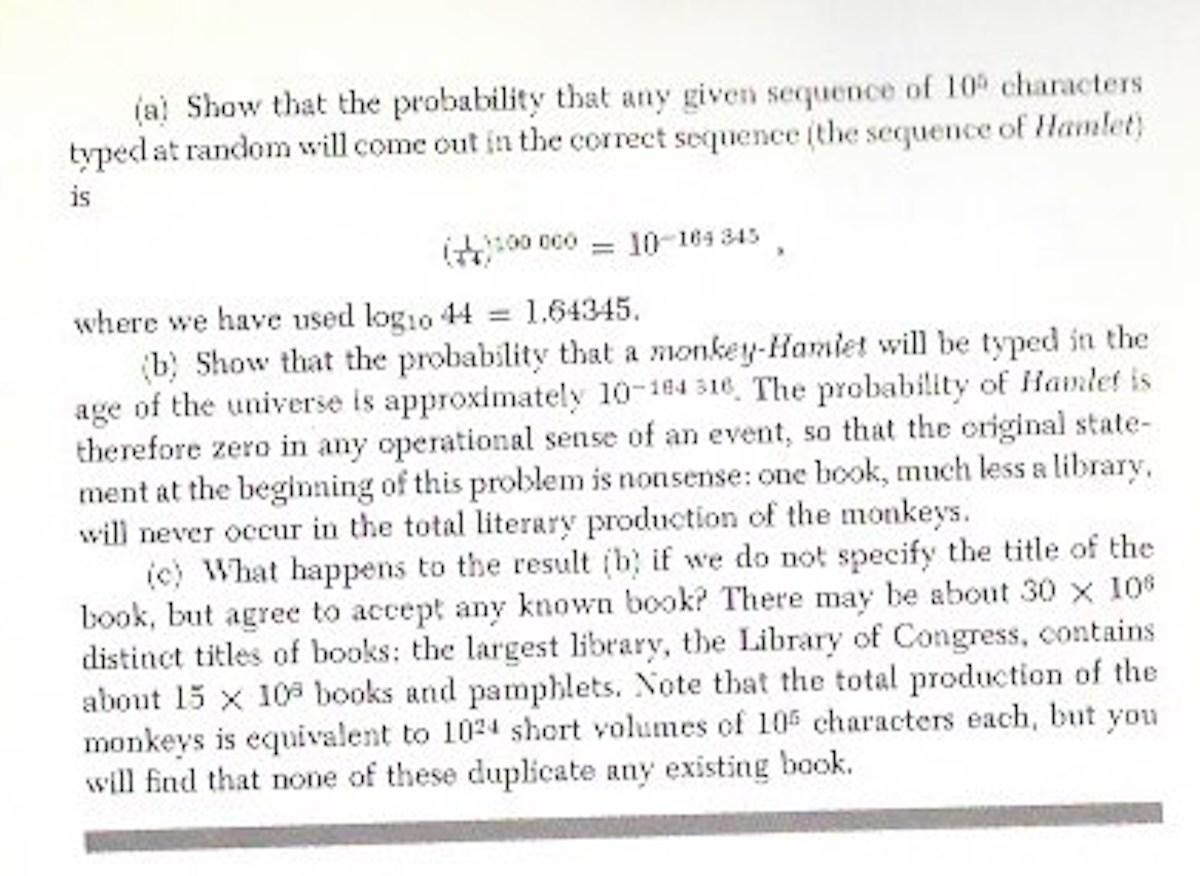
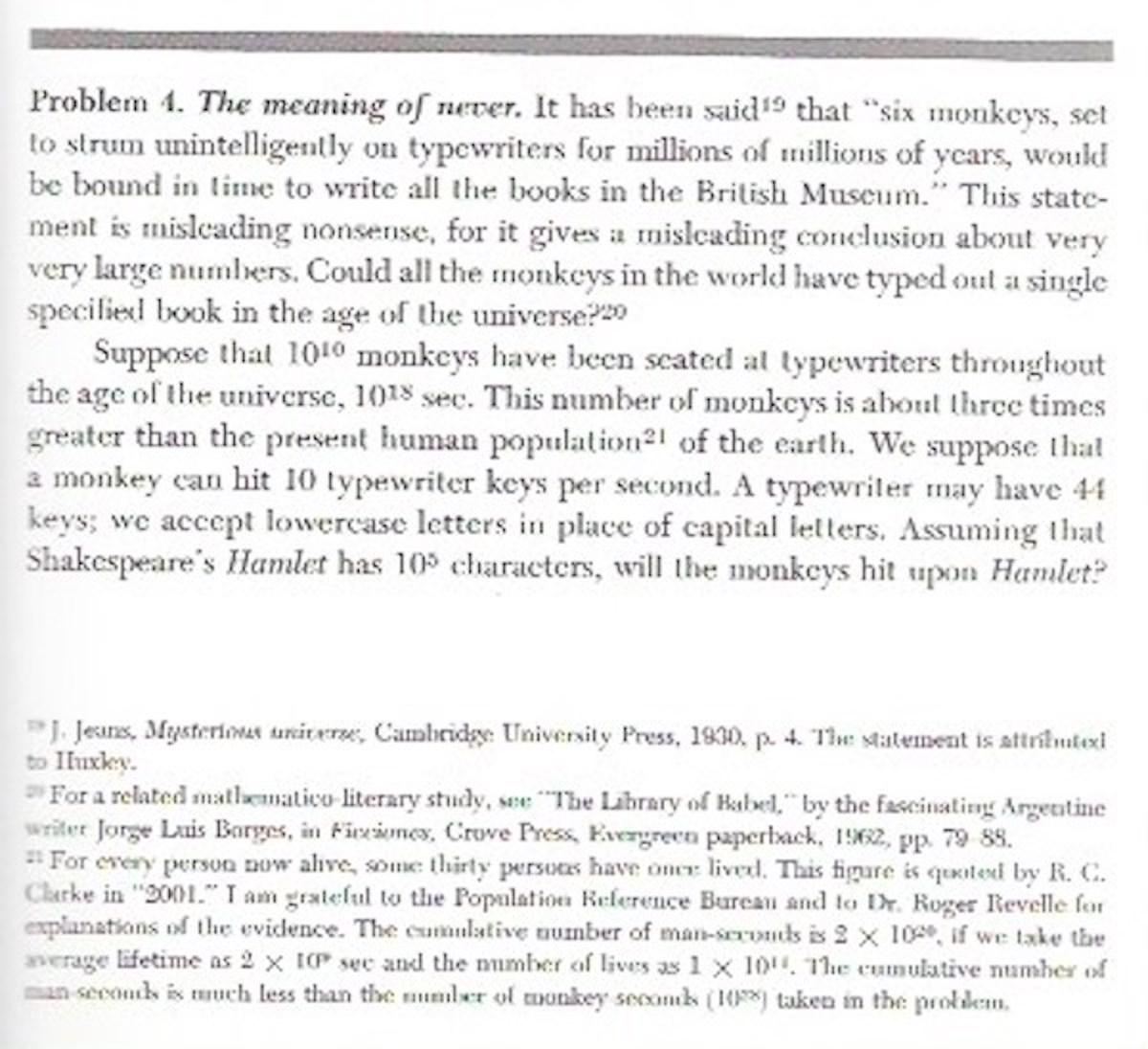
Something the monkey excerpt above fails to mention:

Most of the biochemical processes involved in life are “reversible”, and would reverse themselves unless held in equilibrium. To make the monkey example relevant as an attempted explanation that life arose by chance, we’d have to add the following: every time a monkey randomly typed a character, it would also type a backspace key and type over the letter using the correction ribbon. 

There are as many forces in nature that undo built-up arrangements of molecules as there are forces that do the building up; probably more (that’s why the 2nd Law says that entropy moves from low to high, and not the other way around, at least not without purposeful action to maintain the earlier low-entropy state). So the assumption that, if only given enough time, random combinations will inevitably build up arrangements that are functional (e.g., proteins) and meaningful (e.g., literary novels) is a non-starter.

2 hours ago, Economic Freedom said:

It’s called “statistical mechanics” and it provides a compelling illustrating of how things break down over time when left by themselves without intelligent intervention to maintain their low-probability arrangements, as well as illustrating how things cannot go from high probability (high entropy) arrangements to low probability arrangements (low entropy) without intelligent intervention. I.e., without purposeful, goal-directed, teleological action.

The entropy of the entire system always increases, even when the entropy of parts of it decreases.  This is true whether the decrease of entropy in part of the system is due to purposeful, goal-directed, teleological action or to some other cause.

Natural selection does not operate at random in the long run.  It is capable of producing low-entropy results in parts of a system whose total entropy is always increasing.  It is not purposeful and does not need to be.

We do not yet know exactly how life began.  The appropriate reaction to this situation is to investigate and to find out as much as we can, not to arbitrarily say a purposeful being had to do it.


1 Like

On the origins of human reason and morality, I’d bet on the worth of Michael Tomasello. I have purchased three of his books years past, but as yet have not gotten to read them:

A Natural History of Human Thinking

From the Publisher –

Quote

Tool-making or culture, language or religious belief: ever since Darwin, thinkers have struggled to identify what fundamentally differentiates human beings from other animals. In this much-anticipated book, Michael Tomasello weaves his twenty years of comparative studies of humans and great apes into a compelling argument that cooperative social interaction is the key to our cognitive uniqueness. Once our ancestors learned to put their heads together with others to pursue shared goals, humankind was on an evolutionary path all its own.

Tomasello argues that our prehuman ancestors, like today’s great apes, were social beings who could solve problems by thinking. But they were almost entirely competitive, aiming only at their individual goals. As ecological changes forced them into more cooperative living arrangements, early humans had to coordinate their actions and communicate their thoughts with collaborative partners. Tomasello’s “shared intentionality hypothesis” captures how these more socially complex forms of life led to more conceptually complex forms of thinking. In order to survive, humans had to learn to see the world from multiple social perspectives, to draw socially recursive inferences, and to monitor their own thinking via the normative standards of the group. Even language and culture arose from the preexisting need to work together. What differentiates us most from other great apes, Tomasello proposes, are the new forms of thinking engendered by our new forms of collaborative and communicative interaction.

A Natural History of Human Thinking is the most detailed scientific analysis to date of the connection between human sociality and cognition.

A Natural History of Human Morality

From the Publisher – 

Quote


Michael Tomasello reconstructs how early humans gradually became an ultra-cooperative and, eventually, a moral species.

There were two key evolutionary steps, each founded on a new way that individuals could act together as a plural agent “we”. The first step occurred as ecological challenges forced early humans to forage together collaboratively or die. To coordinate these collaborative activities, humans evolved cognitive skills of joint intentionality, ensuring that both partners knew together the normative standards governing each role. To reduce risk, individuals could make an explicit joint commitment that “we” forage together and share the spoils together as equally deserving partners, based on shared senses of trust, respect, and responsibility. The second step occurred as human populations grew and the division of labor became more complex. Distinct cultural groups emerged that demanded from members loyalty, conformity, and cultural identity. In becoming members of a new cultural “we”, modern humans evolved cognitive skills of collective intentionality, resulting in culturally created and objectified norms of right and wrong that everyone in the group saw as legitimate morals for anyone who would be one of “us”.

As a result of this two-stage process, contemporary humans possess both a second-personal morality for face-to-face engagement with individuals and a group-minded “objective” morality that obliges them to the moral community as a whole.


Becoming Human – A theory of Ontogeny

From the Publisher –

Quote

A radical reconsideration of how we develop the qualities that make us human, based on decades of cutting-edge experimental work by the former director of the Max Planck Institute for Evolutionary Anthropology.

Virtually all theories of how humans have become such a distinctive species focus on evolution. Here, Michael Tomasello proposes a complementary theory of human uniqueness, focused on development. Building on the seminal ideas of Vygotsky, his data-driven model explains how those things that make us most human are constructed during the first years of a child’s life.

Tomasello assembles nearly three decades of experimental work with chimpanzees, bonobos, and human children to propose a new framework for psychological growth between birth and seven years of age. He identifies eight pathways that starkly differentiate humans from their closest primate relatives: social cognition, communication, cultural learning, cooperative thinking, collaboration, prosociality, social norms, and moral identity. In each of these, great apes possess rudimentary abilities. But then, Tomasello argues, the maturation of humans’ evolved capacities for shared intentionality transform these abilities―through the new forms of sociocultural interaction they enable―into uniquely human cognition and sociality. The first step occurs around nine months, with the emergence of joint intentionality, exercised mostly with caregiving adults. The second step occurs around three years, with the emergence of collective intentionality involving both authoritative adults, who convey cultural knowledge, and coequal peers, who elicit collaboration and communication. Finally, by age six or seven, children become responsible for self-regulating their beliefs and actions so that they comport with cultural norms.

Becoming Human places human sociocultural activity within the framework of modern evolutionary theory, and shows how biology creates the conditions under which culture does its work.

Nozick on The Geneology of Ethics

Rand and Evolution

Concerning Rand’s definition of reason:

Rand’s definition of reason is: the faculty that identifies and integrates the evidence of the senses. In my dictionary, I find reason defined as the capacity for rational thought, rational inference, or rational discrimination. The terms rational and thought go to already familiar synonymies with reason. The differentia within the rational, in this dictionary definition, are the discriminatory and the inferential.

Rand’s definition stays close to the common usage reflected by the dictionary, but it replaces discrimination and inference by their kin identification and integration, it eliminates the non-explicative rational, and it adds a base for the activities of reason, specifically, deliverances of the senses. Rand’s definition is explanatory of the common usage found in the dictionary, and it is tailored to tie neatly to a particular wider philosophical view. 

Quine could say this is a fine explicative type of definition. Rand has given the term reason a new synonymy. The various contexts in which reason under the dictionary definition is properly used remain contexts in which reason under the new, explicative definition is properly used. The new definition covers the processes of drawing distinctions and making inferences. The new definition also applies to the wider processes of identification and integration of sensory evidence, processes in which the narrower processes are embedded.


A sense in which Darwin Was a Teleologist by James G. Lennox.

Concerning Darwinism by James G. Lennox.

From that second link, in the preceding post, to Lennox:

Quote

One can understand why devout and orthodox Christians would have problems; but why Darwin’s philosophical and scientific mentors? It would seem to be the model of Herschelian/Lyellian orthodoxy.

2.3 Philosophical Problems with Darwin’s Darwinism

The answer lies in five philosophically problematic elements of the theory.

2.3.1 Probability and Chance

First, notice the use of the language of ‘tendencies’ and ‘frequencies’ in the above principles. Privately, Darwin learned, Herschel had referred to his theory as ‘the Law of higgledy-piggledy’, presumably a reference to the large element played in its key principles by chance and probability. Darwin’s theory is, as we would say today, a ‘statistical’ theory. One cannot say that every individual with favorable variation v will survive or will leave more offspring than individuals without it; one cannot say that no environment will ever support all of the offspring produced in a given generation, and thus that there must always be a competitive struggle. These are things that tend to happen due to clearly articulated causes, and this allows us to make accurate predictions about trends, at the level of populations, but not to make absolute claims about what must happen in each and every case. Only well after Herschel’s time did philosophers of science become comfortable with the idea of a theory of this sort, and the proper philosophical understanding of such explanations is still debated.

2.3.2 The Nature, Power and Scope of Selection

The core of Darwin’s theory is the concept of natural selection. Perhaps because of his use of the term selection, this core element of his theory apparently baffled nearly everyone. Could it be, as Lyell, Herschel and Darwin’s great American defender Asa Gray would ask, an ‘intermediate cause’, i.e. a causal principle instituted and sustained by God? Or is it, in its very nature, the antithesis of such a principle, as his old geology teacher Sedgwick believed? Could it possibly create species, or is it, by its nature, a negative force, eliminating what has already been created by other means? In one of his copies of On the Origin of Species, Alfred Russell Wallace crosses out ‘natural selection’ and writes ‘survival of the fittest’ next to it. Wallace always felt that ‘selection’ inappropriately imported anthropomorphic notions of Nature choosing purposefully between variants into natural history. And, in a devastating review, Fleeming Jenkin happily accepted the principle of natural selection but challenged its power to modify an ancestral species into descendent species, and thus limited its scope to the production of varieties. A number of reviewers, even some sympathetic ones, questioned the possibility of extending the theory to account for the evolution of those characteristics that differentiate humans from their nearest relatives.

2.3.3 Selection, Adaptation and Teleology

Moreover, because Darwin was very fond of describing natural selection as a process that worked for the good of each species, Darwin’s followers seemed to have diametrically opposed views as to whether his theory eliminated final causes from natural science or breathed new life into them. In either case, there was also serious disagreement on whether this was a good thing or a bad thing.[8]

2.3.4 Nominalism and Essentialism

There is a fundamental philosophical problem with the idea that a species can undergo a series of changes that will cause it to become one or more other species. To illustrate it, look carefully at the first question that Charles Lyell wishes to address in the second volume of the Principles of Geology:

…first, whether species have a real and permanent existence in nature; or whether they are capable, as some naturalists pretend, of being indefinitely modified in the course of a long series of generations. (Lyell 1831, II. 1)

Lyell pretty clearly assumes that to allow for evolution is to deny the reality of species. For a species to be ‘real’, it must have ‘permanent existence in nature’, or as he puts it elsewhere , “…fixed limits beyond which the descendants from common parents can never deviate from a certain type…”. (Lyell 1831, II. 23) To accept evolutionary change, on this view, you must become comfortable with a variety of nominalism about species. And Darwin seems to have become so.[9]

Hence I look at individual differences, though of small interest to the systematist, as of high importance for us, as being the first step towards such slight varieties as are barely thought worth recording in works on natural history. And I look at varieties which are in any degree more distinct and permanent, as steps leading to more strongly marked and more permanent varieties; and at these latter, as leading to sub-species, and to species. (Darwin 1859, 52)

Permanence, as applied to species, is for Darwin a relative concept, and there are no fixed limits to variability within a species. Given enough time the individual differences found in all populations can give rise to more permanent and stable varieties, these to sub-species, and these to populations that systematists will want to class as distinct species. Moreover, he concludes the Origin with very strong words on this topic, words bound to alarm his philosophical readers:

Systematists will be able to pursue their labours as at present; but they will not be incessantly haunted by the shadowy doubt whether this or that form be in essence a species. …In short, we will have to treat species in the same manner as those naturalists treat genera, who admit that genera are merely artificial combinations made for convenience. This may not be a cheering prospect; but we shall at least be freed from the vain search for the undiscovered and undiscoverable essence of the term species. (Darwin 1859, 485)

Lyell, Herschel, Whewell, Sedgwick and many of Darwin’s contemporaries certainly would not find this a cheering prospect, since they were unrepentant essentialists about species.[10] Members of a species possess a ‘type’ established in the original parents, and this type provides ‘fixed limits’ to variability. Lyell clearly feels this is an empirically verifiable fact—most of chapters 2–4 of Principles Vol. II is devoted to presenting the evidence that such ‘fixed limits’ exist; and after the Origin’s publication this evidence was canvassed again in Fleeming Jenkin’s review. If this is so, then species extinction is easy to account for—there are fixed limits to a species’ ability to track environmental change. But a naturalistic account of species origination is more difficult, since there will need to be, in sexually reproducing species, a natural production of a new pair of parents with a new type. On the other hand, to adopt the sort of nominalism that Darwin seems to be advocating in the above quotations has undesirable consequences as well. How are we to formulate objective principles of classification? What sort of a science of animals and plants will be possible if there are no fixed laws relating their natures to their characteristics and behaviors? A good deal of chapter 2 of Darwin’s Origin is devoted to convincing the reader that current best practice among botanists and zoologists accepts a natural world organized as he is insisting rather than as his opponents claim:

It must be admitted that many forms, considered by highly competent judges as varieties, have so perfectly the character of species that they are ranked by other highly competent judges as good and true species. (Darwin 1859, 49)

From a Darwinian perspective, this is a predictable consequence of the fact that the organisms we today wish to classify as species are merely the most recent stage of a slow, gradual evolutionary process. Organisms within a genus have common ancestors, perhaps relatively recent common ancestors; some naturalists may see ten species with a few varieties in each; others may rank some of the varieties as species and divide the same genus into twenty species. Both classifications may be done with the utmost objectivity and care by skilled observers. As systematists like to say, some of us are ‘lumpers’, some of us are ‘splitters’. Reality is neither.

2.3.5 Tempo and Mode of Evolutionary Change

The question of nominalism versus realism regarding species points toward a final aspect of Darwin’s theory with which many of those otherwise sympathetic to him disagreed, his gradualism. For apart from the question of whether his views entailed ‘nominalism’ about natural kinds, they do seem to reflect a belief that the evolutionary process must be a slow and gradual one. It is perhaps here that we see the most lasting impact of Darwin’s careful study of Charles Lyell’s Principles of Geology while on H.M.S. Beagle. I stress slow and gradual, for it is clear that one could have a slow but non-gradual evolutionary process (perhaps the long periods of evolutionary stasis punctuated by geologically rapid periods of speciation postulated by Eldridge and Gould’s ‘punctuated equilibrium model’ is such); and one could have a rapid but gradual one (for example the process George Gaylord Simpson labeled ‘adaptive radiation’, where a population migrates to a location with a variety of unexploited niches, and rapidly evolves to exploit them). Darwin stresses over and over again that he conceives of natural selection ‘adding up infinitely small variations’, and that he imagines the process of speciation to take place over a very long period of time.

One of the strongest arguments for insisting that ‘Darwinism’ as it is used today is isomorphic to Darwin’s Darwinism, as Gayon puts it, is that each of these questions is still hotly debated, and has been throughout the theory’s history. With all of the amazing changes that have been wrought by the genetic, biochemical, and molecular revolutions, with the development of mathematical models of population genetics and ecology, of sophisticated techniques for both field and laboratory investigation of evolutionary processes, and of cladistic analysis in systematics, it nevertheless remains true that one can find evolutionary biologists who adhere to Darwin’s Darwinism, and are recognized as doing so by both themselves and their critics. In the next section of this article, I will develop a portrait of contemporary Darwinism around each of these contested features.

By the same token, however, Darwinism has evolved. As one example of this truth, think for a moment of contemporary debates about the nature of selection. The problems people had with natural selection in the 19th century continue to be problematic, but there are a variety of problems that were either not discussed, or discussed very differently, in the 19th century. Can, and does, natural selection work at levels other than the level of Darwin’s focus, individual organisms; is there a non-vacuous way to formulate the theory abstractly; how are we to understand the relationships between the concepts of fitness, selection and adaptation? How strong are the constraints on the selection process, and what sorts of constraints are there? Are there other motors of evolutionary change besides selection, and if so, how important are they? In particular, how important is ‘drift’, and how are we to differentiate it from selection?