I’ve been really invested in the show Vikings lately, and one of the intellectually rewarding things I’ve gotten from it is the opportunity to focus on the actions of characters who are extremely selfishly motivated. The fact that the show digs hard into the characters’ religious grounding allows it to demonstrate what it looks like for individuals to act with a certain metaphysical conviction rather than simply out of “practicality”. Obviously, the religious conviction also manifests as thoughtless brutality, but the show does well to stage it as a foregone conclusion and therefore to make the audience forget all about the baseness of violent conquest. With that detail out of sight and mind, it’s easy to focus on the fact that the Vikings were not fundamentally self-loathing in their philosophy, in contrast to their Christian opponents, who preach self-immolation (although they ironically manage to practice it less consistently than the Vikings do).
Anyways, I had a realization today about the gross contradiction that results from repressing one’s selfish “impulses” _as a means _of self-preservation. What happens when a child is made to believe that, contrary to the basic facts of his daily life - the value of health, security, patience, learning, focus (put another way, the possibility of value as such) - he is expected to act in total disregard of his own well-being? I remember, for most of my childhood, having a vague sense that selfishness was still the end of the ethics I was slowly taught to adopt (emphasis on “adopt” - it was so transparent as to go unnoticed that this ethics was not of my own making).
Forget the Christian (Catholic) milieu altogether - it was hardly necessary at this stage. The mental gymnastics involved were enough to create a young mystic.
Fast forward two decades and change, and I can see no other possibility than psychological egoism. To a degree, I still subscribe. I believe there is something - not self-preservation, surely, nor something as simple physical pleasure either - that everyone inevitably seeks: some kind of peace of mind, maybe in the form of moralism, maybe in the form of power. But in everyone I knew, down to the most pathetic, there was some kind of wanting. Yet at the back of my mind for my whole life lived this belief that it was happiness - or serenity, at least - that mattered most.
Rewind to the early days: How does one reconcile one’s adopted ethics with the ups and downs of life? Rationalism, surely. At least, that was the case for me. The truth, for which I retained a strained reverence (you might see here where the religious fox gets into the psychological garden), was not being given the respect it deserved by reality, or if I introspect, others. Here was the seat of all evil: other people. On the one side there was consciousness (my own), and on the other, society. And society was winning. How did I know they were winning? I didn’t - it was assumed. As far as I knew, other people were what kept me alive. The gods set the terms, and in total disregard of reality. What could I do?
Well, I could lie. I could steal, cheat, manipulate. Or I could dominate. I could win or intimidate or shove. I’m grateful both that I wasn’t uniquely talented at anything and that I’ve always had a distaste for dishonesty, or I might have been more prolific in both arenas. But the frustration was there regardless: the envy, the impatience, the rage, and eventually hopelessness, fear, and sadness. And the bedrock of it all: superiority. What could be more valuable in a society that values society above all else? For me it was mostly moral conquest - my own little private superiority. I only got the wins others could see in the rare moments when I had the courage, stupidity, or luck to find myself on top in some contest of ability. Eventually, when my moral superiority became hard to believe in, epistemological superiority became attractive. I was already well-equipped; the intellectual high bar was my event.
Unfortunately, life just kept happening and I still wasn’t getting what I wanted, so determinism became a no-brainer (or an only-brainer, if you like). One things leads to another, and I’m a moralist again, doomed to a superiority no one could see.
What if I’d been more selfish? What if I’d insisted on seeing what was right under my nose? What if rationality had been about achieving knowledge rather than constructing philosophies? About striking gold rather than practicing alchemy? What if the only thing I needed to trust was myself? What if I’d allowed myself to feel my own being in its totality? What if I’d belonged on Earth?
The Vikings, not to mention the Greeks, had some of this. They had a worldliness that polytheisms like Hinduism and monotheisms pulled out from under their own feet. Even if the Vikings and Greeks were too often rash and mindless in their practice, they took for granted that reality had something to offer to them. And their failure in life was the proof of any guilt they warranted. They didn’t believe that guilt was something one carried around in one’s soul as a reminder never to assert oneself. For them, it was the only reason there could be to assert oneself. This is religious metaphysics, of course, but at the very least, it doesn’t foreclose on the possibility of existential vitality.
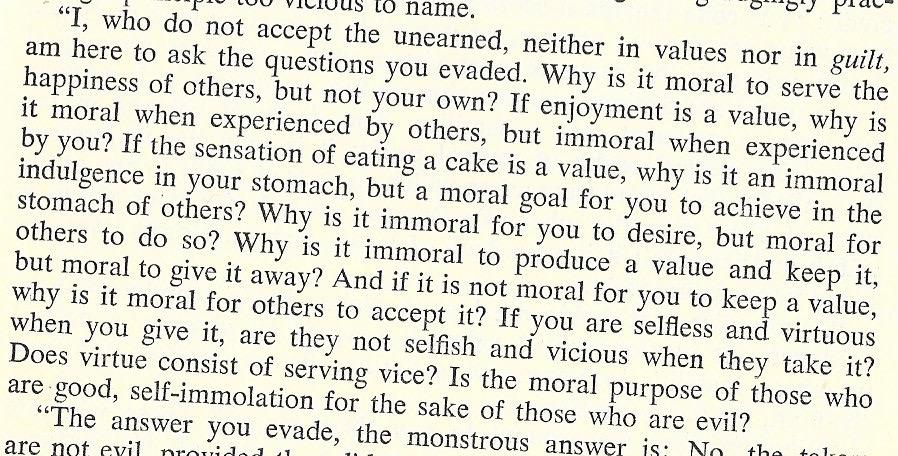
Why humanity today won’t embrace this such a lust for life - and to what lengths of corruption they will go to enact it anyways, against their best “judgment” - is a question, the answer to which Ayn Rand gave. This fact is becoming very real to me, and soon, the reality it represents will too.
Does this resonate with anyone? How many children have had/are having the same experience? What about its empiricist twin brother? Who here succumbed to that particular drooling beast? What was that like?
And most importantly, how is a child in this world supposed to grow up properly, without the bottomless guilt that is supposed to come from the decision to love oneself? How does one laugh and smile as shamelessly as a child year after year?