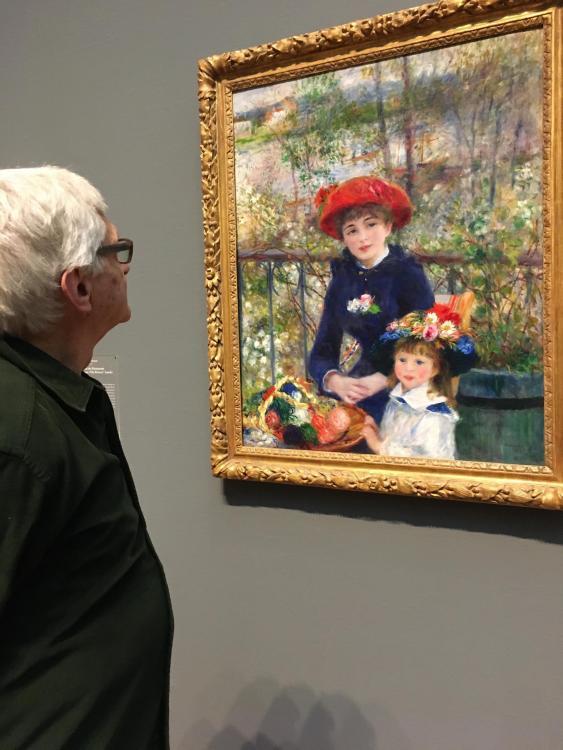
To begin where I began to see works in the great art museums, The Art Institute of Chicago.
I’ve a good picture of On the Terrace by Renoir. It is my favorite painting at this museum, a truly great museum. I’ll link to some other paintings I especially like in this collection.
The woman’s hands express a pensive mood while the child’s ,so aptly caught, suggest an unconscious effort at purpose. Is it just me or does the direction of their gazes make you want to see what they do?
I don’t think I ever got that far. I get captured by the older woman’s face, the red above and blue below, and I’m gone. Now you mention it, Tad, I wonder what they are about to do, are they going to make something, and are they waiting for someone. On the Terrace
Wasn’t really aware of Renoir until this thread , so thanks
There is a photographic quality to the works I’ve seen so far. Not so much in the rendering being photo-realistic(?), but in the sense of capturing a frozen moment of action, not a conjured scene to set the mood more of the impression the artist had at the witnessing and conveyance thereof.
In Bal Moulin de la Galette, the couple left of center are looking into the ‘camera’, the boy on the bench is watching the camera looking at them.
I don’t think I ever got that far. I get captured by the older woman’s face, the red above and blue below, and I’m gone. Now you mention it, Tad, I wonder what they are about to do, are they going to make something, and are they waiting for someone. On the Terrace
Actually I meant that their gazes make me want to see what they are seeing, the scene is self broadening.
And whichever possible perspective you’d imagine would cut you off from the other, it’s almost as bad as the ‘following’ eye portraits and I mean bad in no way. If I’m ever in Chicago…
The third art museum we got to visit in Wien years back was the Belvedere (upper). There were a number of Klimts there including “ADELE BLOCH-BAUER I” which has been known also as “The Woman in Gold”. We were surprised to see that widely loved painting again a few years later in New York at the petite Gallery Neue across the street from the Met. It turned out, as we learned later, that that famous and marvelous painting had been put into Belvedere by the Nazi’s after the Anschluss, and they had stolen it from a Jewish family who had fled. “ADELE BLOCH-BAUER I” was returned to its rightful family heirs, and they have it on display in New York. Double luck for us. // Before our trip to Vienna, I read a book on the history of Austria. While we were there, we went to the great cemetery, and made sure to visit the old Jewish cemetery therein, where there are no deaths after the year the Germans took over (the Jewish people had been shipped away to forced labor camps at that time), and with only one exception, the gravesites were unattended, as there were no descendants caring to come back to live in that city where the atrocity of removal and murder had occurred.
Alexander Rothaug’s painting of Apollo killing an army with invisible arrows (a plague really), also at Belvedere.
The story of the painting and its recovery, was a movie a few years ago. The family’s lawyer, played by Ryan Reynolds, was a grandson of the composer Arnold Schönberg.


 and I mean bad in no way. If I’m ever in Chicago…