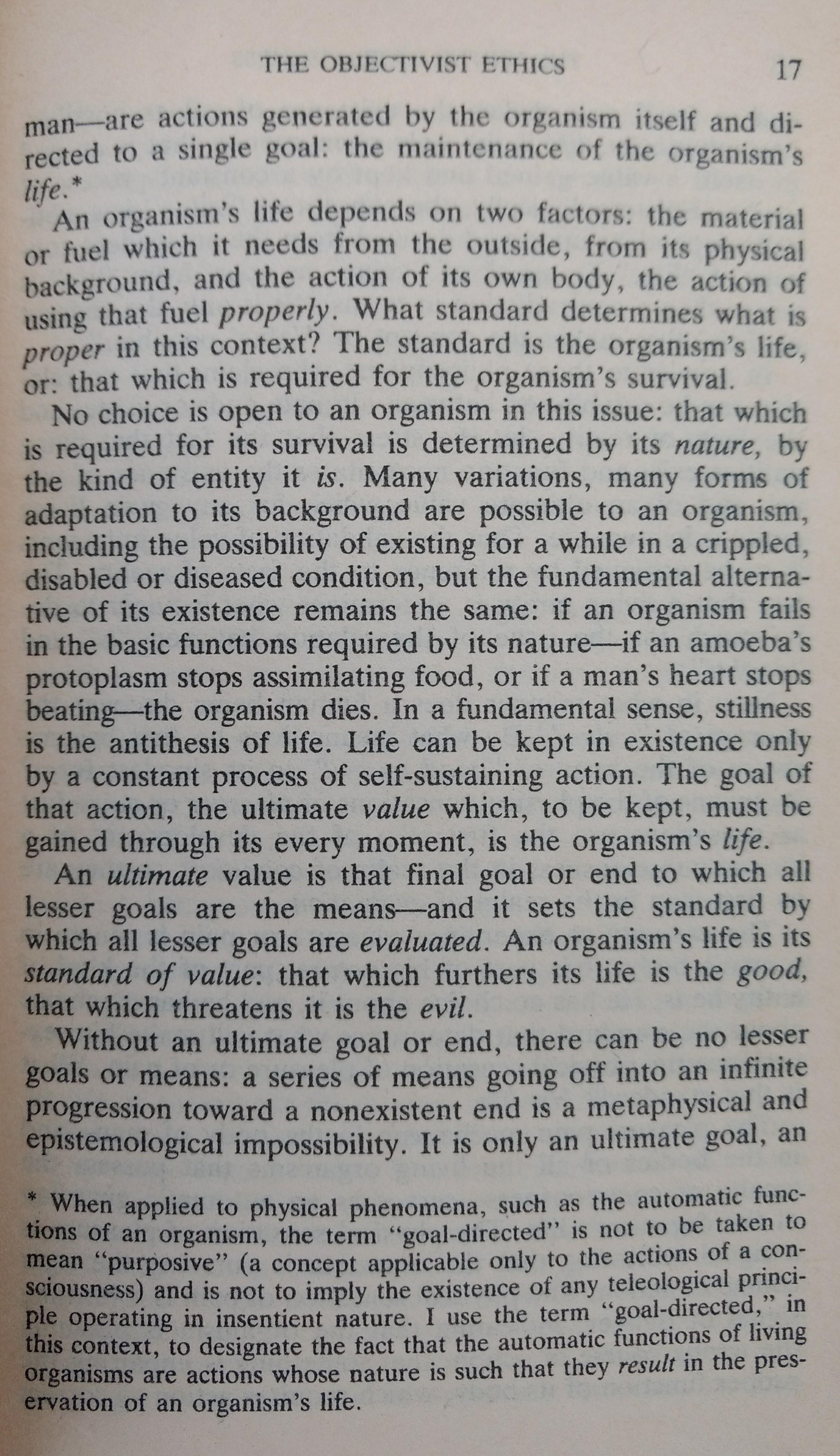
Okay, I think your views about human development might be the issue you have with me calling life binary. You already have different kinds of states of life baked in here, so of course it isn’t binary. Rand’s theory of ethics depends on there being a binary nature to your existence and your life. We either go towards it or not. There is no in between. There are no alternative means of survival besides reason. You either do the moral thing or you don’t. It’s not like health where there is always more than one way to be healthy.
Sure, you described a developmental process. But it doesn’t follow that there is therefore a gradient of life. It might seem like you have a correct, based on what you think human development even is. Human development is not like what you described, which was I think an attempt to say that there are different forms of human life. I’m saying there is exactly one.
Involuntary to voluntary action is not a distinction of development. Babies begin with this. What they lack is skillful action, sometimes limited due to physical size and some perceptual development like motor skills.
Reflexes and mimicking is not something children move “beyond” to reach rational action. Reflexes aren’t any type of cognition anyway, and imitation is only one step in the process of learning that even children have. The best you might be able to say is that 4-year-olds don’t know how to generalize yet, and need to become more skillful at reasoning.
In any case, if you have distinct stages where life itself operates by a different method or requires different methods of survival, there is no reason to say that there are not numerous changes to the nature of your life even in adulthood. And if that is the case, the best you can do when judging or evaluating your life is judging the change of that state in relation to the thing changing states.
To summarize that: it’s not true, scientifically or philosophically, that over the course of your development, the nature of your life changes. We have a means of survival, and we become more skillful at reasoning over time. Sometimes there are major steps we can distinguish in terms of milestones, but it’s not because of some neurological transformation (like puberty with physical development).