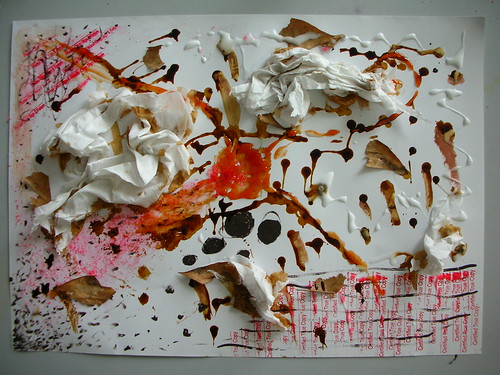
Non Objective art

*** Split from another thread. - sN ***

An unintelligible, amorphous, obscure, indefinite and ambiguous collection of smears on a canvas, which has to be given meaning arbitrarily through an enigmatic code of mysterious symbolism hidden from a rational mind, is definitively not an example of art under Ayn Rand’s aesthetic theory.

I disagree. As I see it, we have a choice: we can either be sticklers and strictly adhere to Rand’s requirement of objectively identifiable, intelligible subjects and meanings in art, or we can follow her lead in the opposite direction and grant exceptions for the non-objective art forms that we like. Personally, I prefer the latter.

See, the problem is that if we opt to be sticklers, then music should also not be considered a valid art form under Rand’s criteria, since it is no more objectively meaningful than abstract paintings.

As Rand said, music “cannot tell a story, it cannot deal with concretes, it cannot convey a specific existential phenomenon, such as a peaceful countryside or a stormy sea…even concepts which, intellectually, belong to a complex level of abstraction, such as ‘peace,’ ‘revolution,’ ‘religion,’ are too specific, too concrete to be expressed in music.”

She also said that “until a conceptual vocabulary is discovered and defined, no objectively valid criterion of esthetic judgment is possible in the field of music,” and, therefore, that our musical tastes and judgments must be treated as a “subjective matter.”

So, I prefer to opt to not be a stickler. Since exceptions can be made for a non-objective art form like music, then there is no reason that they can’t also be made for other non-objective art forms (from which millions of people get as much emotional impact and meaning as Rand did from music).

Perhaps the meaning of the author’s paintings can only be revealed to a distinct class of art critics, but I, for one, cannot distinguish most of them from this doodle…

Not to be disrespectful, but, to me, your inability to distinguish between Tym’s work and the image you posted is nothing more than an indication of your personal visual limitations.

J

I disagree. As I see it, we have a choice: we can either be sticklers and strictly adhere to Rand’s requirement of , or we can follow her lead in the opposite direction and grant exceptions for the non-objective art forms that we like.

Some evidence, if you’d please. Which not “objectively identifiable, intelligible subjects and meanings” did Ayn Rand grant an exception to?

Some evidence, if you’d please. Which not “objectively identifiable, intelligible subjects and meanings” did Ayn Rand grant an exception to?

I thought that it was clear that I was referring to music. Music does not present objectively identifiable, intelligible subjects and meanings, yet Rand categorized it as a legitimate art form. She accepted it as art despite admitting that there are no objective criteria by which to judge it and that our musical tastes must be treated as a “subjective matter.”

J

I thought that it was clear that I was referring to music. Music does not present objectively identifiable, intelligible subjects and meanings, yet Rand categorized it as a legitimate art form. She accepted it as art despite admitting that there are no objective criteria by which to judge it and that our musical tastes must be treated as a “subjective matter.”

J

Then because you seem unable to identify aural percepts - indeed, seem to claim percepts must be visual in order to be objective - you wish to claim what properly is termed decorative arts [those non-objective smears of colors and blobs of amorphous shapes] as fine art because they ‘please you’, in effect accepting Bell’s criteria for what is ‘fine art’ and yourself as one of ‘those with aesthetic sensibilities’… and claim that as exception making…

Music does not present objectively identifiable, intelligible subjects and meanings.

A couple of points:

  1. That is not an Objectivist position, or a statement Rand ever made.

  2. There is nothing that fits that description (and that is the Objectivist position, there is no limit on our ability to get to know reality), so the statement cannot be true.

there are no objective criteria by which to judge it

True, but that’s a statement about our (current) knowledge of music, not music.

Besides, what’s the point of you suggesting we apply this to paintings, when Ayn Rand made the statement exclusively about music (and explained in what way music is different from visual arts, and why it is possible to enjoy it without conceptualizing it), and made this other statement about the visual arts:

As a re-creation of reality, a work of art has to be representational; its freedom of stylization is limited by the requirement of intelligibility; if it does not present an intelligible subject, it ceases to be art.

I’m sorry, but you’re not following Ayn Rand’s lead by accepting the unintelligible in art, you are missing her point about both the visual arts and music.

I thought that it was clear that I was referring to music.

I could’ve sworn you were talking about the paintings that are the subject of the other thread. I still can, actually. But, if you changed your mind, and no longer wish to apply Rand’s statements about music to paintings, then never mind, and congratulations for reconsidering.

A couple of points:

  1. That is not an Objectivist position, or a statement Rand ever made.

  2. There is nothing that fits that description (and that is the Objectivist position, there is no limit on our ability to get to know reality), so the statement cannot be true.

Music is not representational. That is not a Rand quote, but it’s not a contradiction either.

I’m not sure if I should post this on my thread or this one.

Referring to the ‘I Walk the line’ thread.

Objectivist should know what “objectivity” and “non-objectivity” mean

To Howard, The Lonely Rationalist, Amaroq, Jake_Ellison:

Tenzing_Shaw pointed out Bryan Larsen as a fine example of Objectivist art.

Do you have examples of what you think Objectivist art is that you would like to add?

I am trying to gain a clearer understanding of what art is according to Objectivist philosophy.

Do you believe photorealism is a major validating factor in Objectivist art? If so, how does one differentiate it from photography?

With the advent of modern imaging techniques photorealism has becoming much easier to achieve. http://www.conceptart.org/gallery/ I know very few of these examples would qualify as Objectivist. I can easily see that the vast majority of these works are focusing on the vise of indulgence rather than the heroic in man. Many of them still achieve a high level of photorealism and anatomy in their work to the point where photorealism isn’t as elite a criteria as it once was.

Perhaps the meaning of the author’s paintings can only be revealed to a distinct class of art critics…

I respect your desire to maintain high standards. I understand that a universally accepted visual representation would place a piece of work into an iconic status.

My curiosity of the scope of Objectivist art is an exploration into whether it is wide enough to keep me interested.

I’m not sure if I should post this on my thread or this one.

I’d prefer if any general discussion of art, of Rand preferences and of Objectivist aesthetics is kept in this thread. So, you chose the right thread for your reply. (However, to point out that your own art is objective, the other thread is more appropriate.) A year from now, having the threads less intertwined will help.

I am trying to gain a clearer understanding of what art is according to Objectivist philosophy.

Rand was not very radical in what she considered art, and what she did not. The real place where she made her points was: what is good art.

Do you believe photorealism is a major validating factor in Objectivist art?

No. (Though I wouldn’t use the term “Objectivist art” to describe anything.)

(Though I wouldn’t use the term “Objectivist art” to describe anything.)

sorry. I will edit ‘Objectivist art’ = good art as defined by Objectivist philosophy.

sorry. I will edit ‘Objectivist art’ = good art as defined by Objectivist philosophy.

:stuck_out_tongue: if it seems picky, it is just that I’ve seen too many people misinterpret Rand’s “Romantic Manifesto”. We might classify art as good or bad, on its aesthetic merits: e.g. a beginner and an expert trying to represent the same thing, with one attempt being crude and the other being beautiful. In “Romantic Manifesto”, Rand also classified art another way: what she termed Romantic vs. Naturalistic.

Just using these two schemes, one can end up with good Romantic art, bad Romantic art, good Naturalistic art, and bad Naturalistic art. All these are still art. Yet, every now and then someone misinterprets Rand to be saying that anything that is not good Romantic art is not art!

Withing Romantic art, and within the sub-area of literature (since this would not apply to all arts), Rand classified her art as Romantic Realism. So, Romantic Realism is a sliver within the overall category of art and even within good art. One must distinguish what she meant by “realism” used this way and contrast it to what she termed “naturalism”. She was against art being a transcription. Also, chew on the idea that she said that her play “Night of January 16th” was “not Romantic Realism, but Romantic Symbolism”. Her books, “The Romantic Manifesto” and her “Art of Fiction” delve further into why she thinks art should not be a transcription. I suppose any budding Objectivist artist would check those out (particularly the former), but, here’s a more informal comment from a letter she wrote:

Dear Henry,…

The method of romantic realism is to make life more beautiful and interesting than it actually is, yet give it all the reality, and even a more convincing reality than that of our everyday existence…

When reading Rand’s books on art, there are at least three different hats she is wearing: philosopher, artist and author. When she speaks about different aspects of fiction (theme, characterization, etc.) this is not philosophy (i.e. not Objectivism); she is speaking as an author and as a teacher in the field of literature. When she speaks about liking Romantism, or says that a particular Naturalistic art is good art but she does not like it, or when she calls her book a “manifesto”, she is talking more generally as an artist and as a consumer of art. When she talks about the role of art in life, about its connection to a sense of life, etc. she is finally at the broad level of philosophy and aesthetic theory. When one speaks of a philosophical theory of art, one is talking about those broad fundamentals. That’s why there is an Objectivist theory of art (what it is, why it is important, etc.), but no Objectivist art, as such.

Do you have examples of what you think Objectivist art is that you would like to add?

I am trying to gain a clearer understanding of what art is according to Objectivist philosophy.

Rand had very specific preferences as far as good art goes (especially in literature), but for the wider definition of any art (good or bad), all she asked is that it be intelligible, not some kind of arbitrary code between an artist and critics, or worse, an obvious guessing game. I wouldn’t say those pieces of yours Sofia singled out in the other thread are not art, or even that they are bad art. I like them. What would be excluded from the category is not modern or abstract art in general, but obvious attempts at selling nothing as something. Like someone throwing buckets of paint at a canvas, and everyone pretending it means something, or something like this, perhaps:

Or even this, though this is getting closer to actual art: http://farm3.static.flickr.com/2060/226248…21227d0.jpg?v=0

Do you believe photorealism is a major validating factor in Objectivist art? If so, how does one differentiate it from photography?

To be clear, I do not believe that the degree of realism determines the quality of a work of art. I was primarily trying to provide an example of a point I made in my post, which is that art should not attempt to hide its content from the viewer (or reader, or listener). This seems clear to me, because art should strive to convey meaning as effectively as possible, and I do not know of a rational justification for including occlusion in a work of art. Perhaps the essence of the issue is that I do not consider “mystery” or “ambiguity” to have aesthetic value. I am reminded of a quote by Richard Feynman:

I have a friend who’s an artist and he’s some times taken a view which I don’t agree with very well. He’ll hold up a flower and say, “look how beautiful it is,” and I’ll agree, I think. And he says, “you see, I as an artist can see how beautiful this is, but you as a scientist, oh, take this all apart and it becomes a dull thing. […] I see much more about the flower that he sees. I could imagine the cells in there, the complicated actions inside which also have a beauty. I mean, it’s not just beauty at this dimension of one centimeter: there is also beauty at a smaller dimension, the inner structure…also the processes. […] It only adds. I don’t understand how it subtracts.”

As I see it, the point Feynman was trying to make is that clarity of perception and understanding do not detract from beauty; and can greatly add to it. In your work, I see an attempt to make content less clear, and this is what I object to. Although I like the sense of life I see in some of your works (Inkling, in particular), and certainly prefer them to works which portray ugliness with photographic precision, I do not understand why you choose to stray so far from a precise depiction of reality. Why not take the same sense of life, and express it more exactly? This does not entail attempting to make your paintings look like photographs. For example, Nick Gaetano’s paintings certainly do not resemble photographs. What they do do is portray meaning with brilliant clarity, attempting to hide nothing from the viewer. I am certainly not suggesting that you copy either of the artists I mentioned (that is the last thing you should do). There are clearly innumerable ways to effectively convey meaning in visual art. Why not develop your style around this same goal?

A couple of points:

  1. That is not an Objectivist position, or a statement Rand ever made.

Rand’s recognition that there is not an objective “conceptual language of music” is the recognition that music does not present objectively identifiable, intelligible subjects and meanings, as is her statement that music “cannot tell a story, it cannot deal with concretes, it cannot convey a specific existential phenomenon.”

Jake, are you saying that you believe that a medium which lacks a “conceptual language” and which cannot “convey existential phenomena” can be called “objective,” and that it can present “intelligible subjects and meanings”?

  1. There is nothing that fits that description (and that is the Objectivist position, there is no limit on our ability to get to know reality), so the statement cannot be true.

Yet when it comes to visual abstraction and composition, I’m suddenly supposed to not only believe that there is a limit on “our” ability to get to know reality, but that I and others don’t experience what we experience because you or Rand don’t experience it as well?

Here’s the problem: In pondering the effects of music, Rand says that a man “experiences it as an indivisible whole, he feels as if the magnificent exaltation were there, in the music – and he is helplessly bewildered when he discovers that some men do experience it and some do not.” But she also asserts that the “color symphonies” of abstract visual art produce “nothing, in the viewer’s consciousness, but the boredom of being unemployed.” Which is not true of all men. Just as “some men” do not experience what Rand experienced when listening to music, Rand did not experience what I and others experience when looking at abstract paintings, and she arbitrarily dismissed our experiences simply because she did not experience them. Rather than considering the possibility that she was among the “some men who do” when it came to music, but among the “some men who don’t” when it came to abstract art, she imposed her personal responses (or lack thereof) as the universal standard, and claimed to know the content of others’ consciousnesses, despite the fact that they have very clearly testified that they were very stimulated by abstract art – as stimulated as Rand claims to have been by music – and anything but “bored” from being “unemployed.”

there are no objective criteria by which to judge it

True, but that’s a statement about our (current) knowledge of music, not music.

So your view is that music doesn’t have to be currently objective, but we can simply assert that it will be objective at some point in the future, and you imagine that the same device can’t be applied to abstract visual art? Do you think that those who experience strong emotions and deep meanings when looking at abstract paintings can’t apply the same method and assert the notion that, despite our current limits of knowledge of abstract visuals, someday someone will discover an “objective conceptual language” of abstract art, and therefore abstract paintings should also currently qualify as art along with music?

Besides, what’s the point of you suggesting we apply this to paintings, when Ayn Rand made the statement exclusively about music (and explained in what way music is different from visual arts, and why it is possible to enjoy it without conceptualizing it)

The point is that it’s also possible for people to enjoy abstract visual art on the level that Rand enjoyed music “without conceptualizing it.” It may not be possible for you to enjoy abstract art, or for Rand, or for many others, but your lack of emotional response is not the universal standard by which to determine what is or is not art, just as the “some men” who don’t experience what Rand experienced while listening to music are not the standard by which to determine whether or not music is art. Your method comes across as an attempt to deny others’ abilities and sensitivities because you don’t possess them – if you don’t experience something, why, then no one else does either, and they’re either lying or delusional if they say that they do. The idea that Jake or Rand might have some limitations compared to others when it comes to the appreciation of visual composition is apparently not a possibility to be considered.

and made this other statement about the visual arts:

As a re-creation of reality, a work of art has to be representational; its freedom of stylization is limited by the requirement of intelligibility; if it does not present an intelligible subject, it ceases to be art.

That wasn’t a statement about only the visual arts. It was a statement about Rand’s requirements for all of the arts. The requirement of intelligibility in all art is one of the reasons that it’s important for Objectivism to assert that one day an objective language of music will be identified: the possibility that music is ultimately, by its nature, not a purely objective medium is apparently an idea that is not to be entertained.

I’m sorry, but you’re not following Ayn Rand’s lead by accepting the unintelligible in art, you are missing her point about both the visual arts and music.

If there can be different criteria for different art forms – if music can be art despite not currently fitting Rand’s definition and criteria for all art, if some art forms don’t have to be directly mimetic or intelligible, or if some art forms don’t have to “re-create reality” – then visual art can be subdivided according to different criteria as well: Realistic visual art can be said to be that which presents identifiable likenesses of things from reality, but abstract art achieves its effects in a different way: it’s a compositional artform which, like music, affects “some men” by directly stimulating their emotions through an objective means that has yet to be discovered and identified.

I could’ve sworn you were talking about the paintings that are the subject of the other thread. I still can, actually. But, if you changed your mind, and no longer wish to apply Rand’s statements about music to paintings, then never mind, and congratulations for reconsidering.

What I was doing was expecting to be able to apply Rand’s definitions, criteria and principles to all art, or to apply her exceptions to all art. I don’t think it makes sense to have definitions and criteria, and then ignore them or have all sorts of exceptions which are applied selectively or abritrarily.

If something ceases to be art because it does not present an objectively intelligible subject, then music is not art, since it doesn’t present an objectively intelligible subject. If music is art despite the fact that some men don’t experience anything while listening to it, then abstract visual art is art despite the fact that some men don’t experience anything while viewing it. Is art a “selective re-creation of reality” which excludes utilitarian objects? If so, then architecture, which Rand said does not “re-create reality,” and which is utilitarian, is not art according to her definition and criteria. Or, if architecture can be an artform in a special “class by itself” despite not “re-creating reality” and being utilitarian, then other utilitarian objects which don’t “re-create reality” can also be art in special classes by themselves. Etc.

J

1 Like

Then because you seem unable to identify aural percepts - indeed, seem to claim percepts must be visual in order to be objective

I have no such inability, and I’ve made no such claim. In fact, I think that abstract visual forms are just as objectively observable as “aural percepts.” If you’re going to claim that music is “objective” because you can point out the notes that you hear, and if you then want to claim that the notes are the “subject” of the music, then I can do the same with abstract visual art forms. I can point to them and objectively identify their shapes and colors and call them the “subject” of the art.

you wish to claim what properly is termed decorative arts [those non-objective smears of colors and blobs of amorphous shapes] as fine art because they ‘please you’

Rand declared that music was art for no reason other than that she felt emotions when listening to it. What’s sauce for the goose…

in effect accepting Bell’s criteria for what is ‘fine art’ and yourself as one of ‘those with aesthetic sensibilities’… and claim that as exception making…

The point is that if we can make an exception for abstract compositions of sounds, then we can do the same for abstract compositions of visuals.

J

The point is that if we can make an exception for abstract compositions of sounds, then we can do the same for abstract compositions of visuals.

I’m not even sure what you mean by abstract art. You should give examples of *particular* artists.

Music still fits the definition Rand gave of art: a recreation of reality which conveys an artist’s metaphysical value judgments. It absolutely concretizes an abstraction. Sound waves exist and can be sensed and therefore can be understood. I think Rand’s point about music was that *she* didn’t know the best way to measure and judge music. I wish she wrote more on aesthetic theory in general, though.

I think you could suggest that if music is to be considered art, then certain types of abstract works should be considered art as well. At best all you’re suggesting is abstract works should be given a better evaluation than most Objectivists provide.

I’m not even sure what you mean by abstract art. You should give examples of *particular* artists.

When I use the term “abstract art” (and other similar terms such as “non-objective art” or “non-figurative art”) when discussing Rand’s ideas, I generally mean the art that Rand rejected on the basis that it did not contain directly mimetic, readily identifiable likenesses of things from reality. I mean the art that she described as unintelligible smears and shapes, and meaningless “color symphonies,” which I take to be a reference to Kandinsky’s later work and that of those who were either influenced by him or who had similar ideas, which would included artists like Mondrian, Pollock, Motherwell, Rothko, etc.

Music still fits the definition Rand gave of art: a recreation of reality which conveys an artist’s metaphysical value judgments.

If the fact that music stimulates emotions in some people is what allows it to be called a “re-creation of reality,” then there are a lot of things which could be called a “re-creation of reality,” things which Rand and many of her followers don’t want to be called a “re-creation of reality.”

It absolutely concretizes an abstraction. Sound waves exist and can be sensed and therefore can be understood.

And abstract artists could then argue (and if fact, have argued) that non-figurative colors and shapes exist, including blobs and smears of paint, and therefore can be understood.

I think Rand’s point about music was that *she* didn’t know the best way to measure and judge music.

No. She meant that there is no objective means to judge music as art, which means that, so far, no one has identified a means for anyone to objectively identify a piece of music’s subject and meaning, or to evaluate how well it projected its subject and meaning.

I wish she wrote more on aesthetic theory in general, though.

I do too. If she had written more, I think she would have seen some of the problems with her theories. For example, if she had approached the topic of architecture with philosophical rigor, instead of setting aside the issue and referring her readers to her fictional writings on the topic, I think she would have recognized her contradictions, and she would have done something to resolve them. Her attempt to find a solution might have led her to read and recognize the value of the ideas of people like Wright and Kandinsky, or at least the ideas of theirs which were objective and rational.

I think you could suggest that if music is to be considered art, then certain types of abstract works should be considered art as well. At best all you’re suggesting is abstract works should be given a better evaluation than most Objectivists provide.

Basically, yes. But I’m also suggesting that the general Objectivist view of the nature of art needs to change. It needs to be less restrictively literary-based, and it needs to recognize that there is more to the various art forms than Rand may have been capable of grasping (or that any single person would be capable of grasping on their own).

J

When I use the term “abstract art” (and other similar terms such as “non-objective art” or “non-figurative art”) when discussing Rand’s ideas, I generally mean the art that Rand rejected on the basis that it did not contain directly mimetic, readily identifiable likenesses of things from reality. I mean the art that she described as unintelligible smears and shapes, and meaningless “color symphonies,” which I take to be a reference to Kandinsky’s later work and that of those who were either influenced by him or who had similar ideas, which would included artists like Mondrian, Pollock, Motherwell, Rothko, etc.

This is why I wanted you to point out what you mean by abstract art. Kandinsky’s paintings (and I would say what he made is art) are so different than Pollock’s paintings (which I would say is not art) that I don’t even think they can be categorized together. And even Mondrian is worth categorizing as something entirely different (but not as art) as well.

And abstract artists could then argue (and if fact, have argued) that non-figurative colors and shapes exist, including blobs and smears of paint, and therefore can be understood.

I guess I should say that yes such things can be understood, but for it to be art it must convey a metaphysical value judgment of some kind. It must be able to be understood on that level, not just an understanding of “this is how it was made.”

No. She meant that there is no objective means to judge music as art, which means that, so far, no one has identified a means for anyone to objectively identify a piece of music’s subject and meaning, or to evaluate how well it projected its subject and meaning.

Exactly, that *she* didn’t know doesn’t mean there is no possible way to identify a method.

This is why I wanted you to point out what you mean by abstract art. Kandinsky’s paintings (and I would say what he made is art) are so different than Pollock’s paintings (which I would say is not art) that I don’t even think they can be categorized together. And even Mondrian is worth categorizing as something entirely different (but not as art) as well.

I know many people who would argue that they respond as strongly to paintings by Pollock and Mondrian as Rand responded to music, if not more so, and that such paintings are just as meaningful to them as music was to Rand.

I guess I should say that yes such things can be understood, but for it to be art it must convey a metaphysical value judgment of some kind. It must be able to be understood on that level, not just an understanding of “this is how it was made.”

A lot of people feel that abstract art “conveys” “metaphysical value judgments” no less effectively and reliably than music does, and the fact that some people, including you or Rand, might get nothing out of abstract art is as irrelevant as the fact that some people might get nothing out of, say, opera or country music. That some people get nothing from certain types of art is not a reason to deny its status as a legitimate art form. I think the idea of having a rational philosophy of aesthetics should be to study the nature of art and its effects on mankind, and that would include studying the nature of art which affects millions of people other than Rand and those fans of hers who might share some of her tastes and limitations.

Exactly, that *she* didn’t know doesn’t mean there is no possible way to identify a method.

Then, as I’ve been saying, the same is true of abstract art. Just because Rand didn’t know – or didn’t even pursue the idea – of how to identify an objective method of explaining why abstract art affects people, doesn’t mean that there is no possible way to do so. In fact, I think that Kandinsky did quite well in beginning to identify an “objective language” of abstract forms and colors.

Anyway, if you think that you or anyone else has discovered an objective “language of music,” or some other universal objective means of judging music as art, I would love to hear it. And I’d be interested in testing any theory that you might propose by posting unidentified samples of music and asking you demonstrate how to objectively identify the subjects, meanings and “metaphysical value-judgments” that they allegedly convey (without relying on any “outside considerations”), and then comparing your rate of success or failure with the abilities of fans of abstract art to identify meaning in abstract art.

J

I know many people who would argue that they respond as strongly to paintings by Pollock and Mondrian as Rand responded to music, if not more so, and that such paintings are just as meaningful to them as music was to Rand.

Introduce us to one such person who described his response in writing, please. I’d be curious if it is really in any way “LIKE” Rand’s work on music, or nothing like it at all.

I think some people confuse visual stimulation with art.

This is visually stimulating, it is a riot of shapes and colours and textures which your eye (or I should say mine… because I don’t know about yours) tries to make sense of, but that sensation, that reaction is not the same reaction one gets from viewing the Mona Lisa, there is no indication of an artist in the former but it is everywhere in the latter. Distracting the mind and stimulating ones vision is not the same as focusing it and drawing it in with skill.