Non Objective art

You and Alfa can’t identify which of the realistic images I posted are paintings and which are not, so does that make realist art non-art?

It makes thumbnails bad-art.

If I were to give you a book without telling you in advance whether it’s fiction versus an account of real events, and after reading it you still couldn’t tell if it was fact or fiction, would that make realist literature non-art?

Bad art.

They don’t stand on their own TO YOU, but we were talking about what qualifies as art, not your personal, subjective tastes, opinions, sensitivities or limitations. You are not the standard by which to determine if something is art or not for everyone else.

They don’t stand on their own TO YOU either, if you have read Kandinsky. They don’t stand on their own to anybody.

Okay, then, let’s not argue over semantics. If you prefer the term “perception and recognition” rather than “sensitivity,” how would you propose that we objectively test viewers’ abilities to “perceive and recognize”? If a person who has deep aesthetic responses to certain abstract works of art also scores very highly on standard visual/spatial reasoning tests, where a person who doesn’t respond to any abstract art scores much lower on the same tests, might that be an indicator that appreciation of abstract art might not be due to psychological deficiency as you’ve assumed without evidence?

It is not semantics at issue. You want to test the subjects perceiving, I want to test the objects being perceived. The problem with abstract paintings is that nothing on the surface of the works looks like anything. Similarity in shape is objective, and could even be given a computer generated quantitative score.

I didn’t conclude that she changed her mind. I said that everything indicates that she probably changed her mind. And I don’t need to be a mindreader to justifiably make such speculation. There are reports that Binswanger, a close associate of Rand’s, has semi-publicly commented on the subject.

A “justified” speculation (an oxymoron) is still just a speculation, unreliable and unable to support any conclusion.

I and others don’t have to read an instruction manual,

Have you in fact read Kandinsky and thus are qualified to know what you are talking about, or not?

No, that is merely the physical subject matter. You’re confusing the concept “subject matter” with the concept “subject.” The objects depicted are the subject matter. The subject is the _conceptual conten_t of the art. For example, characters like Dagny, Hank, Frisco and Galt, etc., are subject matter within Atlas Shrugged, they are not the novel’s subject.

A still life or a landscape cannot convey much conceptual content, which is why they are pretty unexciting even when done realistically. The style is very important when other kinds of content is omitted, and style itself is largely omitted in a thumbnail. Even a Monet is equivalent to photo-realistic when reduced to 32x32 pixels.

So, therefore the images are not art?

Uninspiring art. Remember, I’m not Rand.

They’re about the same size as the images in the abstract art quiz that you posted, and I didn’t see you complaining that those images were too small to judge the styles.

Because they were bigger, and thus not too small. Also, none of the images would have benefited from enlargement as they had no details to lose by being reduced in size in the first place. The relatively spare featureless appearance of abstract art is part of what makes it so vulnerable to being mocked by casually slapped together digital drawings.
Is that an identification of the painting’s subject and meaning? If so, several of the paintings in the right column are also lush, rich and colorful, and therefore anyone could easily identify their subjects and meanings by your standards.

In your seven descriptions, I didn’t see any identifications of thematic meanings, and only one description – “capturing the light of an overcast day” – that might qualify as the identification of a “subject” in the sense that Rand seems to have meant. All of your descriptions are less detailed and contain much less content than my descriptions here of what I see and feel in a couple of abstract paintings.

The images are way too small to make any judgements at all. Also, not all of us are used to judging paintings of schrubbery. Not all paintings have any meaning, and all meanings are not expressed clearly. Latsly, to really make accurate judgemens takes a great deal of knowledge and analysis. Even if you get it, explaining the how and why is not a small task. For example:

This painting is called “Philip the Good”, but what is it that’s supposedly good about him?

http://idadeadulta.files.wordpress.com/2008/07/philip_the_good1.jpg

Or her?

http://www.paintinghere.com/painting/Portrait_of_Mme_N._M._Polovtsova_21750.html

What’s the main theme here?

http://www.artilim.com/painting/c/cecchi-adriano/at-the-dressmakers.jpg

Or what’s the narrative here, and why?

http://www.artrenewal.org/pages/artwork.php?artworkid=32161&size=large

These examples are just things I found after recently revisiting a favorite DVD of mine, called “Mechanics of Color”. Anyway, my guess is that without a basic understanding of color it will be hard to answer the questions.

As for the details of my descriptions, let’s pretend that I answered something like; “the texture on the flower petals suggest a rugged individualism”. What’s your answer to that?

And just because something evokes feelings or sensations, even if you can objectively explain why, doesn’t make it art. It could, however, be an effective design.

No, it’s a traditional painting. No computers involved. Heh – Snorlax. :lol:

Clearly my guesswork wasn’t very good, however that picture must be seen in full size before I believe you. Until then it’s a fractal image generated by a computer on Charlie Sheen. I can clearly see leafy things, a Snorlax and some green translucent tentacles.

It makes thumbnails bad-art.

So, was that the point of your posting the abstract art quiz – that thumbnails are bad art?

They don’t stand on their own TO YOU either, if you have read Kandinsky. They don’t stand on their own to anybody.

So you are claiming to speak for everyone, and to tell them what they do or do not experience or think!

I didn’t “have to read” Kandinksy. Absract works of art stood on their own to me prior to reading him. By your ‘reasoning’ I suppose that Rand’s novels aren’t art because you’ve read her theory of aesthetics?

Also, Rand’s novels don’t stand on their own to someone who hasn’t learned to read English, and therefore aren’t art by your theory (if someone’s needing to learn the language of color and form in order to appreciate abstract art makes it non-art, then needing to learn the language of English in order to appreciate Atlas Shrugged makes it non-art).

It is not semantics at issue. You want to test the subjects perceiving, I want to test the objects being perceived. The problem with abstract paintings is that nothing on the surface of the works looks like anything. Similarity in shape is objective, and could even be given a computer generated quantitative score.

No, you want to test people for their ability to recognize the attributes of objects which you recognize or find meaningful, but you want to eliminate from consideration the attributes which you don’t find meaningful. If effect, you’re proposing a tainted “scientific” test which is designed to confirm your biases. “Similarity in shape” is apparently the attribute which you think you find meaningful (while not actually being able to identify subjects and meanings from “similarities in shapes”). Others find similarity in hue, saturation, texture, gesture, or visual rhythm, etc., expressive and meaningful, but since you apparently don’t, you arbitrarily reject those attribubtes despite the fact that they are just as objective as “similarity in shape.”

A “justified” speculation (an oxymoron) is still just a speculation, unreliable and unable to support any conclusion.

I’m thinking that maybe you need to calm down. How many times do I need to repeat that I was not making a conclusion?

As for “justified speculation,” certain speculations are indeed justified where others are not. We have reasons to consider that Rand may have changed her mind on architecture as an art form, and we have reasons to speculate and to ask more questions about the issue. We don’t have reasons to consider that she, say, changed her mind on the initiation of force, or to speculate and ask questions about her doing so.

A still life or a landscape cannot convey much conceptual content, which is why they are pretty unexciting even when done realistically.

To whom? To everyone?

The style is very important when other kinds of content is omitted, and style itself is largely omitted in a thumbnail.

So, are you saying that if I had only posted large enough images for you to see the brushwork, why, then you would have been able to instantly identify subjects and meanings? You’re a connoisseur of the expressiveness of brushwork and other small details?

Uninspiring art. Remember, I’m not Rand.

Don’t you mean that you are uninspired by the art rather than that the art is uninspiring?

Because they were bigger, and thus not too small.

Ah, I see. So, when others look at thumbnails of art which you don’t like and which are around 0.25 to 12 percent of the size of the originals, it’s hilarious that they can’t tell which are works of art and which are not (except when someone nails 100%, then it’s not so hilarious), but when you are asked to look at thumbnails of realist art which are 0.25 to 12 percent of the size of the originals, it’s unfair and pointless and mean?

Also, none of the images would have benefited from enlargement as they had no details to lose by being reduced in size in the first place.

Again, you don’t know what you’re talking about. I’ve seen enough abstract art to know that the brushwork and other abstract details are significantly more expressive and effective when viewed in person than when viewed in small thumbnails. Seeing full scale abstract paintings quite often reveal a level of intention and control that viewers hadn’t expected.

The relatively spare featureless appearance of abstract art is part of what makes it so vulnerable to being mocked by casually slapped together digital drawings.

Abstract art isn’t featureless. How can you not see its features? Maybe you should get out and look at it in person rather than trying to judge it based on thumbnails.

J

As for the details of my descriptions, let’s pretend that I answered something like; “the texture on the flower petals suggest a rugged individualism”. What’s your answer to that?

My answer would be a question: If I see the same texture in an abstract painting as also representing rugged individualism, would you accept that the painting is art?

And just because something evokes feelings or sensations, even if you can objectively explain why, doesn’t make it art.

So when is something which evokes feelings or sensations art, and when is it not? What are the objective criteria for making such determinations? As it stands, it appears to me that Rand’s feelings are the criteria: non-mimetic music made her feel something, and non-mimetic visual art did not (well, except when she was younger and commented that certain abstract shapes expressed laughter and defiance), therefore she judged music to be art and abstract not. If I’m wrong, please explain how I’m wrong. If Rand’s (or yours, or Grames’, etc.) feelings or lack thereof are not the standard that you’re using to determine what is art and what is not, then what standard are you using? What objective standard?

Clearly my guesswork wasn’t very good…

Well, I thought your Snorlax comment was awesome. It was a good catch. I hadn’t seen the leaf as being similar to a Snorlax until you pointed it out.

…however that picture must be seen in full size before I believe you.

You can find it here. If you’re on a Mac (I don’t know if the same is true on other systems), just drag and drop the image to your desktop and you can then open it to a size up to 11.639 x 15.653 at 72ppi. Is that big enough to objectively identify subject, meaning and the artist’s metaphysical value-judgments?

Btw, I’m pretty sure that Rand didn’t see at full size most of the paintings that she judged. Do you think that all of her judgments which were not based on viewing full sized images were therefore unfair or inaccurate?

J

My answer would be a question: If I see the same texture in an abstract painting as also representing rugged individualism, would you accept that the painting is art?

I wouldn’t accept that the texture could represent rugged individualism in the first place.

So when is something which evokes feelings or sensations art, and when is it not? What are the objective criteria for making such determinations? As it stands, it appears to me that Rand’s feelings are the criteria: non-mimetic music made her feel something, and non-mimetic visual art did not (well, except when she was younger and commented that certain abstract shapes expressed laughter and defiance), therefore she judged music to be art and abstract not. If I’m wrong, please explain how I’m wrong. If Rand’s (or yours, or Grames’, etc.) feelings or lack thereof are not the standard that you’re using to determine what is art and what is not, then what standard are you using? What objective standard?

For one thing, art is a concretization of abstractions. It is for example like taking a theme, say love or heroism, and making a conrete representation of that. That’s from where art derives it’s value. And, music can actually do that. It just communicates differently, more directly, than the visual arts. I am yet to be convinced abstract art can do that. So far I have only seen it being defended as doing the opposite - making abstractions of concretes.

Well, I thought your Snorlax comment was awesome. It was a good catch. I hadn’t seen the leaf as being similar to a Snorlax until you pointed it out.

Unfortunately it seems once it’s been seen, it cannot be un-seen.

You can find it here. If you’re on a Mac (I don’t know if the same is true on other systems), just drag and drop the image to your desktop and you can then open it to a size up to 11.639 x 15.653 at 72ppi. Is that big enough to objectively identify subject, meaning and the artist’s metaphysical value-judgments?

Btw, I’m pretty sure that Rand didn’t see at full size most of the paintings that she judged. Do you think that all of her judgments which were not based on viewing full sized images were therefore unfair or inaccurate?

J

That certainly makes it big enough to see. As for the subject I can’t find anything that suggest other than it would be about the colors on the leaves. With a subdued value range the color and their saturation is the point of interest, and it’s not a far stretch here to say that she used them to get at something lively and energetic.

Well, if Rand ever judged pictures so small she had to put her nose to the canvas and squint real hard…

I wouldn’t accept that the texture could represent rugged individualism in the first place.

I’m not understanding what you’re saying. I thought that you were proposing a hypothetical in which you identified a texture as representing rugged individualism. Now you’re saying that you wouldn’t recognize it as such.

Do you mean that you don’t accept that a specific texture that you actually had in mind (but didn’t show us) can represent rugged individualism (or at least play a significant part in representing it when combined with other abstract elements), or are you saying that no texture could possibly represent toughness, and that it therefore could not be used to represent rugged individualism?

I mean, even Rand claimed that a blotched, cracked texture could represent decay and degradation, so I’m not understanding why anyone would argue that textures can’t convey quite a lot of information, including on a “metaphysical value” level.

For one thing, art is a concretization of abstractions. It is for example like taking a theme, say love or heroism, and making a conrete representation of that. That’s from where art derives it’s value. And, music can actually do that. It just communicates differently, more directly, than the visual arts. I am yet to be convinced abstract art can do that.

Does the fact that you’re not convinced prove anything other than that you don’t respond to abstract art? How would anyone prove to you that they experience what you don’t? Someone who is tone-deaf could take your same approach and say that music does not do what you say it does, and that you’re just making stuff up (along with everyone else who claims that music “communicates” something). What would you say in response?

That certainly makes it big enough to see. As for the subject I can’t find anything that suggest other than it would be about the colors on the leaves. With a subdued value range the color and their saturation is the point of interest, and it’s not a far stretch here to say that she used them to get at something lively and energetic.

Pretty vague. If fact, your explanation is still much more vague and indecisive than my analyses of the abstract paintings. It doesn’t appear that recognizable objects add to your ability to identify subjects or find meaning in still lifes.

J

I’m not understanding what you’re saying. I thought that you were proposing a hypothetical in which you identified a texture as representing rugged individualism. Now you’re saying that you wouldn’t recognize it as such.

Do you mean that you don’t accept that a specific texture that you actually had in mind (but didn’t show us) can represent rugged individualism (or at least play a significant part in representing it when combined with other abstract elements), or are you saying that no texture could possibly represent toughness, and that it therefore could not be used to represent rugged individualism?

I mean, even Rand claimed that a blotched, cracked texture could represent decay and degradation, so I’m not understanding why anyone would argue that textures can’t convey quite a lot of information, including on a “metaphysical value” level.

My point is, what if I just start making stuff up with fanciful descriptions? If you doubt my claims i’ll refer you to my friends, or suggest that you might be dysfunctional.

Not a very convincing case though, is it?

I’m saying that a texture by itself is just a “pattern”. Within the right context though it can be used to describe certain attributes.

Does the fact that you’re not convinced prove anything other than that you don’t respond to abstract art? How would anyone prove to you that they experience what you don’t? Someone who is tone-deaf could take your same approach and say that music does not do what you say it does, and that you’re just making stuff up (along with everyone else who claims that music “communicates” something). What would you say in response?

Tone-deaf people are dysfunctional in their ability to distinguish relative pitches. I have seen no evidence to suggest that my abilities in the visual arts are dysfunctional in a similar way. In fact, I can distinguish light and color fairly accurately and I have no problems seeing shape and form.

For the record, I didn’t say that I dont respond to abstract art. As a matter of fact, I do respond to some of it. I think that combinations of colors, values, shapes and forms can have a psychological impact. However, I do not think that abstract art can concretize abstractions. It may cause feelings or sensations, but whatever meaning you put into them comes from your imagination.

I can make an analogy to product design. Take the iPhone for example. It’s something that alot of people find desirable, very much thanks to it’s design. A little fascinating considering it’s basically a square with rounded corners. However, what makes it so sucessfull is how the bevels and fillets are shaped, where even tiny differences effect how we feel, and the material/texture and color that helps us relate to how it would be to interact with it(and create the sensations when we’re actually interacting).

Very much like your abstract art, is it not? However, even though Steve Jobs probably would like to call it art, it really isn’t. Millions of people may experience similar feelings and sensations, but it’s only a successful design.

Pretty vague. If fact, your explanation is still much more vague and indecisive than my analyses of the abstract paintings. It doesn’t appear that recognizable objects add to your ability to identify subjects or find meaning in still lifes.

J

It may not have been the most elaborate explanation, but I don’t think I was vague. I mean, the value range is pretty even with mid-greys in foreground and darker values in the bagground/negative spaces - nothing really stands out there. The colors are very saturated though, especially the reds and oranges with the greens helping them “pop”. Saturated colors are often used to suggest life, vitality, energy or prosperity. Considering there is an energetic feel to the painting that’s probably what the artist was after. If you want a really good explanation you should get in touch with those post-modernists selling their feces for millions. I’m not sure what they’ll tell you, but their pitches have to be something really amazing.

I usually don’t care for still lifes other than to admire some artists techniques. Actually, there’s very little art I care for other than admiring technique.

My point is, what if I just start making stuff up with fanciful descriptions? If you doubt my claims i’ll refer you to my friends, or suggest that you might be dysfunctional.

The same can be said of anyone’s descriptions of what they see in any realist/figurative painting, and of what meaning they claim to get out of it. The same could also be said of the meaning that anyone claims to find in any work of architecture or music.

Not a very convincing case though, is it?

I’m saying that a texture by itself is just a “pattern”. Within the right context though it can be used to describe certain attributes.

That’s exactly what I’m saying: Textures combined with colors and abstract shapes can be used to communicate certain attributes – including human emotions, attitudes or personalities – which can add up to meaning.

Tone-deaf people are dysfunctional in their ability to distinguish relative pitches. I have seen no evidence to suggest that my abilities in the visual arts are dysfunctional in a similar way. In fact, I can distinguish light and color fairly accurately and I have no problems seeing shape and form.

Have you actually taken any tests which rate your visual/spatial abilities in comparison to others, or your ability to harmonize colors similar to the way that tones are harmonized to form musical chords? Have others here, who don’t respond to abstract art, been tested to see how well they respond to things such as facial or body language, or the “personality” or “attitude” that various colors or forms can suggest, etc.?

For the record, I didn’t say that I dont respond to abstract art. As a matter of fact, I do respond to some of it. I think that combinations of colors, values, shapes and forms can have a psychological impact. However, I do not think that abstract art can concretize abstractions. It may cause feelings or sensations, but whatever meaning you put into them comes from your imagination.

Many people believe that the same is true of music. In fact, Rand herself said that we cannot tell which aspects of the meaning that people think they get from music are actually contained in the music and which are put into it by listeners’ imaginations. So, again, we have a double standard in the Objectivist Esthetics: It’s okay for people to not be able to objectively prove that they’re not just “making stuff up with fanciful descriptions” when it comes to music, but it’s not okay when they can’t objectively prove what is or is not contained in abstract art – music is categorized as glorious art, where abstract art is categorized as a vicious assault on rationality and all values.

I can make an analogy to product design. Take the iPhone for example. It’s something that alot of people find desirable, very much thanks to it’s design. A little fascinating considering it’s basically a square with rounded corners. However, what makes it so sucessfull is how the bevels and fillets are shaped, where even tiny differences effect how we feel, and the material/texture and color that helps us relate to how it would be to interact with it(and create the sensations when we’re actually interacting).

Very much like your abstract art, is it not?

And it’s also very much like architecture, and very much like music.

However, even though Steve Jobs probably would like to call it art, it really isn’t. Millions of people may experience similar feelings and sensations, but it’s only a successful design.

If it gives people a “sense of life” response, and says something significant to them in the way that architecture or music did to Rand, then I would say that it is art in the same sense, or, conversely, if the criteria are such that the aesthetics of product design cannot qualify as art, then the same is true of architecture and music.

To me it’s about consistency as opposed to certain people’s feelings (or lack thereof) somehow vetoing or invalidating others’ feelings – if the feelings that Rand experienced while listening to music or viewing architecture allow both forms to qualify as art, then the feelings that others have while viewing abstract art allow it to qualify as art.

It may not have been the most elaborate explanation, but I don’t think I was vague. I mean, the value range is pretty even with mid-greys in foreground and darker values in the bagground/negative spaces - nothing really stands out there. The colors are very saturated though, especially the reds and oranges with the greens helping them “pop”. Saturated colors are often used to suggest life, vitality, energy or prosperity. Considering there is an energetic feel to the painting that’s probably what the artist was after.

The same is true of some of the abstract paintings in the right-hand column. Everything you’ve said about the painting of the leaves could be said about the abstract paintings.

J

Also, Rand’s novels don’t stand on their own to someone who hasn’t learned to read English, and therefore aren’t art by your theory (if someone’s needing to learn the language of color and form in order to appreciate abstract art makes it non-art, then needing to learn the language of English in order to appreciate Atlas Shrugged makes it non-art).

Language is the medium of literature. Needing to know the language is not equivalent to needing to know how to understand a book. In order to read Atlas Shrugged in the original language having the skill of reading in English is required but having the Cliff’s Notes on it is not.

Objectivity acknowledges and requires a knowing subject. So if I did not understand English then a novel in English would not be art to me in a very real first-handed sense. I could still acknowledge that other people who can read it treat it as art. There is no sense in which looking at a painting is like learning a language.

No, you want to test people for their ability to recognize the attributes of objects which you recognize or find meaningful, but you want to eliminate from consideration the attributes which you don’t find meaningful.

No, you are missing the point of abstract act, which is to abstract. Abstraction is a process of omission. All of the attributes which remain on an abstract paintings canvas are to be recognized and still found ridiculously trivial compared even to a boring still life of a flower arrangement.

I’m thinking that maybe you need to calm down. How many times do I need to repeat that I was not making a conclusion?

Everytime you repeat it.

So, are you saying that if I had only posted large enough images for you to see the brushwork, why, then you would have been able to instantly identify subjects and meanings? You’re a connoisseur of the expressiveness of brushwork and other small details?

It would help.

Ah, I see. So, when others look at thumbnails of art which you don’t like and which are around 0.25 to 12 percent of the size of the originals, it’s hilarious that they can’t tell which are works of art and which are not (except when someone nails 100%, then it’s not so hilarious), but when you are asked to look at thumbnails of realist art which are 0.25 to 12 percent of the size of the originals, it’s unfair and pointless and mean?

Yes.

Again, you don’t know what you’re talking about. …

Abstract art isn’t featureless. How can you not see its features? Maybe you should get out and look at it in person rather than trying to judge it based on thumbnails.

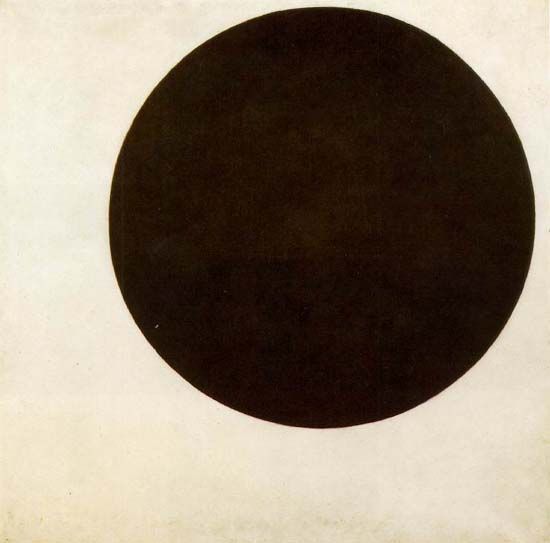
Refutation: Black Circle, Kazimir Malevich, 1913-15

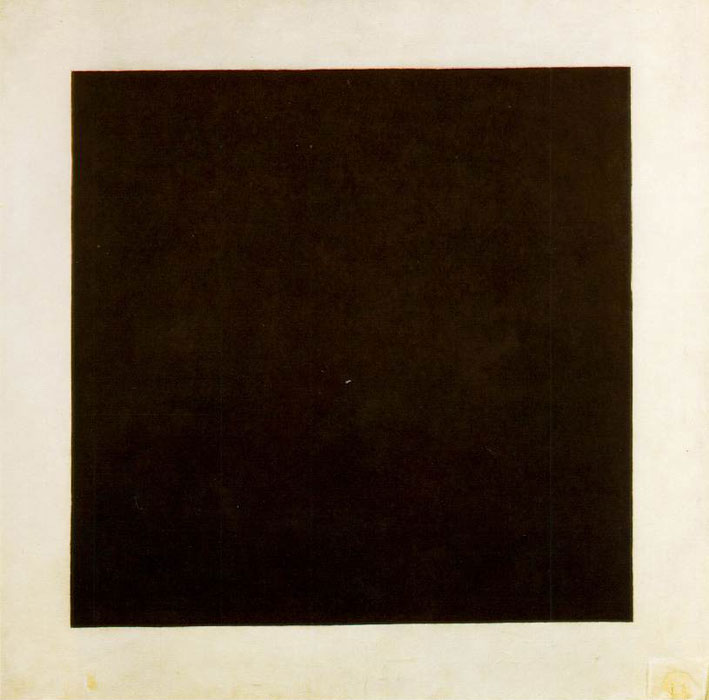
And the stunning sequel, Black Square 1913

IKB 191, Yves Klein, 1962

Language is the medium of literature. Needing to know the language is not equivalent to needing to know how to understand a book. In order to read Atlas Shrugged in the original language having the skill of reading in English is required but having the Cliff’s Notes on it is not.

Objectivity acknowledges and requires a knowing subject. So if I did not understand English then a novel in English would not be art to me in a very real first-handed sense. I could still acknowledge that other people who can read it treat it as art. There is no sense in which looking at a painting is like learning a language.

Really? Then why are there people like Luc Travers out there promoting podcasts designed to teach people how to “read” the visual information in a painting? Why are such presentations being marketed specifically to Objectivists? It seems that he believes that there’s a market for teaching Objectivists the language of the visual arts, and on quite an elementary level, and that’s rather odd if looking at a painting is in no sense like learning a language.

All of the attributes which remain on an abstract paintings canvas are to be recognized and still found ridiculously trivial compared even to a boring still life of a flower arrangement.

You’re still stuck on basing everything on your limitations and lack of emotional responses, which are not an objective standard by which to judge anything.

It would help.

And yet you still haven’t identified the subject, meaning and “metaphysical value-judgments” in the realist painting to which I posted a link to a fifteen inch image. It doesn’t appear to have helped at all.

J

Really? Then why are there people like Luc Travers out there promoting podcasts designed to teach people how to “read” the visual information in a painting? Why are such presentations being marketed specifically to Objectivists? It seems that he believes that there’s a market for teaching Objectivists the language of the visual arts, and on quite an elementary level, and that’s quite odd if looking at a painting is in no sense like learning a language.

When there is something there to talk about, that is fine. In abstract art there is not enough content.

Black Circle, Kazimir Malevich, 1913-15

And the stunning sequel, Black Square 1913

IKB 191, Yves Klein, 1962

Show us your artistic chops and display your fine sensitivities by discussing these paintings.

The same can be said of anyone’s descriptions of what they see in any realist/figurative painting, and of what meaning they claim to get out of it. The same could also be said of the meaning that anyone claims to find in any work of architecture or music.

When I say this depicts a chivalrous knight coming to save the lady in distress, I can in fact point to the guy in armor about to sheath his sword, the other guy laying beaten on the ground and the lady tied to the tree. With music maybe someone well versed in musical theory can explain how it works, but the fact is that people will fairly universally get the same message. Responses may differ, but there’s rarely any doubt if it’s a romantic song or a heroic piece.

It’s pretty hard to miss what Dicksee’s painting is about, and it’s hard to miss the heroism in Hans Zimmers Knight’s March:

https://www.youtube.com/watch?v=ujx-\_yZVqHg

Like it or not, you’re still going to “get it”.

Are there abstract painting that can do the same?

That’s exactly what I’m saying: Textures combined with colors and abstract shapes can be used to communicate certain attributes – including human emotions, attitudes or personalities – which can add up to meaning.

But an abstract shape is not really a context. A square or a circle doesn’t really tell me what that texture belongs to.

Have you actually taken any tests which rate your visual/spatial abilities in comparison to others, or your ability to harmonize colors similar to the way that tones are harmonized to form musical chords? Have others here, who don’t respond to abstract art, been tested to see how well they respond to things such as facial or body language, or the “personality” or “attitude” that various colors or forms can suggest, etc.?

No, I haven’t taken any tests, but I can say with confidence that my abilities would exceed any untrained eyes. Also, I would have noticed if I was dysfunctional in any such regard.

Many people believe that the same is true of music. In fact, Rand herself said that we cannot tell which aspects of the meaning that people think they get from music are actually contained in the music and which are put into it by listeners’ imaginations. So, again, we have a double standard in the Objectivist Esthetics: It’s okay for people to not be able to objectively prove that they’re not just “making stuff up with fanciful descriptions” when it comes to music, but it’s not okay when they can’t objectively prove what is or is not contained in abstract art – music is categorized as glorious art, where abstract art is categorized as a vicious assault on rationality and all values.

What exactly did she say and in what context?

And it’s also very much like architecture, and very much like music.

Not exactly. The only abstract ideas communicated by product designs are those tied to the utilitarian aspects of the product. It’s like accelerated lines on a car with the right proportions will communicate “fast” or “sporty”. I think what i’ve written previously on painting and music covers them, but let’s touch on architecture. Architecture is different because it fundamentally deals with man’s place on earth. This is by it’s very nature of covering the fundamental need of shelter. If a painting shows a “microcosm” then architecture would be more like “macrocosm”, it creates it’s own world for man to live in. That makes it fundamentally different from any other artistic pratice.

If it gives people a “sense of life” response, and says something significant to them in the way that architecture or music did to Rand, then I would say that it is art in the same sense, or, conversely, if the criteria are such that the aesthetics of product design cannot qualify as art, then the same is true of architecture and music.

No, I think architecture and music can “say something significant” and communicate a sense of life, but I don’t think product designs can do that. At best they could perhaps communicate some sense of life(like for instance how choice of cars are often tied to lifestyles and such preferences).

To me it’s about consistency as opposed to certain people’s feelings (or lack thereof) somehow vetoing or invalidating others’ feelings – if the feelings that Rand experienced while listening to music or viewing architecture allow both forms to qualify as art, then the feelings that others have while viewing abstract art allow it to qualify as art.

I don’t think anyones feelings are a good criteria for qualifying anything as art.

Show us your artistic chops and display your fine sensitivities by discussing these paintings.

I would say the first painting gives me the feeling of enjoying the unexpected or seemingly contradictory. The circle seems to have great mass, yet the image has compositional motion and lightness. Its high contrast, lack of hue, and rather precise rendering gives me a feeling of formal seriousness, but the off-centeredness adds a sense of playfullness. Translated to more physically detailed terms, I would say that the image gives the sort of feeling that I might get from seeing something like a large defensive lineman doing ballet, and doing it surprisingly well. The meaning I get out of the image is valuing discovering the unexpected, or moving beyond conventional methods of thinking or seeing.

The second image gives the feeling of being in the presence of power. It is balanced, perfectly proportioned and immobile, but enveloping me or pulling me in. (The scan is rotated about 0.5 degrees CCW, but I’m asssuming that is an error made by whomever scanned and posted it online.) The image implies power to me, but it doesn’t seem to suggest either passionate good or evil, but dispassionate amorality. Translated to Aristotelian/Randian terms, I’d say that it is an Immovable Mover. The meaning that I get out of it is that man is godlike.

As for the third image, I think I’d need to see it in person to judge it. As it’s showing up on my monitor, it is way outside the gamma range of reflective colors and therefore is very unlikely to be an accurate representation of the original. I suspect that the original has an intensity that can’t be matched digitally, or is very difficult to match digitally (the same can be true of certain orange tones and lime greens).

J

When I say this depicts a chivalrous knight coming to save the lady in distress, I can in fact point to the guy in armor about to sheath his sword, the other guy laying beaten on the ground and the lady tied to the tree.

And someone could also point to the content of the painting when claiming that the man on the ground is the hero who came to rescue the woman, and the man who just slew him is the villain who captured her. The woman could be interpreted as not expressing joy and relief, but shock.

The artist apparently wanted us to see the hero’s face, regardless of how it might affect the “story” that the image conveys, so he painted him without head gear, which is pretty odd for a knight riding up knowing that he’ll be entering battle. On the other hand, the slain villain is wearing head gear, or at least the lower part of it, where in reality he probably wouldn’t be doing so while tying a woman to a tree. So the visual information could reasonably be seen as supporting the interpretation that the hero is the man in the image who has been slain and the perpetrator is now free to have his way with the woman. The red cloth at the woman’s feet could be seen as symbolizing her lifeblood leaving her – that she is recognizing her fate and losing all hope.

With music maybe someone well versed in musical theory can explain how it works, but the fact is that people will fairly universally get the same message. Responses may differ, but there’s rarely any doubt if it’s a romantic song or a heroic piece.

There’s rarely any doubt that an abstract painting is joyous or chaotic or solemn or light or imposing.

Like it or not, you’re still going to “get it”.

Ditto abstract art.

Are there abstract painting that can do the same?

To you? Apparently not. To others? Yes.

But an abstract shape is not really a context.

I didn’t say that an abstract shape was a context. My point was that the combination of abstract shapes, colors and textures can work together to provide a context and meaning in a painting or sculpture just as effectively as they do in architecture.

A square or a circle doesn’t really tell me what that texture belongs to.

I get it already: I understand that it doesn’t tell you anything.

On the other hand, a square or circle told Frank Lloyd Wright a lot. He thought such shapes were loaded with meaning. He seems to have known what he was talking about. Do you think it’s possible that he might have known more about it than you do, and that he therefore could experience more than you do and create on a level that you can’t? Is that at least a possibility?

No, I haven’t taken any tests, but I can say with confidence that my abilities would exceed any untrained eyes. Also, I would have noticed if I was dysfunctional in any such regard.

I’m not saying that you’d necessarily have to be “dysfunctional.” One who scores poorly compared to others doesn’t necessarily qualify as being dysfunctional. Anyway, do you think most people notice and are openly accepting of their dysfunctions or limitations compared to others? In my experience, people are often very emotionally attached to the idea that they’re not only normal, but quite special, especially when it comes to something like tastes and judgments of art. They’re usually very strongly attached to the belief that they’re very refined and sensitive, and that everyone else is an unwashed bumpkin (or sometimes evil and/or insane).

What exactly did she say and in what context?

Are you asking me what she said about the subjectivity of music, or are you asking me which moral and psychological judgments she made of people who create or enjoy abstract art? If the former, then she said, “In listening to music, a man cannot tell clearly, neither to himself nor to others – and, therefore, cannot prove – which aspects of his experience are inherent in the music and which are contributed by his own consciousness.” (RM, p.55) If the latter, then I’d say start reading at about page 76 of the Romantic Manifesto, and there are other sources where she made similar comments, but I don’t have time to hunt them down at the moment.

Not exactly. The only abstract ideas communicated by product designs are those tied to the utilitarian aspects of the product. It’s like accelerated lines on a car with the right proportions will communicate “fast” or “sporty”.

I disagree. Automotive aesthetics can communicate any number of concepts, from “elegant” to “masculine” to “lighthearted” to “casual” to “powerful,” etc. There’s no limit to what forms, colors and texures can communicate. And I think there are probably many more people who respond deeply to the aesthetics of automotive design than to architecture.

I think what i’ve written previously on painting and music covers them, but let’s touch on architecture. Architecture is different because it fundamentally deals with man’s place on earth. This is by it’s very nature of covering the fundamental need of shelter. If a painting shows a “microcosm” then architecture would be more like “macrocosm”, it creates it’s own world for man to live in.

Yes, architecture creates – not “re-creates” in the Randian sense – an actual living space, not an imaginary one. Rand’s view of art is that it re-creates, and that what it re-creates is imaginary, not real.

That makes it fundamentally different from any other artistic pratice.

No, aesthetically it’s not different from the other forms. It works in the same way as abstract sculpture. It’s an issue of the expressiveness of form, color, texture and proportion.

No, I think architecture and music can “say something significant” and communicate a sense of life, but I don’t think product designs can do that.

And you’ve come to that opinion based on what? On your feelings?

I don’t think anyones feelings are a good criteria for qualifying anything as art.

Good, then you either have to agree that abstract art and product design can be art, or that architecture and music are not art.

J

I would say the first painting gives me the feeling of …

The second image gives the feeling of …

As for the third image, I think I’d need to see it in person to judge it.

That is a thread killer response. I can’t argue against your feelings, nor can you argue I should feel what you feel. Non-objective art simply leaves nothing to talk about.

Speaking of Luc Travers,

https://www.youtube.com/watch?v=6Ohsj1Cs0Nc

on the VanDamme Academy youtube channel. This is the painting he is discussing.

Speaking of Luc Travers,

https://www.youtube.com/watch?v=6Ohsj1Cs0Nc

on the VanDamme Academy youtube channel. This is the painting he is discussing.

Thank you for linking to Mr. Traver’s talk at the VanDamme Academy, it is outstanding. In fact I started a thread praising it and linking to it and to another set of videos of VDA’s Literature curriculum here. I cannot say enough good things about him and his approach. I think everyone should view those videos and this is coming from an art appreciation novice.

Do you know of any other material available by him?

Your link to “This is the painting” is not working. It goes somewhere but doesn’t present the painting.

Thank you for linking to Mr. Traver’s talk at the VanDamme Academy, it is outstanding.

Could not agree more. Here’s more information on Mr. Travers from OList dot com.

He has, apparently, a web site, but I could not get it to load.

Your link to “This is the painting” is not working. It goes somewhere but doesn’t present the painting.

Here is one from the Metropolitan Museum of Art: Joan of Arc, 1879 Jules Bastien-Lepage (French, 1848–1884)

The painting I linked and Luc Travers’ website both load for me. (Google Chrome browser)

That is a thread killer response. I can’t argue against your feelings, nor can you argue I should feel what you feel. Non-objective art simply leaves nothing to talk about.

Why did you selectively quote only the parts where I wrote about my feelings and ignore the parts where I wrote about the objectively identifiable characteristics in the paintings, such as mass, compositional motion, contrast, lack of hue, precision in rendering, balance, proportion, and immobility, and the meanings they imply? I wonder how you’d respond if I did the same thing and selectively quoted Rand talking about the feelings that she had when looking at paintings or listening to music.

Also, it’s odd that you’d claim that sharing what one feels when experiencing a work of non-objective art leaves nothing to talk about. I’ve frequently seen Objectivists, including Rand, saying quite a lot about the feelings they’ve gotten from music – a non-objective art form – and their comments are no more objective than my comments on the feelings I get from abstract paintings. In fact, their comments are less objective.

Speaking of Luc Travers,

https://www.youtube.com/watch?v=6Ohsj1Cs0Nc

on the VanDamme Academy youtube channel. This is the painting he is discussing.

Um, when viewing the painting under Travers’ guidance, did you happen to notice, unlike Travers, that Joan is leaning against a tree, and that her right hand is merely loosely closed and not rigidly “clenched,” and that therefore she is not presenting the rigid body language that Travers quite erroneously describes? Also, have you noticed all of the references to “outside considerations” that Travers eventually makes when analyzing paintings?

J