Questions About Concepts

5 hours ago, Grames said:

When you omit the measurements a quantitative measurement becomes qualitative.  That is what a quality is: a certain range of measurements.  The quality of red means (refers to) any of the various shades and intensities of color within the range of red, and it does so open-endedly (all reds near, far, past, future, known, unknown). 

  1. Consider different contents of books. Some books are fiction and others are non-fiction. Types of fiction are mystery, romance, children’s stories, etc. Types of nonfiction are history, science, mathematics, music, food recipes, etc. These various contents are congruous but not commensurable. The differences between them that need to be omitted to form the concept book are qualitative, not measurable.

  2. Consider different kinds of boats. There are rowboats, some with an outboard motor, some are steamboats, some have an inboard diesel engine, some have paddle wheels, some airboats/fanboats, and so forth. The different kinds of locomotive power are qualitative differences.  That some aspect of the different kinds, e.g. horsepower, is measurable does not overturn the fact the some differences between the kinds are only qualitative.

  3. A child capable of identifying different colors is not measuring anything. People who lived before it was known that colors reflect different light wave lengths/frequencies were not measuring anything. Also, a wave length is a length, not a color. 


17 hours ago, Eiuol said:

Rand was wrong to put so much focus on measurement omission. She only talks about quantitative measurements, nothing qualitative.

You might like my essay “Omissions And Measurement” in The Journal of Ayn Rand Studies, Volume 7, No. 1 – Fall 2005, pp. 383-405. The entire essay can be read on jstor.org with a free membership.

@Eiuol

I agree with a lot of what you said. I also think qualitative distinctions are more fundamental than quantitative ones.

@Grames

@Easy Truth

I will write out some rough thoughts I’ve been having and some research I’ve been doing on this subject. Hopefully it will make things clearer.

Imagine that you have two entities where the measurements of the first entity with respect to some characteristics (that we care about) are (1.0,1.0,1.0) and the measurements of the second entity are (2.0,1.0,1.0). Now, at the end of the day, Objectivism allows you to form exactly one “big” concept from this data set:

A = (x,1.0,1.0)

where the use of the variable “x” means that the entities belonging to this concept must have some measurement value for the first characteristic, but may have any measurement value. But also, we can use differentia to get many more “small” concepts by specifying ranges that the variable is allowed to take. For example:

B = ([1.0, 12.0], 1.0, 1.0)

means that the value of the first characteristic can be anything between 1.0 and 12.0, but the values of the other two characteristics must be exactly 1.0 and 1.0, respectively. So B is a sub-concept of A. You can take concepts like these and make further restrictions to get sub-concepts of sub-concepts, for instance

C = ([2.3, 4.6], 1.0, 1.0).

And, I don’t think it would be too much of a stretch to say that you can do disjunctive sums of intervals to get even more complex concepts such as:

D = ([1.0, 12.0] + [26.5, 123.4], 1.0, 1.0)

where the notation “+” means that the entity is allowed to have values either in the interval [1.0, 12.0] or in the interval [26.5, 123,4]. Furthermore, by using these two entities in combination with others, again, I don’t think it would be an unreasonable interpretation of Objectivism to say that you can have concepts that look like this:

E = ([1.0, 12.0] + [26.5, 123.4], y, [0.1, 2.6])

or even ones that allow for infinite collections of allowed intervals like this:

F = ( [1,0, 2.0] + [4.0, 5.0] + [7.0, 8.0] + …, y, z).

If you spend some time graphing these examples, you will notice that all of the concepts formed by these methods look like rectangular prisms arranged in rectangular prisms arranged in rectangular prisms, etc., all of which have edges that are parallel to at least one of the axes. Furthermore, these are the only kinds of shapes that concepts in Objectivism are allowed to have. I hope that this will make clear what I meant when I said that Rand’s theory of concepts is “merely classifying things”.

The problem with her theory is that there will always be real-world collections of entities that completely confound this sort of scheme. That is, when you plot the measurements of all the entities in the collection, they might form a shape which is very simple but which cannot be a combination of rectangular prisms.

For instance, consider the collection of entities:

{(0,2),(1,1),(2,0),(3,1.1)(4,2.1),(3.1,3),(2.1,4),(1.1,3)}

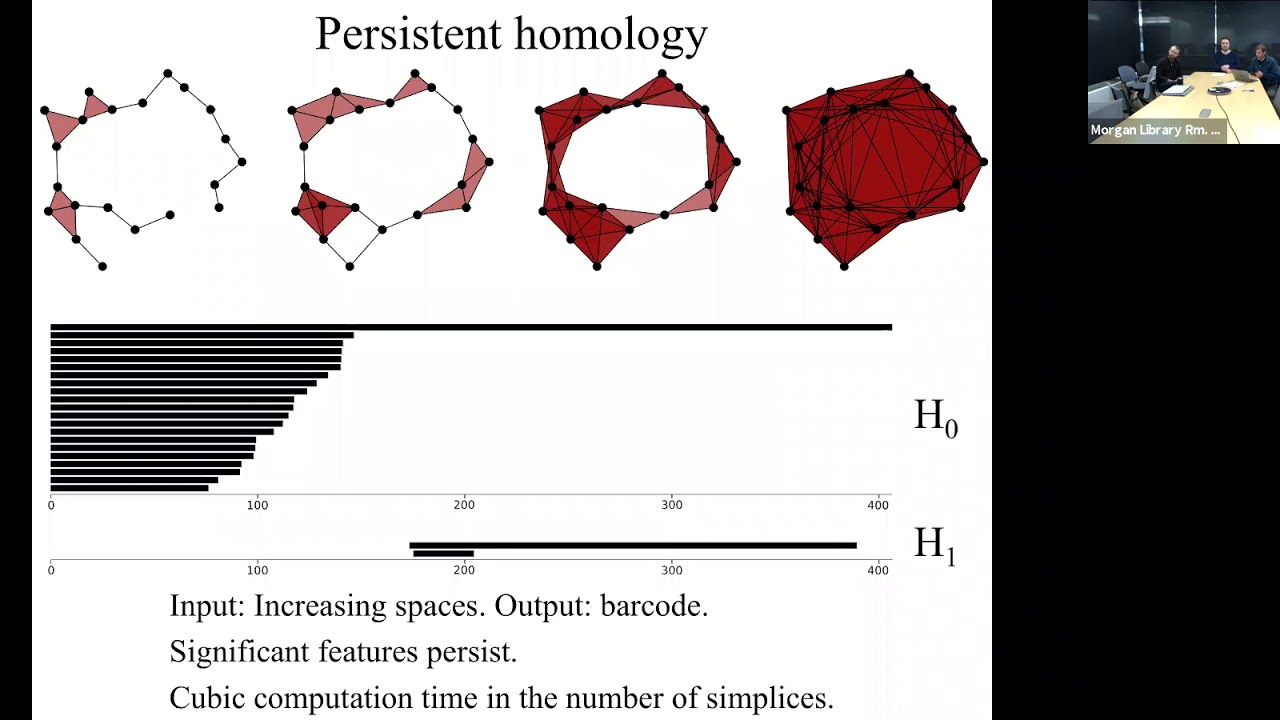
Any combination of measurement omissions and restrictions to intervals will result in just two kinds of interpretations of the data. On the one hand, you will have very simple interpretations which underfit the data. And on the other hand, you will have very complicated and counter-intuitive interpretations which overfit the data. And in no case whatsoever will you obtain a system of concepts which notices the super-simple underlying pattern you would have gotten had you simply plotted some points and used your spatial intuition to play connect-the-dots.

Even though none of the entities in the above example have any measurements in common, by using your spatial intuition, you can form a simple network of similarities:

(0,2) ~ (1,1) ~ (2,0) ~ (3,1.1) ~ … ~ (1.1,3) ~ (0,2)

which your brain would immediately recognize as a one-dimensional loop. A one-dimensional loop is a notion that:

  1. Is highly abstract, and can be applied to just about any data whatsoever to yield tons of non-trivial information about that data.

  2. Is super easy to understand. It’s almost concrete in how easy it is to understand.

  3. Captures the essence of how the entities in the example are related in a very simple and accurate way, even though they are all different from each other.

I say “accurate” in the above because saying that the data is described by a one-dimensional loop also implies a network of dissimilarities among the given entities. For instance, we can say that (0,2) is dissimilar to (2,0), because, on the one-dimensional loop, there is no shortcut from (0,2) to (2,0) which allows you to skip the entity (1,1).

The process of fitting a manifold to a set of data-points is studied in the field of Persistent Homology:


In my opinion, I think that Rand was trying to do something like this when she formulated her theory of concept formation.

Rand’s theory also suffers from another problem which I’ve been trying to address. Basically, it smuggles huge portions of mathematics (at the very least the non-zero rational numbers), which themselves have highly non-trivial spatial structure, into the notion of measurement. This, in addition to the above, is why I don’t find Grames’ account of how concepts of space can be derived from measurement omission at all convincing.

I believe that this problem can be remedied by claiming that the human brain comes equipped with a very small number of simple spatial ideas and operations which can be used to form any mathematical concept including the concepts of logic.

All this has lead me to investigating the theory of simplicial sets. These are very simple and very interesting mathematical gizmos that can encode combinatorial and topological information simultaneously. Furthermore, they constitute what is called a “topos” in category theory, which means that they are capable of serving as a foundation for all of mathematics. Additionally, every topos has its own internal logic, (and these logics are, in general, higher-order intuitionistic type theories). So there is a conception of logic out there somewhere which can be derived entirely from spatial concepts.

The main problem is that the standard theory of simplicial sets allows for simplices of arbitrarily high finite dimension, and the human brain can handle only 3. However, as it turns out, it’s very easy to prove that simplicial sets restricted to at most 3 dimensions also constitute a topos.

I am currently trying to figure out the ins-and-outs of all of this stuff, but I think that Rand’s dream of a mathematical epistemology is on the horizon.
 

2 hours ago, merjet said:

  1. Consider different contents of books. Some books are fiction and others are non-fiction. Types of fiction are mystery, romance, children’s stories, etc. Types of nonfiction are history, science, mathematics, music, food recipes, etc. These various contents are congruous but not commensurable. The differences between them that need to be omitted to form the concept book are qualitative, not measurable.

  2. Consider different kinds of boats. There are rowboats, some with an outboard motor, some are steamboats, some have an inboard diesel engine, some have paddle wheels, some airboats/fanboats, and so forth. The different kinds of locomotive power are qualitative differences.  That some aspect of the different kinds, e.g. horsepower, is measurable does not overturn the fact the some differences between the kinds are only qualitative.

  3. A child capable of identifying different colors is not measuring anything. People who lived before it was known that colors reflect different light wave lengths/frequencies were not measuring anything. Also, a wave length is a length, not a color. 


1.  ‘Book’ is a first level concept that even an illiterate child or adult can have and use correctly.  One can also understand that the words (content) are the essential characteristic of books that cause the other characteristics and that the book only exists at all for the sake of the words within, all while being unable to read them or read at all.  Certainly one understands books better if one were literate but not a different set of objects.

  1. This boat example is merely taking for granted the quality of the locomotive power, treating it as a primary when it is not.  Oared boats differ in the number and placement along a spectrum from a one person dinghy to a competitive crew boat for racing to an ancient trireme. Paddle wheel boats differ in the size, placement midships or stern, and whether single or split port and starboard.  Outboard motor boats differ in horsepower, size, weight, and fuel type and whether one or more motors are used.  Each of these different kinds of locomotive power do form a qualitative difference between boats but each is also a conceptual category itself.   

  2. Rand’s point with measurements is that they were always there in the form of the attributes of entities.  Recall that Rand also teaches that entities are their attributes, not that entities have their attributes.  Thus there is no underlying substratum, no place for an Aristotelian essence to be (nor a quality) and no role for a metaphysical essence (or a quality) in knowledge.  The attributes are all that exists, they exist in definite specific form amenable to measurement, and even when not mathematically measured merely perceiving a thing creates a particular percept  (perceptual form in Kelley) in the subject.  The percept is a measure, caused by and corresponding to the thing perceived and the means of perceiving it (and by Kelley the environment in which it was perceived). 

“Implicit measurement” is a phrase Rand uses on page 13 of ITOE 2nd when writing about color.  Perceiving similarity among percepts is also given directly by the perceptual faculty.  One does not need to measure explicitly or know how to measure explicitly to perceive similarity between percepts or an entire range of percepts.  The measurements involved are implicit and automated by the sensing and perceiving structures of the body.  For example we know scientifically how color perception works, how the eye has structures named rods and cones and there is a set just for red light.  Redness and similarity of redness means the neurons connected to the red-responding rods and cones being excited and then the same ones being excited again.


2 hours ago, SpookyKitty said:

I hope that this will make clear what I meant when I said that Rand’s theory of concepts is “merely classifying things”.

I hope you may someday come realize that “merely classifying things” is precisely what concepts do and are for.  Knowing in depth about what the concepts refer to is a different problem.

That a string of numbers in one format seems meaningless but in another is easily recognizable has little to do with Rand’s theory of concepts but is rather about the human body’s means of perceiving.  The implicit measurements of perception are actually easier to work with conceptually than the explicit measurements of an abstract set of numbers.  That said, there is no reason why an artificial structure cannot be made to work as Rand describes directly with those numbers in the explicit form.

You need to become more familiar with the capabilities of networks of neurons.  They can recognize complex patterns not merely rectangular ranges.  There is thread here that brought his theory of Hierarchical Temporal Memory to my attention. 

edit: searching youtube for “Jeff Hawkins” or "hierarchical temporal memory " brings up lots of hits to the present, he is continuing his work.  Example 

47 minutes ago, Grames said:

I hope you may someday come realize that “merely classifying things” is precisely what concepts do and are for.

I agree, but that’s not all that they are for. To be fair, I misspoke here. The central component of Rand’s theory is that you can extrapolate values of characteristics from the range of the “crow epistemology” (measurements whose values you can directly perceive) to the conceptual level (measurements you can’t directly perceive, such as distances in the light years and such). Rand’s theory allows you to do this. My problem with it is that, since it only allows for the total abstraction of one characteristic at a time, the resulting concepts cannot encode complicated interdependencies among characteristics. Rand did try to mitigate this issue to some extent by allowing for some unspecified functional relationship between a single characteristic (an independent variable) and all the rest (dependent variables) by using the notion of an “essential” characteristic. But this still wouldn’t be enough, since actual phenomena may not have any essential characteristic in the Randian sense. This happens all the time when you have feedback loops. When this occurs, engineers and scientists are forced to describe the behavior of such systems by using differential equations and characterizing those systems by their solution sets. And these solution sets are abstract spaces! These spaces are then understood to be the essential defining features by which systems are classified. Note that in these cases, the systems are not classified by any one nor any combination of their measurements. Indeed, they cannot be.

Quote

That a string of numbers in one format seems meaningless but in another is easily recognizable has little to do with Rand’s theory of concepts but is rather about the human body’s means of perceiving.  The implicit measurements of perception are actually easier to work with conceptually than the explicit measurements of an abstract set of numbers.

No, it has everything to do with Rand’s theory of concepts, because it is precisely the concepts we have that make some data-sets easily recognizable. A layman and a physicist may have the exact same perceptual apparatus, but data that is meaningful to the physicist might seem completely random to the layman. The difference is in the physicist’s far superior integration of lots and lots of physics and math concepts.

Quote

You need to become more familiar with the capabilities of networks of neurons.  They can recognize complex patterns not merely rectangular ranges.  There is thread here that brought his theory of Hierarchical Temporal Memory to my attention. 

Exactly. Which is precisely why Rand’s theory of measurement omission cannot possibly be complete.

3 hours ago, Grames said:

1. 

I’m responding to your response to Merjet because his first response to you I agree with.

  1. Perhaps we can still view the different types of books as commensurable (they are comparable in terms of content), but it still illustrates what is meant by qualitative. You brought up color to point out quantitative measurement omission resulting in a qualitative measurement, which is fine. But that doesn’t address differentiating in terms of anything else. The difference between a shadow and a black piece of paper is not something measured quantitatively. It would be something to do with lack of physical extension; to comprehend physical extension as a measurement requires very complex thinking way after you already form the concept ‘shadow’. In this way, quality is not necessarily less concrete than measurement. 

Spatial thinking is not space; you don’t literally measure the space between perceptions that you remember. It might be better to call it relational thinking, yet I don’t even experience it as quantitative. Even if you are right about how to describe spatial relationships represented within the mind, these spatial relationships aren’t used for differentiation. They are used after you have already differentiated. I wouldn’t describe placing “poodle” within “dog” as an act of measurement omission. With quantitative measurement omission, measurement is what you use to differentiate. Measurements like that can help differentiate concepts when you retrieve them in memory and they are organized in a spatial fashion, though. Besides, I think is really stretching it when you consider directions to be quantitative measurements.

  1. Sure, there are many ways to initially form a concept. But many people can and do differentiate boats in terms of quality of locomotive power. It doesn’t cause problems either. Whether a characteristic really is primary isn’t important when forming a concept. If anything, what we initially think is primary is often not. 

  2. Yeah, entities are their attributes. All entities can be measured quantitatively, and attributes can’t be removed from an entity. I don’t see how this means that all attributes are quantitatively measurable. You could argue for intensity as an omitted quantitative measurement for colors, but that really breaks down if you differentiate a dog from a cat, or a hamburger from a meatloaf sandwich, or sweet from sour.

3 hours ago, Grames said:

Redness and similarity of redness means the neurons connected to the red-responding rods and cones being excited and then the same ones being excited again.

This is why I think it’s fair to say that color can be differentiated with measurement omission. But there are also different cells in your that eyes are sensitive to orientation, so it’s not like everything your eyes do involves implicit quantitative measurement. 

27 minutes ago, SpookyKitty said:

Note that in these cases, the systems are not classified by any one nor any combination of their measurements. Indeed, they cannot be.

Given that Rand allowed for abstraction from abstractions and concepts of concepts,  an abstract description and categorization based on common solution sets of an underlying set of differential equations is actually still a kind of measurement if that premise that there is ‘describing’ going on is true.  Not only concretes are measurable.


32 minutes ago, SpookyKitty said:

No, it has everything to do with Rand’s theory of concepts, because it is precisely the concepts we have that make some data-sets easily recognizable. A layman and a physicist may have the exact same perceptual apparatus, but data that is meaningful to the physicist might seem completely random to the layman. The difference is in the physicist’s far superior integration of lots and lots of physics and math concepts.

Now it appears you conflate what is not possible to the theory with what is not possible to a man without a particular set of concepts. Nothing about the physicist’s integration of multiple and highly abstract concepts is uniquely impossible to Rand’s theory.  It will stretch that far, so I see no problem where you claim to find one.

3 hours ago, SpookyKitty said:

Exactly. Which is precisely why Rand’s theory of measurement omission cannot possibly be complete.

What I find most interesting about the Hierarchical Temporal Memory theory is the possible discovery of the mathematical mechanics of measurement omission buried in the sparse representation matrices.

55 minutes ago, Eiuol said:

  1. Yeah, entities are their attributes. All entities can be measured quantitatively, and attributes can’t be removed from an entity. I don’t see how this means that all attributes are quantitatively measurable.

If it isn’t quantitatively measurable then it does not exist.  In non-trivial way what it means to exist is to be measurable.  Qualities are epistemological artifacts, abstractions just as are universals and essentials.

39 minutes ago, Grames said:

Given that Rand allowed for abstraction from abstractions and concepts of concepts,  an abstract description and categorization based on common solution sets of an underlying set of differential equations is actually still a kind of measurement if that premise that there is ‘describing’ going on is true.  Not only concretes are measurable.

Abstraction from abstraction isn’t relevant here because what I described is an abstraction from concretes.

Quote

Now it appears you conflate what is not possible to the theory with what is not possible to a man without a particular set of concepts. Nothing about the physicist’s integration of multiple and highly abstract concepts is uniquely impossible to Rand’s theory.  It will stretch that far, so I see no problem where you claim to find one.

Not at all. My point was that what patterns someone can recognize in data is a function of the concepts they have and not simply perception.

30 minutes ago, Grames said:

If it isn’t quantitatively measurable then it does not exist.  In non-trivial way what it means to exist is to be measurable.  Qualities are epistemological artifacts, abstractions just as are universals and essentials.

Yes, for an entity to exist, it must be measurable. In other words, it must have physical extension. If something has physical extension, there is something quantitatively measurable. But how does that mean that there can’t also be qualitative aspects that are not quantitative? As I pointed out, orientation is qualitative. And it isn’t anymore abstract than the length of an entity. Orientation is perceived just as directly as color, and perhaps even more so. Of course, anything with an orientation has physical extension, yet orientation is an example of a qualitative distinction. I suppose you could say that orientation is a measurement of angle, except when you use an orientation to distinguish things, all you need is that up is not the same as down (and requires no angular measurement). Simply based upon having a different appearance or experience.

I’m just not seeing why all qualities must be epistemological artifacts.

44 minutes ago, SpookyKitty said:

My point was that what patterns someone can recognize in data is a function of the concepts they have and not simply perception.

Wouldn’t this be more of an issue about induction, rather than concept formation? 

4 minutes ago, Eiuol said:

Wouldn’t this be more of an issue about induction, rather than concept formation? 

Recognizing a pattern you’ve already seen would be an instance of induction. But figuring out a totally new pattern you’ve never seen before would be an instance of concept formation.

20 minutes ago, SpookyKitty said:

Abstraction from abstraction isn’t relevant here because what I described is an abstraction from concretes.

Not at all. My point was that what patterns someone can recognize in data is a function of the concepts they have and not simply perception.

“Common solution sets of differential equations” is an abstraction, and using that commonality among abstractions as a basis to perform a mental integration into a concept is abstraction from an abstraction.  Its all well and good that there is some chain of validation for the differential equations reaching back to the concretes involved but the path to finally discriminate the commonality (Rand’s CCD) was quite abstract.

Your second point relates to what is called ‘perceptual relativity’.  Practice and knowledge makes improved discrimination possible, so two men can perceive the same thing in the same conditions but not reach the same identification.  But my point was just that drawing a picture always makes data easier to understand when the data forms lines or curves or loops, and that includes easier for the kind of scientists and engineers that can read the data in tabular form.  Again I cannot agree that there is any problem here for Rand’s theory of concepts to overcome.


1 hour ago, Eiuol said:

… As I pointed out, orientation is qualitative. …

I’m just not seeing why all qualities must be epistemological artifacts.

The quirk about orientation compared to regular attributes of an entity is that it is relative to some reference, either oneself as observing subject or some relevant thing in the environment.  Orientation then is a relationship not an attribute.  It still exists in the form of some angular rotation with respect to that reference and could be measured.  Saying that something is “facing up” is dropping/omitting the measurement because it is within a certain range.  So in conclusion orientation is no more qualitative than color, and describing a thing as “facing up” is similar to claiming it is “red”.  This is not just an analogy because “red” is also a relationship between subject and object not an intrinsic attribute of an entity.

Qualities (in this context qualitative thinking as opposed to quantitative thinking) are epistemological artifacts because the only way to get rid of the quantitative character which constitutes all of existence is to omit it, omission being an epistemological operation. All that exists are concretes with their measurable attributes and relationships.  Orientation is an existent and is measurable and in any particular manifestation is a concrete.

1 hour ago, Grames said:

It still exists in the form of some angular rotation with respect to that reference and could be measured.

I’m fine with saying that orientation is a relationship, not an attribute - but that’s because I agree that orientation must be in respect to something else. How does that support your position though that all qualitative things are epistemological artifacts? After all, you can’t think about a length either unless you’ve compared it to some other entity. Length is intrinsic to an entity, sure, yet omitting particular measurements of length is dealing with something relational because you would be dealing with “long” and “longer”. 

Of course orientation can be measured quantitatively, I’m claiming that you can also do qualitative measurement omission. I’d rather say that for a concept to be verifiable, quantitative measurement must be at some level possible. The problem I’m running into is how you would explain coming up with the concept “shadow”, or the concept “sour”. You could come up with sour by trying a variety of sour things (comparing the blueberry to a lemon for example), but you could also do it by trying a sour thing and then a sweet thing (trying a lemon, then eating chocolate cake). Sweet and sour are comparable as far as both being flavors, but their commensurability ends there. They are not on the same range of intensity; there is sweet and sweeter, and there is sour and more sour. But becoming more sour is not the same as becoming less sweet. Neuroscientifically, this is because each flavor refers to a specific chemical combination. This is in contrast to color, where your eyes detect an intensity of wavelength that is not sharply divided each color. 

Basically, if it can be valid to come up with concepts with qualitative methods, you could then say that some sort of spatial thinking method is as valid as quantitative measurement omission.

5 hours ago, SpookyKitty said:

But figuring out a totally new pattern you’ve never seen before would be an instance of concept formation.

Patterns are not concepts, or at least this isn’t what this thread would be about (at least as far as Rand’s ideas). I’ve agreed with a lot of what you said, but this looks like a dead end for your position. I see how you mean that it isn’t induction now, but even my own experience with pattern recognition, I don’t recognize patterns as concepts (you can develop concepts of patterns, though). 

1 Like

8 hours ago, SpookyKitty said:

Recognizing a pattern you’ve already seen would be an instance of induction. But figuring out a totally new pattern you’ve never seen before would be an instance of concept formation.

Are you sure about this? My understanding is that recognizing is deduction while figuring out a new pattern is induction.

You use deduction based on the concepts that you have previously created by using induction.

To recognize requires traveling through the category “tree”, i.e. heuristics.

2 hours ago, Eiuol said:

Patterns are not concepts, or at least this isn’t what this thread would be about (at least as far as Rand’s ideas).

Aren’t patterns equivalent to “definitions”, as in you pattern match to recognize the pattern.

9 hours ago, Easy Truth said:

Aren’t patterns equivalent to “definitions”, as in you pattern match to recognize the pattern.

To fix up what I said, I should say that concepts are made up of patterns. A definition would be an explicit statement of the pattern of a given concept. But the pattern itself is not a concept. 123123123 has a pattern, but “repeated counting from 1 to 3” would not be a concept.

On 2/24/2020 at 10:53 PM, Eiuol said:

I’m fine with saying that orientation is a relationship, not an attribute - but that’s because I agree that orientation must be in respect to something else. How does that support your position though that all qualitative things are epistemological artifacts? After all, you can’t think about a length either unless you’ve compared it to some other entity. Length is intrinsic to an entity, sure, yet omitting particular measurements of length is dealing with something relational because you would be dealing with “long” and “longer”. 

Excuse me but could you please clarify if you think length is a quality or a quantity?  What are examples of qualitative thinking and quantitative thinking with respect to length?

My answer to those questions is that metaphysically what exists is entities with quantities of extension, and length is an human concept which refers to those quantities abstracted from the entities.  If attribute, characteristic, property, and quality are all taken as synonyms then the relationship between quality and quantity becomes clear.

The summary case of why all qualitative things are epistemological artifacts is that they are hierarchically dependent upon pre-existing quantitative things, and derived from them by dropping the quantity (measurement omission).  In chapter 2 of ITOE Rand goes through the gamut of the parts of speech describing how the measurement omission applies to entities/nouns, to materials, to motion, then adverbs, prepositions, adjectives, pronouns, conjunctions and ends with the flourish of claiming love can be measured.  That was what she needed to do for validating the relationship of concepts to reality.

If there is some aspect of thought, such as visualizing spatial manipulations, that is neglected by this theory that is because that is not part of the philosophical problem at hand.  If you think it does touch on the problem, please elaborate.

Taste works almost exactly the same way color perception works, specialized cells detect particular basic tastes just as specialized cells detect particular basic colors.  The basics and their combinations produce the range of what is possible to perceive with that sense.  Color and taste are both relationships.   

3 hours ago, Grames said:

if you think length is a quality or a quantity? 

I think length is a quantity. As far as forming the concept length, I would say it is completely quantitative because it is a concept of measurement. You could think of length qualitatively once the concept has been formed, or going from abstract to abstraction, and all that. My disagreement only comes in when I propose that there are qualitative (or to put in a better way, non-quantitative) aspects of perception of entities that are not measuring anything quantitatively, and that those aspects may be used to form (most) concepts instead of the quantitative measurements.

3 hours ago, Grames said:

If there is some aspect of thought, such as visualizing spatial manipulations, that is neglected by this theory that is because that is not part of the philosophical problem at hand.  If you think it does touch on the problem, please elaborate.

I will need to refresh my memory about chapter 2, but I recall that I never found it very satisfactory as far as forming concepts, even though I found a great for validating concepts. I will have to think about this more to give you a good answer. I wanted to convey first what I think is a problem, and then the solution to it. Maybe not exactly a problem, but a weakness.

3 hours ago, Grames said:

The basics and their combinations produce the range of what is possible to perceive with that sense. 

But this doesn’t explain how sweet and sour are not on the same range, yet that distinction is sufficient to distinguish two entities and then form the concept flavor. Flavor neurons aren’t just attuned to a specific sub-range, they are attuned to completely different ranges, we only recognize them as flavors because we experience them on our tongue. 

2 hours ago, Eiuol said:

I think length is a quantity. As far as forming the concept length, I would say it is completely quantitative because it is a concept of measurement. You could think of length qualitatively once the concept has been formed, or going from abstract to abstraction, and all that. My disagreement only comes in when I propose that there are qualitative (or to put in a better way, non-quantitative) aspects of perception of entities that are not measuring anything quantitatively, and that those aspects may be used to form (most) concepts instead of the quantitative measurements.

I agree. 

Regarding length, one can distinguish between extension and length. The first is an attribute of many entities. The second is, strictly speaking, a relationship rather than an attribute. For example, the pencil’s length is 6 inches determined by measuring it, for example, laying a ruler alongside the pencil and observing numbers on the ruler. Using this distinction, the child in Ayn Rand’s example in ITOE (page 11) grasped extension, not length.

1 Like