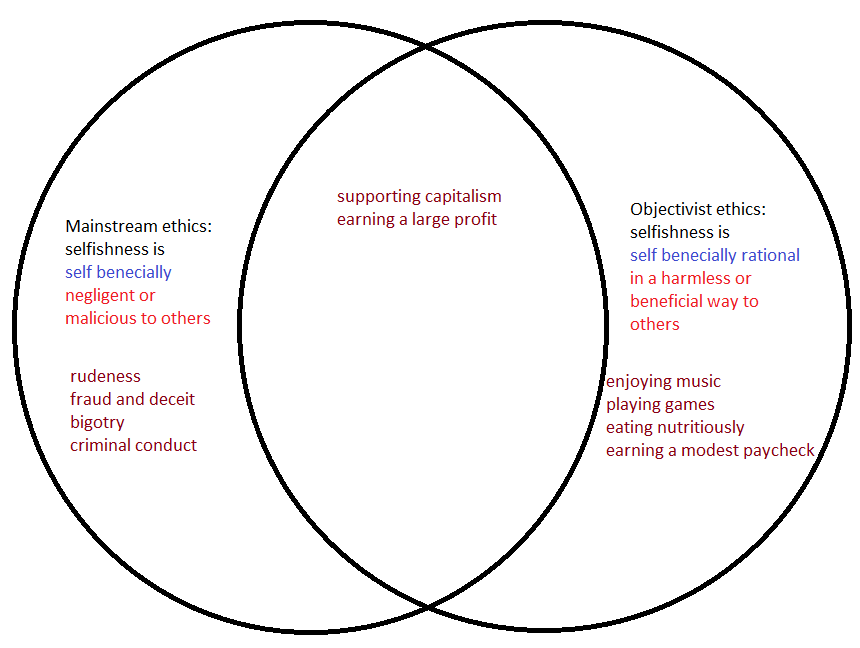
18 hours ago, StrictlyLogical said:
No one word can capture all “they” mean when they say selfish. It is a combination of a whole host of possible vices combined with appearing to act for oneself (at least superficially). There is a misidentification of what the long term self interest is, so it is self-sabotage, misguided selfishness, shortsightedness, ignorance, idiocy?
How to sum up a simpleton’s selfishness?.. no easy task.
Well this is the crux of my post-- I’m not satisfied that the concept does not exist in the English language. My sense is that it must, I (we) just haven’t discovered or identified it… yet.
I may have “buried the lede” to some degree in my initial post. Indeed I have come up with two working terms that I feel do a better (but not completely satisfactory job) of communicating the concept that relates to the specific part of selfishness that Objectivists do not consider as selfish (but so many others do, and even may consider it the primary type of example).
My best working terms are:
- Self-Absorption
- Self-Obsession
Both of these terms seem to satisfy as descriptors for the examples of behaviors in my original post (chicken wing guy and make-up lady). However, I’m still not completely comfortable using those terms because, “obsession” and “absorption,” while typically associated with negatives, may be a “package-deal,” similar to the trick used by those who exploit the words “extreme” or “extremism.”(See Extremism: Or The Art of Smearing - A.R.) I’d prefer not to further muddy the concept if possible. Perhaps obsession with or absorption in “the good,” isn’t bad.
18 hours ago, StrictlyLogical said:
Rather than try to come up with a different word, it suffices to point out that “selfishness” in not the proper characterization and the specific instance is better described by [insert particular short term vice here].
Quote
Let me remind you that the purpose of a definition is to distinguish the things subsumed under a single concept from all other things in existence: and, therefore, their defining characteristic must always be that essential characteristic which distinguishes them from everything else. - Ayn Rand (See Extremism: Or The Art of Smearing - A.R.)
This is why I do not think it suffices and why I’m seeking a definition. We (Objectivists, rational thinkers, etc…) will continually endeavor to educate that the type of examples commonly held by so many about this term are not truly examples of selfishness. As the title of this post states, this only gets us half way… We must be able to explain what that distinction is, and DEFINE it in a clear way that shows it is NOT “subsumed” under the single concept of “selfishness.” Yes, I can do this with a lot of words… But I want to do it with the overarching concept.
This distinction is important. A rational person knows those behaviors are negative, yet we have not unentangled them from the word “selfish,” and as long as those examples are packaged with selfishness, it will continually be difficult to communicate selfishness as a virtue. Those types of examples require a new home.
9 hours ago, Easy Truth said:
I would agree that there is no one term that would do it justice but I got comfortable with the following:
The vice is “social unawareness” or “social blindness” where a person is not aware of the benefits of the people around them. In the examples you put, it is objectively NOT to the benefit to anyone of us to be consistently be like that. And in terms of rational egoism, if something is NOT to your benefit, it isn’t selfish. So these behaviors to an Objectivist would not be considered selfish.
[…]
A socially blind person will act as if no one matters, or no one is around when people are around, which can be dangerous to everyone concerned.
The issue that Rand was attacking was selflessness, AKA altruism.
You are correct, and I assume most of us who understand Rand and Objectivism concur. But again, it doesn’t identify and define this greater concept (that I’m looking for).
Those terms, “social unawareness” or “social blindness,” would surely soften the negativity and destructive nature (to one’s self). They make it seem like an oversight or an accident. Whereas, in truth, those behaviors are more than “not selfish”, they are, in the long term, self-destructive.
1 hour ago, Doug Morris said:
Another way of describing this is as a violation of rules you have implicitly agreed to by entering a situation. If you take food from a buffet, you are implicitly agreeing to a rule about sharing the food. If you drive on a road that is not your private road, you implicitly agree to a number of rules, including not obstructing traffic.
True. And you can get very specific (and that’s what we usually do) for any of these typical misunderstandings of “selfishness.”
As I typed it above, I thought, “self-destructive” is another term that seems to work for this entire category/concept of behaviors incorrectly described as selfish. But it does not define a single concept OUTSIDE of selfishness that distinguishes itself. It would be too broad to simply say that it is the “opposite” of selfish, because that would place it in the category of altruism, which isn’t not where it belongs either.