“. . . trembling with the craving and rapture of questioning . . .” –GS 2
To age 30, the major philosophic influences on Nietzsche were Emerson, Plato (largely negative), Schopenhauer, Lange (materialism), and Kant. At age 21, shortly after his conversion to atheism, Nietzsche read Schopenhauer’s The World as Will and Presentation (1844). He remained a Schopenhauerian for ten years, 1865–75. He continued to read Schopenhauer to the end of his intellectual life. Of special importance, during his philosophically mature period, was his study of Schopenhauer’s On the Basis of Morality (1839), which includes a major critique of Kantian ethics. Nietzsche read Kant’s Critique of Judgment in 1867–68. It appears that his knowledge of Kant’s philosophy outside that work was indirect, coming through a good number of writers on Kant (Brobjer 2008, 22–42, 46–49).
Schopenhauer’s WWP includes endorsement of basic elements of Kant’s theoretical philosophy such as Kant’s distinction between things as they are in any possible cognition of them and things as they are in themselves. Nietzsche had evidently assented to that view of the world and our situation, but broke with this Kantian view along with his break from Schopenhauer’s philosophy, acutely in 1875–76. Nietzsche took a semi-positivist, anti-metaphysical turn at this time, spurred in part by work of Paul Rée (Small 2005). During this profound shift, Nietzsche read favorably the moralists and Enlightenment figures of France.
Schopenhauer had come to the view (1844) that there is a blind, natural, striving will operating in all organisms. This unitary will was alleged to be manifest in organisms by the purposiveness of their ontogeny, inner organization, and interdependence with other species of organisms (WWP I 2.187, 4.323–24, 4.364–65).
Nietzsche had read favorably Julius Bahnsen’s Contribution to Characterology: With Special Regard to Educational Questions in 1867. In this work Bahnsen “followed Schopenhauer closely but at the same time developed his philosophy in a more individual direction by emphasizing that true reality is not one general will as Schopenhauer claimed but instead was many contradicting wills that constitute human beings whose inner life therefore is always in turmoil” (Brobjer 2008, 48).
In Human, All Too Human, Nietzsche criticizes Schopenhauer’s calling by the single designation will what are in fact “many different human states.” Such talk of the will has, “through the philosopher’s rage for generalization turned out to be a disaster for science: for this will has been turned into a metaphor when it is asserted that all things in nature possess will; finally, so that it can be pressed into the service of all kinds of mystical mischief it has been misemployed towards a false reification – and all the modish philosophers speak of it and seem to know for certain that all things possess one will and, indeed, are this one will. . . .” (AOM [1879] 5; also GS 99, 127)
In that rejection of Schopenhauer’s doctrine of will, Nietzsche sounds like one come down to earth and science. Nietzsche comes closest to such an outlook at this stage of his development, but in another of his rejections of doctrines of Schopenhauer, and Kant, we see his enduring bent of mind, which is not to stand with level-headedness, sound science, and close philosophical analysis. Rather, his stand is: Recall extravagant metaphysical ideas and the criticisms that have been made of them in the history of philosophy. Insinuate that he is siding with the criticisms and yet that he is a critic transcending them. Treat the world and comprehensions of it in philosophy as most truly explicable as products of human psychology (cf. Pippin 2010).
Here is Nietzsche setting aside a grand Kantian distinction in “Appearance and the Thing in Itself” (cf. BT 87)). After recalling the fate of the distinction in Hegel and Schopenhauer, he calls on “science” to vindicate his own mythic rendition of reality. “With all these conceptions the steady and laborious process of science, which will one day celebrate its greatest triumph in a history of the genesis of thought, will in the end decisively have done; for the outcome of this history may well be the conclusion: That which we now call the world is the outcome of a host of errors and fantasies which have gradually arisen and grown entwined with one another in the course of the overall evolution of the organic being, and are inherited by us as the accumulated treasure of the entire past – as treasure: for the value of our humanity depends upon it.” (HH I 16; also 9–11, 18–19; GS 54)
Nietzsche opens that aphorism with this statement: “Philosophers are accustomed to station themselves before life and experience – before that which they call the world of appearance – as before a painting that has been unrolled once and for all and unchangeably depicts the same scene . . . .” It is reasonable that he does not want to retain the name and concept world of appearance, for he wants to deny the distinction between that world and a realm of things as they are apart from perception and theoretical reason. Many of us today call the single world that is: the world. That was not what Nietzsche selected to replace world of appearance. He opts for life and experience. Kant’s world of appearance was the world from which the mind makes experience, geometry, and scientific law appropriate to that world. Nietzsche objects to the idea that there is a world, a knowable world, that “once and for all and unchangeably” is the same single thing it is. In lieu of world is life, and of this he writes:
“The picture of life – The task of painting the picture of life, however often poets and philosophers may pose it, is nonetheless senseless: even under the hands of the greatest of painter-thinkers all that has ever eventuated is pictures and miniatures out of one life, namely their own – and nothing else is even possible. Something in course of becoming cannot be reflected as a firm and lasting image, as the ‘the’, in something else in course of becoming.” (AOM 19; also 114 and WS 171)
Nietzsche does speak of the world. He speaks of our judgments about the world. However, it is not truths reported in judgments that is basis of judgments. In his view, it is the judge, the one pronouncing judgment, wanting to appear as striving for truth that is the root of devotion to truth and root of intellectual conscience (AOM 26, 33, 90; HH I 629–37; UM 86-93, 145; cf. D 248). Even more important than truth, the judge. Technique: Replace straight thought about the world and our situation in it with a story of how culture has brought about the appearance that such thought is straightly what it is about. Trump reason with psychology, the world with the human being, and truth with justice (HH I 636–37; D 539; GS 76, 109, 112).
Trump metaphysics with biology. The principle that there are things having in themselves something in virtue of which they are the self-identical things they are, different from some other things, is a principle that evolved from the lower organisms. The distinctions among different substances are the different relations they have to organisms. “Belief . . . in identical things is . . . a primary, ancient error committed by everything organic. . . . [Metaphysics is] the science that treats of the fundamental errors of mankind – but does so as though they were fundamental truths” (HH I 18; also 10; GS 110, 111).
Notice that the predicament of an individualist who is also a determinist—such as Nietzsche—is made less acute by absence of same things and same actions. Uniqueness of the individual is guaranteed without the bright possibility of different human actions upon same conditions and without the dark possibility of same human actions upon same conditions.
There is an ancient enduring doctrine in philosophy that reason can be kept from truth by interference from feeling and preferences; therefore guard against this subversion. Nietzsche slides from that sound wariness to doubtfulness that reason can attain truth not beguiled by human need and utility (HH I 32, 131, 146, 227, 517, AOM 32, 50, 98; D 543; GS 110). He does, however, hold to the idea that we (true intellectual sorts) have some true needs, and one of them is a need for truth, which only impartial critical and experimental reason could possibly win (HH I 22, 633–35; D 270, 424, 432; GS 2). Moreover, skepticism not subject to experimental test wins nothing (GS 51).
In Human Nietzsche was at a phase more welcoming of “science,” “scientific philosophy,” and “philosophical science” than in his earlier or later phases. He speaks of science getting us closer “to the true nature of the world and to a knowledge of it” (HH I 29; also 38, 27; D 270). Even here though, in 1878, he depreciates the ability of science, mathematics, and logic to reach important truth. Nietzsche was himself not well versed in the hard sciences nor in mathematics beyond high school geometry. (He had high school physics and opened some biology books eventually; he alludes to chemistry and geology in his writings.)
“Science furthers ability, not knowledge. – The value of having for a time rigorously pursued a rigorous science does not derive precisely from the results obtained from it: for in relation to the ocean of things worth knowing these will be a mere vanishing droplet. But there will eventuate an increase in energy, in reasoning capacity, in toughness of endurance; one will have learned how to achieve an objective by the appropriate means. To this extent it is invaluable, with regard to everything one will afterward do, once to have been a man of science” (HH I 256; cf. 251, 635, WS 4; earlier, BT 74–75, 82, 85–88, and TL).
More important than the results of science, the practice? No, the preceding passage was written by a philosopher living in the nineteenth century, in the midst of enormous scientific and technological advancement decade after decade. Nietzsche recognized the great utility of modern science, though he inveighed against making utility its aim (HH I 6, 38; D 41, 195; GS 12, 37). Modern science has delivered truth, which is the proper aim of science. This it does not by the lifetime work of the individual scientist, necessarily narrowly channeled for solid contribution, rather by accretion of such narrow contributions across generations (D 547; GS 46).
“Error regarding life necessary to life. [An error concerning life, which error is necessary for life] – Every belief in the value and dignity of life rests on false thinking . . . . [He who has] succeeded in encompassing and feeling within himself the total consciousness of mankind . . . would collapse with a curse on existence – for mankind has as a whole no goal . . . . If in all he does he has before him the ultimate goallessness of man, his actions acquire in his own eyes the character of useless squandering. . . . / In mitigation. – But will our philosophy not thus become a tragedy? Will truth not become inimical to life . . . ? A question seems to lie heavily on our tongue and yet refuses to be uttered: whether one could consciously reside in untruth? Or, if one were obliged to, whether death would not be preferable? For there is no longer any ‘ought’; for morality, insofar as it was an ‘ought’, has been just as much annihilated by our mode of thinking as has religion. Knowledge can allow as motives only pleasure and pain, utility and injury: but how will these motives come to terms with the sense for truth?” (HH I 33–34; cf. 6, 22; GS 1, 7, 110, 121)
With truth and knowledge in significant opposition to life, its value, and the values it requires, there is no morality with oughts beyond is. Furthermore, there is no given goal for humanity as a whole, so adopting individual goals supporting that sort of goal is not a source for external, given direction in which actions among possible actions one should take.
Mankind as a whole has no goal, and mankind is not the goal of nature. Truth is not always something salutary and useful to man. “To determine that a plant makes no contribution to the treatment of sick human beings is no argument against the truth of the plant” (D 424). Nietzsche goes on to suggest “that truth, as a whole and interconnectedly, exists only for souls that are at once powerful and harmless, and full of joyfulness and peace (as was the soul of Aristotle), just as it will no doubt be only such souls capable of seeking it . . .” (D 424; cf. Spinoza at GS 37). Nietzsche is on to some truth here. I observe, however, that determining that a plant makes no contribution to the treatment of human beings does contribute to the overall goal of finding plants that are curative. Mankind’s knowledge, especially in scientific integration, can make mankind the goal of nature.
Error of life regarding itself runs deep, according to Nietzsche. In an individual organism, including the individual human, what appears to be teleological action is not action due to final causes, but is entirely the result of efficient causes. That we feel hunger is not due to a desire of the organism to sustain itself, not due to that end or any other end. Hunger in an organism appears to it as not connected with antecedents or consequents. It appears as something isolated, such as the isolation envisioned in the concept freedom of the will. “Belief in freedom of will is a primary error committed by everything organic . . .” (HH I 18; also 38; cf. D 6, 148; see also Small 2005, 69). Similarly, in The Gay Science (1882), Nietzsche writes that it is a self-deception to “conceive reason as a completely free, self-originated activity” (GS 110).
Value is not in the world. Value is from those who thoughtfully sense the world, who create the world that concerns human beings (GS 301). “It is not the world in itself, it is the world as idea (as error) that is so full of significance, profound, marvelous, and bearing in its womb all happiness and unhappiness” (HH I 29; cf. D 76, 148). We who will to value bear the pearls within us as waves seeking treasures on the shore (GS 310; also 59, 324, 342; D 102). Even more important than value, the weight-giving (HH 177; cf. 629). (Cf. Clark 1998, 47–73.)
Nietzsche was familiar prior to HH with the egoisms of Hobbes, Spinoza, Stirner, and La Rochefoucauld (Brobjer 2008; Safranski 2002). Nietzsche held to psychological egoism in HH. The good for each agent is what the agent sees as useful to his self-preservation (HH 103). This is a thesis of how people are and cannot otherwise be; it is not a normative egoism. The challenge for the thesis of psychological egoism is to show that cases in which behavior appears to be unselfish are actually selfish.
A soldier willing to die for his country or a mother who deprives herself for the sake of her child would seem not egoistic. “Is it not clear that in . . . these instances man loves something of himself, an idea, a desire, an offspring, more than something else of himself, that he thus divides his nature and sacrifices one part of it to the other?” (HH I 57; also 138). The ascetic is a partisan to parts of himself warring with other parts of himself (HH 137, 141; cf. D 215). Amelioration of the suffering of others relieves one of any pain one may feel at the sight of the suffering and gives one the satisfaction of exercising power (HH I 103; also 133). Furthermore, virtues such as prudence, fortitude, temperance, and justice would be abolished if egoism were abolished. No vanity, no virtues (WS 285).
“The struggle for pleasure is the struggle for life. Whether an individual pursues this struggle in such a way that people call him good, or in such a way that they call him evil, is determined by the degree and quality of his intellect” (HH I 104; cf. 99 and AOM 91). Knowledge is pleasurable mainly because it brings consciousness of one’s strength, its acquisition can be a victory over one’s former conceptions, and it can make one feel superior to other people (HH I 252). Causing others to suffer, which is called “evil,” is not basically about those others; it is selfish in that it is exciting, sometimes sweet revenge, and it gives one a feeling of power and ascendancy (HH I 103; further, D 18, 30).
Nietzsche takes egoism as desirable, as normative, even in HH. “Let us work for our fellow men, but only to the extent that we discover our own highest advantage in this work: no more, no less. All that remains is what it is one understands by one’s advantage; precisely the immature, undeveloped, crude individual will understand it most crudely” (HH I 95). Such admonitions are out of order if everyone simply does seek his or her own advantage. Urging better understanding of what is one’s advantage is also out of order. If other motives outweigh improvement of understanding what is one’s advantage, then they do, and they are selfish motives. Psychological egoism is an unstable position. Nietzsche lets go of it as absolutely general, beginning with his next book. (See also Abbey 2000, 37–39; and Clark and Leiter 1997, xxiv–xxv.)
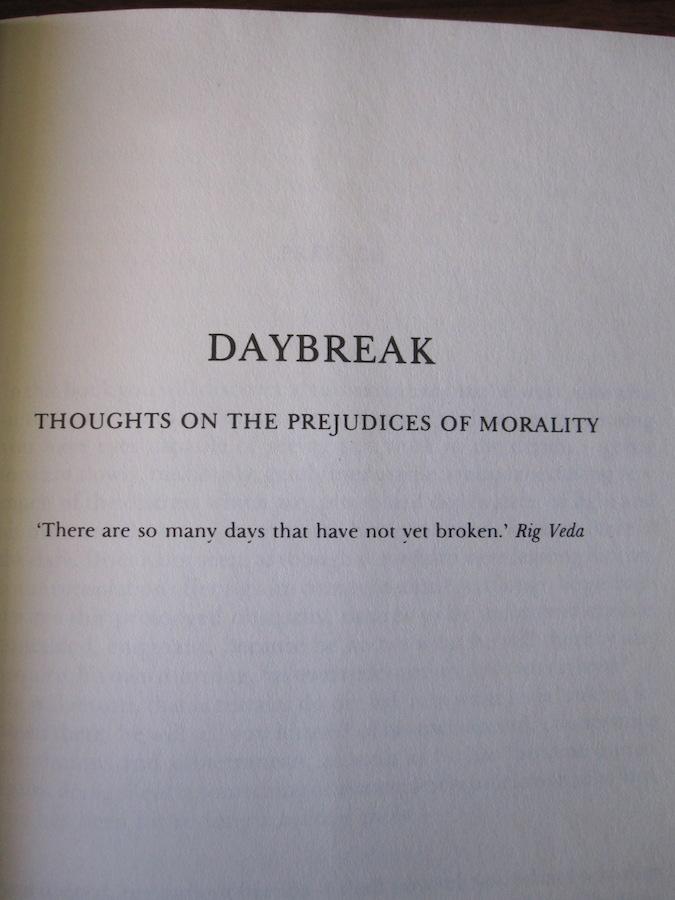
“‘There are so many days that have not yet broken’. –Rig Veda”. That is the epigram Nietzsche placed at the fore of Daybreak – Thoughts on the Prejudices of Morality (1881). The obligatory force of moral judgment (e.g. in Kant) and moral feeling (e.g. in Schopenhauer) are at odds with the obligatory force of reason. The foundations of the former obligatory force are all defective. We need to “construct anew the laws of life and action,” and for this we should take our foundation-stones from the “sciences of physiology, medicine, sociology, and solitude. . . . It is from them that the foundation-stones of new ideals (if not the new ideals themselves) must come” (D 453; cf. HH I 37).
Moralities can be false in two ways. Motives for actions can be other than the moral ones people claim for them. That is one kind of falseness, and Nietzsche sees a lot of it. Another is to base morality on false premises. Where motives are genuinely moral, as designated in past and present moralities, the base premises are false. True, some of the things that have been regarded as immoral ought to be avoided, and some of the things that have been regarded as moral ought to be done. But this is so for reasons other than those that have hitherto been adduced (D 103).
Some of the old ideals are wrong. Their valence is conferred inversely, or the weights given them are too much compared to weights given to other possible ideals. The feeling rated positively and called humility by Christianity could be rated negatively and called cowardice by another custom (D 38).
The right valence and balance is found by the feeling of power and its lack (D 23). The feeling of power and its lack is the cipher of religions (D 65), of praising or blaming after wars won or lost (D 140), of the pleasantness of being a banker (D 205), of ecstatic self-sacrifice (D 215). The feeling of power is a factor beyond utility and vanity in national decisions for war (D 189, 360). The feeling of power is an inducement to look to distant goals beyond direct consequences to others or to oneself (D 146). The feeling of power is the first effect of happiness (D 356, 146).
Men may have their needs and desires fulfilled; they may have health, food, housing, and entertainment. Yet they remain unhappy if they lack power in the soul. They may lose everything, yet be almost happy, if they retain that power. Nietzsche quotes Luther: “‘Let them take from us our body, goods, honor, children, wife: let it all go—the kingdom [Reich] must yet remain to us!’” (D 262; also 206).
Where happiness is, there is “the feeling of power: this wants to express itself, either to us ourselves, or to other men, or to ideas or imaginary beings. The most common modes of expression are: to bestow, to mock, to destroy—all three out of a common basic drive” (D 356; also 146).
The drive for the feeling of power, like all drives, has no moral valence. In itself it is neither good nor evil. It acquires moral rating “only when it enters into relations with drives already baptized as good or evil or is noted as a quality of beings the people has already evaluated and determined in a moral sense” (D 38; also 110, 35, and GS 21).
In The Gay Science benevolence is ciphered by the feeling of power. Benefactors whose temperament is irritable and who are covetous of the feeling of power find pleasure in lording their power over the beneficiary. Proud natures, by contrast, are often hard and not obliging towards those who suffer and are broken; proud natures delight in unbroken persons who could become their equals, worthy contestants for power; towards these, the proud are more obliging (GS 13; also 118; D 133).
There is something Nietzsche presupposes to be good, and noble too. A man who “flees from himself, hates himself, does harm to himself—he is certainly not a good man” (D 516). One should be benevolently inclined towards oneself. Therefore, reject allegedly virtuous benevolence towards others in which one would “live in others and for others” (D 516). One who “flees from himself, hates himself, and does harm to himself” is not benevolently inclined towards himself. Therefore, one who is benevolent towards others so as to “live in others and for others” cannot be virtuous by that (contra Comte, D 132; see also GS 119).
Nietzsche continues in GS to render some occasions of putative self-sacrifice, such as that of martyrs, as for the self, for the self not to part from its feeling of power (GS 13). Still, at least in some other cases, he sees some degree of genuine self-sacrifice. Industriousness, obedience, and justice are praised by society as moral virtues insofar as these virtues benefit others and prevent an agent from applying “his entire strength and reason to his own preservation, development, elevation, promotion, and expansion of power” (GS 21).
Does Nietzsche hold to the ancient “medical formulation of morality” captured by the dictum “virtue is the health of the soul”? No. To get closer to Nietzsche’s mark, one would need to at least change the dictum to read “‘your virtue is the health of your soul’. For there is no health as such, and all attempts to define such a thing have failed miserably. Deciding what is health even for your body depends on your goal, your horizon, your powers, your impulses, your mistakes and above all on the ideals and phantasms of your soul. Thus there are innumerable healths of the body . . .” (GS 120). Furthermore, considering the usefulness of illness to quicken the development of one’s virtue, especially one’s “thirst for knowledge and self-knowledge,” Nietzsche would question “whether the will to health alone is not a prejudice, a cowardice . . .” (GS 120). Notice the last word in the phrase “will to health alone.” Preserving one’s own health, of body and soul, remains a virtue in Nietzsche’s book, a virtue in competition with others.
References
Abbey, R. 2000. Nietzsche’s Middle Period. Oxford.
Brobjer, T.H. 2008. Nietzsche’s Philosophical Context – An Intellectual Biography. Illinois.
Clark, M. 1998. “On Knowledge, Truth, and Value: Nietzsche’s Debt to Schopenhauer and the Development of his Empiricism.” In Willing and Nothingness – Schopenhauer as Nietzsche’s Educator. C. Janaway, editor. 1998. Oxford.
Nietzsche, F. 1873. The Birth of Tragedy and Other Writings. (Includes “On Truth and Lying in a Non-Moral Sense” [1872].) R. Geuss and R. Speirs, trans. 1999. Cambridge.
——. 1873–76. Untimely Meditations. R.J. Hollingdale, trans. 1997. Cambridge.
——. 1878–80. Human, All Too Human. (Includes “Assorted Opinions and Maxims” and “The Wanderer and His Shadow.”) R.J. Hollingdale, trans. 1986. Cambridge.
——. 1881. Daybreak. Hollingdale, trans. 1997. Cambridge.
——. 1882. The Gay Science I–IV. J. Nauckhoff, trans. 2001. Cambridge.
Safranski, R. 2000. Nietzsche – A Philosophical Biography. S. Frisch, trans. Norton.
Schopenhauer, A. 1859 [1819]. The World as Will and Presentation (Vol. I). Aquila, trans. 2008. Pearson Longman.
Small, R. 2005. Nietzsche and Rée – A Star Friendship. Oxford.